
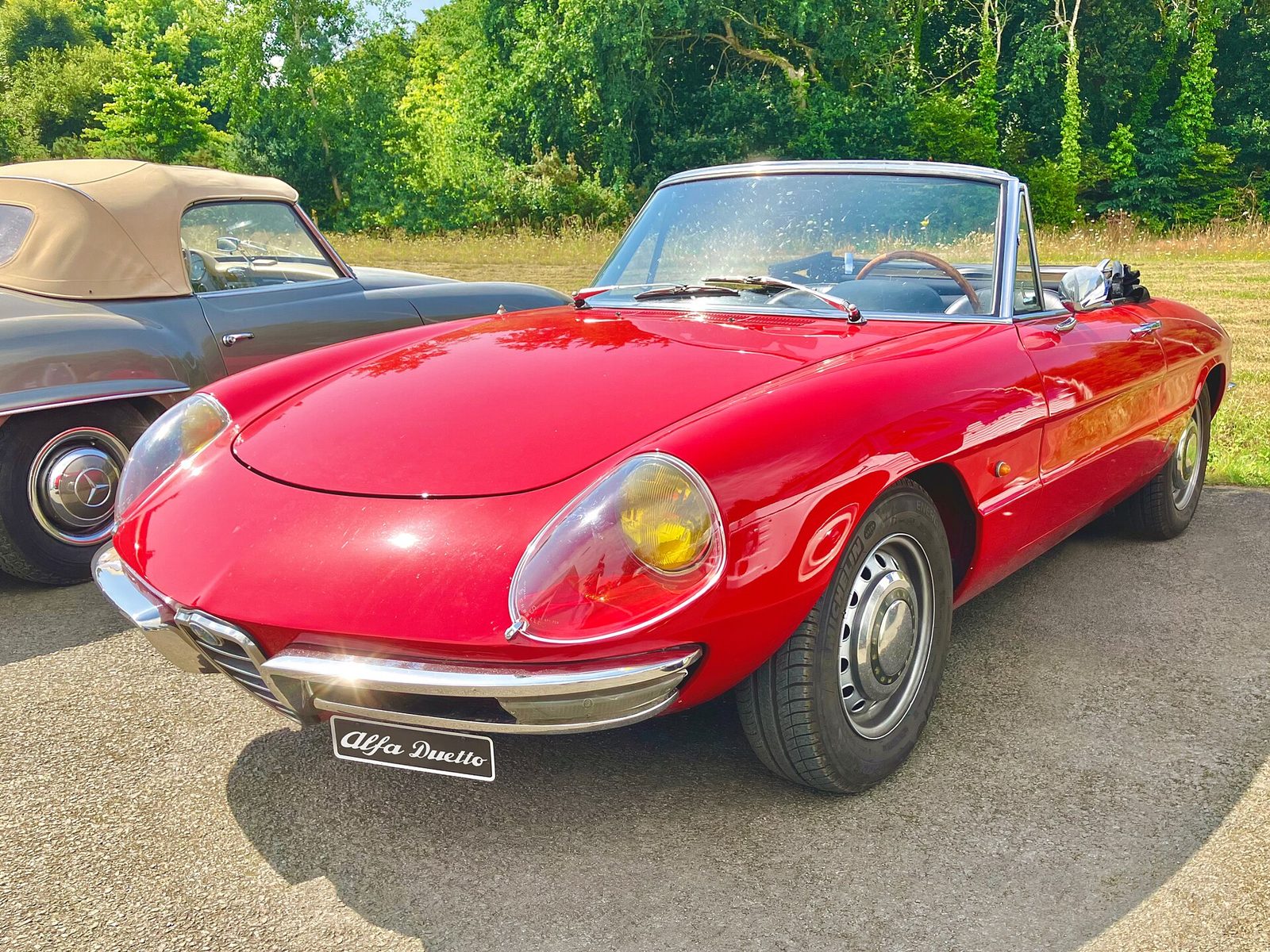
The Alfa Romeo Spider (105/115 series, 1966-1993) is the longest-lived single model in Alfa Romeo's history and the last car overseen by Battista 'Pinin' Farina, who died on 3 April 1966, weeks after its Geneva debut. Launched as the Spider 1600 - the 'Duetto' name came from a public naming competition but was already trademarked and never officially used - it paired Pininfarina's pointed 'cuttlefish bone' body with Alfa's all-alloy twin-cam four, a five-speed gearbox and four disc brakes. Round-tail Series 1 cars ran only to 1969 before the Kamm-tail Series 2 arrived, and the twin-cam grew through 1300, 1600, 1750 and 2000 forms. US cars used SPICA mechanical injection from 1969 to meet emissions rules, giving way to Bosch L-Jetronic in 1982 and Motronic on the Series 4. Roughly 124,104 were built. Series 1 cars command a large premium; later Kamm-tail cars remain among the most affordable genuinely classic Italian convertibles, with structural rust the defining risk.
Spider
105/115 Series
124,104 built · 2-door Convertible (Spider)
How rare is it?
With about 124,104 built, the Alfa Romeo Spider is rarer than a 240Z (~160k) yet more common than a DeLorean (~9k).
Approximate total production placed on a log scale against well-known reference cars, for scale only. Figures and any disputes are detailed in the production notes and sources.
History
Pininfarina's Last Car
The Tipo 105 Spider was shown at the Geneva Motor Show in March 1966, replacing the Giulietta/Giulia Spider that Pininfarina had also bodied. Alfa Romeo's own heritage material describes it as the last project led personally by Giovanni Battista 'Pinin' Farina, who died on 3 April 1966, within weeks of the car's public debut. The shape drew on Pininfarina's early-1960s aerodynamic show cars: a low, pointed nose, a full-length crease along the flanks and a tail that tapered to a point in mirror image of the front. Italians called it 'osso di seppia' - cuttlefish bone; English speakers settled on round tail or boat tail. The platform was a shortened Giulia Sprint GT floorpan, with the wheelbase cut by roughly 8.9 in (225 mm).
Duetto, and a Name That Never Was
Alfa Romeo ran a public naming competition through its dealer network, drawing a very large entry - one specialist account puts it above 140,000 submissions. The winning suggestion, 'Duetto', was credited to Guidobaldo Trionfi of Brescia, but the name was already registered by a confectionery firm and had to be abandoned after about a year. The car was sold simply as the Alfa Romeo Spider 1600. The rejected name stuck anyway, and is now used almost universally for the 1966-1969 round-tail cars.
Round Tail to Kamm Tail
The 1,570 cc twin-cam gave around 108 hp on twin 1.57 in (40 mm) carburetors, with a five-speed gearbox and discs all round - an unusually complete specification for 1966. A 1,779 cc 1750 Spider Veloce followed in 1967, and a 1,290 cc 1300 Junior arrived in 1968 as the European entry model. The boat tail lasted only to the end of the decade: the truncated Kamm tail arrived for 1970 (some sources date its introduction to late 1969), squaring off the rear for better luggage space and, arguably, better aerodynamics. Round-tail production was therefore a small fraction of the total, and this scarcity, plus the purity of the original shape and its film association, is why Series 1 cars sell for multiples of equivalent Series 2 money.
Emissions, SPICA and the American Decades
A 1966 Spider 1600 appeared in The Graduate (1967), the year's highest-grossing film. Its immediate commercial effect is easy to overstate - Series 1 1600 production still stopped at around 6,325 cars, and at roughly 4,000 dollars the Spider was not a mass-market proposition - but the association gave the model a durable American identity, and Alfa Romeo later sold a US base trim called the Graduate from 1985. To meet tightening US emissions rules Alfa fitted SPICA mechanical fuel injection to US-specification cars from the 1969 model year. Developed by Società Pompe Iniezione Cassani & Affini from diesel-injection technology and proven by Autodelta in competition, SPICA used a crank-driven four-plunger pump with a three-dimensional cam and centrifugal weights acting as a mechanical computer, at around 400 psi. It preserved power where rivals were being strangled, but demanded specialist setup, and many US cars were converted to Weber carburetors. Bosch L-Jetronic replaced it in 1982; Bosch Motronic followed on the Series 4.
Rubber Spoilers, the Series 4 and the End
The Series 3 'Aerodinamica' of 1982 added a black rubber front spoiler and a rear duck-tail - soft foam rubber at first, redesigned in hard plastic around 1986 to carry a third brake light - along with heavier bumper treatments. It is the most numerous and the least admired of the four series. The Series 4 of 1989/90 removed both spoilers, re-curved the tail, adopted full-width body-colored bumper fascias, Motronic injection and, on many cars, power steering and electric windows. Production ended in 1993 after 28 years, with the final 190 cars sold in North America as 1994-model-year Commemorative Editions.
Common Problems
Corrosion is the defining failure mode: sills, floors, rear suspension mounts and chassis rails, plus the front crossmember and spare wheel well. Mechanically the twin-cam is durable but seeps oil, and neglected coolant leads to corroded alloy castings, blocked radiators, overheating and head gasket failure. Gearboxes wear second and third synchros; clutches slip; bearings become noisy. Later differentials can be tired by around 60,000 miles and axle leaks are common. Right-hand-drive cars use a complex twin-servo brake arrangement prone to pedal creep. SPICA-injected US cars need a specialist who understands the pump; a poorly set up system is the usual reason owners convert to carburetors. On catalyzed later cars, the exhaust system noticeably blunts response. Series 3 soft rubber spoilers degrade, and interior trim and electrics on pre-Series 4 cars are the weak point relative to contemporary rivals.
What to Look For
Structure first, everything else second. Check the sills, floors, chassis rails and - critically - the rear suspension mounting points, along with the front crossmember beneath the radiator and the spare wheel well, where the towing eye is welded directly to the underside. Sills are load-bearing and are harder to assess on Series 4 cars because plastic covers hide them. On a bare-looking car, assume filler until proven otherwise; a cheap Spider with rotten mounts is worth less than nothing. Mechanically, drive the car hard enough to warm it fully and watch for overheating; check coolant condition and inhibitor level, because the alloy castings corrode from the inside when antifreeze is neglected. Listen for axle rumble and propshaft knock, test second and third gear synchros, check for clutch slip and steering box play, and confirm the handbrake works - it acts on small internal drums. On US cars, establish whether SPICA injection is present, original and correctly set up, or whether the car has been converted to Webers; on Series 3 and 4 cars, confirm the L-Jetronic or Motronic system is healthy. Verify series identity matches the claimed year: round tail versus Kamm tail is the single biggest value determinant, and Series 1 values make misrepresentation worth guarding against. Check soft-top fit at the screen and quarter-windows.
Market Notes
As of August 2026, classic.com listed an average sale price of about 17,900 US dollars across all Alfa Romeo Spider generations, with roughly 51 cars for sale. The series split is stark: Series 1 averaged about 39,400 dollars, with recorded results running from around 2,100 dollars for a 1967 project up to an 89,000-dollar asking price in July 2026, while Series 2 averaged about 17,600 dollars (recorded range roughly 600 to 28,900 dollars), Series 3 about 11,000 dollars (roughly 1,500 to 34,900 dollars) and Series 4 about 16,200 dollars (recent auction results roughly 11,550 to 31,000 dollars). Series 3 dominates supply - 28 of the cars listed for sale at that date were Series 3.
Where sources differ
Series 1 round-tail production was small relative to the total, at roughly 11,000 to 13,700 cars depending on source.
Wikipedia gives 13,678 Series 1 cars. Supercar Nostalgia gives 6,325 Spider 1600s and 4,672 Series 1 1750 Veloces, totalling 10,997; InsideHook independently cites about 6,300 Series 1 1600s. The gap is most plausibly explained by whether Series 1 1300 Junior cars are included, but no source consulted reconciles the two figures, so no single number is asserted.
The pointed 'boat tail' Series 1 body gave way to the truncated Kamm tail from 1970, which improved luggage space.
Wikipedia and the Alfa Spider FAQ date the Series 2 Kamm tail to 1970; Alfa Romeo's own heritage page and Classic & Sports Car both date its introduction to 1969. The discrepancy reflects a late-1969 launch for the 1970 model year rather than a factual disagreement about the car.
Sources
- Alfa Romeo Spider "Duetto" celebrates its 60th anniversary, Stellantis Media / Alfa Romeo · manufacturer
- Alfa Romeo Spider 1600 "Duetto", Stellantis Heritage (FCA Heritage) · manufacturer
- Alfa Romeo Spider, Wikipedia · reference-book
- Alfa Romeo Spider FAQ - Development and History, Alfa Romeo Spider FAQ · club-forum
- Guide: Alfa Romeo Tipo 105 Spider Series 1, Supercar Nostalgia · journalism
- Alfa Romeo Spider buyer's guide: what to pay and what to look for, Classic & Sports Car · journalism
- Alfa Romeo Spider S3 & S4 buyer's guide, Classics World · journalism
- Alfa Romeo Spider Market, classic.com · journalism
- Alfa Romeo Spider - Series 1 Market, classic.com · journalism
- Alfa Romeo Spider - Series 2 Market, classic.com · journalism
- Alfa Romeo Spider - Series 3 Market, classic.com · journalism
- Alfa Romeo Spider - Series 4 Market, classic.com · journalism
- How's That Work? Spica Fuel Injection, Hemmings Motor News (archived by Wes Ingram Enterprises) · journalism
- April 3, 1966 - Battista "Pinin" Farina, founder of Pininfarina, dies, This Day In Automotive History · reference-book
- Sorry Dustin, the Alfa Romeo Duetto Spider Was the Real Star of The Graduate, InsideHook · journalism
- Alfa Romeo Spider Graduate - Model Information, Conceptcarz · reference-book
Synthesized from the sources above and cross-checked. We cite and link out; we do not republish other databases verbatim.
Fully Sorted is an independent publisher and is not affiliated with, endorsed by or sponsored by Alfa Romeo. Alfa Romeo and the model names on this page are trademarks of their respective owners and are used here only to identify the cars being described.
Chassis register
Nobody has recorded a car here yet. Own one, or know one? Chassis number, what you can prove about it, and a source if there is one. Every entry is reviewed before it appears.
Nerd Notes
What owners know that the sources don't. Every note is read and checked before it appears here.
Key Specs
- Brakes
- Four-wheel discs
- Engine
- Alfa Romeo all-alloy DOHC inline-4, 1,290 / 1,570 / 1,779 / 1,962 cc
- Layout
- Front engine, rear-wheel drive
- Fuelling
- Twin sidedraught carburetors; SPICA mechanical injection on US cars from 1969; Bosch L-Jetronic from 1982; Bosch Motronic on Series 4
- Power 1300
- ~88 hp
- Power 1600
- ~108 hp at 6,000 rpm
- Power 1750
- ~116 hp (Europe)
- Power 2000
- ~130 hp
- Suspension
- Independent front with wishbones and coil springs; live rear axle located by trailing arms and a T-bracket, coil springs
- Curb weight
- ~1,984-2,183 lb (early cars)
- Transmission
- 5-speed manual (3-speed automatic optional on later US cars)
- Top speed 1600
- ~~113 mph
- Wheelbase note
- Shortened by roughly 8.9 in (225 mm) relative to the Giulia Sprint GT
Notable Variants
Spider 1600 ('Duetto')
1966-1967 round-tail original, 1,570 cc twin-cam, ~108 hp, five speeds and four disc brakes. The name was never officially adopted; roughly 6,325 built.
1750 Spider Veloce
1,779 cc from 1967. Built in both round-tail (Series 1) and Kamm-tail (early Series 2) form; the round-tail 1750 is the rarest of the boat-tail cars.
1300 Junior
1,290 cc, ~88 hp, European-market entry car from 1968. Cheaper when new and cheaper now; typically valued around 15 percent below equivalent 1750/2000 cars.
2000 Spider Veloce
1,962 cc from 1971, ~130 hp. The definitive long-run engine, carried through Series 2, 3 and 4 with SPICA, then Bosch, injection in the US.
Spider Graduate (US)
1985-1990 US base trim named for the 1967 film: manual windows, vinyl top, steel wheels, vinyl seats. Positioned below Veloce and Quadrifoglio.
Spider Quadrifoglio (US)
Top Series 3 US trim with air conditioning, leather wheel, alloys and the full body-kit treatment; the most equipped rubber-spoiler car.
Commemorative Edition
Final 190 cars, built 1993 and sold as 1994 models in North America, each with a numbered dash plaque.
Value Trajectory
The market has split rather than risen uniformly. Round-tail Series 1 cars long ago separated from the rest and now trade at roughly two to three times Series 2 money on average, a premium built on a three-year production run, the purity of Pininfarina's original shape and the car's film association. The Kamm-tail cars have moved far less: Series 2 and Series 3 averages sat near or below 18,000 US dollars in August 2026, and Series 3 in particular remains plentiful, with 28 cars listed for sale at that date against five Series 1. That supply keeps the Spider one of the last genuinely affordable classic Italian convertibles - a running, usable, five-speed, disc-braked twin-cam roadster for the price of an ordinary used car. The risk in that affordability is that restoration cost is largely independent of series: welding a Series 3 costs what welding a Duetto costs, while the finished values differ by a factor of three, which continues to thin the Series 3 population and should, over time, support good survivors.
Next
Shopping for one?
Browse Alfa Romeo listings, or decode a VIN before you buy.