
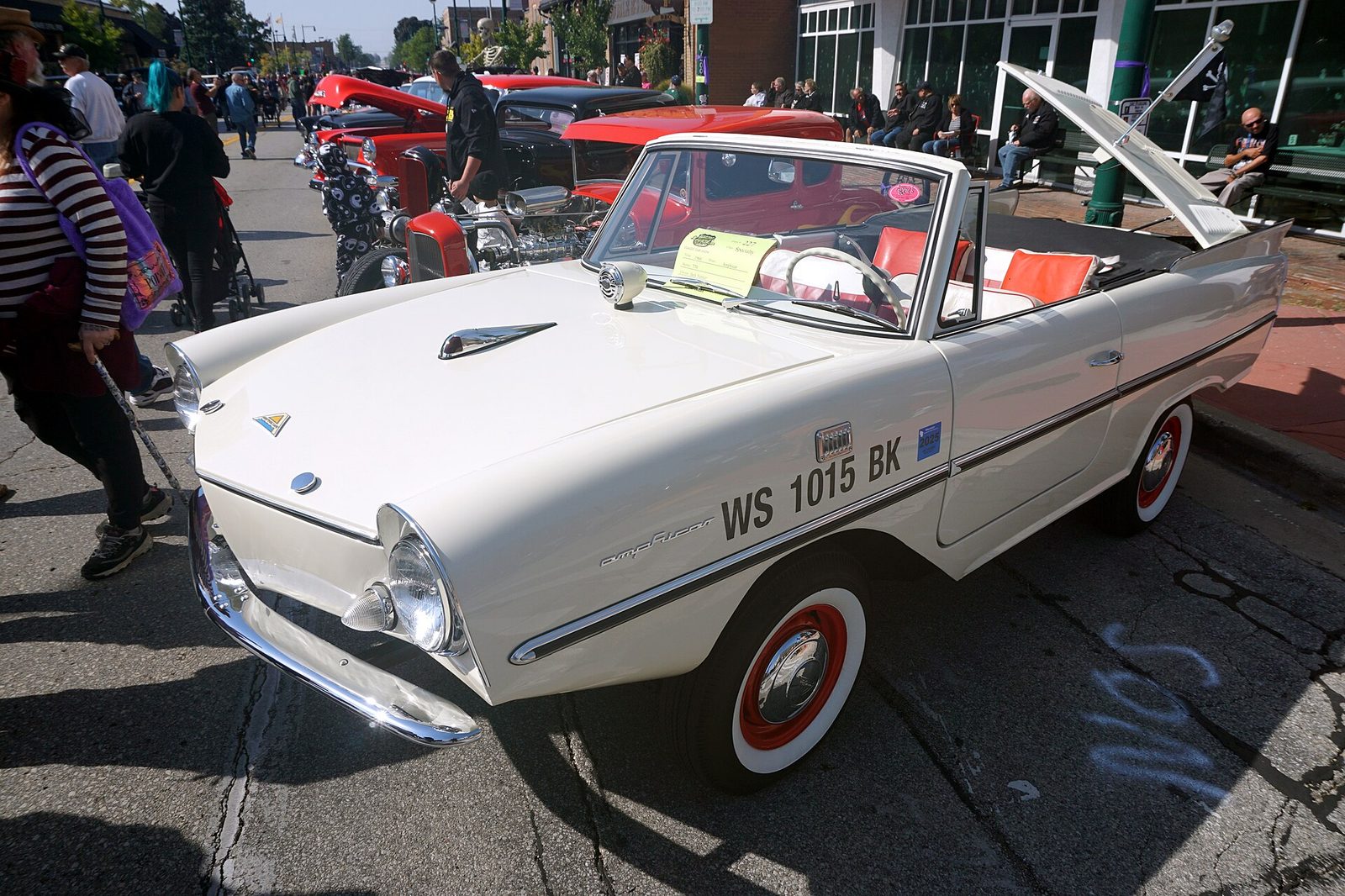
The Amphicar 770 is the world's first - and by far the most successful - mass-produced civilian amphibious car: a car that drives straight into a lake and floats away under its own power. Designed by German engineer Hans Trippel and built by the Quandt Group from 1961 to 1968, it paired a jaunty finned convertible body with a rear-mounted 1147cc Triumph Herald four-cylinder engine. On land it drove the rear wheels through a conventional 4-speed manual (~70 mph); in the water a second gearbox spun twin nylon propellers (~7 knots), giving rise to the '770' name. About 3,878 were built, most exported to the United States. Its most famous owner, President Lyndon B. Johnson, delighted in terrifying guests by feigning brake failure and plunging his Amphicar into the lake at his Texas ranch. Today it is a beloved, genuinely usable novelty and a social-media favorite; running, water-worthy examples command strong money while corrosion is the perennial enemy.
770
1961-1968
3,878 built · Amphibious convertible
How rare is it?
With about 3,878 built, the Amphicar 770 is rarer than a DeLorean (~9k) yet more common than a F40 (~1k).
Approximate total production placed on a log scale against well-known reference cars, for scale only. Figures and any disputes are detailed in the production notes and sources.
History
Origins and Design
The Amphicar was the brainchild of Hans Trippel, a German engineer who had developed amphibious vehicles during WWII (his lineage is often linked to the era of the Volkswagen Schwimmwagen). His civilian amphibious car reached the public in 1960 and entered series production in 1961. It was manufactured by the Quandt Group, initially in Lübeck and later at Berlin-Borsigwalde.
Engineering the Car-Boat
Rather than build a bespoke drivetrain, Trippel used a proven, serviceable powerplant: the 1147cc inline-four from Britain's Triumph Herald, producing around 43 hp. Mounted at the rear, it drove the rear wheels on land through a 4-speed manual, and a separate marine gearbox engaged twin nylon propellers under the rear bumper for water travel. A selector allowed wheels-only, propellers-only, or both together - useful for clawing up a slippery boat ramp. The front wheels doubled as rudders. The name '770' reflects its dual nature: roughly 7 (knots/mph) on water and 70 mph on land. Its tailfins were famously said to be the tallest on any production car, an inch higher than a 1959 Cadillac.
Selling to America
The Amphicar was aimed squarely at the US market - the '70 into the 770' export focus - where its novelty had obvious appeal. Of ~3,878 built, the great majority were left-hand-drive US exports (Heacock cites 3,046 US imports); only ~97 were right-hand drive.
The LBJ Prank
The car's most enduring story belongs to President Lyndon B. Johnson, who kept a Lagoon Blue Amphicar at his Stonewall, Texas ranch. He would drive unsuspecting guests toward the lake shouting that the brakes had failed - 'We're going in! We're going under!' - before the car simply floated. Aide Joseph Califano was a noted victim.
Decline
Rising costs, tightening US safety and emissions rules, and a limited niche market ended production; the last cars were sold off through 1968. No direct mass-produced successor ever matched it.
Common Problems
Corrosion is the number-one enemy because the body is the boat; hidden rust in the hull, floor pans and seams can be dangerous and expensive. Water intrusion past worn door seals or drain plugs is common if the car has been neglected. The dual-gearbox setup and propeller drive add mechanical complexity and require specialist knowledge; parts for the marine portion and body are scarce. The Triumph-derived engine is reliable and serviceable but modestly powered. Cars that have sat unused often have seized water-drive components, perished seals and electrical faults from moisture.
What to Look For
Prioritize a hull and body that are genuinely rust-free - the steel unibody doubles as the boat hull, so corrosion in the floors, sills, seams and lower body is both a value-killer and a safety issue. Confirm the car actually floats and has been water-tested recently; ask about the condition of the rubber seals and the two large door/bilge drain plugs and bilge pump. Check that both drive systems work: the road gearbox and the separate propeller gearbox, plus the nylon propellers and their shafts/seals. Complete, original trim and the distinctive tall fins are hard to source. Documented restoration history, service records and evidence of regular use (rather than a long static sit) are strong positives.
Market Notes
As of mid-2026, the Amphicar 770 trades as a fun, usable, headline-grabbing collectible rather than a blue-chip investment. Aggregated auction data (CLASSIC.COM) shows an average sale price around $76,000, with a benchmark near $69,000 and a range from roughly $15,000 for a project to about $93,500 at the top. Notable recent results include two sales at $93,500 (Hershey PA Oct 2025; Fort Worth TX Nov 2025), $85,800 (Kissimmee FL, Jan 2026) and $78,100 (Tulsa OK, June 2026); the benchmark trend has ticked slightly downward. Provenance, cosmetic quality and - crucially - proven, water-tested seaworthiness drive the premiums, while rough or non-floating projects trade far cheaper. A well-restored car was estimated at $80,000 - $100,000 as far back as 2022, so values have broadly held in that band.
Where sources differ
The '770' name reflects performance of roughly 7 (knots/mph) on water and about 70 mph on land; the sometimes-cited '10/10' nickname is not well documented in the reputable sources reviewed.
Multiple reputable sources consistently explain the name as 7 (water) / 70 (land). The '10/10' framing (~10 mph water / ~70 mph land) does not appear in the primary sources found; water speed is documented as ~7 knots/6.5 mph, so '10 mph on water' is at the optimistic end and the '10/10' label is treated as unverified.
The overwhelming majority of production was exported to the United States (the '70 into the 770' focus); Heacock cites 3,046 US imports versus ~832 European sales, while other accounts say roughly 3,700 reached the US.
US import figures differ by source (3,046 per Heacock vs ~3,700 in some accounts); all agree the US was the dominant market.
Estimates of surviving Amphicars range from 'several hundred' to around 500 still operable today.
Survivor counts are estimates only; figures cited range from a few hundred to ~500 operable, with no authoritative registry total confirmed.
Sources
- Amphicar, Wikipedia · reference-book
- 1964 Amphicar Model 770, Heacock Classic Insurance · journalism
- Amphicar 770-1964, Lane Motor Museum · reference-book
- The Amphicar 770: A Vintage Car That's Also A Boat, Silodrome · journalism
- Amphicar Model 770 Market, CLASSIC.COM · journalism
- LBJ would prank guests at his ranch by driving his car into the lake, History Facts · journalism
Synthesized from the sources above and cross-checked. We cite and link out; we do not republish other databases verbatim.
Fully Sorted is an independent publisher and is not affiliated with, endorsed by or sponsored by Amphicar. Amphicar and the model names on this page are trademarks of their respective owners and are used here only to identify the cars being described.
Chassis register
Nobody has recorded a car here yet. Own one, or know one? Chassis number, what you can prove about it, and a source if there is one. Every entry is reviewed before it appears.
Nerd Notes
What owners know that the sources don't. Every note is read and checked before it appears here.
Key Specs
- Power
- ~43 hp at 4,750 rpm
- Width
- 62 in (1,575 mm)
- Engine
- Triumph Herald 1147cc inline-four (Standard-Triumph SC unit)
- Height
- 60 in (1,524 mm)
- Layout
- Rear-mounted engine, rear-wheel drive on land; twin rear propellers on water
- Length
- 171 in (4,343 mm)
- Wheelbase
- 84 in (2,134 mm)
- CurbWeight
- ~2,315-2,324 lb (2,315-2,324 lb)
- TopSpeedLand
- ~70 mph
- OriginalPrice
- approx. $2,800 - $3,300 (1960s US)
- TopSpeedWater
- ~7 knots (roughly 6.5-8 mph)
- SteeringOnWater
- Front wheels act as rudimentary rudders
- LandTransmission
- 4-speed all-synchromesh manual
- WaterTransmission
- Separate 2-speed marine gearbox driving twin nylon propellers (forward/reverse); a selector lets the engine drive wheels only, props only, or both
Notable Variants
Model 770
The only model sold; the '770' name denotes ~7 mph (knots) on water and ~70 mph on land.
Export/US-spec
The overwhelming majority of production was left-hand drive and shipped to the US market via the Amphicar Corporation.
Value Trajectory
Values climbed steadily as the Amphicar became a viral, feel-good icon, and have plateaued at a healthy level in the mid-2020s - solid usable cars generally in the $60k - $95k window, with the very best floating, well-documented examples pushing toward or beyond $90k and projects far below. The mid-2026 benchmark shows mild softening rather than a boom, suggesting a mature, enthusiast-driven market. Because the appeal is experiential (you can drive it into the water), running and seaworthy cars will continue to command a clear premium over static restorations or projects.
Next
Shopping for one?
Browse Amphicar listings, or decode a VIN before you buy.