
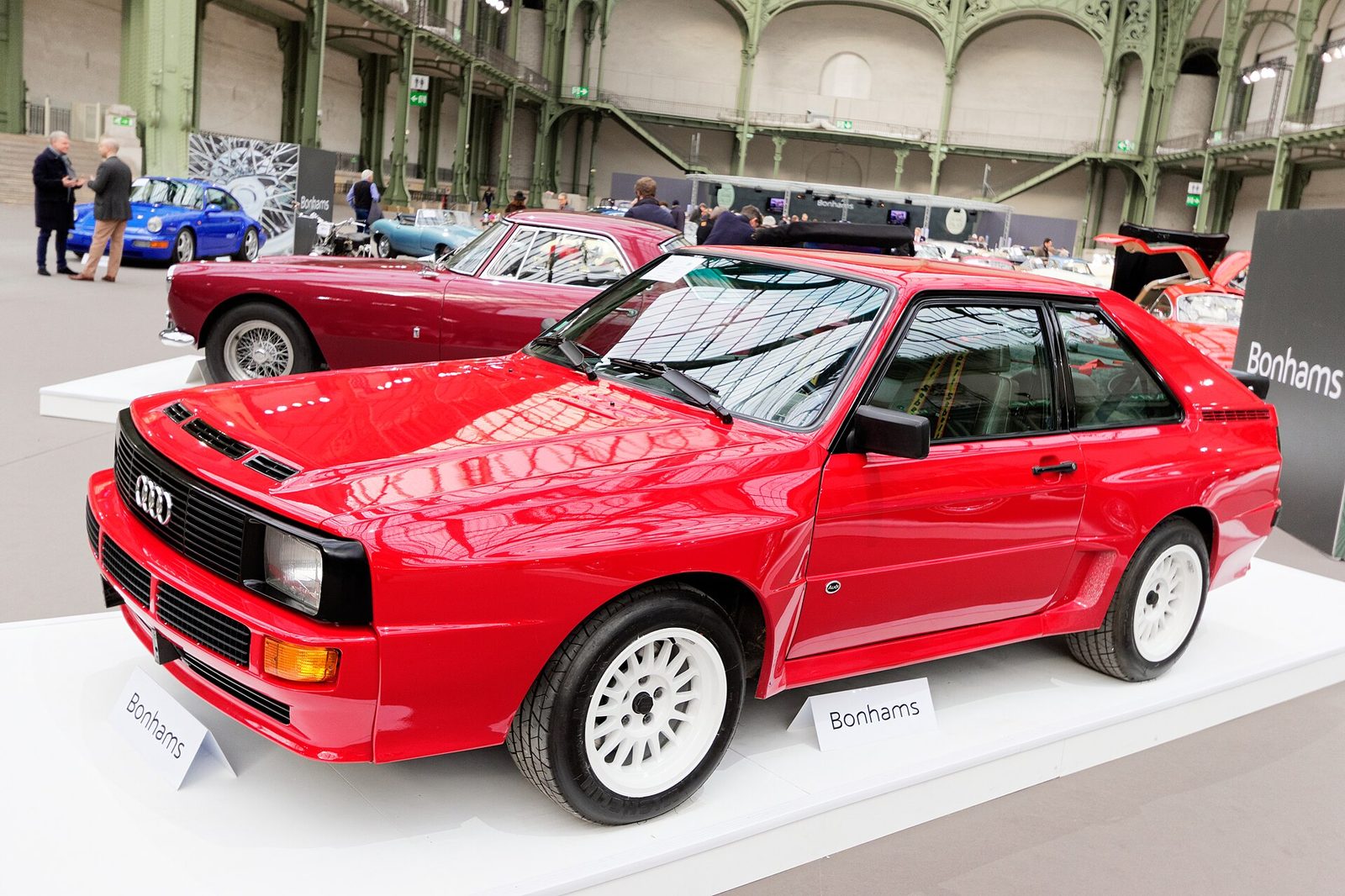
The Audi Quattro of 1980-1991 - called the Ur-Quattro since, to separate the car from the drivetrain that took its name - is the machine that moved four-wheel drive out of agriculture and into performance. The idea came from winter testing in Scandinavia in 1976-77, where a Volkswagen Iltis military vehicle outran far more powerful front-drive Audi prototypes on snow. The packaging problem was solved by a drilled-out 10.4 in (263 mm) hollow secondary shaft in the gearbox: one shaft drove the center differential while a second ran inside it to the front axle, so there was no separate transfer case and very little added bulk. Presented at Geneva on 3 March 1980 with a 2,144 cc turbocharged five-cylinder of 197 hp, it was planned as a homologation run of about 400 cars and stayed in production for eleven years and 11,452 of them. Group B rallying made its reputation, the short-wheelbase Sport quattro homologated the extreme version of it, and the 20-valve cars of 1989-91 closed the run.
Ur-Quattro
Original quattro coupe (B2 platform)
11,452 built · 2-door coupe on the Audi 80 (B2) floorpan, with blistered arches and a fixed roof
How rare is it?
With about 11,452 built, the Audi Ur-Quattro is rarer than a 240Z (~160k) yet more common than a DeLorean (~9k).
Approximate total production placed on a log scale against well-known reference cars, for scale only. Figures and any disputes are detailed in the production notes and sources.
History
An Iltis in the Snow
The quattro began as an observation rather than a project. During winter testing in Scandinavia in 1976-77, Audi engineers found that a Volkswagen Iltis - a slab-sided four-wheel-drive military light utility with a 74 hp four-cylinder - could stay with, and on snow outrun, far more powerful front-drive Audi prototypes. Chassis engineer Jorg Bensinger is the name usually attached to the insight; Walter Treser, director of pre-development, was given twelve engineers in February 1977 to turn it into a car, with Ferdinand Piech behind them. The Iltis was not merely inspirational: the ur-quattro's lockable rear differential was developed from the Iltis unit, and an Audi-prepared Iltis won the 1980 Paris-Dakar outright while the road car was being launched.
The Hollow Shaft
Four-wheel drive was not new. What was new was making it light and compact enough that a sedan-based coupe could carry it without a transfer case slung alongside the gearbox. Audi's answer was a drilled-out 10.4 in (263 mm) secondary shaft in the transmission: the hollow outer shaft drove a bevel-gear center differential at the rear of the gearbox, while a slim shaft running inside it took drive forward to the front differential. The split was a nominal 50:50, against the 33:67 of the Jensen FF, and both center and rear differentials could be locked - by cable, then pneumatically, then by rotary switch from 1986. The center differential weighed about five kilograms. From the 1987 model year a Torsen torque-sensing unit replaced the manual center lock, ending the era in which the driver had to remember to unlock it.
Group B and the Sport quattro
Audi entered rallying in 1980 as a development season, and in 1981 Michele Mouton became the first woman to win a World Championship rally. The quattro took the manufacturers' title in 1982 and 1984, with Hannu Mikkola taking the drivers' championship in 1983 and Stig Blomqvist in 1984. By 1984 the long wheelbase and nose-heavy layout were being punished by mid-engined Group B rivals, and Audi's answer was the Sport quattro: 12.6 in (320 mm) cut from the wheelbase, an all-alloy 20-valve five of 306 hp, Kevlar and glassfiber panels over a steel base still using Audi 80 doors. It was homologated on 1 May 1984 and competed two days later on the Tour de Corse. The works cars evolved beyond it into the S1 and S1 E2, quoted officially at 473 hp and believed to be well past 500, and finished by winning Pikes Peak three years running from 1985.
WR, MB, RR
The road car changed less than its reputation suggests. The WR - 2,144 cc, single cam, ten valves, 200 hp - ran from launch to 1988, gathering ABS as standard, eight-inch wheels and a 0.79 in (20 mm) lower ride height for 1984, and a raked grille and headlamps for 1985. In 1987 the MB brought 2,226 cc, a water-cooled turbocharger and the Torsen differential. Then in 1989 came the RR: the same 2,226 cc block under a twin-cam 20-valve head, with higher compression, more boost, Bosch Motronic and twin catalytic converters, for 220 hp at 5,900 rpm and 143 mph. It is the engine specialists rate most highly, and the last; the final car left Ingolstadt on 17 May 1991.
The Talking Dashboard
From late 1983 the quattro received a green LCD instrument cluster, and with it something stranger: an autocheck system monitoring around twenty sensors that spoke its warnings aloud in German through the car's speakers, ranked by severity so that a brake fault took precedence over washer fluid. The voice belonged to Patrizia Lipp, and the 1983-84 units used a National Semiconductor Digitalker chip. Warning lights were ordinary for the period; a car that told you it had had enough was not. The display color was revised later in the run, and an early digital cluster paired with a synthesiser nobody now supports is among the harder ownership problems the car sets.
Common Problems
Corrosion is the first and largest bill, particularly on pre-1985 cars, compounded by panels Audi no longer supplies - wings, hoods and trunk lids among them, with post-1987 plastic bootlids needing specialist repair. Mechanically the ten-valve engines are the weaker pair: Octane suggests early 2.1-liter units may want rebuilding around 150,000 miles where later MB and RR engines run past 200,000 on proper servicing, and the 20-valve is the unit specialists rate highest. Cracked exhaust manifolds following engine-mount failure are a known pattern and expensive in parts alone. Turbocharger bearing and seal failure is common, aggravated on the MB by the absence of the water cooling fitted later. Oval bore wear, worn valve guides and corroded oil-cooler joints all appear. Gearboxes are heavy in action and weak on synchromesh. Differential-lock actuators and rear differential seals leak or seize. The brakes use hydraulic assistance fed from the steering pump - shared on WR cars to 1987, a tandem arrangement on MB and RR cars from 1988 - and the two take different fluids: ATF in the later green mineral-oil system will destroy seals. Fuel tanks weep at the seam welds, and the wiring deteriorates at its connections.
What to Look For
Establish which car it is before anything else. WR, MB and RR are three different propositions, and a 1989 car can be a late ten-valve or an early 20-valve depending on build date, so match the code on the block to the paperwork rather than to the badge. Galvanizing is the other dividing line: shells before 1985 had none and cars from 1988 are the best protected, so sills, door bottoms, wheel arch lips and panel seams all want a torch, with incorrect jacking the usual cause of sill damage. Work the differential locks through their full travel and confirm the tell-tales light: pneumatic center locks seize on cars used gently for years, and a lock that will not disengage is worse than one that will not engage. A tick during warm-up points to a cracked exhaust manifold, itself usually a symptom of a collapsed right-hand engine mount. Blue smoke under load is turbo seals or valve guides. Check the external oil cooler behind the front bumper for corroded unions, ask when the cam belt was last done, and on 20-valve cars inspect the rear subframe for cracking. Then work every function of the digital cluster and, if fitted, the voice system: with window motors, ABS sensors and much interior trim no longer available, a dead dash is a permanent condition rather than a fault to be quoted for.
Market Notes
The aggregate figures mislead if read alone, because competition cars and Sport quattros sit in the same database as ordinary coupes. As of August 2026, classic.com records an average sale price of $123,888 across all Audi Quattro listings, but its lowest recorded result is $5,040 for a 1983 car on 26 October 2024 and its highest visible is EUR 862,500 for a 1983 car sold through Bonhams on 24 April 2026 in Corsica - a competition car, and classic.com does not state whether that figure is hammer or premium-inclusive. Sport quattros trade in a market of their own: RM sold chassis 905147 for $401,500 at Arizona in January 2015 and the same car for $665,000 at Arizona in January 2024, a UK-delivered 1986 example for GBP 403,200 at London in 2016, and a heavily modified 435 hp car with United States competition history for $643,000 at Monterey in 2025. Octane's published UK guidance puts the best ten-valve road cars at GBP 55,000-90,000 and 20-valve cars at GBP 75,000-100,000 and above; it carries no date of its own and reads best against the auction record rather than instead of it.
Where sources differ
Published counts for the short-wheelbase Sport quattro homologation car range from 161 to 224, and no source consulted here reconciles them.
Audi's own press material, Supercar Nostalgia and Exclusive Car Registry state 214. Wikipedia and Hagerty state 224. Sports Car Market gives 214 split into 164 road cars and 50 competition cars, and Supercar Nostalgia says 164 were sold to customers with five more assembled from leftover parts in 1988. RM Sotheby's has cataloged the model as 'one of just 214', 'one of only 164' and '214 produced, of which only 161 were homologated road versions'. Group B homologation required 200 cars, which explains the cluster but not the spread. Not resolved by any source consulted here, and no single Sport quattro figure is asserted.
The number of 20-valve RR cars built in the final phase of the run is unsettled: one specialist source states 934 while another's year-by-year table implies 898.
Supercar Nostalgia states 934 RR cars built between August 1989 and 17 May 1991. The ableitet.no year table gives 462 for 1989, 413 for 1990 and 23 for 1991, totalling 898 - but 1989 was a split year in which ten-valve cars were still delivered, so the two may be counting different things. Neither source explains its basis and the conflict cannot be resolved from the sources consulted here.
A green LCD digital instrument cluster was introduced in 1983, but sources disagree on when the display color changed.
Wikipedia dates the green LCD cluster to 1983 and an orange cluster to 1988. Classics World states the green 1983 dash changed to orange in 1984. ableitet.no records red digital displays arriving with the 20-valve cars in 1989. The three accounts cannot all be correct and the sequence is not resolved by any source consulted here.
Sources
- Always one step ahead of the competition: the technical milestones, AUDI AG (Audi MediaCenter) · manufacturer
- 40 years, 40 figures, 40 images: fascinating facts and tales about Audi's quattro technology, AUDI AG · manufacturer
- Audi Quattro, Wikipedia · encyclopedia
- Volkswagen Iltis, Wikipedia · encyclopedia
- Audi Quattro UR Guide, Supercar Nostalgia · specialist
- Audi Quattro MB Guide, Supercar Nostalgia · specialist
- Audi Quattro Sport Guide, Supercar Nostalgia · specialist
- Audi Quattro (urquattro) - Audi Sport, Rallye & Racing Quattro, ableitet.no · specialist
- Audi Quattro buyer's guide, Classics World · journalism
- Audi quattro buying guide, history and model review, Octane · journalism
- The Audi Quattro, April 1980, Motor Sport · journalism
- Ready To Race: 1981 Audi quattro Group 4, Silodrome · journalism
- Audi's Ur-Quattro, trend-setter on the rally stage and street, is fast becoming a blue-chip '80s classic, Hagerty Media · journalism
- Audi Quattro Market, classic.com · market-data
- 1984 Audi Sport quattro, Monterey 2025, RM Sotheby's · auction-house
- 1984 Audi Sport quattro, Arizona 2024, RM Sotheby's · auction-house
- 1986 Audi Sport quattro, London 2016, RM Sotheby's · auction-house
- 1984 Audi Quattro Sport SWB Coupe, Sports Car Market · journalism
- Audi Sport quattro list, Exclusive Car Registry · registry
- The Audi ur-quattro's Hydraulic Brake Assist System, Isham Research (mirrored by Audifans) · specialist
- Audi ur-quattro Voice Synthesiser - Green Digital Dashboard, Isham Research · specialist
Synthesized from the sources above and cross-checked. We cite and link out; we do not republish other databases verbatim.
Fully Sorted is an independent publisher and is not affiliated with, endorsed by or sponsored by Audi. Audi and the model names on this page are trademarks of their respective owners and are used here only to identify the cars being described.
Chassis register
Nobody has recorded a car here yet. Own one, or know one? Chassis number, what you can prove about it, and a source if there is one. Every entry is reviewed before it appears.
Nerd Notes
What owners know that the sources don't. Every note is read and checked before it appears here.
Key Specs
- Power
- 200 hp at 5,500 rpm (WR and MB); 220 hp at 5,900 rpm (RR); 160 hp (WX, North America) - manufacturer figures
- Brakes
- Hydraulically assisted discs, 11.0 in (280 mm) ventilated front and 9.6 in (245 mm) solid rear, fore-and-aft dual circuit; ABS standard from the 1984 model year
- Engine
- Turbocharged inline five: 2,144 cc WR 10-valve to 1988, 2,226 cc MB 10-valve 1987-88, 2,226 cc RR 20-valve DOHC 1989-91
- Layout
- Front longitudinal engine, permanent four-wheel drive with lockable center and rear differentials
- Torque
- 210 lb-ft at 3,500 rpm (WR); 270 lb-ft at 3,000 rpm (MB); RR quoted at 309 lb-ft by Supercar Nostalgia, a figure other guides do not repeat
- Weight
- 2,866 lb (WR); 2,943 lb (MB); 3,042 lb (RR)
- Chassis
- Pressed-steel unitary bodyshell on the Audi 80 (B2) platform; partial galvanizing from 1985, more extensive from 1988
- Fuel tank
- 90 liters
- Induction
- KKK K26 at 0.68 bar with intercooler and Bosch K-Jetronic (WR); water-cooled turbo (MB); 0.84 bar, 9.3:1, Bosch Motronic and twin catalysts (RR)
- Top speed
- 137 mph (WR); 143 mph (RR) - manufacturer claims
- Wheelbase
- 99.4 in (2,524 mm) road car; 86.8 in (2,204 mm) Sport quattro
- Suspension
- Independent MacPherson struts front and rear; ride height lowered about 0.79 in (20 mm) for 1984
- Bore stroke
- 79.5 mm x 86.4 mm (WR); 3.2 in (81.0 mm) x 86.4 mm (MB and RR)
- Acceleration
- 7.1 sec to 62 mph (WR); 6.5 sec to 62 mph (RR) - manufacturer claims
- Transmission
- Five-speed manual only; manually locked center differential to 1986, Torsen torque-sensing center differential from the 1987 model year
- Instrumentation
- Analogue to 1983, then a green LCD digital cluster with a German-language voice synthesiser on WR cars, later revised in color
- Drivetrain detail
- Drilled-out 10.4 in (263 mm) hollow secondary shaft in the gearbox feeding the center differential, with a second shaft running inside it to the front axle; 50:50 nominal split
Notable Variants
quattro (WR, 1980-1988)
The original: 2,144 cc 10-valve turbo five, manually locked center and rear differentials, 6x15 Ronal alloys to 1984 and 8x15 after. Pre-1985 shells were not galvanized, so condition rather than year decides value.
quattro (WX / GV emissions cars)
The 160 hp WX for the United States, Canada, Switzerland and Japan, and the 165 hp GV listed for Sweden and Switzerland from 1985. All 664 US and 99 Canadian cars are WX, some 40 hp down on European output.
quattro (MB, 1987-1988)
2,226 cc, still 10-valve, but with a water-cooled turbocharger and the Torsen torque-sensing center differential in place of the manual lock. Torque rose to 270 lb-ft at 3,000 rpm; the driveline change matters more than the power.
Edition Speciale (1988)
Two hundred individually numbered ten-valve cars marking the end of the two-valve-per-cylinder engine. The numbered plaque is the check, and an unplaqued car offered as one is the obvious trap.
quattro 20V (RR, 1989-1991)
The final specification: 2,226 cc twin-cam 20-valve, 220 hp at 5,900 rpm, twin catalysts, 143 mph. Rated by specialists as the most durable of the three engines and the most sought-after road car in the range.
Sport quattro (1984-1986)
Wheelbase cut 12.6 in (320 mm) to 86.8 in (2,204 mm), all-alloy 20-valve KW engine at 306 hp, Kevlar and glassfiber panels over a steel base with Audi 80 doors, left-hand drive only. Built to homologate the Group B car; the count is disputed.
quattro A1 / A2 / S1 works rally cars
The competition line, built and continuously rebuilt by Audi Sport rather than assembled on the road-car line, and counted separately from every road-car total. Provenance rests on works records, not a chassis plate.
Value Trajectory
For most of its life this was a cheap fast Audi, and a generation of them was scrapped or modified accordingly. The re-rating began around 2015 and has been steep: Hagerty's tracking shows a condition-2 standard Quattro rising roughly 237 per cent over ten years, from about $20,000 to $55,600, with the Sport quattro up around 415 per cent to $458,000. The auction record for the short-wheelbase car makes the point more bluntly: chassis 905147 took $401,500 at RM Arizona in January 2015 and $665,000 at the same sale in January 2024. Two forces are working. The first is the 1980s Group B cohort re-rating as a group, as the people who watched those rallies reach the age at which they buy. The second is attrition: 11,452 is a small number to begin with, corrosion took many of the early cars, and unrepeatable parts mean one that has gone too far cannot economically come back. As of August 2026 the gap between a documented, unmodified, structurally sound car and a tidy-looking one continues to widen, and 20-valve cars sit clearly above ten-valves in every guide consulted.
Next
Shopping for one?
Browse Audi listings, or decode a VIN before you buy.