
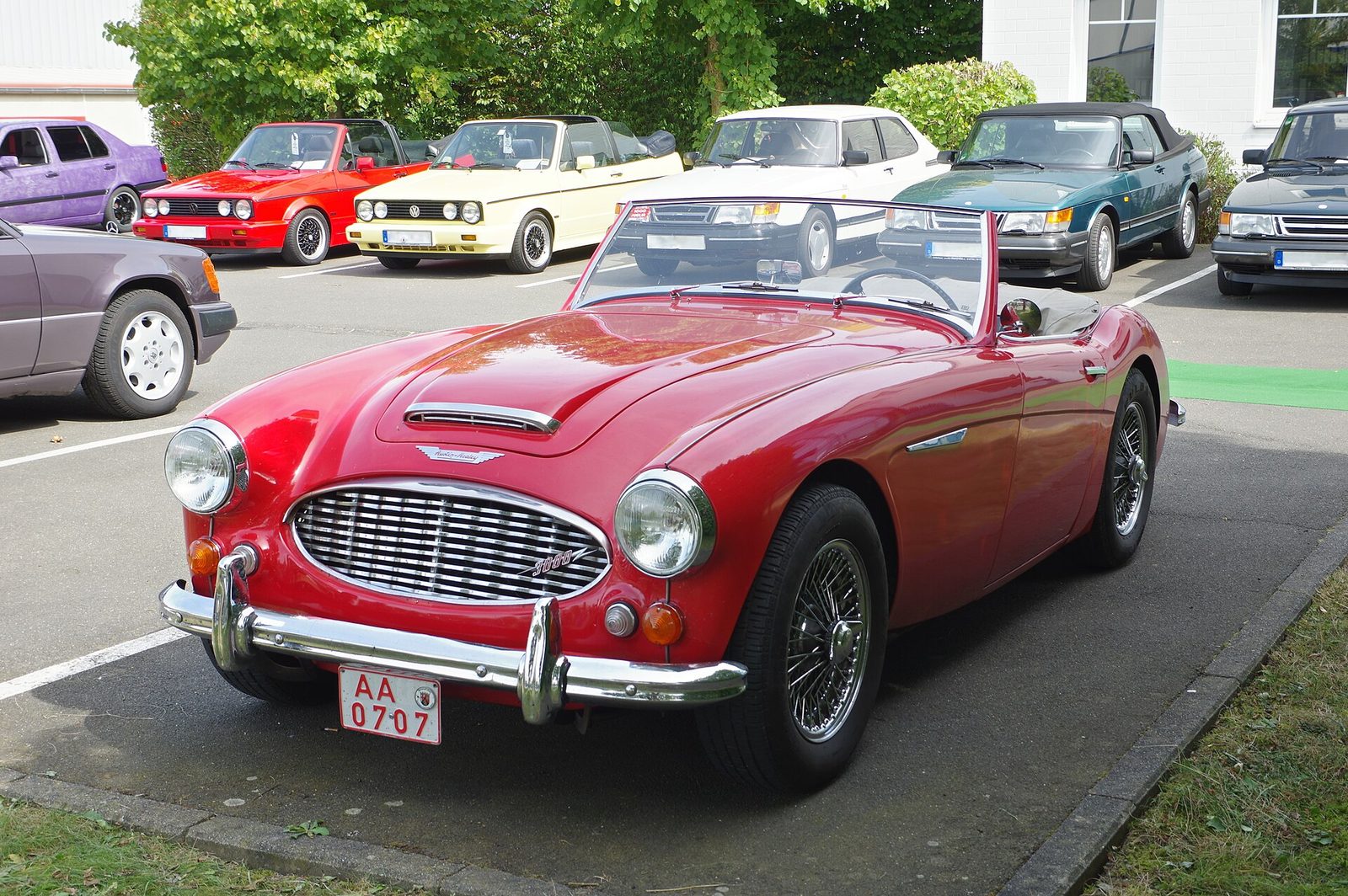
The Austin-Healey 3000 (1959-1967) is the last and best known of the Big Healeys, a body-on-frame two-seater and 2+2 built by BMC at Abingdon on Jensen-made bodywork and sold overwhelmingly to the United States. It replaced the 100-Six's 2.6-liter engine with a 2,912 cc C-Series six and added front disc brakes, then developed through three marks: the side-screen Mark I roadsters, a Mark II that briefly ran three SU carburetors before retreating to two, and the Mark III BJ8, which brought twin HD8s, a walnut fascia, servo brakes and, from May 1964, a reshaped rear chassis that finally gave the car usable ground clearance. The 1962 BJ7 introduced wind-up windows and ended the roadster line. Abingdon's works cars won the Liège-Rome-Liège and the Alpine outright, and the model died at the end of the 1967 season because it could not be federalized for the American market that had sustained it.
3000
Big Healey (3000, Mk I to Mk III)
42,926 built · 2-door open two-seater roadster with detachable side screens (BN7, Mk I and Mk II) · 2-door open 2+2 roadster with detachable side screens (BT7, Mk I and Mk II) · 2-door 2+2 sports convertible with wrap-around windshield, wind-up windows and quick-action folding hood (BJ7, Mk II) · 2-door 2+2 sports convertible with wood-veneer fascia (BJ8, Mk III Phase I and Phase II) · Factory detachable hardtop, optional on 2+2 bodies
How rare is it?
With about 42,926 built, the Austin-Healey 3000 is rarer than a 240Z (~160k) yet more common than a DeLorean (~9k).
Approximate total production placed on a log scale against well-known reference cars, for scale only. Figures and any disputes are detailed in the production notes and sources.
Production by variant
How the 3000run breaks down, and which variants are the scarce ones. Approximate figures from this model’s cited sources.
Rarest of the bunch: the Works competition 3000 (Abingdon, 1959-1965), only about 24 built, roughly 1 in every 1,789 3000s. If provenance and rarity drive your buy, this is the one to hunt.
Variants shown ≈ 34% of the ~42,926 built. Figures approximate; see Sources below.
History
From 100-Six to Three Liters
The Austin-Healey 3000 was announced on 1 July 1959, replacing the 100-Six's 2.6-liter unit with BMC's 2,912 cc C-Series six and adding disc brakes at the front. Little else changed: the wheelbase, the Jensen-built bodywork and the two body styles carried over, the two-seat BN7 and the 2+2 BT7, and assembly continued at BMC's MG works at Abingdon. Weather equipment stayed rudimentary: a folding hood on a light demountable frame and detachable side screens holding sliding Perspex panels. BMC claimed 60 mph in 11 seconds and 100 mph in 31. The Motor tested a hardtop BT7 with overdrive in 1960 at 115 mph and 11.7 seconds to 60 mph. Mark I production ran to 13,650 cars, 2,825 of them BN7s and 10,825 BT7s.
Three Carburetors, and the Retreat From Them
At the end of May 1961 BMC announced the Mark II, its engine now carrying three SU carburetors and a revised camshaft behind a vertical-barred grille. The triple layout is the odd episode in the car's development. The gain over the twin-carburetor Mark I was modest, and against it stood the difficulty of keeping three constant-depression instruments balanced on a long six. When the BJ7 arrived in 1962 the triples went and twin SU HS6s took their place with no material loss of output; the club literature is blunt that the third carburetor had simply proved troublesome to keep in tune. The Mark III's answer was fewer and larger still, twin SU HD8s with two-inch chokes for a total area of 6.3 square inches, a 30.6 percent increase, together with a higher-lift camshaft.
Side Screens to Wind-Up Windows
The change that redefined the car came at the end of August 1962 with the BJ7 sports convertible. It brought a wrap-around windshield, wind-up side windows, swivelling quarter lights and a quick-action folding hood,. The BN7 two-seater had already been discontinued in March 1962 and the BT7 followed in June, so the side-screen Big Healey ended there; every subsequent 3000 was a 2+2 convertible. The Mark III BJ8 that followed added servo brakes as standard, a walnut-veneered fascia with the instruments moved in front of the driver, a center console and Ambla upholstery. By 1963, 91.5 percent of 3000 production was exported, overwhelmingly to North America, and the car's specification followed that market rather than the British one.
Abingdon's Rally Weapon
BMC's competitions department rallied the 3000 from its introduction, and the car's size and torque suited the long road events of the period better than its ground clearance did. Pat Moss and Ann Wisdom won the 1960 Liège-Rome-Liège outright in URX 727, the first all-woman crew to do so, from a field in which only 13 of 90 starters finished and the first three places all went to Healeys. The Morley brothers took the Alpine Rally, Paddy Hopkirk and Henry Liddon won the 1964 Austrian Alpine, and Rauno Aaltonen won the Spa-Sofia-Liège the same year. Works development effectively stopped in 1965, largely because the Mini Cooper S had become the better tool. Works cars were built to a distinct specification, with aluminum panels, reinforced frames, triple Weber carburetors and outputs approaching 210 hp by the mid-1960s.
Low Slung, Hot, and Legislated Out
Ground clearance was the car's structural weakness, and Motor Sport was recording sump damage on privately entered Healeys as early as 1961. The May 1964 Phase II Mark III addressed it with reshaped rear chassis rails, radius arms in place of the Panhard rod and an exhaust system tucked higher into the floor. That exhaust, running beneath the cabin, is also why the car is remembered for its heat: owners report the footwells and transmission tunnel becoming genuinely uncomfortable, and heat-shielding and insulation are among the most common retro-fits. The end came from Washington rather than Abingdon. The 3000 could not be made to meet the United States federal safety and emissions requirements taking effect for 1968, and with roughly nine cars in ten going to America there was no case for a redesign. The 4000 Mark IV prototypes with Rolls-Royce power went no further than three cars.
Common Problems
Corrosion is the dominant problem and the expensive one. Aluminum shrouds corrode electrolytically where they meet steel, steel wings rot, inner sills, footwells, trunk floor and chassis outriggers all trap moisture, and the ladder frame itself distorts easily; restoration costs on a rotten shell routinely exceed the finished value. Mechanically the C-Series six is durable but not tight. Coolant weeps between head and block are normal and there are known modifications to cure them. Oil consumption of up to a pint every 250 miles is within expectation. The four-speed gearbox has no synchromesh on first, and worn or missing first-gear teeth follow from being forced. Overdrive faults are usually electrical, with the solenoid the common culprit. Brake-light pressure switches degrade so that ever-harder pedal pressure is needed to light the lamps, and the rear brakes should be checked annually for leaks. Wire wheel splines and knock-offs need periodic attention. The car runs hot by design, both mechanically, with normal operating temperatures around 190 degrees Fahrenheit under a seven-pound cap, and in the cabin: the exhaust runs beneath the floor, and owners describe footwells and transmission tunnel hot enough to melt shoe heels through carpet on a long run. American-market survivors often have sun-damaged dashboards and seats, and trim is expensive and not interchangeable between models.
What to Look For
The body shell is what separates a good car from a bad one, and the two places to start are the aluminum front and rear shrouds and the sills. The shrouds sit against steel and are prone to electrolytic corrosion where the two meet; they also dent from little more than being leaned on, and replacement panels, though available, are hand-made and expensive. The inner sills are structural and awkward to repair properly, and a car with covered or patched rockers should be treated as an unknown until the covering comes off. Doors that sag are the usual symptom of sill or A- and B-post rot, or of structural repairs already done badly. Below that, check the floorpans, scuttle footwells, trunk floor and the chassis outriggers, where mud packs between the outrigger and the main rail and destroys both. The bottom nine inches of the car are the vulnerable zone. Underneath, look for a bent or kinked ladder frame and for exhaust damage, both of which follow from the low stance. Establish whether the car is a Phase I or Phase II Mark III, since the reshaped rear rails and radius arms change how usable it is on ordinary roads. On the engine, look for coolant weeping between head and block, expect 45-50 psi of oil pressure running and 10-15 psi at idle, and treat oil consumption approaching a pint every 250 miles as normal rather than alarming. Check that overdrive engages, and confirm the car's original specification and colors against a British Motor Industry Heritage Trust certificate.
Market Notes
As of September 2026, classic.com records a CLASSIC.COM Market Benchmark of $50,272 for the Mark III BJ8 on a downward trend, with an average recorded sale of $52,225 for that variant and $47,087 across all 3000 variants. The lowest tracked BJ8 result is $5,175 for a 1966 car on 27 November 2024, and across the wider 3000 listing the low is $1,500 in February 2025 for a project-grade 1963 BJ7; the highest recorded sales sit at $100,000 for 1967 BJ8s, higher numbers on the site being asking prices rather than results. Sports Car Market puts the Mark III price guide at $60,000 to $100,000 with an investment grade of B. Auction evidence sits inside that band. RM Sotheby's sold a restored, numbers-matching 1965 BJ8, chassis H-BJ8-L/27938, for $67,200 at its Arizona sale in 2026, and a concours-restored 1967 BJ8, chassis H-BJ8-L/40531, for $85,000 from the Dare to Dream Collection in 2024. Worldwide Auctioneers sold a 1966 Mark III at Tempe, Arizona on 26 January 2024 at $62,500 hammer, $70,000 with buyer's premium, which Sports Car Market graded fair both ways while noting prices trending gently downward. The ceiling for an exceptional restored car is set by the $123,200 paid for chassis H-BJ8-L/32843 at RM Sotheby's Amelia Island in 2022. Works competition cars are a separate market: URX 727 made $323,380 including premium at Christie's London on 7 June 2004.
Where sources differ
Sources disagree on which SU type the Mark II's triple installation used, with Wikipedia citing The Times of 29 May 1961 for HS4 units and Classics World naming HS8s.
Wikipedia states three SU HS4 carburetors, sourced to a contemporary report in The Times dated 29 May 1961, and Hagerty UK also names HS4s. Classics World states the Mk II experimented with triple SU HS8 carburetors. No source consulted here reconciles the two, so the type is left unresolved and only the fact of a three-carburetor installation is asserted.
Published power figures for the 3000 do not agree across the marks: the Mark I is quoted at 124 hp, the triple-carburetor Mark II at 132 hp, the twin-HS6 BJ7 at 131 hp or 136 hp, and the Mark III BJ8 at 148 hp or 150 hp.
Hagerty UK gives 124 hp for the Mk I, 131 hp for the BJ7 and 148 hp for the Mk III. The Healey Drivers Club gives 132 hp for the Mk II and 150 hp for the Mk III. Wikipedia describes the Mk III as rising from 136 hp to 150 hp. Ate Up With Motor gives the 29K unit as 148 hp and 165 lb-ft with an alternative 150 hp and 173 lb-ft in circulation. The spread is consistent with different rating conventions but no source consulted here states which convention it is using, so the difference is not resolved.
Sources disagree on how the 17,712 Mark IIIs divide either side of the May 1964 Phase II chassis revision, with healey.org giving 1,390 Phase I cars and 16,322 Phase II and Conceptcarz giving 1,302 Phase I.
healey.org states 1,390 Phase I and 16,322 Phase II Mark IIIs. Conceptcarz states 1,302 Phase I cars. Both agree the Mark III total is 17,712 and neither explains the discrepancy, which is not resolved by any source consulted here.
Sources disagree on when the last Big Healey was built, with December 1967 and March 1968 both stated.
Wikipedia and Ate Up With Motor place the end of manufacture at the end of 1967, and Just British reports the last car, chassis HBJ843025, as built on 21 December 1967. The Healey Drivers Club states production ceased in March 1968 and Classic Motorsports states the last Big Healey was built in March 1968. The difference is most likely one of build date against final despatch or registration, but no source consulted here says so, and it is left unresolved.
Sources
- Austin-Healey 3000, Wikipedia · encyclopedia
- Buyer's guide: Austin-Healey 100 and 3000, Hagerty UK · journalism
- Big Healey Guide, Austin-Healey Club of America · club-forum
- Big Healey 3000, healey.org (Austin-Healey club site) · club-forum
- A Big Healey History: The Austin-Healey 100, 100-6, and 3000 (page 5), Ate Up With Motor · specialist
- A Big Healey History: The Austin-Healey 100, 100-6, and 3000 (page 6), Ate Up With Motor · specialist
- 60 Years of the Austin Healey 3000, Healey Drivers Club · club-forum
- Top 7 Austin-Healey 3000 facts, Classics World · journalism
- Austin-Healey 3000 Market, classic.com · market-data
- Austin-Healey 3000 BJ8 - Mk III Market, classic.com · market-data
- 1965 Austin-Healey 3000 Mk III BJ8, Arizona 2026, RM Sotheby's · auction-house
- 1967 Austin-Healey 3000 Mk III BJ8, Dare to Dream Collection, RM Sotheby's · auction-house
- 1966 Austin-Healey 3000 Mark III, Sports Car Market · journalism
- 1960 Austin-Healey 3000 Sports Works Rally Car, Sports Car Market · journalism
- Who will answer the rallying cry for this ex-Pat Moss Austin-Healey?, Hagerty UK · journalism
- The Austin Healey 3000 as a Rally Car, Motor Sport · journalism
- Historic Healey seeking new owner, Motor Sport · journalism
- 1964 Austin-Healey 3000 Works Rally Car, Silodrome · journalism
- 1964 Austin-Healey 3000 MK III, Conceptcarz · specialist
- 1965-1968 Austin-Healey 3000 MkIII BJ8 'Phase II', Supercars.net · specialist
- Austin-Healey 3000: Expert tips on buying, maintenance and more, Classic Motorsports · journalism
- The Big Healey: The 100/3000 Series Classic, Classic Motorsports · journalism
- Austin-Healey 3000 Buying Guide, Motorious · journalism
- Austin-Healey 3000: Buy one now?, Classic Motorsports · journalism
- 1966 Austin-Healey 3000 Mk III BJ8, Amelia Island 2022, RM Sotheby's · auction-house
- 1964 Austin-Healey 3000 Mk III BJ8 Works Rally Car, Paris 2017, RM Sotheby's · auction-house
- Keeping the heat out?, British Car Forum · club-forum
- Heritage Certificates, British Motor Museum / British Motor Industry Heritage Trust · manufacturer
- Last Big Healey Ever Made to be Auctioned, Just British · journalism
Synthesized from the sources above and cross-checked. We cite and link out; we do not republish other databases verbatim.
Fully Sorted is an independent publisher and is not affiliated with, endorsed by or sponsored by Austin-Healey. Austin-Healey and the model names on this page are trademarks of their respective owners and are used here only to identify the cars being described.
Chassis register
Nobody has recorded a car here yet. Own one, or know one? Chassis number, what you can prove about it, and a source if there is one. Every entry is reviewed before it appears.
Nerd Notes
What owners know that the sources don't. Every note is read and checked before it appears here.
Key Specs
- Power
- Quoted at 124 hp (Mk I), 132 hp (Mk II triple-carburetor), 131-136 hp (BJ7) and 148-150 hp at 5,250 rpm (Mk III BJ8) - manufacturer and secondary-source figures, rating convention unstated
- Brakes
- Front discs and rear drums throughout; servo optional from August 1961 and standard on the Mk III
- Engine
- 2,912 cc BMC C-Series overhead-valve inline six, bore and stroke 83.3 mm x 88.9 mm, compression 9.2:1 on the Mk III
- Layout
- Front-mounted longitudinal engine, rear-wheel drive
- Torque
- 165 lb-ft at 3,500 rpm quoted for the Mk III BJ8; 173 lb-ft also quoted for the same engine
- Weight
- Approximately 2,550 lb curb; 2,650 lb quoted for the Mk III Phase II
- Chassis
- Separate ladder frame with box-section side members and body/chassis outriggers; steel bodywork with aluminum front and rear shrouds, bodies built by Jensen Motors
- Steering
- Cam and lever
- Top speed
- 115 mph recorded by The Motor for the Mk I BT7 with hardtop and overdrive; 112.9 mph for the Mk II BT7; about 115 mph quoted for the Mk III
- Dimensions
- Wheelbase 92 in (2,337 mm), length 157 in (3,988 mm), width 60 in (1,524 mm), height 46 in hood down
- Suspension
- Independent front by coil springs and wishbones; live rear axle on semi-elliptic leaf springs, located by a Panhard rod to 1964 and by twin radius arms on the Mk III Phase II
- Fuel system
- Twin SU carburetors (Mk I); three SU carburetors (Mk II BN7/BT7, from May 1961); twin SU HS6 (Mk II BJ7); twin SU HD8 with 2-inch chokes (Mk III BJ8)
- Acceleration
- 11.7 seconds to 60 mph recorded by The Motor for a 1960 Mk I BT7; 10.9 seconds for a 1961 Mk II BT7; about 9.7 seconds quoted for the Mk III Phase II
- Transmission
- Four-speed manual, no synchromesh on first, Laycock overdrive optional and near-universal in practice; center gearchange from the BJ7
- Engine prefixes
- 29D on the Mk I, 29K on the Mk III BJ8 per BMIHT-certified auction records
- Electrical ignition
- Lucas, 12-volt; Lucas 25D6 distributor on the Mk III
Notable Variants
3000 Mk I BN7 (1959-1961)
Side-screen two-seater, 2,825 built. The purest configuration of the 3000 and much scarcer than the 2+2, which is what draws collectors to it.
3000 Mk I BT7 (1959-1961)
Side-screen 2+2 and the volume Mark I at 10,825 cars. The Motor's 1960 test car, with hardtop and overdrive, recorded 115 mph and 11.7 seconds to 60 mph.
3000 Mk II BN7 (1961-1962)
Only 355 built before the two-seater was discontinued in March 1962, making it the rarest series-production Austin-Healey. Carries the short-lived triple-carburetor engine.
3000 Mk II BT7 (1961-1962)
5,096 built, the last side-screen 2+2, discontinued June 1962. Vertical-barred grille and the triple-carburetor engine identify it.
3000 Mk II Convertible BJ7 (1962-1963)
6,113 built. The car that introduced wind-up windows, a wrap-around screen and a quick-action hood, and that retreated from three carburetors to twin HS6s.
3000 Mk III BJ8 Phase I (1963-1964)
The smallest Mark III group, stated as either 1,390 or 1,302 cars depending on source. Has the HD8 engine and wood fascia but retains the earlier rear chassis and its ground-clearance problem.
3000 Mk III BJ8 Phase II (1964-1967)
The bulk of Mark III production from May 1964, with reshaped rear chassis rails, radius arms replacing the Panhard rod and a tucked-up exhaust. The most usable Big Healey on ordinary roads.
Works competition 3000 (Abingdon, 1959-1965)
Aluminum panelling, reinforced frame, close-ratio gearbox and triple Weber carburetors for around 200-210 hp. Sports Car Market states 24 were built with 19 surviving; documented cars trade far above road examples.
Value Trajectory
The 3000 rose sharply with the wider classic market through the 2010s and has since flattened and edged back. As of September 2026, classic.com shows the Mark III BJ8 benchmark at $50,272 on a downward trend, and Sports Car Market observed the same drift when it profiled a $70,000 Mark III sale in January 2024. The structural reason is the cost of doing the job properly. The Austin-Healey Club of America's president put the arithmetic to Classic Motorsports in 2026: a $30,000 car plus $50,000 of work comes back as a $70,000 to $80,000 car. That caps values for average examples and widens the gap to genuinely sound, documented ones. Within the model the market has a settled hierarchy. Mark III BJ8s carry the highest ordinary values, being the fastest, best equipped and most numerous. The 355 Mark II BN7s are the scarcest series cars, and side-screen Mark I roadsters have a following among owners who prefer the earlier shape. Works competition cars, of which only 24 were built between 1959 and 1964 with 19 believed to survive, have decoupled from the road-car market entirely, and documented history rather than condition sets their price.
Next
Shopping for one?
Browse Austin-Healey listings, or decode a VIN before you buy.