
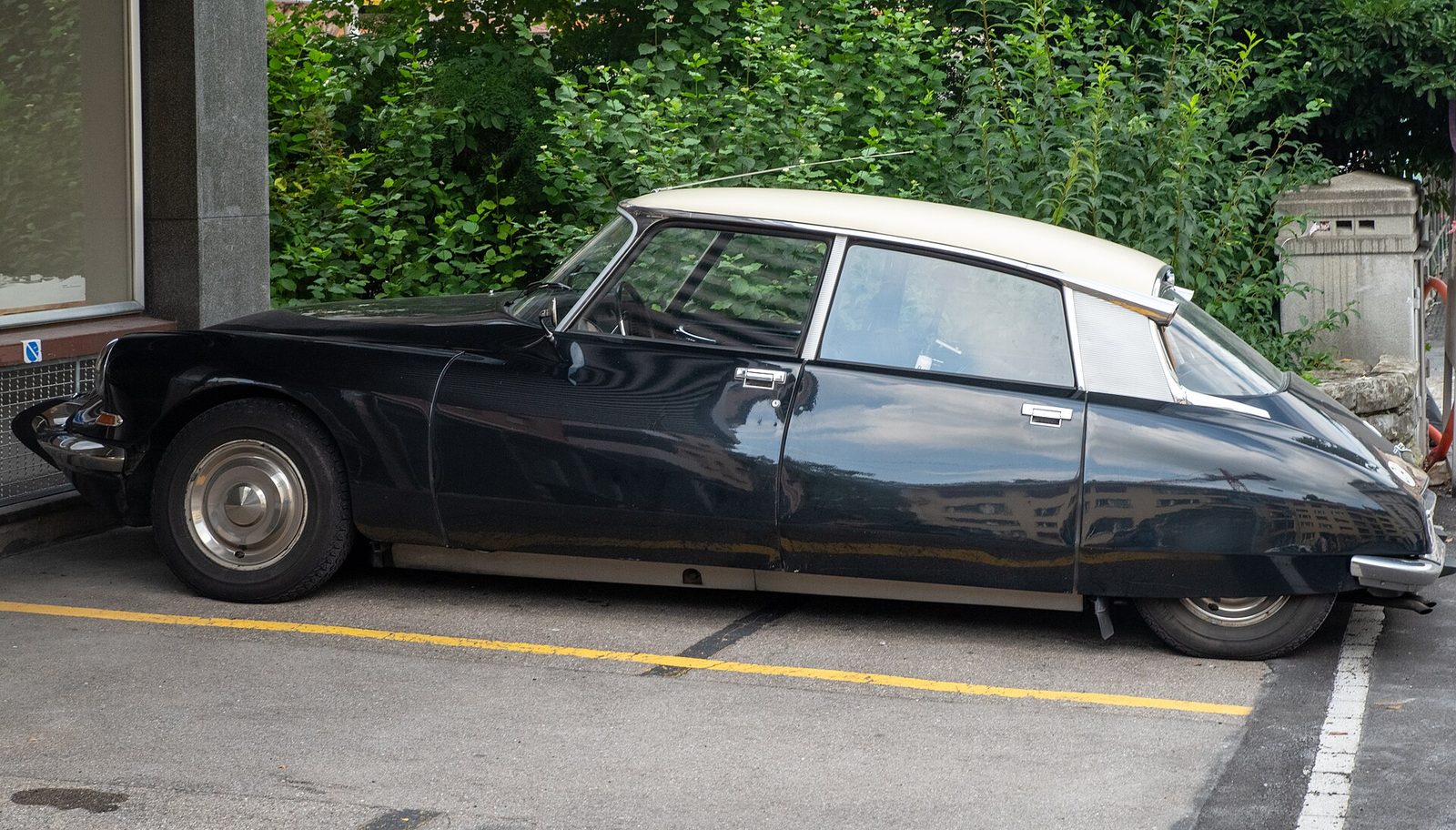
The Citroen DS (1955-1975) replaced the Traction Avant after a program running intermittently since before the war. Andre Lefebvre laid the car out with front-wheel drive and a much wider front than rear track, Flaminio Bertoni shaped a body not settled until weeks before launch, and Paul Mages supplied the hydropneumatic system that fed suspension, brakes, steering and gearchange from one high-pressure circuit. Shown at the Paris Salon in October 1955, it took tens of thousands of deposits inside a week. A cheaper ID 19 followed, a Break estate arrived in 1958, and Henri Chapron built the factory-authorized Decapotable alongside coupes sold on his own account. Engines grew from 1,911 cc to 2,347 cc, and Robert Opron's late-1967 restyle put four lamps behind glass with the inner pair steered by cable - a feature American lighting law would not accept.
History
A Program That Predated the Peace
The DS came out of Citroen's Voiture a Grande Diffusion project, begun under Pierre-Jules Boulanger in the late 1930s and carried on quietly through the occupation alongside the work that became the 2CV. Andre Lefebvre, chief engineer on the Traction Avant, set the architecture: front-wheel drive, integral body-frame construction, and front and rear tracks of deliberately different width to shrink the turning circle. Flaminio Bertoni did the body, and did it late - the exterior was not signed off until weeks before the show, because Pierre Bercot wanted the shape to look as unusual as the engineering underneath. The third name is Paul Mages, whose 1942 proposal for a self-adjusting suspension run from a central high-pressure circuit was taken up by Boulanger over the objections of more senior men, and was running on a Traction by 1949.
October 1955
The DS 19 was shown at the Paris Salon in October 1955, and the sources do not agree on the day: Wikipedia says the 6th, while Ate Up With Motor, Motoring Research and Conceptcarz say the 5th. Nor do they agree on the arithmetic of the reception. Wikipedia and Conceptcarz record 743 orders in the first fifteen minutes and 12,000 by the end of the first day, with Wikipedia putting 80,000 deposits across the show's ten days; Motoring Research gives over 700 in the opening minutes and 79,000 by the close. What arrived was a car with powered brakes and steering, a hydraulic semi-automatic gearbox, inboard front discs and suspension that levelled itself, on a platform carrying unstressed bolt-on panels, an aluminum hood and a fiberglass roof.
The Cheap One, the Estate, the Cabriolet
The complexity was expensive, so Citroen made a simpler version. The ID 19 - dated 1956 by Motoring Research and 1957 by Ate Up With Motor and Petrolicious - kept the hydropneumatic suspension but replaced the power steering and hydraulic clutch with conventional items and used a detuned engine that sources put at 66 or 69 hp. From 1958 there was an estate, Break in France and Safari or Estate in Britain, with a steel roof in place of the sedan's fiberglass so a loaded rack could be carried, seven seats in Familiale form, and DS brakes even where the rest of the car was ID. Henri Chapron built a cabriolet on his own initiative in 1958; Citroen relented and had him build factory cars from 1960, sold through its dealers on a reinforced platform with doors four inches longer than the sedan's. Chapron also sold coupes on his own account - the Concorde, the Le Dandy - at roughly twice the price of a standard DS.
Bigger Engines and Opron's Nose
A five-bearing 2,175 cc engine arrived for 1965 as the DS 21, with a 1,985 cc DS 20 beneath it. A conventional manual gearbox had become available in 1963; a five-speed followed in September 1970 and a Borg-Warner automatic in September 1971. The hydraulic fluid changed from hygroscopic, corrosive LHS to green mineral LHM, with sources placing the switch variously at 1966, 1967 and 1968. In late 1967, for the 1968 model year, Robert Opron reworked the front: four lamps behind a glazed cowl, the inner pair swivelling with the steering. Bosch electronic fuel injection reached the DS 21 for 1970, and in 1972-73 the 2,347 cc DS 23 topped the range. The ID gave way to the D Special and D Super in 1970.
America, and the End
North America would not take the swivelling lamps. Citroenvie records a rule that no private vehicle may carry an external light whose direction is controlled from inside the car, and a 1 January 1971 deadline after which any new Citroen entering the United States or Canada needed a fixed, unshielded system; American cars ran four exposed sealed beams instead. Citroen announced in 1970 that meeting North American safety standards had become uneconomic. Production ended at Paris on 24 April 1975, by which time Citroen had passed to Peugeot.
Common Problems
The hydraulic system is not fragile, but it is unforgiving of neglect and of the wrong fluid. Spheres lose their nitrogen charge and are generally treated as a five-yearly item; a failed diaphragm means replacement rather than recharging. Corroded high-pressure pipework is routine, and the Citroen Car Club notes that when pressure is lost the system sheds functions in a defined order - steering assistance first, with warning, then suspension, then brakes. Early LHS fluid is hygroscopic, corrosive and prone to leaking, which is why so many surviving early cars have been converted. Engines are long-lived, with Petrolicious quoting 150,000 miles between rebuilds, but timing chains stretch and replacement is an engine-out job, camshaft seals leak at the distributor base, and Classics World reports big-end failure as most common on the 2,347 cc unit. Manual boxes crunch their synchromesh and five-speeds whine as the bearings dry. The BVH semi-automatic suffers internal leaks that make it jump out of second or third and a leaking selector plate that puts LHM into the gear oil.
What to Look For
Structure first, because the D-series hides its corrosion behind bolt-on panels that come off easily and tell you little until they do. Classics World singles out sills, trunk floor, roof gutters where water traps and rots from the inside, and the area carrying the trailing arm mounts, and notes cracking around the front wishbone carrier bolts with repair quoted between GBP 200 and GBP 2,000. Petrolicious adds the lower rear corners of the front wings, door bottoms and the bodywork below faired-in headlamps, and warns that the aluminum hood can crack down the center. On the hydraulics, listen to the pump: Classics World describes a tick roughly every thirty seconds as normal and anything more frequent as a leak, and says a car pushed down at each corner should sink willingly and rise softly, a firm response pointing at spent spheres. A permanently sagging car is a leak until proved otherwise. Establish which fluid the car is on and that it has never been mixed, because LHS and LHM use different seals and converting means replacing every unit and seal rather than topping up. Compression should read 120 to 140 psi per cylinder. On Pallas cars, confirm the moldings and trim are present: small trim pieces are the hardest parts to find.
Market Notes
As of August 2026, classic.com gives an average Citroen DS sale price of $62,630 and a lowest recorded sale of $1,350 for a 1970 DS 20 on 28 January 2023; the benchmark tile and trend arrow did not render on either fetch, so no benchmark is quoted. Recent results there, all as of August 2026, run from a 1965 DS 21 Concorde at $95,200 on 14 August 2026 through a 1972 DS 21 Pallas at $35,000 on 6 August 2026 to a 1973 DS 23 Cabriolet at EUR 33,800 on 3 August 2026. Classic Trader, read in August 2026, showed 31 cars advertised from GBP 13,602 for a 1973 DS 20 to GBP 178,800 for a 1967 DS 21 Chapron, and a mainstream band of roughly EUR 20,000 to EUR 60,000 for sedans. Magneto's guide, read in August 2026, prices a 1971 DS 21 Pallas at GBP 11,300 fair, GBP 17,600 good, GBP 27,500 excellent and GBP 39,600 concours. Coachbuilt cars trade separately: RM Sotheby's sold Chapron Decapotables for $291,000 at Monterey 2021, $268,800 at Arizona 2022, $246,400 from the Elkhart Collection and EUR 195,500 at Paris 2023, and Artcurial sold a 1962 Concorde for EUR 153,120 at Retromobile in February 2017 and a 1965 Le Dandy for EUR 262,240 at Retromobile 2018. The lot pages print the sale name and result but not the date.
Where sources differ
Total D-series production is given as 1,455,746 by Wikipedia, Ate Up With Motor, Conceptcarz and Motoring Research, but the citroen-ds-id.com registry table sums to 1,456,115; no grand total is asserted here.
Four sources state 1,455,746. The citroen-ds-id.com year-by-year table sums to 1,456,115 and separately offers an adjusted 1,376,631 over seventeen years, citing no source for either. The 369-car difference is not explained by any source consulted here, so productionTotal is left null.
The number of factory-authorized Chapron Decapotables is not settled, with published counts of 1,365, fewer than 1,400, approximately 1,400 and 1,325 plus 287.
RM Sotheby's Monterey and Elkhart catalogs and Motoring Research state 1,365, as 770 DS 19s, 483 DS 21s and 112 ID 19s. RM's own Arizona 2022 catalog states fewer than 1,400 with under 500 DS 21s. Wikipedia states approximately 1,400. citroen-ds-id.com states 1,325 plus 287. No source reconciles these, and the line between factory Usine cars and Chapron's own coachwork is drawn differently by each. Unresolved.
The DS 19 was shown at the Paris Salon in the first week of October 1955 and took tens of thousands of deposits, but the sources disagree on both the date and the count.
Wikipedia gives 6 October 1955, 743 orders in fifteen minutes and 80,000 deposits over ten days. Ate Up With Motor, Conceptcarz and Motoring Research all give 5 October. Conceptcarz repeats 743 and 12,000; Motoring Research gives over 700 and 79,000 by the close; Ate Up With Motor gives more than 80,000 in the first week. Not resolved by any source consulted here.
Quoted power outputs differ between sources for two engines: the ID 19 is given as 69 hp and as 66 hp, and the DS 21's 2,175 cc unit as 106 hp DIN and as 109 hp.
Wikipedia states 69 hp for the ID 19 against 75 hp for the DS 19, and 106 hp DIN for the DS 21. Ate Up With Motor states 66 hp and 109 hp; Conceptcarz and RM Sotheby's Paris 2023 catalog also state 109 hp. No source states which rating standard produced which figure, so no single output is asserted.
The changeover from corrosive LHS hydraulic fluid to green mineral LHM is dated differently by different sources, with North America lagging in any case.
Wikipedia places the switch at the 1967 model year everywhere except the United States and Canada, where it came in January 1969. Classics World draws the line at pre-1967, Magneto at pre-1968 and Petrolicious at pre-1966. The sources agree only that the two fluids use different seals and must never be mixed. Unresolved.
The ID 19 was a cheaper version that kept the hydropneumatic suspension but used conventional steering, clutch and gearchange with a detuned engine; sources date its introduction to either 1956 or 1957.
Motoring Research dates the ID 19 launch to 1956. Ate Up With Motor and Petrolicious both date it to 1957. Wikipedia describes the ID's specification without stating a launch year in the material retrieved. Not resolved by any source consulted here.
Sources
- Citroen DS, Wikipedia · encyclopedia
- Deesse Ex Machina: The Remarkable Citroen DS, Ate Up With Motor · specialist
- Citroen DS - Model Information, Conceptcarz · reference-book
- DS/ID production numbers, Citroen DS/ID and XM Web-Site · registry
- Citroen DS - Photos, details et equipements, Citroen (Citroen Origins heritage site) · manufacturer
- Road Test - The Latest Citroen DW, Motor Sport · journalism
- French Goddess: the history of the Citroen DS, Motoring Research · journalism
- Why Citroen's steerable headlights were banned from North America, Citroenvie · specialist
- Hydraulic Suspension, Citroen Car Club (UK) · club-forum
- Citroen DS buyer's guide, Classics World · journalism
- 1955-1978 Citroen DS buying guide from Magneto magazine, Magneto · journalism
- Citroen DS Buying Guide, Petrolicious · journalism
- Citroen DS Market, classic.com · market-data
- Citroen DS Classic Cars for Sale, Classic Trader · market-data
- 1970 Citroen DS 21 Decapotable by Chapron, Monterey 2021, RM Sotheby's · auction-house
- 1966 Citroen DS 21 Decapotable by Chapron, The Elkhart Collection, RM Sotheby's · auction-house
- 1967 Citroen DS 21 Decapotable by Chapron, Arizona 2022, RM Sotheby's · auction-house
- 1965 Citroen DS 21 Decapotable by Chapron, Paris 2023, RM Sotheby's · auction-house
- 1962 Citroen DS Concorde par Chapron, Retromobile 2017, Artcurial · auction-house
- 1965 Citroen DS 21 Coupe Chapron Le Dandy, Retromobile 2018, Artcurial · auction-house
Synthesized from the sources above and cross-checked. We cite and link out; we do not republish other databases verbatim.
Fully Sorted is an independent publisher and is not affiliated with, endorsed by or sponsored by Citroen. Citroen and the model names on this page are trademarks of their respective owners and are used here only to identify the cars being described.
Chassis register
Nobody has recorded a car here yet. Own one, or know one? Chassis number, what you can prove about it, and a source if there is one. Every entry is reviewed before it appears.
Nerd Notes
What owners know that the sources don't. Every note is read and checked before it appears here.
Key Specs
- Power
- 75 hp at 4,500 rpm (DS 19) to 141 hp SAE / 130 hp DIN (DS 23 injection); DS 21 quoted at either 106 hp DIN or 109 hp
- Brakes
- Inboard front discs, rear drums; powered high-pressure system on DS and on the Break, conventional master cylinder on early ID
- Engine
- Four-cylinder OHV gasoline only, in 1,911, 1,985, 2,175 and 2,347 cc; never a six-cylinder
- Layout
- Front-mounted longitudinal four-cylinder, front-wheel drive, front track wider than rear
- Torque
- No torque figure appears in any source fetched for this entry; none is asserted
- Weight
- 3,051 lb quoted by Wikipedia for the estate; no sedan curb figure recovered
- Chassis
- Steel platform base unit carrying unstressed bolt-on outer panels; aluminum hood, fiberglass sedan roof. Two exposed headlamps to 1967, four behind a glazed cowl after, inner pair cable-steered
- Steering
- Rack and pinion, powered on DS and unassisted on ID; 2 7/8 turns lock to lock, 37-foot turning circle on the 1964 DW
- Top speed
- About 100 mph recorded by Motor Sport on a 1.9-liter DW in 1964; 108 mph published for the DS 21
- Hydraulics
- One engine-driven high-pressure circuit for suspension, brakes, steering and gearchange; 17.2 MPa (2,490 psi) per Wikipedia, 2,400 psi per Petrolicious
- Suspension
- Self-levelling hydropneumatic front and rear, nitrogen-charged spheres with rubber diaphragms separating gas from fluid, driver-selectable ride height
- Acceleration
- Under 16 seconds 0-62 mph for the DS 21 and under 11 seconds for the injected DS 23 per Ate Up With Motor; no measured figure recovered
- Transmission
- Four-speed hydraulic semi-automatic from launch; manual from 1963; five-speed from September 1970; Borg-Warner 35 automatic on DS 21 and DS 23 from September 1971
Notable Variants
DS 19 (1955-1965)
The launch specification: 1,911 cc, 75 hp at 4,500 rpm, powered steering and brakes, hydraulic semi-automatic, corrosive LHS fluid and, until 1960, 6-volt electrics.
ID 19 (1956 or 1957, depending on source)
The cheap one: hydropneumatic suspension kept, but conventional steering, clutch and gearbox and 66 or 69 hp. In later D Special and D Super form, the version buying guides recommend.
Break / Safari / Familiale (from 1958)
Steel roof in place of the sedan's fiberglass so a loaded rack could be carried, seven seats in Familiale form, and DS brakes even where the rest of the car was ID.
DS 21 (1965-1972)
The 2,175 cc five-bearing engine, open lamps to 1967 and the glazed four-lamp nose after; 108 mph per Motoring Research, with Bosch injection from 1970.
DS 23 and DS 23 Injection Electronique (1972-1975)
The last and largest engine at 2,347 cc, 115 hp carbureted and 141 hp SAE injected. Classics World reports big-end failure as most common on this unit.
Pallas (from 1965)
The luxury level: extra moldings, better seats and, where fitted, air conditioning. Check the moldings are present, because Pallas badging outlives Pallas trim.
Decapotable Usine by Henri Chapron (1960-1971)
The factory-authorized convertible, reinforced and with doors four inches longer than the sedan's. RM Sotheby's records 40 DS 21 cabriolets for 1970; the last was completed in 1978.
Chapron catalog coachwork (Le Dandy, Concorde)
Built on Chapron's own account rather than for Citroen, at roughly double a standard DS. Artcurial gives 37 or 38 Concordes and fewer than 50 Le Dandys.
Value Trajectory
The DS spent decades as a cheap and slightly forbidding used car, and the spread in today's figures still shows it: as of August 2026 classic.com's lowest recorded sale is $1,350 for a 1970 DS 20 in January 2023, against a $62,630 average across all body styles - a gap that says more about what has been thrown away than about what survives. The sedan market has settled rather than surged. Classic Trader's August 2026 listings put usable DS 20, DS 21 and DS 23 cars in a EUR 20,000 to EUR 60,000 band, and Magneto's August 2026 guidance for a 1971 DS 21 Pallas tops out at GBP 39,600 for concours, well below where the coachbuilt cars sit. Chapron bodies have moved on a different curve, with RM Sotheby's Decapotable results between $246,400 and $291,000 across four sales. The result is a market in two halves: a sedan and estate sector where condition and hydraulic history set the price, and a coachbuilt sector where authenticating factory rather than aftermarket conversion is the whole argument.
Next
Shopping for one?
Browse Citroen listings, or decode a VIN before you buy.