
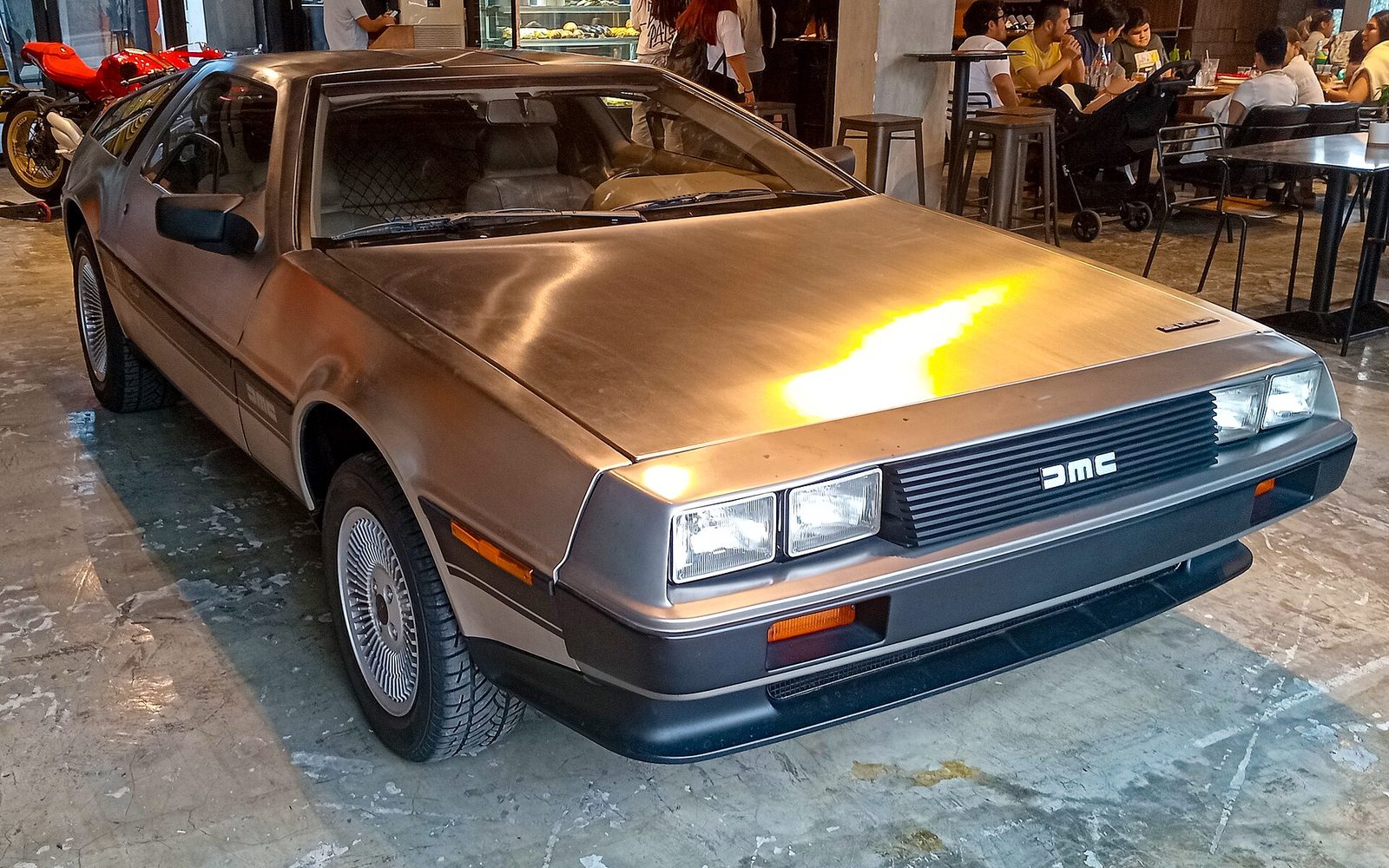
The DeLorean DMC-12 is one of the most instantly recognizable cars ever built: a wedge-shaped, Giorgetto Giugiaro-designed coupe wrapped in unpainted brushed stainless steel and fitted with dramatic gullwing doors. Underneath the spaceship looks sat a far more ordinary reality - a rear-mounted 2.85L PRV V6 making only about 130 hp (US spec), giving performance that never matched the car's futuristic presence. Built in Northern Ireland from 1981, the DMC-12 was the singular vision of ex-GM executive John Z. DeLorean, whose company collapsed spectacularly in 1982 amid financial crisis and his own drug-trafficking arrest. Roughly 8,975 were made before the factory closed. What could have been a footnote instead became a global icon in 1985 when the DeLorean starred as the time machine in Back to the Future. Today it enjoys a devoted enthusiast following and unusually strong parts support, making it one of the more ownable 'exotic-looking' classics.
DMC-12
1981-1983
8,975 built · Coupe (gullwing)
How rare is it?
With about 8,975 built, the DeLorean DMC-12 is rarer than a DeLorean (~9k) yet more common than a F40 (~1k).
Approximate total production placed on a log scale against well-known reference cars, for scale only. Figures and any disputes are detailed in the production notes and sources.
History
A star executive's gamble
John Z. DeLorean was a celebrated General Motors engineer and executive who left to build his own 'ethical' sports car. His DeLorean Motor Company set out to produce a stylish, safety-minded coupe aimed at the American market, and secured substantial UK government financial incentives to build the factory in Dunmurry, near Belfast, Northern Ireland - a site chosen partly to bring jobs to a region hit by economic and political turmoil.
Design and engineering
The body was styled by Giorgetto Giugiaro of Italdesign, giving the car its crisp wedge profile, and it was finished in unpainted, brushed 304-grade stainless steel - a signature that resists rust and needs no repaint. The gullwing doors added theater. Engineering was troubled until Lotus founder Colin Chapman was brought in to make the car buildable; the result used a steel backbone chassis with a fiberglass underbody and stainless panels on top, echoing Lotus practice. Power came from the co-developed Peugeot-Renault-Volvo (PRV) 2.85L V6 mounted behind the rear axle, producing only around 130 hp in US trim. The striking looks wrote a check the underpowered drivetrain couldn't cash.
Collapse and arrest
Production began in 1981, but quality problems, a soft market, and severe cash shortages quickly overwhelmed the company. In October 1982 it entered bankruptcy. That same year John DeLorean was arrested in an FBI sting on drug-trafficking charges - a desperate attempt, he claimed, to save the firm. He was later acquitted on grounds of entrapment, but the company was already finished. Around 8,975 cars had been built.
From flop to icon
The DeLorean's second life began in 1985 when Back to the Future cast it as Doc Brown's flux-capacitor time machine. The film franchise cemented the car's pop-culture immortality, transforming a commercial failure into one of the most beloved and photographed cars in the world.
Common Problems
The PRV V6 is fundamentally durable (capable of very high mileage) but the surrounding systems cause most grief: fuel-delivery blockages and brittle injector pipes in the K-Jetronic system, corroded electrical sensors and connectors from long storage, marginal factory cooling (aging radiators, cracked plastic header tanks) leading to overheating, and weak front lower ball joints. Gullwing door struts/torsion bars weaken and let doors sag. The epoxy-coated steel chassis can rust where the coating fails. Dashboards crack in cars from hot climates, and sticky throttles and general build-quality quirks reflect the rushed, financially strained factory. Parts support is a major saving grace: DeLorean Motor Company (DMC) in Houston, Texas acquired the original parts inventory and remanufactures components, so most parts remain readily available.
What to Look For
Inspect the steel backbone chassis carefully: the original frame was epoxy-coated mild steel, and where that coating has cracked, rust can form despite the rust-proof stainless skin. Check the brushed stainless panels for dents and clumsy prior repairs (they can be refinished but not easily filled). Confirm the gullwing doors open, close, and seal correctly and that the torsion bars/struts still hold them up. Test all electrics - many cars sat unused, causing terminal corrosion, window, mirror, and central-locking faults. Verify the Bosch K-Jetronic fuel injection runs cleanly and check for brittle plastic injector pipes, cooling-system upgrades (original radiator/fans are weak), dashboard cracks, and worn front lower ball joints. Documented service history and known provenance add value.
Market Notes
As of mid-2025, the DMC-12 sits in a stable, gently rising enthusiast market rather than a speculative one. Hagerty placed the DeLorean on its 2025 Bull Market List, describing it as 'gradually transitioning from 1980s oddity to full-on classic,' with condition-based values around #1 $101,000, #2 $75,100, #3 $52,300, and #4 $34,500. Marketplace listings tracked by classic.com through late 2025 show a broad spread: project cars in the $25,000 - $33,000 range, solid drivers roughly $40,000 - $65,000, and exceptional or upgraded examples reaching $77,000 to well over $100,000 for custom builds. Manual cars typically edge out automatics. Because so many DeLoreans led pampered, low-mileage lives, genuinely nice examples are relatively plentiful, which keeps the market accessible for an exotic-looking classic.
Where sources differ
Approximately 8,975 DeLorean DMC-12s were built in Dunmurry, Northern Ireland, with production running 1981-1982 (some 1983 designations).
Sources give figures around 8,975 and often round to 'roughly 9,000'; exact totals vary slightly by source and there is no single authoritative registry.
An estimated ~6,500 DeLoreans survive today.
The ~6,500 figure is an estimate (cited as of 2015) rather than a verified count from a formal registry; survivor numbers are approximate.
Sources
- DMC DeLorean, Wikipedia · reference-book
- 2025 Bull Market List (DeLorean DMC-12), Hagerty · journalism
- DeLorean DMC-12 Market, classic.com · registry
- DeLorean DMC-12 buyer's guide: what to pay and what to look for, Classic & Sports Car · journalism
- DeLorean DMC-12 – The Essential DMC Buying Guide, Silodrome · journalism
Synthesized from the sources above and cross-checked. We cite and link out; we do not republish other databases verbatim.
Fully Sorted is an independent publisher and is not affiliated with, endorsed by or sponsored by DeLorean. DeLorean and the model names on this page are trademarks of their respective owners and are used here only to identify the cars being described.
Chassis register
Nobody has recorded a car here yet. Own one, or know one? Chassis number, what you can prove about it, and a source if there is one. Every entry is reviewed before it appears.
Nerd Notes
What owners know that the sources don't. Every note is read and checked before it appears here.
Key Specs
- Doors
- Gullwing, torsion-bar/gas-strut assisted
- Power
- ~130 hp (US spec); European versions ~155 hp
- Engine
- 2.85L PRV SOHC V6, rear-mounted
- Layout
- Rear engine, rear-wheel drive; steel backbone chassis (Lotus-derived) with fiberglass underbody and brushed 304 stainless-steel outer panels
- Torque
- ~153 lb-ft
- Weight
- ~2,700 lb
- 0-60mph
- Claimed ~8.8s (manual); road tests measured ~10.5s
- Designer
- Giorgetto Giugiaro / Italdesign
- TopSpeed
- Claimed ~130 mph; tested closer to ~110 mph
- FuelSystem
- Bosch K-Jetronic mechanical fuel injection
- BasePriceNew
- ~$25,000 (1981)
- Transmission
- 5-speed manual or 3-speed automatic
Notable Variants
5-speed manual
Standard transmission; slightly quicker, generally preferred by enthusiasts.
3-speed automatic
Roughly $650 option when new; blunts already-modest performance.
Gold-plated DMC-12
A promotional gold-plated edition was planned; only a handful were actually produced, making them curiosities rather than a real production trim.
Value Trajectory
Once dismissed as a kitschy 1980s curiosity, the DMC-12 has appreciated steadily and gained collector legitimacy, helped enormously by enduring Back to the Future fame and its inclusion on Hagerty's 2025 Bull Market List. Values have firmed into a stable band - mid-$30,000s for rougher cars up to roughly $100,000+ for the very best or custom examples - with manuals and low-mileage originals leading. Excellent parts availability, a passionate community, and a fixed, small production run underpin long-term demand. The outlook is one of continued gradual appreciation rather than dramatic spikes, keeping the DeLorean an attainable entry into visually exotic classic ownership.
Next
Shopping for one?
Browse DeLorean listings, or decode a VIN before you buy.