
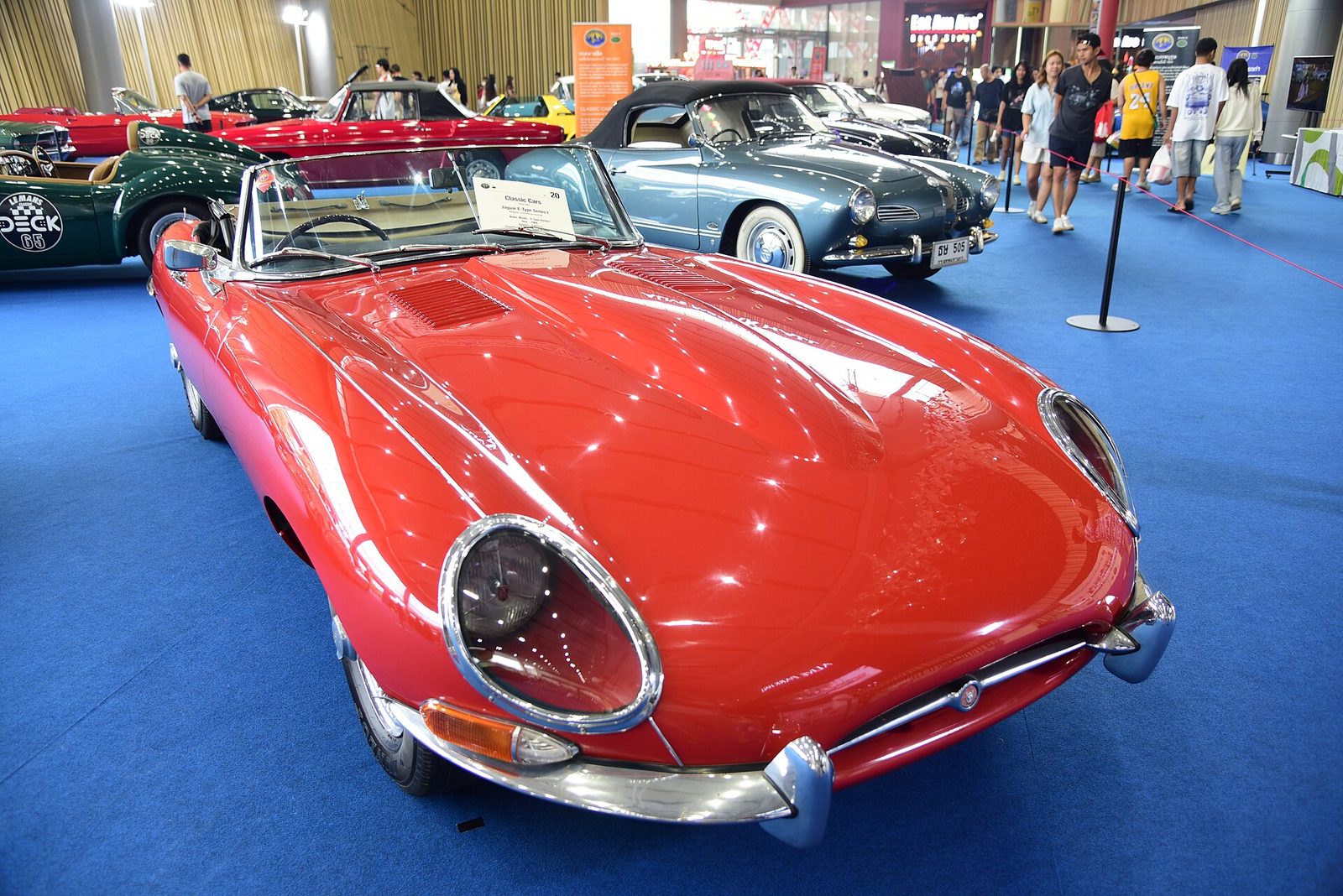
The Jaguar E-Type Series 1 (1961-1968) put racing-derived engineering under a body drawn by an aerodynamicist and sold it for a fraction of what a comparable Ferrari cost. William Heynes began the project in December 1956, and the E1A and E2A prototypes carried D-Type monocoque thinking into a road car. The production version combined a steel monocoque and bolted tubular front subframe with the 3,781 cc XK six, three SU HD8 carburetors, four-wheel disc brakes mounted inboard at the rear and rack-and-pinion steering. It was shown at Geneva in March 1961 and reached American showrooms at $5,595 for the roadster, and the press promptly recorded 149 and 150 mph in cars that were probably not to standard tune. Over seven years it gained a 4.2-liter engine and a gearbox worthy of it, grew a longer-wheelbase 2+2 body, and finally lost its headlamp covers to American regulation. Something close to 38,400 Series 1 cars were built, the large majority left-hand drive.
History
From D-Type to Production Car
Work began under technical director William Heynes in December 1956, three years before there was a car to show. E1A was completed in May 1957: shorter than the production car at fourteen feet two inches, built around a central monocoque tub in the D-Type manner but with a new independent rear end. E2A followed with a 2,997 cc racing XK six and went to Briggs Cunningham for Le Mans in 1960, where it failed to finish. Malcolm Sayer, an aerodynamicist who joined Jaguar in 1950, shaped the open car; Lyons and Bob Blake settled the coupe's roof. Bob Knight's rear suspension - lower wishbones, twin coil-spring damper units each side, the assembly in a detachable cage - is the piece of engineering that dates least.
Geneva, March 1961, and the 150 mph Question
The car was announced at Geneva on 14 March 1961, export first, the British market following in July. Two press cars did the work: 9600 HP, the seventh prototype and a fixed-head coupe, driven to Geneva overnight by Bob Berry; and 77 RW, the roadster Norman Dewis was called from MIRA to bring through the night once demonstration rides were needed. The Motor timed 77 RW at 149.1 mph with 0-60 mph in 7.1 seconds; Autocar took 9600 HP to Belgium and published 150.4 mph mean, 151.7 mph best and 0-60 in 6.9 seconds on 24 March 1961. Those figures made the car's reputation and are not straightforwardly reproducible. Dewis's own testing had recorded 143 mph on the M1 and 142 mph at MIRA in January 1961; when 9600 HP was later stripped its cylinder head proved gas-flowed and matched to the manifolds; and Maurice Smith, who ran the Autocar test, is reported to have said he never saw more than 137 mph from his own 3.8.
Flat Floors, Outside Latches and the Early-Car Hierarchy
The features that now set the price of an early E-Type were, at the time, faults being corrected. The first cars had unrecessed footwells - the flat floors - and were desperately short of legroom; Jaguar pressed depressions into the floors either side of the transmission tunnel. They also had hood latches outside the body and louvers welded in as a discrete panel rather than pressed into the skin. Sources do not agree on the dating. Wikipedia treats them as one event and says the first 500 cars had flat floors and external latches; Classic & Sports Car separates them, putting internal locking in October 1961 and lowered floors in February 1962. That matters commercially: the trade sells flat floors, outside hood locks and welded louvers as three distinct premiums.
The 4.2 and the 2+2
In October 1964 the 3.8 gave way to a 4,235 cc engine, the block lengthened to take bores five millimeters larger. Peak power was unchanged at a claimed 265 hp, now at 5,400 rpm, but torque rose from 240 to 283 lb-ft. More consequential were the ancillaries: the Moss gearbox, with no synchromesh on first, gave way to Jaguar's own all-synchromesh four-speed; an alternator replaced the dynamo; the brake servo and seats improved. Autocar recorded 153 mph from a 4.2 coupe in 1965. In March 1966 came the first change to Sayer's shape: the 2+2, wheelbase stretched from eight feet to eight feet nine inches, doors eight and a half inches longer, the roof raised towards the back. Motor Sport tested one that April and called it, accurately, a two-seater with room for one or two more rather than a four-seater.
Series 1.5: Federal Regulation Arrives
For the 1968 model year Jaguar spent heavily adapting the car to American rules. The glazed headlamp fairings went, the lamps moving forward two and a half inches; toggle switches became black rockers; and US cars took twin Zenith-Stromberg carburetors in place of the triple SUs, claimed output falling to 246 hp. Jaguar issued no new designation and went on calling these Series 1. 'Series 1.5' is an enthusiast coinage applied afterwards, and the register community has never settled on where it begins.
Common Problems
Corrosion is the defining fault and the expensive one. Restoration is complicated further because the cars were hand-finished and no two shells are dimensionally identical, so replacement panels rarely drop into place. Monocoque Metalworks, a US shell specialist, is blunt that reproduction hood panels are poorly built and need considerable adjustment, and puts a new lower valance alone at $1,400 or more; ECD Auto Design put a frame-off E-Type restoration by a reputable shop at $60,000 to $200,000 in 2025. On the XK six, coolant staining and emulsified oil under the filler cap point to head gasket failure; a healthy engine should show around 40 to 45 psi at 3,000 rpm. Light rattling from the front indicates worn timing chains and tensioners. Weeps from the crankcase seals are normal rather than terminal, but the rear seal is an engine-out job. Owners on the Jag-lovers forum report complete XK rebuilds by American shops between $12,000 and $20,000 depending on the shop and the standard asked for. The Moss gearbox on the 3.8 has no synchromesh on first and can need two hands to find reverse, though E-Type manual boxes are durable. Rear discs sit inboard, so changing them means dropping the whole rear suspension cage, a job charged by the day rather than the part. Rusty subframes, worn hubs and universal joints, tired dampers and perished bushes are the usual rear-end complaints. Cockpit heat was a criticism when the cars were new, Motor Sport finding the handbrake and gear lever uncomfortably hot in 1966.
What to Look For
Structure decides the price, and on a monocoque with a bolted-on front subframe the structure is most of the car. The front bulkhead and the mountings for the engine frame rails are the critical area, followed by inner and outer sills, floor pans - especially vulnerable on roadsters - door bottoms, rear arches, trunk floor, rear valance and the rear radius arm mountings. Hood seams behind the chrome trim and coupe tailgate seams hide corrosion well. A Jaguar Daimler Heritage Trust certificate records the chassis, engine, body and gearbox numbers as built, the color and trim, the build and dispatch dates and the destination. The Trust is explicit that it does not inspect cars and that the certificate confirms nothing about identity, provenance, originality or condition: it establishes what left Browns Lane, not what is in front of you. Restamped components are a live issue on high-value early cars, one RM Sotheby's catalog describing a flat-floor roadster that had received a new block and head restamped with factory-correct numbers during an otherwise fully documented restoration. On early cars, flat floors, external latches and welded rather than pressed louvers are worth verifying individually against the chassis number; the three did not all change at the same moment, and the trade prices each one.
Market Notes
All figures below are as of September 2026. classic.com records an average sale of $151,103 across Jaguar E-Type Series 1 cars, with 57 listed for sale. Its benchmarks separate sharply by body: the Series 1 Roadster benchmark stands at $121,781 and the Series 1 Coupe at $81,576, both marked as trending downward. The coupe's average sale is $81,874, over a range running from $9,000 for a 1963 conversion project in August 2024 to $179,995 for a 409-mile 1964 car in July 2026. The roadster's average sale of $210,275 sits well above its own benchmark, which is what a market with a long tail of exceptional cars looks like. 'Flat Floor (1961-1962)' is tracked as a separate category, six cars listed, average sale $139,075, with a 1962 roadster at $140,000 in June 2026 and asking prices running to $450,000. Auction evidence follows the same hierarchy. RM Sotheby's sold chassis 875157, a flat-floor 3.8 roadster with outside hood latches and hand-welded louvers, delivered new through Jaguar Cars of New York, for $324,000 at Monterey in August 2025. The same house offered chassis 875256, a comparable flat-floor car whose restoration involved a replacement block and head restamped to factory-correct numbers, at Monaco in 2024 against an estimate RM published as $185,000 to $220,000; it did not sell.
Where sources differ
The published 150 mph press figures were recorded on cars that were probably not in standard tune. The Motor timed 77 RW at 149.1 mph and Autocar published 150.4 mph mean and 151.7 mph best for 9600 HP on 24 March 1961, but Dewis's own development testing had reached only 143 mph on the M1 and 142 mph at MIRA in January 1961, 9600 HP was later found to have a gas-flowed head matched to its manifolds, and the Autocar tester Maurice Smith is reported never to have exceeded 137 mph in his own 3.8.
Wikipedia reports the period figures of 149.1 mph and 150 mph without qualification. AROnline and Ate Up With Motor both state that press cars had more power than standard tune, citing the gas-flowed head found in 9600 HP and Maurice Smith's own 137 mph maximum. Whether a standard production 3.8 could reach 150 mph is not resolved by any source consulted here.
Series 1 production is variously given as 38,419 cars and 38,423 cars, and no single total is asserted here. Wikipedia tabulates 15,498 3.8-liter cars, 16,195 Series 1 4.2-liter cars and 6,726 Series 1.5 cars; the XKEdata register's chassis ranges sum instead to 15,502, 16,201 and 6,720; and the Jaguar Daimler Heritage Trust publishes chassis ranges with no totals at all.
Wikipedia states 38,419 Series 1 cars, broken down as 15,498 / 16,195 / 6,726. XKEdata's published chassis ranges yield 15,502 / 16,201 / 6,720, or 38,423. The Heritage Trust guide gives ranges only, closing the left-hand-drive 3.8 roadster run at 881886 against XKEdata's 881887 and the left-hand-drive 3.8 coupe run at 890872 against 890873. The discrepancy is not explained by any source consulted here, so productionTotal is left null.
The point at which Series 1.5 production begins is contested and Jaguar never used the designation, so any split of the 4.2-liter cars between Series 1 and Series 1.5 rests on a boundary the factory did not draw.
XKEdata assigns Series 1.5 to chassis 1E1864 onwards for right-hand-drive roadsters and equivalent points in the other ranges, while stating openly that the exact number where they start 'is a hot subject'. The Jaguar Drivers' Club register describes the whole 1961-1968 run as Series 1 and recognizes no Series 1.5. Wikipedia treats Series 1.5 as the 1968 model year cars. There is no factory designation to arbitrate between them.
The earliest cars had unrecessed flat floors, hood latches on the outside of the body and hood louvers welded in as a discrete panel, but sources disagree on when and whether these features changed together.
Wikipedia states that the first 500 Series 1 cars had flat floors and external hood latches, treating the two as a single change. Classic & Sports Car dates them separately, putting internal locking in October 1961 and lowered floors in February 1962, several months and several hundred cars apart. RM Sotheby's catalogs describe individual cars carrying all three features together but state no production count for any of them. The dating is not resolved by any source consulted here.
Sources
- Jaguar E-type (RG001F, v.3, 25-01-2023), Jaguar Daimler Heritage Trust · manufacturer
- Heritage Certificates - Archive Services, Jaguar Daimler Heritage Trust · manufacturer
- XKE Data - Catalog - Car Numbers, XKEdata.com · registry
- The E-Type Register, Jaguar Drivers' Club · club-forum
- Jaguar E-Type, Wikipedia · encyclopedia
- Jaguar E-type - the full story, AROnline · specialist
- Top Cat: The Jaguar E-Type, Ate Up With Motor · specialist
- Jaguar E-type Series 1 (9600 HP) road test, Prestige & Performance Car · journalism
- The Jaguar E-type 2+2, Motor Sport · journalism
- Jaguar E-type S1, S1.5 & S2 buyer's guide, Classic & Sports Car · journalism
- Jaguar E-type S1 & S2 buyer's guide, Classics World · journalism
- Jaguar E-Type Series 1 Market, classic.com · market-data
- Jaguar E-Type Series 1 Coupe Market, classic.com · market-data
- Jaguar E-Type Series 1 Roadster Market, classic.com · market-data
- Jaguar E-Type Series 1 Flat Floor Market, classic.com · market-data
- 1961 Jaguar E-Type Series 1 3.8-Liter Roadster, Monterey 2025, RM Sotheby's · auction-house
- 1961 Jaguar E-Type Series 1 3.8-Liter Roadster, Monaco 2024, RM Sotheby's · auction-house
- Jaguar E-Type values are making a comeback, Hagerty Media · journalism
- XK Engine Rebuild Cost, Jag-lovers Forums · club-forum
- The Cost Breakdown to Restore a Jaguar E-type in 2025, ECD Auto Design · specialist
- E-Type Bonnet Restoration, Monocoque Metalworks · specialist
Synthesized from the sources above and cross-checked. We cite and link out; we do not republish other databases verbatim.
Fully Sorted is an independent publisher and is not affiliated with, endorsed by or sponsored by Jaguar. Jaguar and the model names on this page are trademarks of their respective owners and are used here only to identify the cars being described.
Chassis register
Nobody has recorded a car here yet. Own one, or know one? Chassis number, what you can prove about it, and a source if there is one. Every entry is reviewed before it appears.
Nerd Notes
What owners know that the sources don't. Every note is read and checked before it appears here.
Key Specs
- Power
- 265 hp gross SAE claimed at 5,500 rpm (3.8) and 5,400 rpm (4.2) - manufacturer claims, against published net estimates of 180-228 hp; 246 hp claimed for the US Series 1.5
- Brakes
- Four-wheel discs, mounted inboard at the rear to reduce unsprung weight
- Engine
- 3,781 cc XK DOHC straight-six to August 1964; 4,235 cc from October 1964, the block lengthened to take bores 5 mm larger
- Layout
- Front-mounted longitudinal engine, rear-wheel drive
- Torque
- 240 lb-ft on the 3.8, rising to 283 lb-ft on the 4.2, an increase of roughly 18 percent; 263 lb-ft on the US Series 1.5
- Weight
- About 2,770 lb for the open two-seater and 3,090 lb for the 2+2; 2,899 lb quoted for the earliest cars
- Chassis
- Steel monocoque center section with a bolted tubular front subframe carrying engine and front suspension
- Assembly
- Browns Lane, Coventry
- Steering
- Rack and pinion
- Induction
- Three 2 in SU HD8 carburetors; twin Zenith-Stromberg units on US-market Series 1.5 cars
- Wheelbase
- 8 ft (96.0 in (2,438 mm)) on the two-seaters; 8 ft 9 in (2,667 mm) on the 2+2
- Suspension
- Independent front by torsion bars and wishbones; independent rear by lower wishbones with twin coil-spring damper units per side, in a detachable cage
- Acceleration
- 0-60 mph in 7.1 s (The Motor, 3.8 roadster 77 RW, 1961), 6.9 s (Autocar, 3.8 coupe 9600 HP, 1961) and 7.6 s (Autocar, 4.2 coupe, 1965)
- Transmission
- Moss four-speed manual without synchromesh on first to 1964; Jaguar all-synchromesh four-speed from October 1964; Borg-Warner automatic on the 2+2 only, 2.88:1 final drive against 3.07:1 manual
- Launch price us
- $5,595 for the roadster, with the coupe about $300 more
- Top speed tested
- 149.1 mph (The Motor), 150.4 mph mean and 151.7 mph best (Autocar), 153 mph for a 4.2 coupe in 1965 - all on press cars whose standard tune is disputed
Notable Variants
3.8 'outside hood lock' / flat floor (1961-1962)
The earliest cars, with external hood latches worked by a separate key, footwells with no recesses, and louvers welded in as a discrete panel rather than pressed. Sources disagree on when each feature ended and whether they ended together. The most valuable Series 1 configuration.
3.8 Series 1 (1962-1964)
Recessed footwells and internal hood release, but still the Moss gearbox with no synchromesh on first, a dynamo rather than an alternator, and the original brake servo.
4.2 Series 1 (October 1964-1967)
The mechanical high point of the Series 1: the same claimed 265 hp but 283 lb-ft, an all-synchromesh Jaguar gearbox, an alternator, a better brake servo and reclining seats. Quicker in period testing than the 3.8 despite the identical power claim.
2+2 (March 1966-1968)
Wheelbase stretched from 8 ft to 8 ft 9 in, doors 8.5 in longer, windshield 1.125 in taller and the roofline raised. The only Series 1 body offered with a Borg-Warner automatic, and the cheapest way into a Series 1.
Series 1.5 (1967-1968 model year)
Interim federalized cars: headlamp covers deleted and the lamps moved forward, twin Zenith-Stromberg carburetors on US cars with claimed output down to 246 hp, black rocker switches replacing the toggles. Jaguar never used the name; enthusiasts coined it and still argue about where it starts.
Value Trajectory
The Series 1 has spent the last decade splitting into two markets that share a shape. At the top, flat-floor and outside-hood-lock 3.8 cars with documented early chassis numbers have pulled away: as of September 2026 classic.com tracks them as a distinct category with an average sale of $139,075 and asking prices running to $450,000, and RM Sotheby's achieved $324,000 for one at Monterey in August 2025. Below that, the broad middle is softening rather than rising. As of September 2026 classic.com marks both the Series 1 Roadster benchmark of $121,781 and the Series 1 Coupe benchmark of $81,576 as trending downward, and the house that sold chassis 875157 failed to sell a comparable flat-floor car at Monaco in 2024 once the restoration was found to involve restamped components. Hagerty's market writing credits the American recovery with resetting E-Type values while the British market stayed flat, and identifies the premium specification as a covered-headlamp car with the 4.2 engine rather than the purist's 3.8. The 2+2 remains the cheapest entry and shows least movement. The pattern is one of provenance and originality separating from condition alone.
Market Snapshot
4 recorded sales, too few for a median worth standing behind, so here is the range instead.
Range $68,000 – $114,000
Next
Shopping for one?
Browse Jaguar listings, or decode a VIN before you buy.