
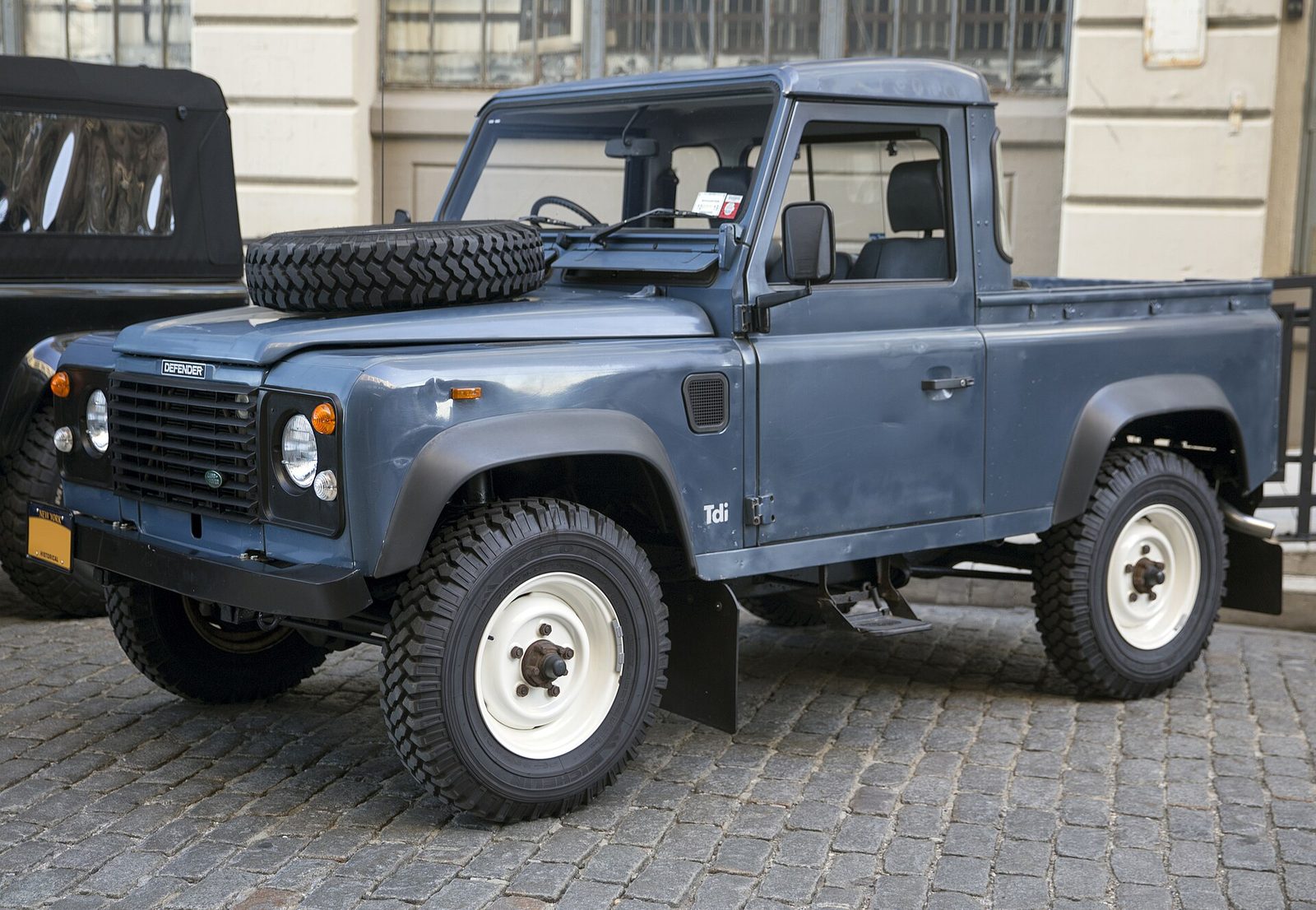
The coil-sprung Land Rover replaced the leaf-sprung Series III in stages, arriving as the One Ten in 1983 and the Ninety in 1984, and taking the Defender name in 1990 once Discovery and Range Rover needed distinguishing from it. Underneath it stayed deliberately archaic: a steel ladder chassis, live axles, a two-speed transfer case and riveted aluminum panels over a steel bulkhead. Engines moved from 2.25/2.5-liter fours through the 200Tdi and 300Tdi, the five-cylinder Td5 and finally Ford-derived 2.4 and 2.2 TDCi units, while the Rover V8 served gasoline markets and every US-market truck. Land Rover sold the Defender in North America only briefly, as the 1993 NAS 110 and the 1994/1995/1997 NAS 90, before US occupant-protection rules closed the door. Solihull built the last one on 29 January 2016. In the US the model is now defined as much by import law as by engineering.
Defender
Coil-sprung Ninety / One Ten / Defender
History
From Series III to Coil Springs
The vehicle collectors call the Defender began as a running modernization of the Series III rather than a clean-sheet design. Land Rover introduced the coil-sprung One Ten in 1983 and followed it with the short-wheelbase Ninety in 1984, replacing leaf springs with long-travel coils and adding a permanent four-wheel-drive transfer case borrowed in concept from the Range Rover. A 127-inch-wheelbase load-carrier joined the range for crew-cab and high-capacity work. The architecture underneath - a steel ladder chassis, beam axles, a steel bulkhead and riveted aluminum alloy body panels - was retained essentially unchanged for the next three decades, which is why a 2015 truck and a 1985 truck share so many part numbers.
The Defender Name and the Diesel Years
The name arrived in 1990. With the Discovery launched and the Range Rover established, Land Rover needed a label for the utility model, and Ninety/One Ten/127 became Defender 90, 110 and 130. The 130 badge was marketing rather than measurement: its wheelbase is 127 inches. The same year brought the 200Tdi, a direct-injection intercooled 2.5-liter turbodiesel of roughly 107 hp that transformed the truck's usability. The 300Tdi replaced it in 1994 with about 111 hp and better refinement, the electronically managed five-cylinder Td5 arrived in 1998 with around 122 hp, and in 2007 a Ford-derived 2.4-liter TDCi and six-speed gearbox brought a redesigned dashboard and the deletion of the inward-facing rear seats. A 2.2-liter TDCi took over for the 2012 model year to meet tightening emissions rules.
The North American Chapter
Land Rover federalized the Defender for North America only briefly. For 1993 it brought over a run of NAS Defender 110 Station Wagons with the 3.9-liter EFI V8 and a five-speed manual, explicitly as an image vehicle to open the door for the Defender 90 and the Discovery; roughly 500 to 525 went to the US and Canada combined. The NAS Defender 90 followed for 1994 and 1995 with the same 3.9-liter V8, initially as a soft top and then with a Station Wagon body, and returned for 1997 with the 4.0-liter GEMS V8 and an automatic option. No 1996 model year was offered, and 1997 was the last. The reason was regulatory rather than commercial: tightening US occupant-protection requirements - dual front airbags and full lap/shoulder belts across the passenger compartment - could not be met by a body-on-frame design conceived in the 1940s without an investment the volumes never justified. Land Rover withdrew rather than re-engineer.
The Long Goodbye and the Import Question
European pedestrian-impact and emissions legislation eventually did to the Defender in its home market what US rules had done in 1997. Solihull built the last classic Defender, a 90 Heritage Soft Top, on 29 January 2016, closing a Series-and-Defender production run that Land Rover puts at more than two million vehicles since 1948. In the United States the consequence has been a market shaped by import law rather than by original sales: a small, well-documented pool of legitimate NAS trucks, a large and growing pool of rest-of-world Defenders becoming legally importable as each production month passes its 25th birthday, and a persistent enforcement problem around vehicles that were brought in before their time.
Common Problems
Corrosion is the dominant issue and it is structural, not cosmetic: rear crossmember first, then outriggers, engine support rails, rear spring mounts and axle supports, then whole chassis sections. The steel bulkhead corrodes around the windshield, the fresh-air vents and the footwells and is expensive to correct. Door pillars, door bottoms and the steel body frames behind the aluminum skins also suffer.
By engine: the 200Tdi (1990-1994) is durable but can fail its head gasket between cylinder four and the pushrod tubes, and suffers injector, Bosch VE pump and fuel return pipe faults; timing belt service is a hard 60,000-mile or five-year item. The 300Tdi (1994-1998) is smoother but more prone to coolant leaks and overheating that warps or cracks heads around the heater plugs and injectors, plus manifold gasket failure; the same timing belt discipline applies. The Td5 (1998-2007) is chain-driven and quick but leaks at the injector harness seals - causing hard starting - and can suffer injector pump failure, head cracking from high fuel pressures and costly dual-mass flywheel replacement. The 2.4 TDCi (2007-2010) can be long-lived but has injector and fuel pressure sensor issues and is less DIY-friendly; early cars could foul the front propshaft against the sump under full articulation, which Land Rover addressed with a recessed sump. The Rover V8 in NAS trucks is straightforward but thirsty, and cylinder liner and head gasket issues are known on the later 4.0-liter blocks.
Beyond that, expect leaks, wind noise, worn swivel housings and bearings, tired steering boxes and drivetrain slack. Parts supply is excellent; specialist labor is not evenly distributed.
What to Look For
Start with identity, not condition. For a US buyer this is the single highest-risk purchase in the classic 4x4 market. Confirm the vehicle is legally in the country: either an original NAS truck with a US-issued VIN and a documented delivery history, or an import whose date of manufacture is at least 25 years before the date it was entered, supported by the actual DOT and EPA entry paperwork rather than a title alone. A clean state title is not proof of lawful importation - state DMVs do not adjudicate federal import compliance, and vehicles have been seized years after being titled and insured. Check chassis and engine VIN stampings physically against the paperwork and look for grinding, re-stamping, filler or mismatched fonts; federal cases have turned on exactly this. Treat any truck presented as a '1983' or other conveniently old model year with visibly later features - Tdi or Td5 engine, later dashboard, later door handles, one-piece front door tops - as a documentation problem until proven otherwise.
Then inspect structure. Factory Defender chassis were painted, not hot-dip galvanized, so corrosion is a question of maintenance history rather than luck: probe the rear crossmember, the outriggers, the spring and axle mounts and the inside of the main rails. The steel bulkhead is the expensive one - check the footwells, the windshield frame corners and the fresh-air vent apertures, because a rotten bulkhead is a full strip-down to replace. Aluminum panels do not rust but corrode galvanically where they meet steel frames and fasteners, so look at door bottoms, door frames and the rear body cappings.
Finally, understand what you are buying. A truck on a new galvanized replacement chassis and a new bulkhead is a legitimate and often superior thing, but it is a rebuild, not an original, and it should be priced and described as one. A 'rebodied' truck - a later vehicle wearing an older identity - is something else entirely, and is the failure mode that has produced federal seizures. Ask for the invoices.
Market Notes
As of August 2026, Classic.com shows a market benchmark of about $78,700 for the NAS Defender 90 across a sales window running from March 2025 to August 2026, with recent results spread from roughly $23,750 for a compromised truck to $139,998 for a 1995 example sold in California in April 2026, and around 45 cars listed. The wider Defender 90 'Classic' market (1990-2006, which mixes NAS trucks with imported rest-of-world cars) benchmarks lower, at roughly $53,300, with live listings running from about $19,000 to about $125,000. Classic.com's all-Defender page shows an average sale near $53,400, but that figure is diluted by the modern L663, which accounts for the majority of current listings and is a different vehicle. Hagerty's overview of the 90/110 reports an auction range of about $20,350 to $125,500 and a #2-condition median near $28,300 for a 1990 truck, notes that values peaked between late 2010 and early 2015 and have been relatively flat since, and ranks V8 cars above four-cylinder gasoline and diesel, 90s above 110s, and soft tops above pick-ups. The premium structure is consistent across sources: NAS provenance, V8 power, short wheelbase, soft top, manual gearbox, low mileage and unambiguous paperwork. Restomods from US converters trade on their own terms and are not comparable to original trucks.
Where sources differ
No reliable production total exists for the coil-sprung Defender alone; the widely quoted 2,016,933 figure covers Series and Defender models together from 1948 to 2016.
Land Rover's own release says only 'more than two million' Series and Defender models; Wikipedia cites a precise 2,016,933 for the same combined run. Neither isolates coil-sprung Defender output, so no Defender-only total is asserted here.
Land Rover sold the NAS Defender 110 in North America for the 1993 model year only, with the 3.9-liter EFI V8 and a five-speed manual, in a run of roughly 500 to 525 vehicles for the US and Canada combined.
Wikipedia states 500 to the US plus 25 to Canada (525 total). East Coast Rover states 509 to the US plus 25 to Canada (534 total, described as 'just over 525'). Bishop+Rook says 'roughly 500'. The range 500-525 is the defensible statement.
The NAS Defender 90 was sold for 1994, 1995 and 1997 with no 1996 model year, using the 3.9-liter EFI V8 for 1994-95 and the 4.0-liter GEMS V8 for 1997, for a total on the order of 6,500 vehicles.
East Coast Rover's year-by-year figures (1994: 2,030; 1995: 1,700; 1997: 2,799) sum to about 6,529, consistent with Bishop+Rook's 'roughly 6,500' overall. However Bishop+Rook separately states that 1997 saw '700 Defenders or less' built for the US, which cannot be reconciled with East Coast Rover's 2,799 for the same year. The aggregate figure is treated as sound; the 1997 split is not.
Sources
- Celebrating The Legend - Last of the Current Land Rover Defenders is Built in Solihull, Land Rover Media Newsroom / Jaguar Land Rover · manufacturer
- Land Rover Defender (L316), Wikipedia · reference-book
- Land Rover Defender, Wikipedia · reference-book
- The SUV market caught up, but the Land Rover 90 and 110 blazed the trail, Hagerty · journalism
- Land Rover Defender 90 NAS - Classic Market, classic.com · market-data
- Land Rover Defender 90 - Classic Market, classic.com · market-data
- Land Rover Defender Market, classic.com · market-data
- Defender 110 (NAS), East Coast Rover · specialist
- Defender 90s (NAS), East Coast Rover · specialist
- The Basic Intro to the Land Rover Defender, Bishop+Rook · specialist
- Land Rover Defender buyer's guide, Classics World · journalism
- Land Rover Defender Rustproofing & Chassis Protection, Rustbuster · specialist
- 49 U.S. Code § 30112 - Prohibitions on manufacturing, selling, and importing noncomplying motor vehicles and equipment, Cornell Law School, Legal Information Institute · government
- EPA Form 3520-1: Importation of Motor Vehicles and Motor Vehicle Engines Subject to Federal Air Pollution Regulations, US Environmental Protection Agency · government
- The Feds Just Seized 40 Land Rovers Imported To The U.S., Jalopnik · journalism
- Why Are The Feds Obsessed With Seizing These People's Old Trucks?, Jalopnik · journalism
- U.S. Customs Crush Illegally-Imported Land Rover Defender, Motor Authority · journalism
- Why Vintage Defenders Are Rare in the United States, ECD Automotive Design · specialist
Synthesized from the sources above and cross-checked. We cite and link out; we do not republish other databases verbatim.
Fully Sorted is an independent publisher and is not affiliated with, endorsed by or sponsored by Land Rover. Land Rover and the model names on this page are trademarks of their respective owners and are used here only to identify the cars being described.
Chassis register
Nobody has recorded a car here yet. Own one, or know one? Chassis number, what you can prove about it, and a source if there is one. Every entry is reviewed before it appears.
Nerd Notes
What owners know that the sources don't. Every note is read and checked before it appears here.
Key Specs
- Layout
- Front engine, permanent four-wheel drive, two-speed transfer case, live axles front and rear on coil springs
- Power td5
- ~122 hp
- Construction
- Steel ladder-frame chassis with aluminum alloy body panels over steel frames and a steel bulkhead
- Power 200tdi
- ~107 hp, 195 lb-ft
- Power 300tdi
- ~111 hp, 195 lb-ft
- Power nas 90
- 3.9L EFI V8 ~182 hp / 232 lb-ft (1994-95); 4.0L GEMS EFI V8 (1997)
- Wheelbase 90
- 92.9 in (2,360 mm)
- Power 24 tdci
- ~122 hp, 265 lb-ft, six-speed manual
- Power nas 110
- 3.9L EFI Rover V8, ~180 hp / 227 lb-ft, five-speed manual
- Wheelbase 110
- 110 in (2,794 mm)
- Wheelbase 130
- 127 in (3,226 mm), despite the 130 badge
- Us import status
- Exempt from FMVSS at 25 years from date of manufacture; EPA exemption at 21 years in original configuration
- Factory corrosion protection
- Painted/primed steel chassis; factory chassis were not hot-dip galvanized
Notable Variants
One Ten / Ninety (1983-1990)
Pre-Defender coil-sprung trucks. The One Ten arrived in 1983, the Ninety in 1984. Mechanically the same recipe as the Defender that followed, and now the earliest and easiest coil-sprung Land Rovers to import into the US.
Defender 90
92.9-inch wheelbase short-wheelbase truck. The most desirable body length in the US market, especially as a soft top.
Defender 110
110-inch wheelbase. Better ride and towing manners than the 90, far more load space, and the body length used for the 1993 US launch trucks.
Defender 130
Despite the badge, a 127-inch wheelbase. Crew-cab and high-capacity load bodies; a working vehicle rather than a collector one.
NAS Defender 110 (1993 only)
US/Canada federalized 110 Station Wagon with the 3.9-liter EFI V8 and five-speed manual, sold as a halo model ahead of the D90. Roughly 500-525 for North America; the rarest official US Defender.
NAS Defender 90 (1994, 1995, 1997)
V8-only US-spec 90. 3.9-liter EFI V8 for 1994-95; 4.0-liter GEMS V8 for 1997, when an automatic became available. Soft tops from 1994, Station Wagons added for 1995.
Td5 Defender (1998-2006)
Five-cylinder electronic diesel; the most usable everyday classic Defender, and the generation now entering US import eligibility on a rolling basis.
Puma Defender (2007-2016)
Ford-derived 2.4 then 2.2 TDCi, six-speed gearbox and a redesigned dashboard. Not legally importable into the US until 2032 at the earliest.
Value Trajectory
Defender values rose sharply through the 2010s, peaking on Hagerty's data between late 2010 and early 2015 and running relatively flat since, with V8 and short-wheelbase soft-top cars holding the top of the range. The US market has a structural feature no other classic 4x4 shares: legal supply expands every month. Because the FMVSS exemption runs 25 years from the date of manufacture and the EPA exemption runs 21 years from the year of manufacture, the 25-year rule is the binding constraint, and it advances continuously. As of August 2026 that means Defenders built up to roughly mid-2001 - which now includes early Td5 trucks - have become importable, while Puma-era vehicles remain years away. Each year of newly eligible supply puts downward pressure on the rest-of-world import segment while doing little to the finite NAS pool, which is why the NAS Defender 90 benchmark on Classic.com sits roughly 50 percent above the broader Defender 90 Classic benchmark as of August 2026. The reasonable expectation is continued separation: documented NAS trucks and properly imported, properly documented rest-of-world trucks behaving as scarce assets, and everything with a questionable paper trail carrying a discount that reflects real seizure risk rather than sentiment.
Market Snapshot
3 recorded sales, too few for a median worth standing behind, so here is the range instead.
Range $64,000 – $92,000
Next
Shopping for one?
Browse Land Rover listings, or decode a VIN before you buy.