
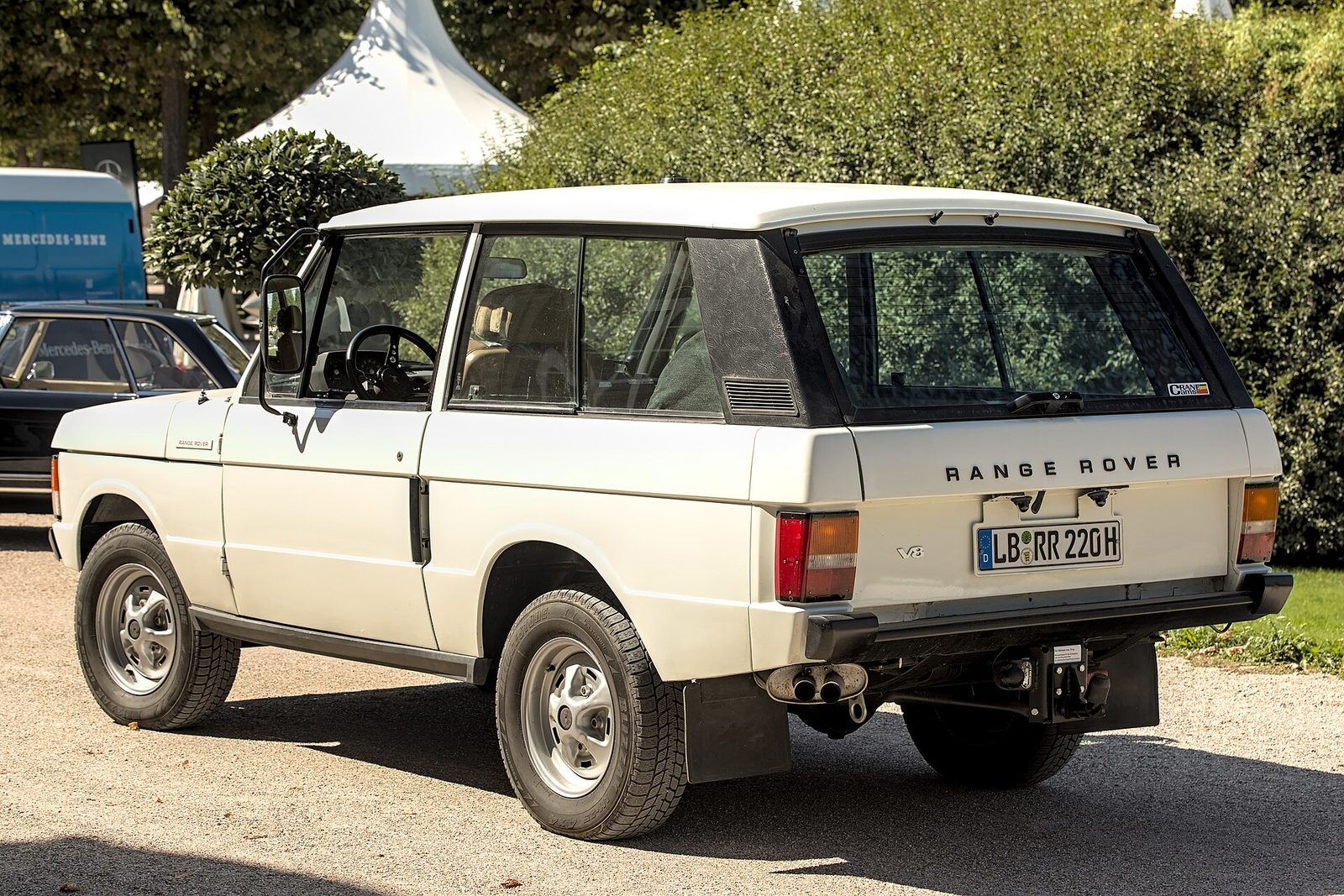
The Range Rover of 1970, renamed Range Rover Classic in 1994 to separate it from its successor, was Charles Spencer King and Gordon Bashford's attempt to graft the manners of a Rover sedan onto the ability of a Land Rover. Where the working four-wheel drives of the day rode on leaf springs, its 100-inch chassis used long-travel coil springs on live axles at both ends, permanent four-wheel drive through a lockable center differential and disc brakes all round, with the all-alloy Buick-derived 3,528 cc Rover V8 detuned to 135 hp so it would run on poor fuel. The first cars were two-door, trimmed in vinyl and floored in rubber so a farmer could hose them out. Within four years the same shape was parked outside country houses; within a decade it had four doors, leather and walnut. American buyers waited until March 1987, when the car finally went on sale in the United States as a luxury good. It created the category that every premium four-wheel drive now occupies.
Range Rover Classic
First generation
History
The Hundred-Inch Station Wagon
Rover had circled the idea since the 1950s Road Rover, but the program that became the Range Rover began in the mid-1960s under Charles Spencer 'Spen' King with Gordon Bashford. King's brief never changed: the comfort and on-road ability of a Rover sedan with the off-road ability of a Land Rover. The project ran as the 100-inch Station Wagon, and the twenty-six development cars wore Velar badges - from the Italian velare, to veil - so the name never appeared on a prototype. David Bache, Rover's styling chief, finessed rather than replaced the engineers' straight-edged mock-up, which is why the clamshell hood, unbroken waistline and split tailgate reached production intact. The press launch was in Cornwall on 17 June 1970, journalists sent into disused tin mines.
Coil Springs Where Everyone Else Used Leaf
The argument was underneath. Land Rovers, and almost every working four-wheel drive of the day, rode on leaf springs. The Range Rover used long-travel coil springs on live axles at both ends with a Boge self-leveling strut at the rear, permanent four-wheel drive through a lockable center differential, and disc brakes on all four wheels. The engine was the all-alloy 3,528 cc Rover V8 bought from Buick, detuned to 135 hp net at 4,750 rpm on a compression ratio lowered to 8.5:1 so it would tolerate 91-octane fuel. Motor Sport tested one in February 1971, recorded 16.3 mpg and under fourteen seconds to 60 mph, and objected to unassisted steering heavy at rest and vague in motion. The same test had the car walking up an army tank-testing course without low range.
Vinyl, Rubber and the Climb Upmarket
The interior was a working one: vinyl seats, a plastic dashboard, rubber matting over corrugated aluminum flooring and a plaque explaining the differential lock. An owner could do the dirty work, hose the car out and drive to dinner. That did not survive the customers. By 1974 What Car? observed that no country house worth its salt was without one, and Solihull spent twenty years chasing buyers it had acquired by accident. A two-door dressed with Wood & Pickett involvement went to Vogue magazine for a 1981 shoot in Biarritz; the demand that followed produced 1,000 In Vogue cars, and Vogue became the range-topping trim name.
Two More Doors, and America
Solihull was beaten to the four-door body by Peter Monteverdi, whose Basel firm had two-doors rebodied by Carrozzeria Fissore from 1980 and sold them through Land Rover dealers under warranty. Land Rover's own four-door followed in July 1981, an automatic in October 1982, and by 1984 it was the only body listed in the United Kingdom. The United States came seventeen years late and mattered enormously: Range Rover of North America launched the car on 16 March 1987 at around $30,000 on an allocation of some 5,000 cars a year, into a market where the Jeep Grand Wagoneer was the only comparable product. Every car sold new in America was therefore an injected four-door of 1987 or later; two-doors and diesels reached the country only as private imports. Fuel injection had arrived in 1986, and the 3.9-liter V8 and four-wheel ABS in 1989.
Air Springs and the Run-Out
The CSK of 1990-91, 200 cars named for Spen King, revived the two-door body as a reference to 1970 and brought anti-roll bars front and rear. The LSE of 1992, sold in North America as the County LWB, went the other way: 108-inch wheelbase, 4.2-liter V8, electronic air suspension, about 3,000 built, and the most complicated Range Rover yet. The P38A arrived in 1994; the old car was renamed Classic, given a padded dashboard and airbags, and kept in build until 1996.
Position Against the Defender
The Range Rover was conceived as a departure from the utility Land Rover, then quietly rebuilt it. The One Ten of 1983 carried coil springs front and rear and permanent four-wheel drive derived from the Range Rover, the Ninety followed in 1984, and the line became Defender in 1991 because the Discovery needed the old name. A Defender is the tool the Range Rover was built to escape; the Range Rover is why the Defender rides as well as it does.
Common Problems
The Rover V8 is durable if oil and antifreeze are changed and fatal if they are not. Neglected coolant silts the radiator and corrodes the alloy, and an overheated engine is where the real damage starts: owners on rangerovers.pub are consistent that the notorious 'porous block' is largely a myth and that the actual failure is cracking behind a cylinder liner, or a liner slipping down after a casting ridge at its base gives way, letting coolant into the combustion chamber. The 3.9 and 4.2 blocks are the vulnerable ones; the remedy is top-hat liners, a set of eight listed at $748 by a US supplier as of September 2026 before any machining or labor, or a reconditioned short block. Head gasket weep, milky oil and a pressurized header tank are the symptoms to look for. Lucas 14CUX injection on post-1986 cars gives hot-start trouble, hunting idle and stalling, usually a sensor rather than the system. The LT77 manual runs low on oil without warning and its synchros suffer on cars used for towing; a clunk on and off the throttle points to a worn mainshaft. Automatics show blackened fluid and slurred shifts. Boge self-leveling rear struts fail and are no longer manufactured, so replacement means a remanufactured unit on specialist order. ABS warning lights are usually a wheel speed sensor sitting proud, often because a wheel bearing has worn. Air springs perish, compressors tire and valve blocks leak on 1993-96 cars. VM diesel injection pumps wear and their timing belts are urgent if undated.
What to Look For
Structure before everything. The aluminum panels do not rust and distract from a steel body frame and steel ladder chassis that do. Kingsley Cars describes the bodyshell as bolted to the chassis at ten points, and warns that a shell rotten enough to matter can collapse if lifted off. Work through the front inner wings and suspension turrets, where later cars with arch liners trap mud behind them; the footwells and A-post bases; the sills, which carry the shell's strength; the rear crossmember, outriggers and coil spring mounts; the cargo floor and rear inner arches around the seatbelt anchorages; and the bulkhead, which is the expensive one because a proper repair means removing the wiring harness. The steel upper tailgate frame rots through as a matter of course and lower tailgate halves are generally unobtainable. Where alloy panels meet steel, galvanic corrosion eats the alloy preferentially, so check wing edges and door skins. Door shuts give a quick first reading of how the rest will be. Classics World reports the 1994-96 soft-dash cars corroding harder than earlier ones, particularly at the scuttle corners.
Then the paperwork, which in the United States is a specification question as much as a legal one. Nothing built before 1987 was sold here new, and no two-door and no diesel ever was, so those cars are private imports: confirm the title, the import history and that the VIN on the car agrees with both. Establish which V8 is fitted and whether it matches the year, because the 3.9 and 4.2 blocks are the ones that crack. On an LSE or County LWB, confirm the air suspension is present, original and working rather than converted to coils and left with a dead warning light; conversions are common enough that one US owner's account puts almost the whole surviving fleet on steel springs. Check the LT77 gearbox for oil, test low range, and look for a steering box weeping past its seals. Non-standard engine conversions reduce both value and desirability.
Market Notes
Classic.com splits the run into three market pages and the split is instructive. As of September 2026 the Classic Series 1 (1969-1980, the two-doors) carries a market benchmark of $35,769 against an average sale of $24,077 on a rising trend across 26 tracked sales, its floor a $618 rolling chassis in December 2022. Series 2 (1981-1985) shows no benchmark at all and an average of $25,060 over 20 sales, its floor a $1,050 two-door in July 2025. Series 3 (1986-1996) is the deepest pool and the one fed by cars sold new in the United States from 1987; it averages $24,326, with a high of $159,900 for a 1991 two-door in August 2026 and a low of $843 for a 1993 Vogue LSE in June 2024. The three averages sit within about $1,300 of each other, which is the useful finding: model year buys almost nothing, and body style, originality and structure buy everything. US retail asking prices bracket the same spread, a restored 1991 two-door offered at $45,000 by Congleton Service in Ohio and a modified VM diesel four-door sold at $26,500 by Commonwealth Classics. For contrast, a fully restored 1973 Suffix B two-door made EUR 72,600 at RM Sotheby's 2020 European Sale, a reminder that the strongest money still follows the earliest bodies wherever the car is standing. All dollar figures as of September 2026.
Where sources differ
The 1970 United Kingdom launch price is stated inconsistently across sources and no single figure is asserted here.
Motor Sport's February 1971 test car is priced at 2,006 pounds purchase-tax paid, which is a tested-car price rather than a base list price. Adrian Flux states the car launched at 'just over 2,000 pounds'. Auto Express's retrospective states a 1970 price 'from 1,500 pounds'. None of the three cites a Rover price list, and the discrepancy is not resolved by any source consulted here.
The original Range Rover was exhibited at the Louvre in Paris as an exemplary work of industrial design, the first vehicle to be shown there, but sources give different years for the exhibition.
Jaguar Land Rover's own 50th-anniversary release dates the Louvre exhibition to 1971. Goodwood Road and Racing states the car appeared there in 1970. The date is not resolved by any source consulted here.
Total production of the first-generation Range Rover between 1970 and 1996 is stated as either 317,615 or 326,070 cars depending on the source, and no single figure is asserted here.
Goodwood Road and Racing and the Classics World buyer's guide both state 317,615 units. Wikipedia states 326,070 over the same 1970-1996 period. Neither figure is traced to a published Solihull build record, and the 8,455-car gap is not resolved by any source consulted here, so productionTotal is left null.
The 'Classic' name was applied retrospectively from 1994 to distinguish the original car from the P38A that succeeded it, and sources disagree on whether first-generation production ended in 1994 or continued to 1996.
Wikipedia, Goodwood and Classics World all run first-generation production from 1970 to 1996, the Classic having been kept in build alongside the P38A after 1994; Collecting Cars likewise treats 1994-1996 soft-dash cars as run-out Classics. Adrian Flux's history instead states the first generation concluded in 1994 when the second-generation car launched. The two accounts are not resolved by any source consulted here.
How well the Range Rover Classic's electronic air suspension has aged is disputed between credible buying guides.
Classics World states that the LSE system is adapted from heavy goods vehicle practice with the compressor mounted away from engine heat, and is more robust than the later P38a arrangement. Hagerty UK states that later air suspension can be problematic, that it resembles the P38a but differs enough that few parts interchange, and Auto Express warns that bodged air suspension is expensive to put right. Rover Spares lists perished air springs, tired compressors and leaking valve blocks as routine on 1993-1996 cars, and a US owner writing for InsideHook reports that almost the whole surviving fleet has been converted to steel springs. The disagreement is about reliability in service rather than about a figure and is not resolved by any source consulted here.
Sources
- Range Rover Classic, Wikipedia · encyclopedia
- Range Rover marks 50 years of all-terrain innovation and luxury with exclusive new limited edition, Jaguar Land Rover · manufacturer
- The first ever credible performance SUV - Range Rover CSK, Land Rover Heritage Collection · manufacturer
- Range Rover, February 1971, Motor Sport · journalism
- The history of Range Rover, Goodwood Road and Racing · journalism
- Buying Guide: Range Rover Classic (1970-1995), Hagerty UK · journalism
- Range Rover Classic buyer's guide, Classics World · journalism
- Range Rover (Mk1, 1970-1994) icon drive: Britain's first luxury SUV, Auto Express · journalism
- Range Rover Classic - Cult Classics, Adrian Flux · journalism
- This Was America's First Taste Of Range Rover, TopSpeed · journalism
- What I Wish I Knew Before I Bought a Range Rover Classic, InsideHook · journalism
- King of the hill: driving the Range Rover CSK, Classic & Sports Car · journalism
- Range Rover In Vogue special edition (1981) - the full story, AROnline · specialist
- The Range Rover Classic value minefield and what it means for the price, Collecting Cars · specialist
- Range Rover Classic Corrosion, Kingsley Cars · specialist
- Range Rover Classic Common Problems & Repair Costs, Rover Spares · specialist
- V8 Gasket Thoughts, RangeRovers.pub · club-forum
- Engine Top Hat Liner Set OEM, Lucky8 Off Road · specialist
- Cost of a Bespoke Classic Car Restoration, ECD Auto Design · specialist
- Range Rover Classic - Series 1 Market, classic.com · market-data
- Range Rover Classic - Series 2 Market, classic.com · market-data
- Range Rover Classic - Series 3 Market, classic.com · market-data
- 1991 Range Rover Classic - 2 Door, Congleton Service · specialist
- 1991 Land Rover Range Rover Classic, Commonwealth Classics · specialist
- 1973 Land Rover Range Rover, The European Sale featuring the Petitjean Collection, RM Sotheby's · auction-house
- 1982 Range Rover Monteverdi, Iconic Auctioneers · auction-house
- Land Rover Defender, Wikipedia · encyclopedia
Synthesized from the sources above and cross-checked. We cite and link out; we do not republish other databases verbatim.
Fully Sorted is an independent publisher and is not affiliated with, endorsed by or sponsored by Land Rover. Land Rover and the model names on this page are trademarks of their respective owners and are used here only to identify the cars being described.
Chassis register
Nobody has recorded a car here yet. Own one, or know one? Chassis number, what you can prove about it, and a source if there is one. Every entry is reviewed before it appears.
Nerd Notes
What owners know that the sources don't. Every note is read and checked before it appears here.
Key Specs
- Power
- 135 hp net at 4,750 rpm for the 1970 carburetor 3.5; about 150 hp for the injected 3.5 federalized for the United States in 1987; 185 hp at 4,750 rpm for the 3.9-liter CSK
- Brakes
- Servo-assisted discs on all four wheels from launch; ventilated fronts and four-wheel ABS on later cars, ABS arriving in 1989
- Engine
- 3,528 cc all-alloy Rover V8 derived from the Buick 215 at launch; 3,947 cc from 1989 and 4,197 cc from 1992; VM 2.4 and 2.5 turbodiesels 1986-1992, 200Tdi from 1992, 300Tdi from late 1994
- Layout
- Front-mounted longitudinal V8, permanent four-wheel drive through a two-speed transfer box with a lockable center differential
- Torque
- 235 lb-ft at 2,600 rpm for the 3.9-liter CSK; about 195 lb-ft quoted for the injected 3.5 sold in the United States. No period torque figure for the 1970 carburetor engine was recovered here
- Weight
- No curb weight for the 1970 two-door was recovered from the sources consulted here; 4,435 lb is quoted for the 1991 CSK
- Chassis
- Box-section steel ladder chassis carrying a separate steel body frame bolted to it at ten points
- Bodywork
- Aluminum alloy outer panels over the steel inner frame; clamshell hood, unbroken waistline, split tailgate. CSK frames were welded rather than bolted
- Steering
- Worm-and-roller and unassisted at launch, four turns lock to lock with a 37 ft turning circle as tested in February 1971; power-assisted recirculating ball later
- Top speed
- Around 90 mph with 85 mph a reasonable cruise in the February 1971 test; 114 mph quoted for the 3.9-liter CSK
- Wheelbase
- 100 in (2,540 mm); 108 in (2,743 mm) for the LSE and County LWB from 1992
- Dimensions
- 183 in (4,648 mm) long in long-wheelbase form, 70.1 in (1,781 mm) wide from 1980; 176.0 x 70.0 x 70.0 in (4,470 x 1,778 x 1,778 mm) quoted for the 1991 CSK
- Suspension
- Live axles front and rear on long-travel coil springs with a Boge self-leveling rear strut; anti-roll bars first on the CSK; electronic air suspension on the LSE from 1992
- Acceleration
- Under 14 seconds to 60 mph and a standing quarter a little over 19 seconds in February 1971; 9.5 seconds to 60 mph quoted for the CSK by Classic & Sports Car against 9.9 in Land Rover's own record
- Transmission
- Four-speed LT95 combined gearbox and transfer box to 1983, then LT77 five-speed with separate LT230; Chrysler TorqueFlite three-speed automatic from October 1982, ZF four-speed from 1985
- Fuel consumption
- 16.3 mpg over varied use in the February 1971 test; 15-21 mpg quoted for the CSK, and around 11 mpg reported by a US owner running a 3.9 on modern roads
Notable Variants
Two-door (Suffix A onwards, 1970-1994)
The original body and the one the market now prefers. Earliest Suffix A cars carry the plainest trim and the highest values; the body left the United Kingdom price list in 1984 and continued chiefly for France, and it was never a new-car option in the United States, so every two-door in American hands arrived as a private import.
Monteverdi four-door (1980-1981)
Two-doors supplied by Land Rover, rebodied as four-doors by Carrozzeria Fissore for Peter Monteverdi of Basel and sold through Land Rover dealers under warranty. It preceded Solihull's own four-door and is now rarer than a Suffix car.
In Vogue (1981-1983)
A Wood & Pickett-influenced prototype lent to Vogue magazine for a 1981 Biarritz fashion shoot; the demand that followed produced 1,000 cars in Vogue Blue with air conditioning, wood cappings, a carpeted load bay and a picnic hamper. Vogue then became the range-topping trim name.
Vogue SE (from 1989)
The top of the range as the car went fully upmarket, and the model on which four-wheel ABS first appeared in 1989. Leather, walnut, air conditioning and the new 3.9-liter injected V8.
CSK (1990-1991)
Two hundred cars marking twenty years and named for Charles Spencer King. Two-door, Beluga Black, individually plaqued, 3.9-liter at 185 hp, and the first Range Rover with anti-roll bars front and rear, its body welded like a four-door rather than bolted.
LSE / County LWB (1992-1995)
The 108-inch long-wheelbase car with the 4.2-liter V8 and electronic air suspension, roughly 3,000 built and sold in the United States as the County LWB. The most equipped Classic and the one whose running gear frightens buyers most.
Soft dash (1994-1996)
Run-out cars with the padded safety dashboard derived from the facelifted Discovery and the only Classics with airbags as standard. Usable and cheap, but Classics World reports them corroding harder than earlier cars, particularly at the scuttle corners.
Diesels (VM 2.4/2.5, 200Tdi, 300Tdi)
Never a United States new-car option, so American diesels are imports. The VM units of 1986-1992 are the weak point of the range and hard to support; the 200Tdi from 1992 and 300Tdi from late 1994 are durable and economical, and suit a car meant to be driven rather than shown.
Value Trajectory
For most of its afterlife the Range Rover Classic was a cheap car, worth less than the cost of putting a corroded one right, and thousands were used up. That is the whole explanation for the present market: attrition removed the bad cars, and the survivors are priced against restoration cost rather than against a used-car ladder. American demand arrived late twice, once in 1987 when the car went on sale here, and again in the last five or six years as vintage four-wheel drives became one of the strongest collector segments. The re-rating has favored the earliest and plainest cars. Classic.com's Series 1 pool carries a benchmark of $35,769 on a rising trend, while the Series 2 and Series 3 pools average $25,060 and $24,326 with no benchmark at all and a very wide spread, all as of September 2026. Collecting Cars records that two-doors consistently outrun comparable four-doors and that the older the two-door the stronger it tends to be, with Suffix A cars, Monteverdis, In Vogues and CSKs at the top. Restoration economics hold the floor down: a Florida specialist puts concours-level work on a Range Rover at $150,000 and upward, which is why a rotten car is worth less than nothing. The widening gap is between cars with sound structure and documented history and cars with neither.
Next
Shopping for one?
Browse Land Rover listings, or decode a VIN before you buy.