
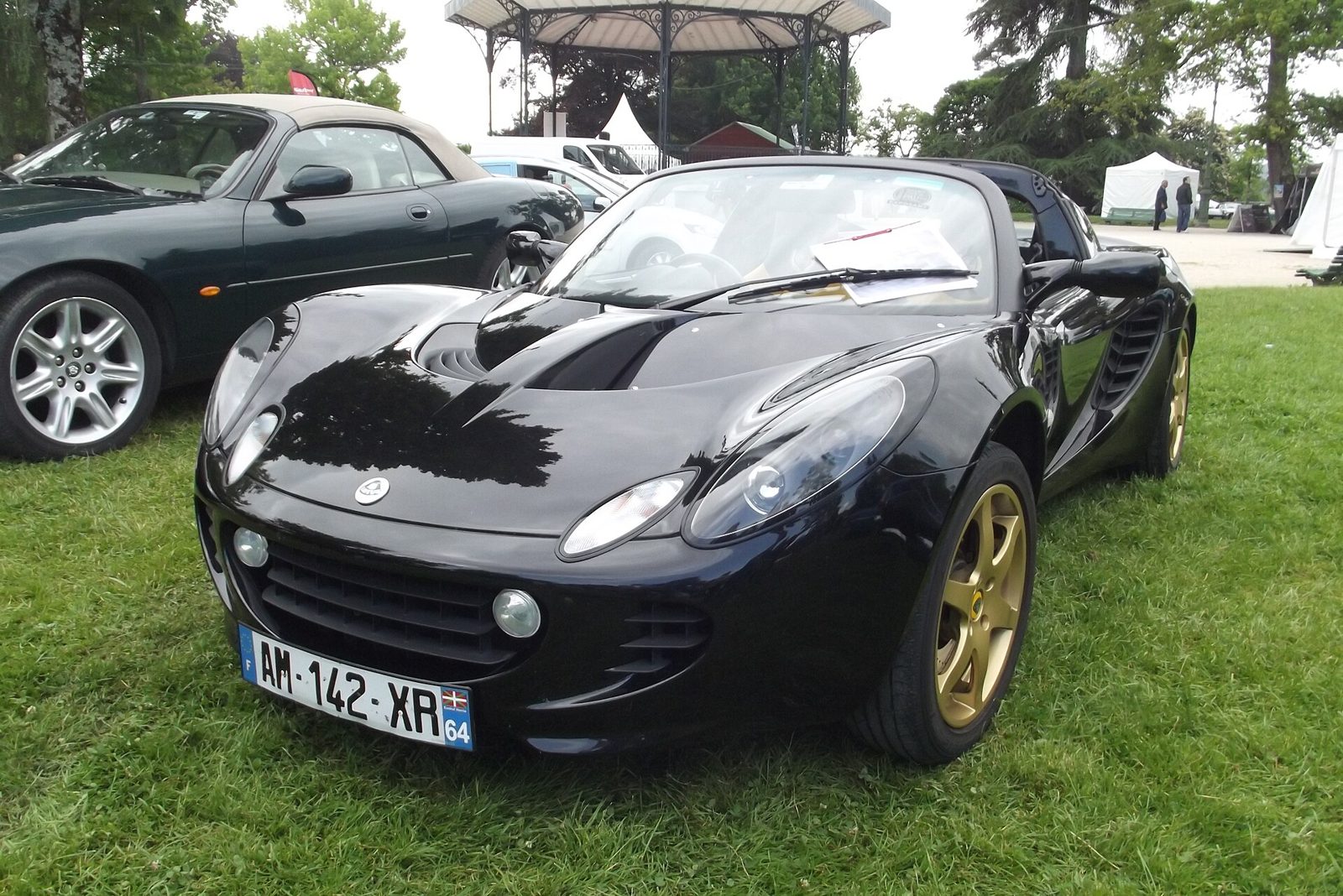
The US Elise is the car that brought Lotus back to American showrooms. The Series 1 of 1996 was never sold new here; the first federal Elise went on sale in summer 2004 as a 2005 model, after some dealers had taken orders since 2001. To get it here Lotus replaced the Rover engine with Toyota's 1.8-liter 2ZZ-GE and a Toyota six-speed, and worked under NHTSA exemptions for its bumpers, headlamps and later its air bags. The result weighed under 2,000 lb, made 190 hp, and listed at $39,985 base per MotorWeek. The line ran through the 2011 model year: drive-by-wire and an optional limited-slip differential for 2006, the supercharged Elise SC for 2008 at $54,990, a string of numbered special editions, and a final Elise R and SC in Series 3 clothing when the air bag waiver ran out in August 2011. Owners count about 6,300 US Elises and Exiges, roughly half of them 2005 cars. Most of what goes wrong is body and chassis, not engine.
Elise
Series 2, US market (Toyota-engined)
History
Why the car exists
The Elise was conceived in 1994 and launched in September 1996 under Romano Artioli, then chairman of both Lotus and Bugatti, and named after his granddaughter Elisa. Julian Thomson and chief engineer Richard Rackham built it around a light extruded and bonded aluminum tub, which MotorWeek later weighed at 150 lb. That Series 1 car, with its Rover K-series engine, was never sold new in the United States. New European crash rules ended it after 2000, and the Series 2 that replaced it was paid for in part by General Motors, which took an Opel and Vauxhall version in return.
Getting it into America
The Series 2 reached the US only after a change of heart about the engine. Lotus fitted Toyota's 1,796 cc 2ZZ-GE, the Celica GT-S unit with a Yamaha-designed head, and a Toyota six-speed. Wikipedia notes the common belief that the Rover engine could not be federalized is largely unproven. The car still failed US bumper and headlamp rules, so NHTSA granted a three-year exemption. The 2005 Elise went on sale in summer 2004; Forbes reported that some dealers had been taking orders since 2001. MotorWeek priced it at $39,985 base and measured it as under 2,000 lb, with Lotus claiming 0-60 mph in 4.8 seconds. Forbes printed the same claim as 4.9 seconds. About half of every US Elise ever sold is a 2005 car.
Seven model years of small changes
For 2006 Lotus added drive-by-wire throttle, LED taillights and an optional limited-slip differential and traction control, and built 50 Sport Elises for the US. The Exige coupe arrived the same year with the same engine. For 2007 the headlamps were sealed, rear bumperettes appeared for US bumper rules, the 111R name became Elise R, and 47 black and gold Type 72D cars were built. The 2008 Elise SC added an Eaton M45 supercharger without an intercooler for 218 hp by AutoGuide's figure and 220 hp by Hagerty's, and sold for $54,990. Special editions followed: California Edition, SC 60th Anniversary, Purist, Jim Clark Type 25. US volume fell every year from 2005 to 2010, reaching 95 Elises and Exiges for 2010 by the owner count, and 3 Elise SCs that year.
The air bag deadline
The Elise never had advanced air bags. NHTSA exempted it from September 1, 2006, and in 2011 Lotus asked for the last renewal, to August 31, 2011, telling the agency that compliant air bags for the current car remained infeasible and the next-generation Elise was behind schedule. The Evora, with compliant air bags from 2010, carried the brand afterward. The 2011 US cars wore the Series 3 face over the 2ZZ and the Toyota six-speed, sold as Elise R, Elise SC and a numbered SC Final Edition.
What it left behind
Owners estimate 6,325 US Elises and Exiges across seven model years, from archive certificates the archivist himself has revised more than once. The chassis outlived the car here: versions of it underpinned the original Tesla Roadster, and Lotus told NHTSA that its own production figures included cars built for Tesla. Hagerty's writer, a 2005 owner, sums up the ownership bargain in one line of fact: the drivetrain is Toyota and the rest of the car is not.
Common Problems
Most Elise trouble is body and chassis, not engine. The clamshells are large single fiberglass panels that are easy to damage and expensive to repair or repaint, and Hagerty notes insurers total cars for minor impacts, which is why so many rebuilt titles circulate. Chassis damage is the serious case: owners report it means a new tub. The 2ZZ-GE is durable for a high-revving four, but its lift bolts wear and camshaft lobe wear is documented. NHTSA recorded three separate oil cooler campaigns covering 2005 through 2011 production, the last in 2014, plus a 2005 recall for six-speed gear levers that could break. Early 2005 headlamps magnified sunlight and melted their own housings; lamps were sealed for 2007. Hard track use can break rear toe links, a design weakness US owners fix with a $500 to $1,000 upgrade. Undertray bolts strip if overtightened, a $100 to $200 repair. MotorWeek found the shifter vague and notchy even when new. Hagerty adds that air conditioning works only modestly and that parts and service are less straightforward than for a Toyota because only the drivetrain is Toyota. The aluminum chassis does not rust.
What to Look For
Chassis first. The tub is extruded and bonded aluminum, and US owners report that a bent chassis or a torn suspension pickup is treated as a total loss and fixed by swapping the whole chassis; minor body damage does not prove the chassis is straight. The bonded front crash structure can be replaced but not patched. A lift inspection by someone who knows these cars costs $300 to $500 by forum report. Title history matters because the fiberglass front and rear clamshells are costly enough to replace and paint that insurers total cars for small collisions; check for spidered paint on the noses, tails and doors. On the engine, the 2ZZ-GE lift bolts are a wear item under a Toyota service bulletin; owners replace them in under an hour for little money, though no US shop price was found. Camshaft lobe wear is a known 2ZZ fault. Confirm the three oil cooler recalls were done: 11V510000 for 2005-2007 cars, 13V041000 for 2007-2008, 14V280000 for 2008-2011; a detached line can spray oil on a tire. 2005 cars should also have the replacement gear lever. Owner figures from the dealer era for wear items: clutch about $1,000, rotors $1,000 or more, rear toe links $500 to $1,000, A048 tires about $1,000 a set. On a 2005, look for sunburned headlamps. Colors are documented by name, not code: 16 for 2005, led by Saffron Yellow (557 cars) and Ardent Red (475); 21 for 2006. Paint codes were not found in any fetched source.
Market Notes
As of September 2026 classic.com gives an average of $43,200 for the Series 2 Elise and $43,518 across all Elise generations, the Series 2 average including European cars. The identified US results that month were all Bring a Trailer sales quoted on classic.com: a 2005 Elise with 76,000 miles at $31,250 in Las Vegas on September 9, a 2006 with 59,000 miles at $34,666 in Kent, Washington on September 22, and three 2005 cars on September 2 and 3 at $45,500 (58,000 miles), $48,000 (25,000 miles) and $52,500 (15,000 miles). A 2009 Elise SC with 35,000 miles sold for $71,000 in Augusta, Georgia on August 29, 2026. The spread tracks mileage and variant more than year, since 2005 cars dominate the supply. Hagerty's editorial, undated on the fetched page, put the median condition 2 value at $57,600 for base cars and $64,900 for the SC at the time it was written, and said driver-quality base cars could be found under $40,000. Special editions such as the Type 72D, California Edition and 60th Anniversary have always carried a premium by Hagerty's account, and 2011 cars are the scarcest. Rebuilt-title cars are a recognized part of this market because clamshell damage totals so many; they trade below clean-title cars and are bought to drive. No fetched source prices the Exige here.
Where sources differ
The 2005 US Elise count is stated three ways from Lotus archive certificates: 3,321, 3,324 and 3,323.
The first LotusTalk compilation gives 3,321 US Elises for 2005. The second says early Lotus certificates gave 3,321, later ones 3,324, and that the archivist now believes 3,323, adding that the Lotus archives are not very detailed. Not resolved by any source consulted here.
The 2011 US total is disputed: Hagerty cites LotusTalk for 128 US cars, while the LotusTalk compilation lists 186 US Elises and Exiges for 2011, 77 of them Elise R and 37 Elise SC.
Hagerty states 128 US cars for 2011 without saying whether Exiges are included. The LotusTalk compilation lists 186 for 2011 including Exiges, of which 77 Elise R and 37 Elise SC make 114 Elises. Neither figure matches the other on any scope, and no Lotus figure was found. Not resolved by any source consulted here.
The 2008 California Edition count differs between the two owner compilations: 46 of 77 US Elises in one, 50 of 78 in the other.
One LotusTalk compilation gives 46 California Editions within 77 US Elises for 2008 and notes more research is needed; the later compilation gives 50 within 78, split 25 Ardent Red and 25 Saffron Yellow. Not resolved by any source consulted here.
Both owner compilations agree on the smaller US special editions: 47 Type 72D Elises in 2007, 39 Elise SC 60th Anniversary cars in 2008, and 15 Jim Clark Type 25 Elise SCs in 2009; they differ on the 2009 SC total, 46 against 47.
The earlier compilation counts 46 US Elise SCs for 2009 and the later one 47; both place 15 Jim Clark Type 25 cars inside that total. Not resolved by any source consulted here.
Output of the naturally aspirated US Elise is printed as 190 hp by MotorWeek, Forbes and Hagerty and as 189 hp by AutoGuide and Wikipedia; MotorWeek and Hagerty agree on 138 lb-ft.
MotorWeek, Forbes and Hagerty state 190 hp. AutoGuide and Wikipedia state 189 hp. The one-horsepower gap is small but real, and no Lotus US document was fetched to settle it. Not resolved by any source consulted here.
Output of the Elise SC is printed as 218 hp by AutoGuide and Wikipedia and as 220 hp and 158 lb-ft by Hagerty.
AutoGuide, from the 2008 US launch drive, and Wikipedia give 218 hp. Hagerty gives 220 hp and 158 lb-ft. No fetched source gives a second torque figure. Not resolved by any source consulted here.
Lotus's own 0-60 mph claim for the 2005 Elise is reported as 4.8 seconds by MotorWeek and 4.9 seconds by Forbes.
Both attribute the figure to Lotus. MotorWeek prints 4.8 seconds; Forbes prints 4.9 seconds. Neither is an instrumented test. Not resolved by any source consulted here.
The 2005 Elise listed at $39,985 base per MotorWeek, with a $1,350 Touring Pack; Forbes gives an MSRP of $41,725 including a $795 destination charge. The 2008 Elise SC listed at $54,990 per AutoGuide.
MotorWeek gives a base price of $39,985. Forbes gives $41,725 including $795 destination, which leaves $40,930 before destination, $945 more than MotorWeek's figure; neither itemizes what the difference is. The SC price rests on AutoGuide alone. Not resolved by any source consulted here.
Sources
- Fuel Economy of 2005 Lotus Vehicles, US Department of Energy and US Environmental Protection Agency (fueleconomy.gov) · government
- Fuel Economy of 2008 Lotus Vehicles, US Department of Energy and US Environmental Protection Agency (fueleconomy.gov) · government
- NHTSA recalls by vehicle: 2005 Lotus Elise, National Highway Traffic Safety Administration · government
- NHTSA recalls by vehicle: 2008 Lotus Elise, National Highway Traffic Safety Administration · government
- Lotus Cars Ltd. Receipt of Petition for Renewal of Temporary Exemption From the Advanced Air Bag Requirements of FMVSS No. 208, National Highway Traffic Safety Administration, Federal Register 76 FR 33406 · government
- 2005 Lotus Elise, Program #2337, MotorWeek (Maryland Public Television) · journalism
- 2005 Lotus Elise, Forbes · journalism
- 2008 Lotus Elise SC Review, AutoGuide.com · journalism
- Lotus Elise, Wikipedia · encyclopedia
- Lotus Elise / Exige U.S. Production Figures 2005 to 2011, LotusTalk (The Lotus Cars Community) · club-forum
- US Lotus Elise/Exige Production Numbers, LotusTalk (The Lotus Cars Community) · club-forum
- Tips for Buying a Used Elise or Exige including information on SALVAGE titles, LotusTalk (The Lotus Cars Community) · club-forum
- Who's replaced their lift bolts?, LotusTalk (The Lotus Cars Community) · club-forum
- Lotus Elise Market - CLASSIC.COM, CLASSIC.COM · market-data
- Lotus Elise - Series 2 Market - CLASSIC.COM, CLASSIC.COM · market-data
- Lotus' pocket-sized supercar is still (somewhat) affordable, Hagerty Media · journalism
Synthesized from the sources above and cross-checked. We cite and link out; we do not republish other databases verbatim.
Fully Sorted is an independent publisher and is not affiliated with, endorsed by or sponsored by Lotus. Lotus and the model names on this page are trademarks of their respective owners and are used here only to identify the cars being described.
Chassis register
Nobody has recorded a car here yet. Own one, or know one? Chassis number, what you can prove about it, and a source if there is one. Every entry is reviewed before it appears.
Nerd Notes
What owners know that the sources don't. Every note is read and checked before it appears here.
Key Specs
- Body
- Open two-seater with removable cloth top standard, removable hardtop optional; Series 3 front and rear styling on 2011 US cars
- Power
- 190 hp per MotorWeek, Forbes and Hagerty, 189 hp per AutoGuide and Wikipedia (Elise, Elise R); 218 hp per AutoGuide and Wikipedia, 220 hp per Hagerty (SC)
- Engine
- Toyota 2ZZ-GE 1,796 cc DOHC inline four with Yamaha-designed head and variable valve lift; Eaton M45 supercharger on the SC
- Layout
- Mid-engine, transverse inline four behind the cabin, rear-wheel drive, two seats
- Torque
- 138 lb-ft (Elise, MotorWeek and Hagerty); 158 lb-ft (SC, Hagerty only)
- Weight
- Under 2,000 lb (MotorWeek); 1,984 lb (Forbes, 2005); 2,006 lb (2008 SC, AutoGuide)
- Chassis
- Extruded and bonded aluminum tub, 150 lb per MotorWeek, with a bonded front crash structure; fiberglass front and rear clamshells
- Options
- Touring Pack $1,350 in 2005 (leather, power windows, carpet, sound deadening, upgraded stereo); Sport package with Bilstein shocks and Eibach springs, part of a $2,480 package per Forbes; hardtop
- Recalls
- Gear lever (05V571000); oil cooler line or hose detachment (11V510000, 13V041000, 14V280000)
- Us msrp
- $39,985 base (2005, MotorWeek); $41,725 including $795 destination (2005, Forbes); $54,990 (2008 SC, AutoGuide)
- Top speed
- Almost 150 mph (2005 Elise, Lotus claim per MotorWeek, single source)
- Acceleration
- 0-60 mph: 4.8 seconds (Lotus claim per MotorWeek) or 4.9 seconds (Lotus claim per Forbes), 2005 Elise; 4.4 seconds and 0-100 mph in 10.7 seconds (2008 SC, AutoGuide)
- Transmission
- Toyota six-speed manual transaxle only; no automatic was offered
- Us model years
- 2005 (on sale summer 2004) through 2011; Series 1 cars were never sold new in the US
- Epa fuel economy
- 20 city, 25 highway, 22 combined (2005, premium); 2008 rows of 21/27/23 and 20/26/22; SC 20/26 per AutoGuide
- Federal compliance
- NHTSA exemptions: bumper and headlamp at launch, advanced air bags from September 1, 2006 to August 31, 2011
Notable Variants
2005 Elise
The first Elise sold new in the US and about half of all US cars, 3,321 to 3,324 depending on which archive certificate is quoted. Cable throttle, 16 colors, headlamps prone to sunburn, and the car most US buyers will actually find. $39,985 base per MotorWeek.
2006 Sport Elise
50 US cars in Saffron Yellow with Storm Titanium stripes, counted inside the 2006 total. 2006 brought drive-by-wire, LED taillights and an optional limited-slip differential and traction control.
2007 Type 72D
47 US cars in Starlight Black with gold pinstriping, per the owner compilation. Both LotusTalk counts agree on 47.
2008-2011 Elise SC
Eaton M45 supercharger with no intercooler, 218 or 220 hp depending on the source, 2,006 lb and 0-60 mph in 4.4 seconds per AutoGuide, $54,990 new. 167 US cars in 2008, 46 or 47 in 2009, 3 in 2010 by the owner count.
2008 California Edition and SC 60th Anniversary
California Edition: 46 or 50 US cars in Ardent Red or Saffron Yellow, the sources disagree. 60th Anniversary SC: 39 cars in four striped color schemes, a figure both compilations share.
2009 Purist and Jim Clark Type 25
33 Purist Editions and 15 Jim Clark Type 25 Elise SCs in British Racing Green with a yellow stripe, from a year in which US Elise sales fell to about 60 base cars and 46 or 47 SCs.
2011 Elise R and SC Final Edition
The last year, wearing the Series 3 face but keeping the 2ZZ and the Toyota six-speed. 77 Elise R, 37 SC including 12 Final Edition and 2 RGB cars per LotusTalk; Hagerty cites 128 US cars in all.
Exige and Exige S (separate page)
The fixed-roof coupe with a rear wing came to the US for 2006 with the same 190 hp engine, then as the supercharged Exige S and S240 and S260 Sport. The owner count gives 441 US Exige S for 2007 alone.
Value Trajectory
For most of their US life these cars were bought as used sports cars, not collectibles. Hagerty reports that a decent Elise traded at around $30,000 for years, largely regardless of options, mileage or color, with 2011 cars and the numbered editions the exceptions. Prices rose in late 2020 and early 2021, most for the best cars, and Hagerty measured the median condition 2 value up 55 percent over three years to $57,600 for base cars and $64,900 for the SC at the time of writing, then said appreciation had slowed. As of September 2026 classic.com averages the Series 2 at $43,200, and that month's US results sit between $31,250 and $52,500 for 2005 and 2006 cars, with a 2009 SC at $71,000 in late August. Supply shapes the market: 2005 cars are half the population, while 2010 and 2011 cars number in the dozens by the owner count. The SC, the 2011 cars and documented special editions sit at the top; high-mileage and rebuilt-title 2005 cars at the bottom.
Next
Shopping for one?
Browse Lotus listings, or decode a VIN before you buy.