
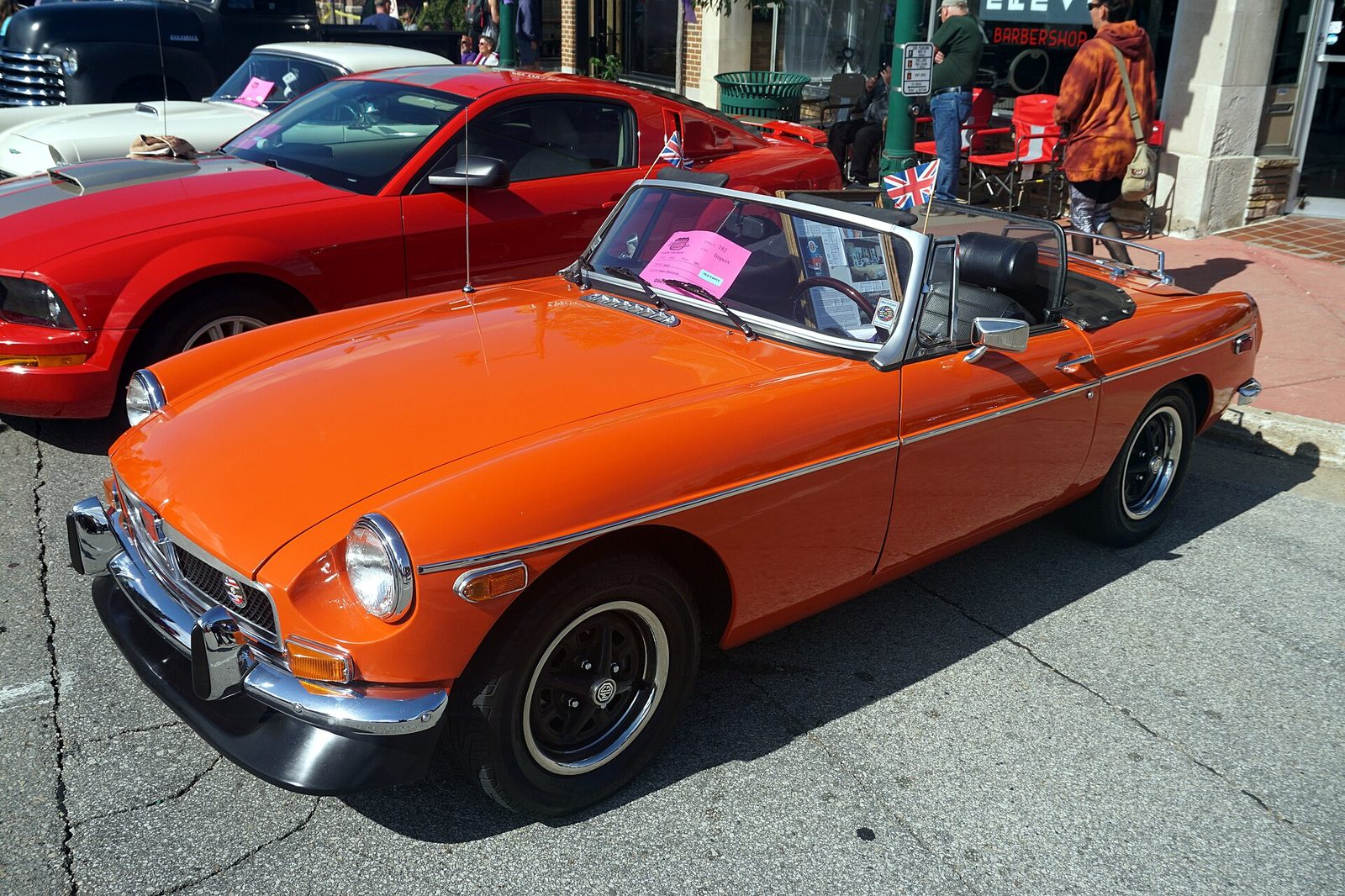
The MGB replaced the MGA in September 1962 and stayed in production at Abingdon until October 1980, an eighteen-year run that made it, on the figures its own registers publish, the best-selling sports car in the world until the Mazda MX-5 passed it. The central engineering decision was structural: where the MGA sat on a separate chassis, the MGB used a steel monocoque, which cost nothing in weight and bought a roomier cockpit and a far stiffer shell. The 1,798 cc B-series four gained a five-bearing crankshaft in October 1964; a Pininfarina-influenced GT arrived in 1965; a six-cylinder MGC and a Rover-engined GT V8 came and went in small numbers. From the 1974-and-a-half model year American bumper legislation brought black polyurethane bumpers and a raised ride height that cost the car much of its poise, and the chrome-versus-rubber divide that followed still sets prices. Parts supply is better than for almost any other classic, complete bodyshells included.
MGB
MGB (Roadster and GT)
History
From MGA to Monocoque
The MGB was developed at Abingdon as ADO23 under chief engineer Syd Enever, whose brief was to replace an MGA whose sales were falling away. The shape came from MG's own Don Hayter with assistance from Pininfarina, but the decision that mattered most was underneath it: a steel monocoque in place of the MGA's separate chassis and body. Classic Motorsports records that the unitary shell saved around forty pounds and freed up interior space at the same time, a rare change that improved stiffness, weight and packaging together. The first production car, GHN3-101, was completed in May 1962 with the three-bearing 18G engine, and Motor greeted the car that autumn as a modern sports car with a marked bias towards grand touring character. North America was the target from the start, and Ate Up With Motor records a base US price of $2,658 at launch, roughly $200 under a Triumph TR4 and about $75 under a Sunbeam Alpine.
Five Bearings, and a Roof by Pininfarina
The original 1,798 cc B-series four carried a three-main-bearing crankshaft inherited from the MGA. In October 1964 a five-bearing crankshaft replaced it and the prefix changed from 18G and 18GA to 18GB, a durability change rather than a power one: the rating stayed at about 95 hp at 5,400 rpm. The other defining addition came in 1965, when the MGB GT appeared with a greenhouse designed by Pininfarina grafted onto the roadster's lower body. Britain took to it immediately, and Classics World records that by 1970 the domestic ratio had reached roughly ten GTs to every roadster, while North America went on buying open cars. The Mk II of 1967 brought the all-synchromesh gearbox developed for the MGC and dual-circuit brakes.
The Six and the Eight
Two attempts to give the MGB a larger engine both failed commercially. The MGC of 1967 used a 2,912 cc seven-bearing C-series six that the North American MGB Register records as 209 lb heavier than the four, forcing a complete redesign of the front suspension around torsion bars, a bulged hood and fifteen-inch wheels; it was withdrawn in August 1969, its reputation already fixed by launch cars handed to the press on the wrong tire pressures. The MGB GT V8 of 1973 was the better car and the worse proposition: the alloy 3,528 cc Rover unit weighed slightly less than the iron four, gave 137 hp and 193 lb-ft and made the GT a genuine 125 mph car, but it looked almost identical to a standard GT, cost far more, was never federalized for the United States, and arrived in the same season as the oil crisis.
Federal Legislation and the Rubber Bumper
The MGB's largest market was North America, and American regulation therefore shaped it. NHTSA's own evaluation of the bumper standard records FMVSS 215 taking effect on 1 September 1972 with a 5 mph front and 2.5 mph rear requirement, tightening to 5 mph at both ends for 1974. MG's answer from the 1974-and-a-half model year was a steel-reinforced black polyurethane bumper at each end, and because those bumpers had to sit within a mandated height band on a car with a low nose, the ride height went up with them. The suspension geometry did not. For 1975 the front anti-roll bar was deleted as a cost saving, and Classic Motorsports notes press reports that the car felt tippy in corners; a rear bar became standard for 1977 and the settings were retrieved. American cars suffered separately under emissions rules, dropping to a single 1.75-inch Zenith-Stromberg carburetor for 1975 and about 62.5 net horsepower, against roughly 97 hp DIN still available in Britain.
Abingdon Closes
British Leyland announced the closure of Abingdon in September 1979, having concluded that the MGB was taking sales from the Triumph TR7. A planned O-series re-engineering for 1981 was never built. The last cars were Limited Editions stockpiled through the autumn of 1980, and the final two carried chassis numbers 523001 and 523002. No successor followed from the same plant, and the bodyshell tooling later passed to British Motor Heritage, which still presses MGB shells at Witney on the original factory presses and jigs.
Common Problems
Corrosion is the dominant fault and the only one that is routinely terminal. Beyond the sills and floors, wings, wheel arches, door bottoms, hood and the GT's tailgate all rot, and the shell hides advancing structural decay well until it becomes unavoidable. Mechanically the B-series is durable, particularly in five-bearing form. Blue smoke on start-up points to valve guides and on the overrun to bores; knocks from the bottom end mean a full rebuild rather than a patch. A leaking rear crankshaft seal requires the engine out, which changes the economics of an otherwise minor job. Classic Motorsports records cylinder head cracking as a frequent failure, typically around number three, worn SU throttle shafts as a rebuild indicator, and cracked exhaust manifolds mainly on the single-carburetor federal cars, whose Zenith-Stromberg installation on its combined intake-exhaust manifold both lost power and created longevity problems. Gearboxes are tough; listen for layshaft rumble that stops when the clutch is depressed. Overdrive faults are usually electrical or low oil, and reconditioned units are a stocked item rather than a special order. Kingpins wear quickly without greasing, lever-arm dampers leak, lower wishbone bushes wear particularly on rubber-bumper cars, leaf springs sag and wire wheels lose spokes, which condemns the wheel. Electrical trouble is usually previous owners' alternator and pump conversions rather than the original loom.
What to Look For
Structure decides everything here, because the monocoque is the chassis. The sills are not a cosmetic panel but a multi-part assembly with inner, outer and castle sections, and Classics World notes that replacing them properly means cutting into the wings. Work along the floors, outriggers, jacking points and rear spring hangers, then the scuttle, windshield surround and door pillars, and reach up inside the front wing behind the wheel to feel the top ledge, which packs with mud and rots from the inside out. A car that flexes, or whose doors need lifting to shut, is saying something the paint is not. Set that against replacement cost: as of September 2026 Moss Motors lists British Motor Heritage structure for the car at $242 to $250 for a rocker or sill section, about $1,029 to $1,042 for a door and $1,177 to $1,472 for a fender, and Classic Motorsports put the parts for one side's rocker and inner section at about $180 in its own sill job. Panels are cheap next to the labor of fitting them, so a structurally spent car is an uneconomic restoration however low the asking price. Galvanized shells have been available since the early 1990s and are worth identifying. Confirm the engine prefix matches the claimed year: 18G and 18GA are three-bearing units, 18GB onwards five-bearing. Oil pressure should read about 15 psi at hot idle and 50-60 psi or more at speed. On rubber-bumper cars, establish whether the 1977-on suspension revisions are present, and treat a rubber-to-chrome conversion as a different car from an original chrome-bumper one. A Heritage Certificate from the British Motor Museum, whose MG records cover 1953 to 1980, confirms build and dispatch dates, engine and body numbers and original color.
Market Notes
As of September 2026, classic.com puts the MG B Roadster market benchmark at $10,993 on a falling trend, with an average sale of $11,279 and recorded results running from $850 for a 1964 project in November 2024 to $29,995 for a 1973 car in July 2026. The B GT benchmark is $12,372, also falling, average sale $12,093, with a $900 low in February 2025 and a $24,950 high for a 1967 car in August 2026; ordinary driver-grade GTs changed hands between $4,300 and $9,800 across July and August 2026. The scarcer variants sit above both: the B GT V8 benchmark is $22,165 across only six tracked sales, average $19,825, and the MG C averages $20,587 with roadster and GT benchmarks of $21,694 and $21,588 and a $45,000 high for a 1968 GT in September 2025. Hagerty's model comparison, read in September 2026, reaches a similar place from the other direction, putting very good cars at $10,000 to $15,000, noting unrestored examples that still turn up at $5,000 or less, and observing that auction results seldom exceed $25,000. Chrome-bumper cars command the premium throughout, and rubber-to-chrome converted cars trade below originals. What moves an individual car above benchmark is structural soundness, an unbroken history and originality rather than specification: there is no rare-model scarcity to trade on in the four-cylinder range.
Where sources differ
Published production totals for the MGB do not agree, and no single figure is asserted here.
MGOCNI, The MG Experience and the North American MGB Register give 386,961 roadsters and 125,282 GTs for 512,243 four-cylinder cars. Classic & Sports Car gives 386,789 roadsters. Classics World gives GT production as 125,323. Wikipedia gives 523,836 for MGB, MGC and MGB GT V8 combined, three cars adrift of the 523,833 the component figures produce. Classic Motorsports rounds to more than 513,000. Not resolved by any source consulted here, so productionTotal is null.
MGC production totals are given differently by different sources and no single figure is asserted here.
Car & Classic states 8,999 cars, split as 4,542 roadsters and 4,457 GTs. Hagerty states 9,009. AROnline says 'just over 9000' and MGOCNI 'about 9,000'. Only Car & Classic offers a body-style split. Not resolved by any source consulted here.
American bumper legislation, which NHTSA records as FMVSS 215 taking effect on 1 September 1972 at 5 mph front and 2.5 mph rear and tightening to 5 mph at both ends for 1974, forced the MGB's ride height up from the 1974-and-a-half model year, but sources disagree on how much.
Wikipedia states the suspension was raised by 1 inch (25 mm). The MG Experience states the chassis was raised 1.5 inches, and Classics World's GT guide agrees at 1.5 inches. Classic Motorsports describes the increase without quantifying it. The figure is not resolved by any source consulted here.
British Leyland announced the closure of Abingdon in September 1979, having concluded that the MGB was taking sales from the Triumph TR7, and the last two cars carried chassis numbers 523001 and 523002; sources give the completion date as either 22 or 23 October 1980.
The MG Experience states the last two MGBs, 523001 and 523002, were completed on 22 October 1980. AROnline states the last MGB roadster came off the line on 23 October 1980, and Ate Up With Motor also gives 23 October 1980. MGOCNI gives only October 1980. The one-day difference is not resolved by any source consulted here.
Laycock overdrive was an option fitted to under 20 percent of all MGBs, operating on third and fourth gears until 1977 and on fourth only thereafter, but sources disagree on when it became standard equipment.
Classic & Sports Car states that overdrive became standard in 1975. Classics World's GT guide states it was optional initially and became standard from 1977. Wikipedia establishes only the change in which gears it served, from 1977. The standardization date is not resolved by any source consulted here.
Sources
- MG MGB, Wikipedia · encyclopedia
- MGB development story - Britain's most successful sports car laid bare, AROnline · specialist
- All the Way from A to B: The History of the MGB, Part One (page 3), Ate Up With Motor · specialist
- All the Way from A to B: The History of the MGB, Part Two (page 4), Ate Up With Motor · specialist
- MGB Evolution and History 1962-1980, The MG Experience · specialist
- The MGB Story: Through the Production Years, MG Owners' Club Northern Ireland · club-forum
- MGB Register, North American MGB Register · registry
- MGC Register, North American MGB Register · registry
- MG MGC: Models, Specs, and Buyer's Guide, Car & Classic · journalism
- 1967-69 MGC, Hagerty Media · journalism
- Mighty Good Buys: Which MGB models are best?, Hagerty Media · journalism
- MGB GT V8, MG Owners' Club · club-forum
- MGB V8 Car numbers, MG Cars Enthusiasts' Club · registry
- The 1962-1980 MGB, Classic Motorsports · journalism
- Off Our Rockers, New Sills for This Old MGB, Classic Motorsports · journalism
- MGB Body Panels and Structure parts and accessories, Moss Motors · specialist
- MGB roadster buyer's guide: what to pay and what to look for, Classic & Sports Car · journalism
- MGB buyer's guide, Classics World · journalism
- MGB GT buyer's guide, Classics World · journalism
- Road Test - 1965 MGB Roadster, Classics World · journalism
- An Evaluation of the Bumper Standard - As Modified in 1982, US National Highway Traffic Safety Administration · government
- British Classic MGB Roadster bodyshells, British Motor Heritage · specialist
- Heritage Certificates, British Motor Museum · registry
- Factory Records, MG Car Club · club-forum
- 1967 MG MGB Roadster, Amelia Island 2017, RM Sotheby's · auction-house
- MG B Roadster Market, classic.com · market-data
- MG B GT Market, classic.com · market-data
- MG B GT V8 Market, classic.com · market-data
- MG C Market, classic.com · market-data
Synthesized from the sources above and cross-checked. We cite and link out; we do not republish other databases verbatim.
Fully Sorted is an independent publisher and is not affiliated with, endorsed by or sponsored by MG. MG and the model names on this page are trademarks of their respective owners and are used here only to identify the cars being described.
Chassis register
Nobody has recorded a car here yet. Own one, or know one? Chassis number, what you can prove about it, and a source if there is one. Every entry is reviewed before it appears.
Nerd Notes
What owners know that the sources don't. Every note is read and checked before it appears here.
Key Specs
- Power
- About 95 hp at 5,400 rpm as launched and about 97 hp DIN in late UK trim; North American output fell to roughly 62.5 net hp for 1975 and about 67 net hp by 1980. MGC 145 hp; MGB GT V8 137 hp at 5,000 rpm
- Engine
- 1,798 cc BMC B-series OHV four; three-bearing (18G, 18GA) to October 1964, five-bearing thereafter (18GB, then 18GF/18GH/18GK/18GV/18V)
- Layout
- Front-mounted longitudinal engine, rear-wheel drive; two-seat roadster or 2+2 hatchback coupe
- Torque
- About 110 lb-ft for the 1,798 cc four, peak rpm not stated by the sources consulted; MGB GT V8 193 lb-ft at 2,900 rpm
- Weight
- Late rubber-bumper cars over 2,400 lb curb; the monocoque saved roughly 40 lb against the MGA
- Wheels
- Fourteen-inch wheels on the MGB, steel or optional center-lock wire; fifteen-inch on the MGC
- Chassis
- Steel monocoque replacing the MGA's separate chassis; roughly 40 lb lighter and roomier than the MGA structure
- Engine v8
- 3,528 cc Rover alloy V8, twin SU HIF6, 8.25:1, 88.9 x 71.1 mm; Wikipedia quotes 3,532 cc (MGB GT V8, 1973-1976)
- Overdrive
- Laycock overdrive optional, on third and fourth until 1977 and fourth only thereafter; fitted to under 20 percent of MGBs, with sources disagreeing on whether it became standard in 1975 or 1977
- Top speed
- About 103 mph recorded for a 1965 roadster; MGC 120 mph; MGB GT V8 125 mph
- Engine mgc
- 2,912 cc seven-bearing BMC C-series straight-six, twin SU carburetors, 145 hp at 5,250 rpm, about 209 lb heavier than the four (MGC, 1967-1969)
- Ride height
- Raised for 1974.5 to bring the impact bumpers within the mandated US height band; stated as 1 inch (25 mm) by Wikipedia and 1.5 inches by The MG Experience and Classics World
- Acceleration
- Just over 11 seconds to 60 mph on the manufacturer figure, with a 1965 car recorded at 10 seconds; MGC 10.0 seconds; MGB GT V8 quoted at 7.7 to 8.5 seconds
- Transmission
- Four-speed manual, no synchromesh on first until the 1967 Mk II adopted the all-synchromesh MGC gearbox; three-speed Borg-Warner automatic optional until 1973
- Anti roll bars
- Front bar deleted for the 1975 model year and offered only as an option; rear bar standard from 1977
- Suspension rear
- Live axle on semi-elliptic leaf springs with lever-arm dampers; Salisbury-type axle on the GT
- Suspension front
- Coil springs and wishbones with lever-arm dampers; MGC substituted torsion bars with telescopic dampers to clear the six
Notable Variants
MGB Mk I roadster (1962-1967)
Pull-handle cars to 1964 use the three-bearing 18G or 18GA engine and external door handles; Hagerty rates them close behind the 1966-67 cars at the top of the desirability order.
MGB with five-bearing 18GB (October 1964 on)
Same 95 hp rating, materially stronger bottom end. Classics World calls the five-bearing unit particularly robust and Classic Motorsports rates 1966-67 cars the sweet spot.
MGB GT (1965-1980)
Pininfarina-designed greenhouse on the roadster's lower body. Outsold the roadster in Britain by roughly ten to one by 1970 and has long been the cheaper of the two to buy.
MGB Mk II (1967-1969)
All-synchromesh gearbox derived from the MGC and dual-circuit brakes. The first MGB with synchromesh on first gear.
MGC and MGC GT (1967-1969)
2,912 cc seven-bearing six, torsion-bar front suspension, bulged hood, fifteen-inch wheels. Launch press cars ran incorrect front tire pressures and the understeer they reported has shadowed the car since.
MGB GT V8 (1973-1976)
3,528 cc alloy Rover V8, 137 hp, GT bodyshell and right-hand drive only, never sold new in the United States; 1,839 chrome-bumper cars and 742 rubber-bumper.
Rubber-bumper MGB and MGB GT (1974.5-1980)
Polyurethane bumpers, raised ride height, front anti-roll bar deleted for 1975 and a rear bar added for 1977. The cheapest way into the model and the configuration the market still discounts.
Jubilee and Limited Edition models (1975, 1979-1980)
751 British Racing Green Jubilee GTs in 1975; 6,668 North American Limited Editions in 1979-80; 1,001 UK Limited Editions in 1980, 580 GTs and 421 roadsters.
Value Trajectory
The MGB has never been a scarce car and its values reflect that. As of September 2026 classic.com shows both mainstream body styles drifting down, the roadster benchmark at $10,993 and the GT at $12,372, each on a falling trend, which leaves the GT marginally the dearer of the two after years as the cheap way in. Ordinary cars trade well under those benchmarks, GTs selling between $4,300 and $9,800 in July and August 2026, while the ceiling for a standard car sits close to the $25,000 Hagerty describes as the practical auction limit. Provenance rather than specification is what breaks it: RM Sotheby's sold a two-owner 1967 roadster with a documented restoration for $38,500 at Amelia Island in March 2017. The structural constraint on the whole market is that restoration cost is largely independent of purchase price, since outer panels alone run into four figures apiece and a complete new shell is still pressed at Witney. A poor car cannot be economically rescued while a sound one is cheap to keep. That has kept good cars scarcer than the production figures suggest, and left the rubber-bumper cars, mechanically the same underneath, as the clearest remaining value in the range.
Shopping for one?
Browse MG listings, or decode a VIN before you buy.