
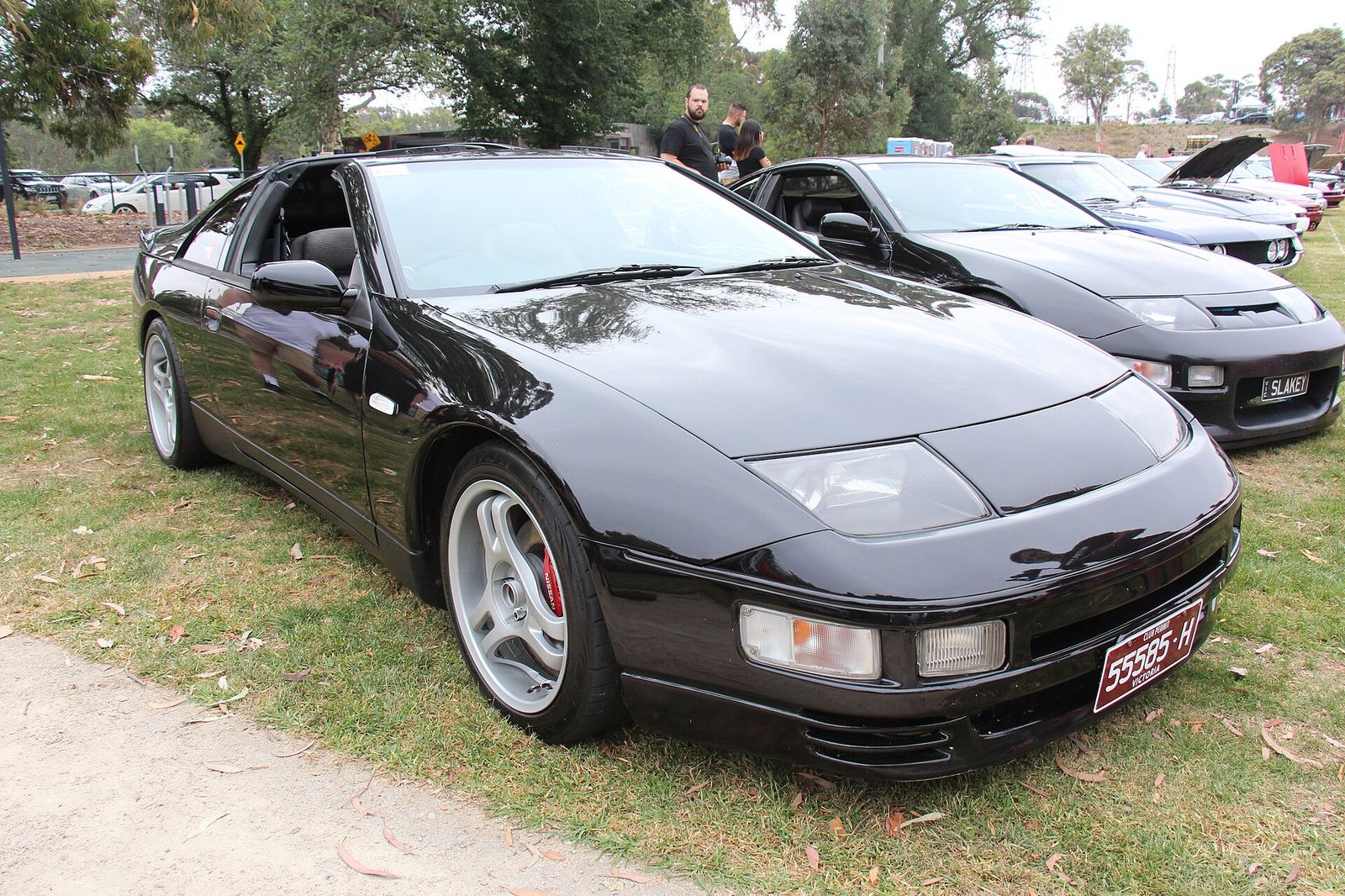
The Z32 Nissan 300ZX replaced the Z31 in 1989 and stayed in production for eleven years, sold at home as the Fairlady Z and everywhere else as the 300ZX. Nissan approved the shape in October 1986 and developed the body with CAD on a Cray supercomputer, then built it around a 2,960 cc DOHC V6 offered either naturally aspirated or, as the VG30DETT, with two parallel Garrett turbochargers and a pair of intercoolers. Export twin-turbo cars were rated at 300 hp; Japanese cars carried 276 hp, because the domestic industry had just agreed among itself not to advertise more. Multi-link suspension at both ends, four-piston aluminum calipers and Super HICAS rear-wheel steering made it the most technically ambitious Z yet and also the hardest to service, since almost nothing under the hood can be reached without removing something else first. It sold in huge numbers in America in 1990, then faded as the yen rose and the price climbed, and Nissan withdrew it from the United States after 1996. Japanese production continued until 2000.
300ZX
Z32 (fourth-generation Z)
History
Drawn in Three Dimensions
Nissan management approved the Z32's final form on 1 October 1986, from work by Isao Sono and Toshio Yamashita, and developed the body with CAD software running on a Cray supercomputer, among the first production cars designed that way rather than modeled in clay and shaped in a wind tunnel. It abandoned the Z31's pop-up lamps for fixed faired units and a wide, low, cab-forward stance, though not for slipperiness alone: the drag coefficient came out at 0.31, marginally worse than the car it replaced. Japan saw it in July 1989, twenty years after the original S30, and America received it as a 1990 model.
One Engine, Three Published Outputs
The 2,960 cc V6 came two ways. The VG30DE was a naturally aspirated DOHC 24-valve unit with variable intake cam timing and coil-on-plug ignition, quoted at 222 hp for the United States. The VG30DETT added two parallel Garrett turbochargers, two intercoolers, oil-cooled pistons and a lower 8.5:1 compression ratio, and was rated at 300 hp and 283 lb-ft for export. In Japan the same engine was advertised at 276 hp. That figure was not a mechanical fact but a commercial one: at the end of 1988 the major Japanese manufacturers settled on a voluntary ceiling of 276 hp for domestic advertising, a restraint that held until 2004, and the Z32 was the first car marketed under it. Continental European cars, tuned for different emissions rules, were quoted at 225 hp. One engine, three numbers, and only one of them describes anything mechanical.
Chassis Ambition and Its Price
Underneath was multi-link suspension front and rear, ventilated discs with opposed four-piston aluminum calipers at both ends, two-mode adjustable damping on turbo cars, and Super HICAS rear-wheel steering, which steers the rear wheels briefly out of phase with the fronts to rotate the car into a corner, then brings them into phase to settle it; actuation was hydraulic until 1993 and electric from 1994. All of it had to be packaged under a low hood line, and the consequence is the defining ownership fact about the car: there is effectively no free space in the engine bay. The camshaft belt is an interference design due every 60,000 miles or 48 months and takes around five hours simply to reach. Replacing injectors or resealing a cam cover means removing the upper intake plenum. Jobs that are an hour on other cars are a day here, and that arithmetic has governed how these cars have been maintained, or not, for thirty years.
Roofs, a Convertible, and the 1994 Revisions
Every Z32 initially carried T-bar roof panels; a fixed-roof slicktop two-seater followed, and a longer-wheelbase 2+2 sat on 101.2 in (2,570 mm) against the two-seater's 96.5 in (2,451 mm). A convertible was announced in August 1992 and sold in America from 1993, naturally aspirated only. The 1994 model year brought the most visible revision of the run: a taller pedestal-type rear spoiler, a passenger airbag as standard, seatbelt anchorages moved from the doors to the pillars, keyless entry, and the switch of Super HICAS to electric actuation.
Daytona, Le Mans, and the Retreat from America
In 1994 Clayton Cunningham Racing's 300ZX Turbo won the Daytona 24 Hours outright from the GTS class and took the IMSA GTS class at Le Mans with fifth overall for Steve Millen, Johnny O'Connell and John Morton. The showroom story ran the other way. American volume fell from around 39,000 cars in 1990 to under 3,000 in 1996 as the yen strengthened, buyers moved to sport utilities and the price climbed: a 1990 Turbo listed near $33,000, a 1996 Turbo at $45,422. Nissan withdrew the Z from the United States after 1996, marking the last 300 cars as a Commemorative Edition, and did not return until the 350Z of 2003. In Japan the Fairlady Z carried on quietly until 2000.
Common Problems
Heat is the root of most of it. The engine bay runs hot and packs tightly, and over three decades that has degraded wiring looms, vacuum lines and connectors, with early cars worst affected. The camshaft belt is an interference design: a failure destroys valves and pistons, and reaching it takes about five hours before any parts are fitted. Owner accounts put the full belt package at roughly $450 in Nissan parts and eight to nine hours of dealer labor, with factory turbocharger seals typically weeping from 60,000 to 80,000 miles and a complete turbo replacement quoted at 15.7 hours plus around $2,400 in parts; one long-term owner budgets $3,000 a year beyond fuel, oil and insurance. Fuel injectors and their hoses leak with age, and replacing them means removing the upper plenum. Ignition coils and the ignition power transistor unit fail, often announced by a light rapid ticking. Alternators fail; pre-1991 master cylinders leak; early variable cam timing springs weaken; automatic transmissions overheat; front tension-rod bushings perish; T-top seals let water in and corrode the seat rails. NHTSA's database returns no recall campaigns at all for the 1990-1996 300ZX; the one campaign it holds for the nameplate, 95I006000 of January 1995, covering leaking fuel injectors and hoses, is filed against the earlier Z31 model years.
What to Look For
Documented cam-belt history comes first. The interval is 60,000 miles or 48 months, the engine is an interference design, and the job is deep enough that owners defer it; a car without paperwork should be costed as though it is due, along with the water pump, tensioner, cam and crank seals and coolant hoses done at the same time. Ask whether the upper plenum has ever been off and whether a coolant bypass was fitted while it was, since that one modification makes every later job cheaper. Heat is the second theme: baked wiring insulation, brittle vacuum lines and crumbling connectors, worst on early cars. On turbo models watch for smoke on overrun pointing to turbo seals, which typically weep between 60,000 and 80,000 miles. Check that Super HICAS still functions rather than having been locked out with an eliminator bar. Bodily, T-top cars leak and rot their seat rails, and cars that have lived through salted winters add sill corrosion in a triple-layer structure that needs a specialist, plus rear arches; pre-1991 master cylinders leak and front tension-rod bushings perish. Establish the body exactly - 2+0 or 2+2, T-top or slicktop, turbo or naturally aspirated - because the value spread between them is wider than the condition spread within any one of them. Modified turbo cars are the norm rather than the exception, and standard, unopened examples carry the premium. On a Commemorative Edition, the number and its certificate are the car.
Market Notes
As of September 2026, classic.com's benchmark for the twin-turbo Z32 stands at $28,182 against an average recorded sale of $29,815, with the trend arrow pointing down and tracked results running from $4,500 for a 1992 car in November 2022 to $55,000 for a 1991 twin turbo in September 2026. Recent ordinary transactions sit a long way below that ceiling: $37,000 for a 1991 car on 31 August 2026, $25,500 for a 1990 car on 14 August 2026 and $21,000 for a 1993 car on 20 August 2026. The naturally aspirated car sits well below the turbo on the same date, at a $13,103 benchmark and a $15,551 average as of September 2026, its lowest tracked result $3,600 for a 1990 project car in October 2025, also trending down. Japanese-market Fairlady Z imports are tracked separately and lower again: an $11,383 benchmark and a $12,621 average as of September 2026, the lowest tracked sale $5,350 for a 1990 2+2 in March 2026. Across the generation as a whole classic.com shows a benchmark and average of $23,827 as of September 2026. Auction results follow the same pattern, a modified 31,000-mile 1993 Turbo selling for $25,300 at Mecum Kissimmee on 9 January 2025, and the headline numbers belong to preservation cars rather than to the model. A 1996 Commemorative Edition, number 300 of 300, showing around 530 miles and previously displayed at the Petersen Automotive Museum, made $90,100 in 2017 against a 1996 Turbo list price of $45,422; a 920-mile car had made $69,900 the year before.
Where sources differ
Published acceleration figures for the twin turbo do not agree, and no single measured figure is asserted here.
Supercars.net gives 5.6 seconds to 60 mph and a 13.7-second quarter mile at 102 mph. Grassroots Motorsports gives 6.0 seconds and 14.4 seconds at over 102 mph. Hagerty UK gives 5.2 seconds to 60 mph. None of the three says which test, which car or which conditions produced its figure, and the conflict is not resolved by any source consulted here.
Total Z32 production is stated as either 164,170 cars or 164,534 cars depending on the source, and no single figure is asserted here.
Wikipedia gives 164,170 cars split 99,286 export and 64,884 domestic. The JDM Registry gives a worldwide total of 164,534 and a Japanese domestic figure of 65,083. Neither source accounts for the other's arithmetic and the difference is not resolved by any source consulted here, so productionTotal is left null.
The year-by-year United States figures differ between sources and are not directly comparable.
ZHome and the Z32 Wiki give model-year build figures of 39,104 for 1990 and 2,629 for 1996. Wikipedia gives 39,290 for 1990, 17,652 for 1991 and 2,929 for 1996 as sales. ZHome states explicitly that its figures are model-year builds taken from VINs rather than calendar-year sales, which explains the direction of the gap but not its size in every year; the discrepancy is not resolved by any source consulted here.
Sources
- Nissan Heritage Collection - FairladyZ 2by2 300ZX Twin-Turbo, Nissan Motor Co. · manufacturer
- Datsun and Nissan Fairlady / Z Heritage, Nissan North America · manufacturer
- Le Mans 1994 - Nissan and the 300ZX Turbo win the IMSA GTS, Automobile Club de l'Ouest · journalism
- 1994 24 Hours of Daytona, Wikipedia · encyclopedia
- Nissan 300ZX, Wikipedia · encyclopedia
- Production - Z32 Wiki, Concept Z Performance (Z32 Wiki) · specialist
- Intake Manifold Removal - Z32 Wiki, Concept Z Performance (Z32 Wiki) · specialist
- Timing Belt Service - Z32 Wiki, Concept Z Performance (Z32 Wiki) · specialist
- HICAS - Z32 Wiki, Concept Z Performance (Z32 Wiki) · specialist
- Z Car Production, ZHome · registry
- Costs Associated With Major Maintenance Intervals, ZHome · specialist
- Z32 Production Matrix - Colors & Variants, The JDM Registry · registry
- Z32-chassis Nissan 300ZX Buyer's Guide, Grassroots Motorsports · journalism
- $90,100 Nissan 300ZX puts a big price on nostalgia, Hagerty · journalism
- Buying Guide: 1990-96 Nissan 300ZX, Hagerty UK · journalism
- Nissan 300ZX Twin Turbo - Z32 Market, classic.com · market-data
- Nissan 300ZX - Naturally Aspirated - Z32 Market, classic.com · market-data
- Nissan Z-car - Z32 Market, classic.com · market-data
- Nissan Fairlady Z - Z32 Market, classic.com · market-data
- 1993 Nissan 300ZX Turbo sold at Mecum Kissimmee (2025), classic.com · market-data
- Vintage Reviews: 1990 Nissan 300ZX Turbo - Porsche Likes Luxury, Curbside Classic · journalism
- The Japanese Gentlemen's Agreement on Horsepower, autoevolution · journalism
- Recalls by Vehicle API - Nissan 300ZX, model year 1990, National Highway Traffic Safety Administration · government
- 1990 Nissan 300ZX Twin Turbo Guide: Specs, Performance & More, Supercars.net · specialist
Synthesized from the sources above and cross-checked. We cite and link out; we do not republish other databases verbatim.
Fully Sorted is an independent publisher and is not affiliated with, endorsed by or sponsored by Nissan. Nissan and the model names on this page are trademarks of their respective owners and are used here only to identify the cars being described.
Chassis register
Nobody has recorded a car here yet. Own one, or know one? Chassis number, what you can prove about it, and a source if there is one. Every entry is reviewed before it appears.
Nerd Notes
What owners know that the sources don't. Every note is read and checked before it appears here.
Key Specs
- Power
- 222 hp (VG30DE, US); 300 hp (VG30DETT, US and export); 276 hp as advertised in Japan; 225 hp for mainland Europe - all at 6,400 rpm, all manufacturer claims
- Brakes
- Ventilated discs all round, with opposed four-piston aluminum calipers front and rear on turbo cars
- Engine
- 2,960 cc VG30DE or VG30DETT 60-degree DOHC 24-valve V6 with variable intake cam timing; two parallel Garrett turbochargers and two intercoolers on the DETT
- Layout
- Front mid-mounted longitudinal V6, rear-wheel drive
- Torque
- 198 lb-ft at 4,800 rpm (VG30DE, US); 283 lb-ft at 3,600 rpm (VG30DETT, US); 286 lb-ft quoted by Nissan for the Japanese twin turbo
- Weight
- 3,289 lb for a 1995 US naturally aspirated 2+0 hardtop to 3,583 lb for a 2+2 turbo; Nissan quotes 3,461 lb for the Japanese 2+2 twin turbo
- Chassis
- Unitary steel body with front and rear subframes; 2+0 and long-wheelbase 2+2 shells
- Steering
- Rack and pinion; Super HICAS rear-wheel steering on turbo models, hydraulic to 1993 and electric from 1994
- Top speed
- 155-156 mph, electronically limited
- Wheelbase
- 96.5 in (2,451 mm) (96.5 in) for the 2+0; 101.2 in (2,570 mm) quoted by Nissan for the 2+2
- Dimensions
- 169.5 x 70.5 x 49.2 in (4,305 x 1,791 x 1,250 mm) for the 2+0; 178.1 x 70.9 x 49.4 in (4,525 x 1,800 x 1,255 mm) quoted by Nissan for the 2+2
- Suspension
- Multi-link front and rear; two-mode adjustable damping on turbo cars
- Valvetrain
- Twin overhead camshafts per bank, four valves per cylinder, coil-on-plug ignition
- Acceleration
- 0-60 mph published between 5.2 and 6.0 seconds for the twin turbo and 6.5-6.7 seconds for the naturally aspirated car; sources disagree
- Transmission
- 5-speed manual standard, 4-speed automatic optional
- Drag coefficient
- 0.31, marginally worse than the Z31's 0.30
Notable Variants
300ZX (naturally aspirated, United States)
VG30DE at 222 hp, sold as a 2+0 T-top, a fixed-roof slicktop from 1991 and a 2+2. Two thirds of American Z32 production was naturally aspirated, so good turbo cars are the scarce half of the market.
300ZX Twin Turbo (United States and export)
VG30DETT at 300 hp with Super HICAS and two-mode adjustable damping, sold in the United States only as a 2+0 T-top. Zhome counts 18,274 American turbo cars against 67,036 naturally aspirated.
300ZX Convertible
Announced August 1992 and sold in the United States from 1993, naturally aspirated only. Zhome and the Z32 Wiki both count 3,846, making it the rarest mainstream US body style.
Fairlady Z Version S (Japan)
The configurable domestic specification, across both bodies and either engine, with a long options list including Recaro seats, Bose audio, ABS and, on turbo cars, Super HICAS.
Fairlady Z Version R (Japan)
A pre-packaged domestic grade on the long-wheelbase 2+2, bundling Recaro seats, side skirts, rear spoiler, ABS, xenon headlamps and climate control below the sum of the options. Often claimed on cars that are not one.
300ZX Turbo Commemorative Edition (1996, United States)
The final 300 American cars, numbered and supplied with decals and certificates of authenticity. The one Z32 variant with a production figure nobody disputes, and the only one to have made six figures at sale.
UK and European 2+2 Twin Turbo
Continental cars were 2+2 twin turbos rated at 225 hp; Britain also received the two-seater. UK sales stopped in 1994, two years before the United States, which is why gray imports dominate the British market.
Value Trajectory
The Z32's value curve is unusual in that it has already flattened. American cars depreciated conventionally through the 1990s and 2000s, when a car with an eight-hour timing belt and a full engine bay was worth less than the cost of putting it right, and a great many were modified, tracked or abandoned. The first real re-rating came with the wave of nostalgia for 1990s Japanese performance cars: by 2016 and 2017, preservation examples were making $69,900 and then $90,100, and Hagerty's commentary at the time treated those results as evidence the model had reached the collector market while cautioning that ordinary cars had not moved with them. That caution reads correctly now. As of September 2026 classic.com shows both the twin turbo and the naturally aspirated car trending downward from benchmarks of $28,182 and $13,103. The market has sorted itself into two populations that are barely connected: numbered, documented, unmodified cars with service history, and everything else. That gap is now wider than the gap between a turbo and a non-turbo, and the supply of the first population does not grow.
Next
Shopping for one?
Browse Nissan listings, or decode a VIN before you buy.