
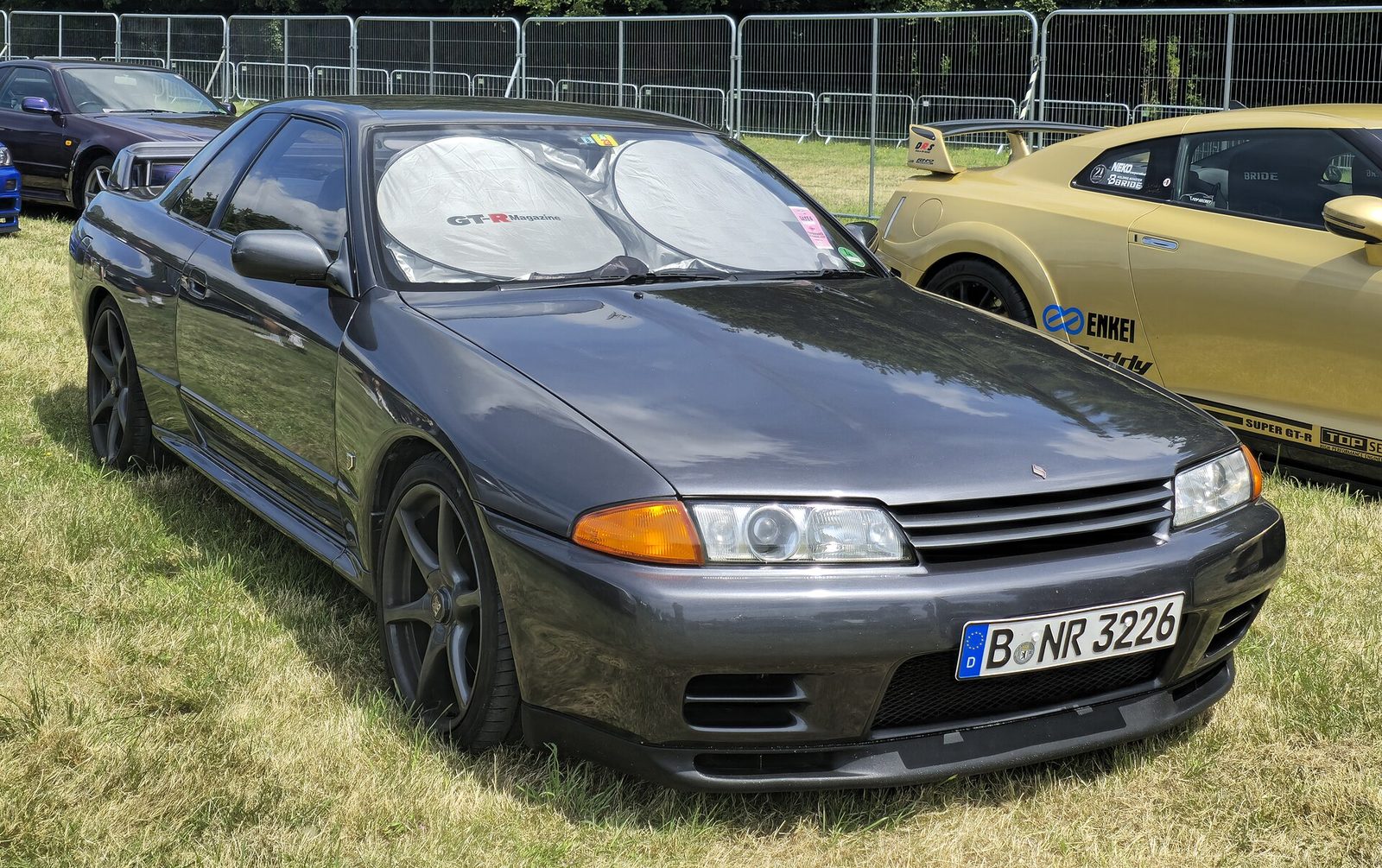
The R32 Skyline GT-R (BNR32) revived a badge dormant since 1973 and was built for one purpose: to win FIA Group A touring car racing. Nissan sized the RB26DETT at 2,568 cc so the turbo equivalency factor placed the car in the 4.5-liter class and its widest permitted tires, then wrapped that iron-block, twin-turbo straight six in ATTESA E-TS electronically controlled torque-split all-wheel drive and Super-HICAS four-wheel steering. Factory output was quoted at 276 hp in line with the Japanese manufacturers' gentlemen's agreement, though independent testing consistently found well over 300 hp. It worked: 29 wins from 29 starts and four consecutive Japanese titles from 1990 to 1993, plus back-to-back Australian championships and Bathurst 1000 victories in 1991 and 1992, where the Australian press named it Godzilla. Sold new almost exclusively in Japan, the R32 reached the United States only from 2014 under the 25-year import exemption, and has since become the entry point to serious GT-R collecting.
History
Reviving the Badge for Group A
Nissan had not used the GT-R name since the KPGC110 of 1973. It returned in August 1989, three months after the R32 Skyline range launched, and the reason was regulatory rather than nostalgic. Group A touring car rules derived a car's class from swept volume multiplied by a turbocharged equivalency factor, and Nissan chose 2,568 cc so the RB26DETT landed in the 4.5-liter class, which carried the widest tires available under the regulations. Group A also required a base homologation run of 5,000 cars within twelve months, with a 500-car evolution allowance on top. Nissan expected to build the minimum; demand ran far past it and production was left open, ultimately running to roughly 44,000 cars over five years.
RB26DETT and the 276 hp Convention
The engine is a cast-iron block with an alloy four-valve head, twin ceramic-turbine Garrett turbochargers, an air-to-air intercooler and six individual throttle bodies, redlined at 8,000 rpm. Nissan rated it at 276 hp at 6,800 rpm with 260 lb-ft at 4,400 rpm, a figure set by the informal agreement among Japanese manufacturers not to advertise more than 276 hp rather than by what the engine made. Independent measurement has repeatedly put flywheel output above 300 hp, with published estimates spanning roughly 310 to 327 hp. The competition engines were a separate matter again, running around 600 hp before regulators intervened.
ATTESA E-TS and Super-HICAS
The drivetrain is what separated the R32 from its rivals. ATTESA E-TS drives the rear axle by default and feeds torque forward through a hydraulically actuated multi-plate clutch, governed by a controller reading lateral acceleration, throttle position and wheel speeds. Super-HICAS adds hydraulic rear-wheel steering with roughly one degree of movement, engaging at speed to stabilize turn-in and lane changes. Both systems were unusual in a 1989 production car and both are now the source of the model's most common deferred-maintenance faults, with HICAS frequently locked out or removed entirely by owners.
Homologation Specials: Nismo and N1
The evolution car was the GT-R Nismo, homologated on 1 March 1990. Five hundred customer cars were built between December 1989 and March 1990, with a further sixty retained by Nissan for competition. The specification reflected the rulebook: steel-turbine Garrett turbochargers in place of the ceramic units, extra intercooler ducting, additional aerodynamic addenda, and the deletion of ABS (banned in Group A), the rear wiper and the stereo, for roughly 66 lb saved. All wore Gun Gray Metallic. From 1991 the N1 followed for Japan's N1 endurance category, stripped further still with no ABS, air conditioning or audio, uprated oil and brake cooling, and Crystal White paint only. N1 build counts differ between sources depending on whether the later V-Spec N1 and V-Spec II N1 cars are counted.
Godzilla
The racing record is the reason the car matters. In Japan the GT-R won all 29 races it contested between 1990 and 1993, taking the title in each of those four seasons. In Australia it took the touring car championship in 1991 with Jim Richards and 1992 with Mark Skaife, and won the Bathurst 1000 in both years; the 1991 race record stood until 2010. Officials responded with weight penalties that took the cars from 2,998 lb in 1991 to 3,307 lb in 1992 and with mandated pop-off valves that cut power from roughly 640 hp to about 450 hp. The nickname Godzilla came from the Australian motoring press, and the car's dominance is widely credited with ending Group A in Australia and pushing the sport toward the V8 formula that became Supercars.
Common Problems
The RB26DETT's most notorious failure is the oil pump drive: the standard crank collar is undersized for sustained high rpm and can crack at the gear interface, an issue serious enough that replacement is routine on any rebuilt or tuned engine. Leaking oil pump backing plates affect both early and late crankshaft designs. The original ceramic turbine wheels can shatter if boost is raised much beyond standard or the rev limiter is used habitually, and turbo oil seals degrade with age, producing white smoke. Bodyshell corrosion is widespread on Japanese-market cars given local winter road salting. ATTESA E-TS suffers hydraulic pump failures and leaking accumulator seals; Super-HICAS fails or is deliberately locked out. Age-related items are constant: tired bushings and dampers, worn clutches (rapid standing starts are the R32's natural habitat), driveshaft and differential clunk, warped brake rotors and perished brake hydraulics. Aging fuel pumps are marginal for anything beyond standard output. The engine is complex and expensive to rebuild, and parts supply, while supported by Nismo Heritage, is not cheap.
What to Look For
Rust is the first check on any Japanese-market car: rear quarter panels, the base of the C-pillars where weatherstripping shrinks and traps water, strut-tower tops in the engine bay, and floor and sill seams damaged by careless jacking. Specialists warn that some export sellers cosmetically disguise corrosion, so inspect underneath and behind trim rather than accepting photographs. Verify the oil pump specification and any documented rebuild history, since the early crankshaft drive collar is the engine's known weak point. Confirm boost has not been raised beyond standard on original ceramic-turbine turbochargers. Check that ATTESA E-TS actually engages and that its hydraulic pump and accumulator are healthy, and establish whether Super-HICAS is functional, locked out or deleted. Drive the car: clutch condition, driveshaft and differential clunk, and brake pulsing are all common and none are cheap. Authenticate variant claims for Nismo, N1, V-Spec and V-Spec II cars against chassis records, as the value gap over a standard car is substantial. For US cars, confirm the build-date compliance plate supports legal import.
Market Notes
As of August 2026, classic.com's R32 GT-R market benchmark stands at approximately $56,600, against a recorded low of $7,777 for a compromised 1994 project car sold in March 2023 and asking prices reaching around $150,000 for heavily modified examples; roughly a dozen cars were listed for sale at the time of reading. JDMBUYSELL's 2026 guide puts clean, well-documented GT-Rs in a $50,000-$90,000 band, with RB-engined non-GT-R GTS-t cars at $8,000-$25,000. Classic Motorsports cites recent results from $53,000 for a standard 1993 car to $126,500 for a 1994 V-Spec II, and $280,000 for a Hasemi Motorsport competition car, and notes Hagerty data showing values peaking in late 2022 and easing since. In Australia, where 100 cars were officially delivered in 1991, WhichCar puts the range at roughly AUD 40,000-150,000, with locally complied cars at a clear premium. Specification drives the spread: V-Spec II, Nismo and N1 cars, low mileage, unmodified drivetrains and clean Japanese auction sheets all command premiums, while modified, rusty or accident-repaired imports sell at steep discounts.
Where sources differ
The 276 hp rating reflected the Japanese manufacturers' gentlemen's agreement rather than measured output; independent testing places real flywheel output above 300 hp.
Published estimates of actual output differ: approximately 327 hp (Wikipedia), 313 hp (Supercar Nostalgia) and approximately 311 hp (Classic Motorsports). All agree the car exceeded its 276 hp rating; the precise figure is not settled, so a range is stated rather than a single number.
No single BNR32 production total is reliably established: commonly cited figures include 43,934 and 43,937, against 42,956 by chassis-number analysis and 43,896 from archived GT-R Registry data.
GTR USA's chassis-number reconciliation identifies roughly 978 cars unaccounted for between the GT-R Magazine figure of 43,934 and its own count of 42,956, and notes Japanese registrations of only 41,692 for 1989-1994. Hagerty and Wikipedia both publish 43,937. No primary Nissan production statement is publicly available, so productionTotal is left null.
The N1 was a stripped homologation variant for Japan's N1 racing category introduced in 1991, without ABS, air conditioning or audio and painted only in Crystal White.
Build counts differ by scope and by source: Hagerty gives 118 (pre-V-Spec cars only); Wikipedia gives 245 in total, comprising 118 N1, 64 V-Spec N1 and 63 V-Spec II N1; GTR USA's tally is 228. No single N1 figure is asserted here.
V-Spec (February 1993) added Brembo brakes, 17-inch BBS wheels and a revised ATTESA E-TS calibration, and V-Spec II (February 1994) followed with wider 245/45R17 tires.
Specification is consistent across sources but build counts are not: V-Spec is given as 1,453 by Hagerty and GTR USA and 1,396 by Wikipedia; V-Spec II as 1,303 by Hagerty and GTR USA and 1,306 by Wikipedia.
Sources
- Nissan Heritage Collection — Skyline GT-R (1989, BNR32), Nissan Motor Co. · manufacturer
- Here's your definitive Nissan Skyline R32 GT-R buyer's guide, Hagerty · journalism
- Nissan Skyline GT-R, Wikipedia · reference-book
- How Many R32 Nissan Skyline GT-R's were Made?, GTR USA Blog · club-forum
- Nissan Skyline Production Numbers: R32, R33, R34 GT-R Guide, GTR USA Blog · club-forum
- Nissan R32 Skyline GT-R Nismo N1 Guide, Supercar Nostalgia · journalism
- Nissan R32 Skyline GT-R Guide, Supercar Nostalgia · journalism
- When Nissan ruled Australia with its 'Godzilla' Group A special, Autosport · journalism
- Nissan Skyline GT-R — R32 Market, classic.com · market-data
- R32 Nissan Skyline GT-R: Buy one now?, Classic Motorsports · journalism
- 2026 Nissan Skyline R32 Buyer's Guide, JDMBUYSELL · journalism
- The US 25-Year Car Import Rule — What It Means, JDMBUYSELL · journalism
- Tips for buying a Nissan BNR32 Skyline GT-R, WhichCar (Wheels/Are Media) · journalism
Synthesized from the sources above and cross-checked. We cite and link out; we do not republish other databases verbatim.
Fully Sorted is an independent publisher and is not affiliated with, endorsed by or sponsored by Nissan. Nissan and the model names on this page are trademarks of their respective owners and are used here only to identify the cars being described.
Chassis register
Nobody has recorded a car here yet. Own one, or know one? Chassis number, what you can prove about it, and a source if there is one. Every entry is reviewed before it appears.
Nerd Notes
What owners know that the sources don't. Every note is read and checked before it appears here.
Key Specs
- Brakes
- Ventilated discs all round; Brembo four-piston front calipers on V-Spec and V-Spec II
- Engine
- 2,568 cc RB26DETT DOHC 24-valve inline-6, twin turbochargers
- Layout
- Front engine, ATTESA E-TS electronically controlled torque-split all-wheel drive
- Redline
- 8,000 rpm
- Steering
- Super-HICAS hydraulic four-wheel steering; rear wheels steer up to about one degree
- Suspension
- Four-wheel multi-link
- Curb weight
- Approximately 3,153 lb standard; approximately 3,086 lb for the Nismo evolution car
- Rated power
- 276 hp at 6,800 rpm (Nissan factory rating)
- Actual power
- Independently tested well above the rating; published figures range from roughly 310 hp to about 327 hp at the flywheel
- Rated torque
- 260 lb-ft at 4,400 rpm
- Transmission
- 5-speed manual, floor shift (no automatic offered)
- Wheels tires
- 16-inch on standard cars; 17-inch BBS with 225/50R17 (V-Spec) or 245/45R17 (V-Spec II)
- Production dates
- August 1989 to November 1994
Notable Variants
GT-R (standard)
The volume car: RB26DETT, ATTESA E-TS all-wheel drive, Super-HICAS four-wheel steering, ceramic-turbine turbos, ABS.
GT-R Nismo
Group A evolution model, 560 built (500 customer cars December 1989-March 1990, 60 kept for racing), homologated 1 March 1990. Steel-turbine Garrett turbos, additional intercooler ducting, hood-lip and secondary boot spoilers, ABS and rear wiper deleted, roughly 66 lb lighter. Gun Gray Metallic only.
GT-R N1
Homologation car for Japan's N1 endurance racing, from 1991. Steel-turbine turbos, uprated oil and brake cooling, no ABS, air conditioning, audio or rear wiper; Crystal White only. Build counts vary by source and by whether later V-Spec N1 and V-Spec II N1 cars are included.
GT-R V-Spec
February 1993. Brembo brakes, 17-inch BBS wheels on 225/50R17 tires, revised ATTESA E-TS Pro torque split.
GT-R V-Spec II
February 1994. As V-Spec with wider 245/45R17 tires; the final and generally most valuable factory specification.
Value Trajectory
The R32 GT-R's value curve is tied directly to the American 25-year import exemption. Before the first cars became eligible in 2014, Hagerty noted that the best example in the United States was worth roughly $30,000. Federal eligibility opened the market on a rolling build-date basis from August 1989 onward, with the last November 1994 cars clearing the threshold at the end of the decade, and prices moved sharply upward through the late 2010s. Values peaked in late 2022 by Hagerty's data and have softened since, with classic.com's benchmark settling near the mid-$50,000s as of August 2026 while exceptional V-Spec II, Nismo and N1 cars continue to trade well into six figures. The structural supports remain: a finite Japan-only production run, an increasingly picked-over supply of unmodified low-mileage cars, and a motorsport record that the later R33 and R34 never matched. The principal risks are condition-driven, since a corroded shell or a grenaded RB26 can exceed the car's value to put right, and state-level emissions compliance (California in particular) still limits the buyer pool.
Market Snapshot
3 recorded sales, too few for a median worth standing behind, so here is the range instead.
Range $248,000 – $620,000
Next
Shopping for one?
Browse Nissan listings, or decode a VIN before you buy.