
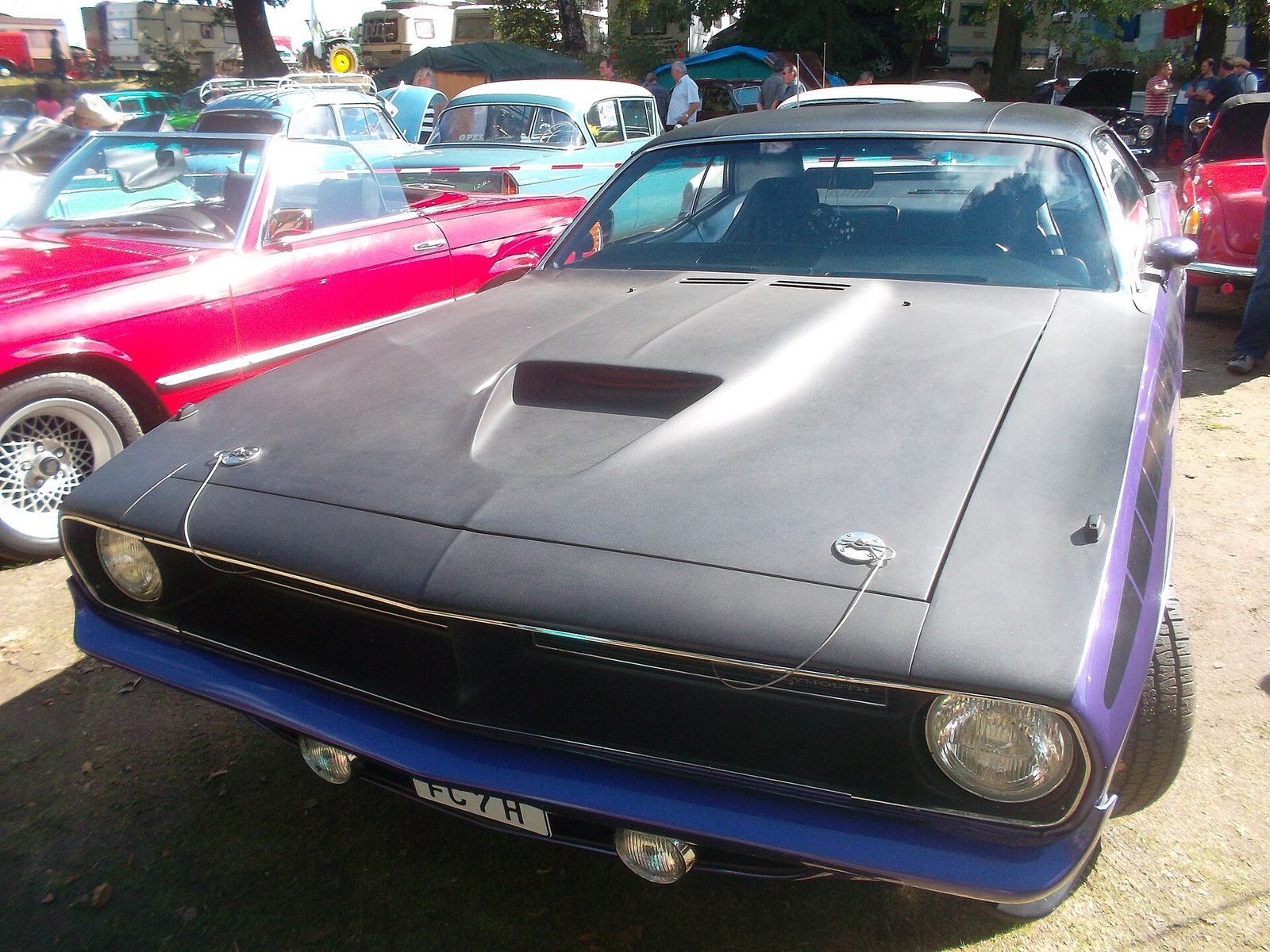
The third-generation Plymouth Barracuda (1970-1974) dropped the Valiant underpinnings of its predecessors for the E-body, a shortened and widened derivative of Chrysler's intermediate B-body shared with the Dodge Challenger. John Herlitz gave it long-hood, short-deck proportions on a 108-inch wheelbase and, for the first time, an engine bay that took the 383, the 440 and the 426 Hemi without contortion. Performance versions wore the 'Cuda name; 1970 alone brought the AAR 'Cuda, a Trans-Am homologation car with a 340 Six Barrel, glassfiber hood and side-exit exhaust. The car arrived four years after the market it was built for had peaked. Insurance surcharges, compression cuts for unleaded fuel and emissions rules pared the range back to a slant six and small-block V8s by 1972 and to two small-blocks by 1974, when production stopped after 11,734 cars, ten years to the day after the first Barracuda went on sale.
Barracuda
Third generation (E-body)
History
From Valiant Derivative to Purpose-Built
Plymouth had answered the Mustang since April 1964, but the first two Barracudas were Valiant derivatives and the market treated them as such. For 1970 Chrysler committed to a purpose-built platform: the E-body, a shortened and widened version of the intermediate B-body that also carried the Dodge Challenger. Ate Up With Motor characterises the decision as a more-is-better answer to the second-generation car's disappointing sales, and identifies the miscalculation plainly: had the E-body arrived in 1967 it would have met the pony-car market at its peak instead of at its collapse. In 1970 the Mustang outsold the Barracuda by more than three to one, and insurers were surcharging drivers under 25 by more than $1,200 a year, over a quarter of a car's price.
Herlitz's Shape and the E-body Package
John Herlitz gave the car the long-hood, short-deck proportions the segment demanded. The wheelbase came down to 108 inches, roughly six inches shorter than the 1969 car, while the hood grew by more than a foot and the body by several inches across. The fastback was dropped; hardtop and convertible remained. Unitary construction and Chrysler's longitudinal torsion-bar front suspension carried over, but the wider engine bay was the point: the 383 and 440, awkward installations in the A-body cars, now fitted without argument, and the 426 Hemi fitted at all.
1970: Eleven Engines and the AAR
The launch range ran from a 198 cu in slant six to the Hemi, with the 340, 383 and 440 in several states of tune between. Performance cars wore the 'Cuda name as a separate series rather than an option package, with a Shaker hood scoop available, hockey-stick side stripes carrying the engine callout, and a Hemi option at $871.45. The one-year AAR 'Cuda existed to homologate Plymouth's Trans-Am entry: a 340 with three Holley two-barrels on an aluminum manifold, a block webbed for four-bolt mains, a glassfiber cold-air hood, chrome exhaust trumpets exiting ahead of the rear wheels, front and rear spoilers, staggered tires and a strobe side stripe, at $3,966. Dan Gurney's All American Racers campaigned the race cars, de-stroked to 303.8 cu in for the class limit. Gurney and Swede Savage took three poles and a best finish of second, and won nothing.
1971: Gills, Quad Lamps and the End of the Big Blocks
1971 is the only E-body Barracuda year with four headlamps, and the only year the 'Cuda carried the fender louvres behind the front wheels that everyone calls gills, alongside billboard side decals naming the engine. It is also the year compression came down for unleaded fuel and the range began to thin. Sales fell from 55,499 to 18,690. The Hemi 'Cuda that year is counted in dozens rather than hundreds, the convertible in single or low double figures depending on who is counting. At the end of the model year the 383, the 440 and the Hemi left the E-body for good.
Decline and 1 April 1974
1972 brought a single-headlamp face, the loss of the convertible and the Gran Coupe, and a three-engine range of slant six, 318 and a detuned 340. 1973 added the federally mandated bumpers and, against the trend, a recovery to 22,213 cars. For 1974 the 360 replaced the 340 at 245 hp SAE net. Production ended after 11,734 cars, most accounts giving 1 April 1974, ten years to the day after the first Barracuda went on sale.
Common Problems
Rust first. The E-body's sills, floors, rear quarters, screen aperture and rear pillars all trap water, and lower door skins go the same way; bubbling around the windshield surround usually means the car needs more than it looks. Panel gaps and weld quality were inconsistent from new, so poor shut lines are not proof of an accident, but they make one harder to see.
Overheating is the standing mechanical complaint, particularly on big-block cars whose cooling was working hard when new; milky oil, staining around hose connections and a tired water pump are things to find before purchase rather than after. The torsion-bar front suspension degrades with age and announces itself as creaking on full lock, and poor camber geometry was noted even in period testing. Original Six Barrel carburetors and their aluminum manifolds are frequently missing or substituted.
Front drums were standard and are not adequate behind a 440 or a Hemi; disc conversions are common, and reversible ones preserve more value. Interiors suffer: vinyl fails, the plasti-wood trim lifts, dashboards crack. Three federal recall campaigns cover the 1971 car - 71V004000 on a brake shoe anchor pin whose failure could cost the front brakes, 71V067000 on disc rotors causing pull or imbalance, and 71V117000 on a power steering hose - and on a car of this age it is worth knowing whether any of them were carried out.
What to Look For
The paperwork is the car. A 'Cuda is a separate series rather than an option package, so the first two characters of a genuine one read BS: BS23 for the hardtop, BS27 for the convertible, against BH and BP for the base car and Gran Coupe. The fifth character is the engine code, which is why a real Hemi convertible reads BS27R and an AAR reads BS23J; the sixth is the model year and the seventh the assembly plant. Chassis BS27R1B269588, the 1971 Hemi 'Cuda convertible RM Sotheby's sold in 2007, reads out exactly that way.
The fender tag on the driver's-side inner wing repeats engine, transmission, axle, paint, trim, build date and scheduling number, read bottom to top and left to right. On E-bodies the last eight VIN digits are also stamped into the body, including the driver's-side firewall below the cowl, with the first and second digits transposed. That stamping is the check that matters, because a fender tag is riveted on and a VIN plate of this period can be held by two screws. Broadcast sheets turn up under and inside seats, above the fuel tank and behind trim panels. Galen's Tag Service reviews a fender tag, dash VIN and any broadcast sheet or window sticker against Chrysler records, and a registry listing is what the top of this market expects to see.
Where the numbers disagree with each other the car is a problem however it presents. RM Sotheby's catalogs Hemi 'Cuda clones as clones, and one 1970 example sold online for $48,600 against a coupe benchmark near $288,000 as of August 2026. That gap is documentation.
Market Notes
As of August 2026 classic.com records an average sale of $142,996 across the third-generation Barracuda market, with 64 cars listed and the market split into standard variants, 'Cuda and Hemi 'Cuda. The 'Cuda sub-market benchmark sits at $120,712, the Hemi 'Cuda coupe at $288,247 and the Hemi 'Cuda convertible at $2,821,429. The full Hemi 'Cuda benchmark of $412,244 spans roughly 21 tracked transactions, from $116,000 for a 1970 car in March 2024 to $3,300,000 for a 1971 convertible in January 2026. Ordinary cars sit elsewhere entirely: the lowest tracked third-generation result is $5,500 for a 1971 Barracuda in May 2026.
Auction evidence over two decades brackets the top. RM Sotheby's sold a 1971 Hemi 'Cuda convertible, chassis BS27R1B269588, for $2,420,000 at Arizona in 2007. Mecum bid a four-speed 1971 Hemi 'Cuda convertible originally exported to France to $4.8 million at Indianapolis in May 2021 without meeting a reserve reported at up to $6.5 million; the same house had set the model record at $3.5 million in 2014. At Kissimmee on 17 January 2026 the first 1971 Hemi 'Cuda convertible built, in Sno White with a TorqueFlite, made $3.3 million including the ten per cent buyer's premium, so roughly $3 million at the hammer.
Where sources differ
The date Barracuda production ended is given as 1 April 1974 by most accounts, ten years to the day after the first Barracuda went on sale, but at least one specialist history places it in March 1974.
Muscle Car Facts and Wikipedia both give 1 April 1974 and tie it to the tenth anniversary of the first Barracuda going on sale. Ate Up With Motor states production ended in March 1974. The difference is not resolved by any source consulted here.
The AAR 'Cuda was built for 1970 only, between 10 March and 17 April 1970 after a pilot car on 3 February, split 1,120 manual to 1,614 automatic; the total is usually given as 2,724 but at least one compilation records 2,742.
Old Cars Weekly states 2,724 with the build window and transmission split. Over-Drive Magazine states 2,724 while recording that some sources give 2,742 instead. The eighteen-car difference is not resolved by any source consulted here, so no single AAR total is asserted.
The number of 1971 Hemi 'Cuda convertibles built is the most disputed figure in the American collector market, with published counts of seven, eleven, eleven-or-twelve, twelve and thirteen depending on the source; no figure is asserted here.
Autoevolution states seven convertibles out of 114 1971 Barracudas fitted with the 426 Hemi. Classic Industries states twelve, split seven automatic to five four-speed. Fox News reports eleven or twelve, noting one four-speed car exported new to France. Wikipedia states thirteen, of which seven were sold domestically. The counts appear to differ over whether export cars are included, but no source consulted here reconciles them and the figure is unresolved.
Sources
- Plymouth Barracuda, Wikipedia · encyclopedia
- Fish Story: The Plymouth Barracuda (Part Two), Ate Up With Motor · specialist
- 1970 Plymouth Barracuda Fact Sheet, Over-Drive Magazine · specialist
- 1971 Plymouth Barracuda Fact Sheet, Over-Drive Magazine · specialist
- 1972 Plymouth Barracuda, conceptcarz.com · encyclopedia
- Car of the Week: 1970 AAR Cuda, Old Cars Weekly · journalism
- Vintage Car Life Road Test: 1970 Plymouth Barracuda 'Cuda 340, Curbside Classic · journalism
- 1970 Plymouth HEMI 'Cuda, Supercars.net · specialist
- The Unicorns of Auburn Hills: 1970 and 1971 Hemi 'Cuda Convertibles, Classic Industries · specialist
- 1974 Barracuda, Muscle Car Facts · specialist
- Plymouth Barracuda - 3rd Gen Market, classic.com · market-data
- Plymouth Hemi 'Cuda Market, classic.com · market-data
- Plymouth 'Cuda - 3rd Gen Market, classic.com · market-data
- 1971 Plymouth Hemi 'Cuda Convertible, Vintage Motor Cars in Arizona 2007, RM Sotheby's · auction-house
- 1970 Plymouth Hemi 'Cuda Clone, Online Only auction, RM Sotheby's · auction-house
- 1971 Plymouth Hemi Cuda Convertible Sells for $3.3 Million, autoevolution · journalism
- Rare 1971 Plymouth Hemi 'Cuda Convertible gets record $4.8 million auction bid, but it's not enough, Fox News · journalism
- Documenting Chrysler, Dodge, Plymouth and Mopar Fender Tags and Body Stampings, MaxWedge.com · specialist
- Registry - Galen's Tag Service, LLC, Galen's Tag Service, LLC · registry
- Fakes, frauds and forgeries: Illegality in the collector-car market, Hagerty Media · journalism
- Recalls by Vehicle: 1971 Plymouth Barracuda, National Highway Traffic Safety Administration · government
- 1970-1974 Plymouth Cuda - Buyer's Guide, Trade Unique Cars · journalism
Synthesized from the sources above and cross-checked. We cite and link out; we do not republish other databases verbatim.
Fully Sorted is an independent publisher and is not affiliated with, endorsed by or sponsored by Plymouth. Plymouth and the model names on this page are trademarks of their respective owners and are used here only to identify the cars being described.
Chassis register
Nobody has recorded a car here yet. Own one, or know one? Chassis number, what you can prove about it, and a source if there is one. Every entry is reviewed before it appears.
Nerd Notes
What owners know that the sources don't. Every note is read and checked before it appears here.
Key Specs
- Power
- 125 to 425 hp SAE gross across the 1970-71 range, the 426 Hemi quoted at 425 hp at 5,000 rpm; by 1974, 150 hp SAE net (318) and 245 hp SAE net at 4,000 rpm (360)
- Brakes
- Drums standard, front discs optional; period testing found the power drum set-up over-servoed, and drums are widely held inadequate behind the big blocks
- Engine
- 1970-71: 3,245 and 3,687 cc slant sixes, 5,211 cc 318, 5,572 cc 340 (four-barrel and Six Barrel), 6,276 cc 383, 7,210 cc 440 (four-barrel and Six Barrel), 6,981 cc 426 Hemi. 1972-73: six, 318, 340. 1974: 318 and 5,899 cc 360
- Layout
- Front longitudinal engine, rear-wheel drive, two-door unibody
- Torque
- 426 Hemi 490 lb-ft at 4,000 rpm and 440 four-barrel 410 lb-ft at 3,600 rpm SAE gross; 1974 360 V8 320 lb-ft at 3,600 rpm SAE net
- Weight
- 3,630 lb curb for a 1970 'Cuda 340 weighed by Car Life, 56/44 front to rear; big-block cars are heavier
- Chassis
- E-body unitary construction, a shortened and widened derivative of the intermediate B-body, shared with the Dodge Challenger
- Steering
- Manual standard; power assistance optional at $105 in 1970 and $97 in 1971
- Dimensions
- 108.0 in (2,743 mm) wheelbase; 186.7 in long and 74.9 in wide for 1970, 186.6 x 74.9 x 50.8-51.2 in for 1971
- Suspension
- Longitudinal torsion bars with upper and lower control arms and an anti-roll bar at the front; semi-elliptic leaf springs and a live axle at the rear
- Valvetrain
- Pushrod overhead valve, two valves per cylinder; the 426 Hemi uses hemispherical chambers and twin Carter AFB four-barrels
- Acceleration
- 0-60 mph in 7.5 s, the quarter in 15.0 s at 94 mph and 125.4 mph for a 1970 'Cuda 340 (Car Life); 5.8 s and 14.0 s at 102 mph for a 426 Hemi 'Cuda (Motor Trend, May 1970)
- Transmission
- Three-speed manual, four-speed manual or three-speed TorqueFlite automatic; the AAR 'Cuda took the four-speed or the TorqueFlite
Notable Variants
Barracuda (BH)
The base series, with the slant sixes and the 318. In 1970 the largest part of the run at 25,651 hardtops and 1,554 convertibles, and the usual donor for tribute builds.
Barracuda Coupe (A93)
A mid-1970 price leader carried into 1971, with fixed rear quarter glass instead of wind-down windows. Cheap when new, scarce now, identified at a glance by that glass.
Gran Coupe (BP)
The trim-led model: 8,183 hardtops and 596 convertibles in 1970, 1,615 cars in 1971, then dropped. Any engine could be ordered, which makes an original Hemi Gran Coupe unusual.
'Cuda (BS)
The performance model, a separate series rather than an option package, which is why a genuine one reads BS in the VIN. Hockey-stick side stripes with engine callout in 1970, billboard decals in 1971.
AAR 'Cuda
1970 only, homologating Plymouth's Trans-Am entry: 340 Six Barrel, glassfiber hood, side-exit exhaust ahead of the rear wheels, spoilers front and rear, strobe stripe, $3,966 new.
Hemi 'Cuda
The 426 Street Hemi cost $871.45 in 1970 and $884 in 1971, about a third of a base car. 652 built in 1970 including 14 convertibles; 1971 is far smaller and far more disputed.
'Cuda 440 Six Barrel
Three two-barrels on the 440, 390 hp SAE gross in 1970 and 385 in 1971. Quicker in a straight line than many Hemi cars and much cheaper to keep.
'Cuda 360 (1974)
The last performance 'Cuda, the 360 at 245 hp SAE net standard. Long ignored, which is why unmolested and documented cars survive more often than the 1970-71 ones do.
Value Trajectory
The E-body Barracuda's value history is a story of separation rather than a single curve. Ordinary sixes and 318 cars were worth restoring only intermittently for thirty years, and classic.com still tracks third-generation results down to $5,500 as of August 2026. The 'Cuda variants re-rated through the 2000s muscle-car boom, and the Hemi cars detached from them entirely: the 1971 Hemi convertible went from $2,420,000 at RM Sotheby's in Arizona in 2007, to a $3.5 million Mecum record in 2014, to a $4.8 million unmet bid at Indianapolis in 2021, to $3.3 million with premium at Kissimmee in January 2026. That reads as a plateau at a very high level rather than continued appreciation, and the 2021 no-sale suggests sellers have at times been ahead of buyers. Lower down the range, documentation now carries more of the value than condition does. A car cataloged honestly as a clone trades in the tens of thousands while a documented coupe of the same apparent specification sits near $288,000 as of August 2026. Cars whose identity cannot be established tend to sit outside the market rather than at a discount within it.
Next
Shopping for one?
Browse Plymouth listings, or decode a VIN before you buy.