
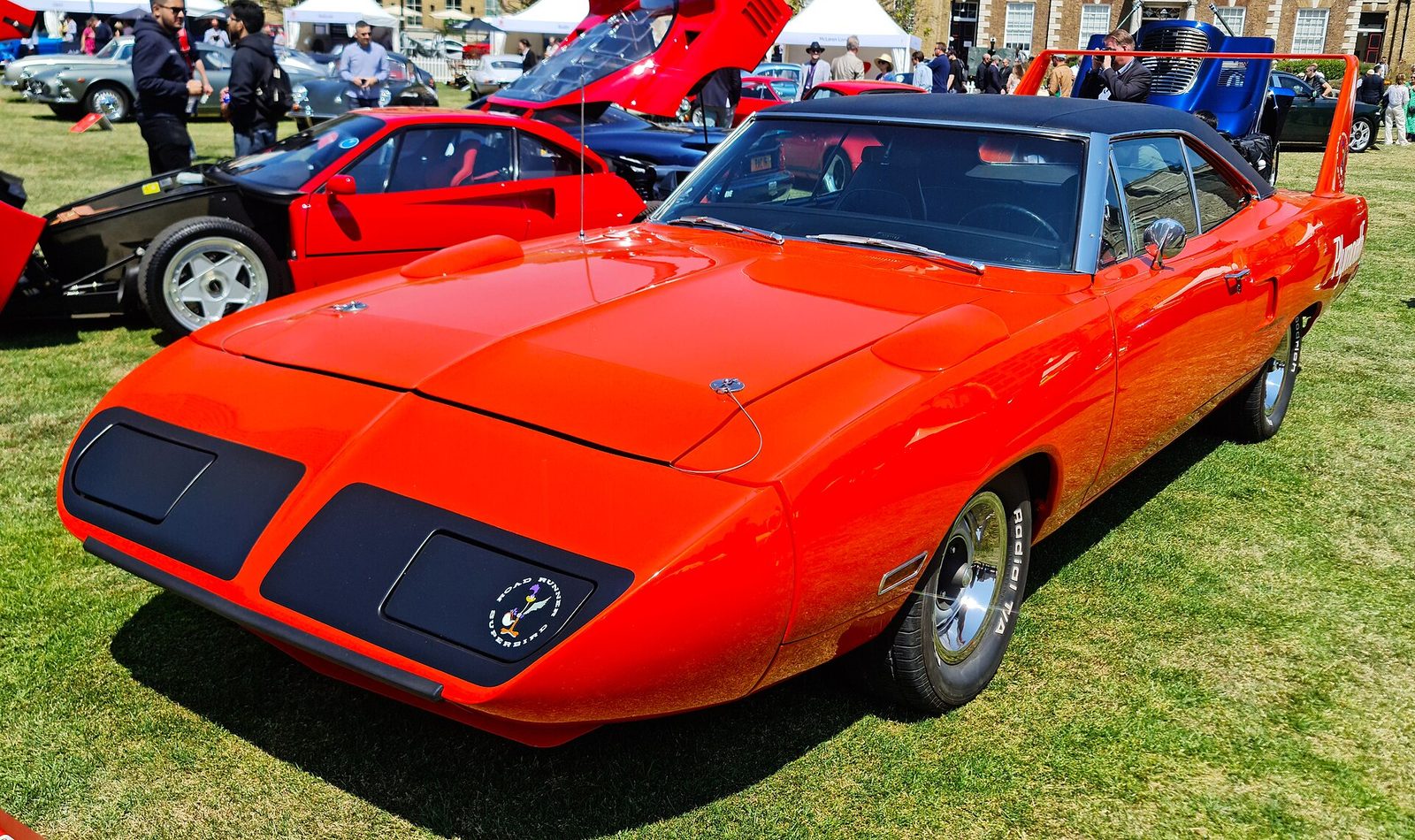
The Plymouth Road Runner Superbird was built for a single model year, 1970, and existed for one reason: NASCAR would not let Plymouth race the shape unless Plymouth sold it. It took the Dodge Charger Daytona's formula - a nose cone adding some 19 inches of length, pop-up headlights, and a rear wing carried high enough to work in clean air above the roof - and applied it to the Road Runner, with a vinyl roof fitted over the welds left by the reworked rear window. Three engines were offered: a 375 hp 440 Super Commando four-barrel, a 390 hp 440 Six Barrel and the 425 hp 426 Hemi. Richard Petty returned to Plymouth to drive it and took 18 wins in 1970. NASCAR then restricted winged cars to 305 cubic inches for 1971, which finished the category outright. How many road cars were built has never been settled: 1,920, 1,923, 1,935 and 1,969 all appear in credible sources. Dealers struggled to sell them, and some cars were stripped of their aerodynamics to move off the lot.
Road Runner Superbird
Superbird
Production by variant
How the Road Runner Superbirdrun breaks down, and which variants are the scarce ones. Approximate figures from this model’s cited sources.
Rarest of the bunch: the 426 Hemi, only about 135 built, roughly 1 in every 6 Road Runner Superbirds. If provenance and rarity drive your buy, this is the one to hunt.
Figures approximate; see Sources below.
History
Homologation Arithmetic
NASCAR's rulebook is the whole explanation for the Superbird. For 1969 a manufacturer had to build 500 road-going examples of a body shell before it could race, which is how Dodge came to sell the Charger Daytona. For 1970 the requirement was recast around dealer counts rather than a flat number, and published accounts do not agree on the multiplier: several state one car for every two Plymouth dealers in the United States, others one for every dealer. Both readings land in the same place - a target near 1,920 cars, roughly four times what Dodge had needed a year earlier. Chrysler internal notes of September 1969 record readiness for 1,920 winged Plymouths. Whatever the wording, the effect was that Plymouth had to build a genuine production run of a shape that made no commercial sense whatsoever.
The Debt Plymouth Owed Richard Petty
Petty had left Plymouth for Ford after 1968, and the Superbird was in large part the cost of getting him back. It worked: he returned for 1970 and took 18 wins from 40 starts. Pete Hamilton, running for Petty Enterprises, won the Daytona 500 and both Talladega races. Roughly twenty Superbirds were built as competition cars, and unlike the racing Daytonas - which had aerodynamic panels hung on chassis that already existed - they were supplied to the race shops as bare bodies in white.
What Was Changed, and Why
Chrysler had concluded that a new higher-output engine would be expensive and uncertain, and that drag reduction was the cheaper route to superspeedway speed. The Superbird's nose is about an inch longer and less angular than the Daytona's, with a wider cooling aperture that answered the overheating the Dodge had suffered. The wing height was set to put the aerofoil in clean air above the roofline rather than to clear the trunk lid, which is a consequence rather than the purpose. The rear window was recessed and capped flush, and where Dodge blended and painted that joint at cost, Plymouth covered the welds with a vinyl roof - which is why almost every Superbird has one. The front fender scoops are the interesting case: Chrysler said for decades that they existed for tire clearance, but documents from engineer Larry Rathgeb's files record exhausters above both front tires worth a three per cent drag reduction, which explains why the holes needed covers at all.
One Season, Then the Rule That Ended It
For 1971 NASCAR restricted special-bodied cars - Superbird, Charger Daytona, Ford Torino Talladega and Mercury Cyclone Spoiler II - to 305 cubic inches, more than 120 cubic inches below what conventional bodies were allowed, or else to a substantial weight penalty. The 305 was not a serious proposition: no parts commonality with the big blocks, around $4,000 an engine with three needed per car, and reliability doubts over race distance. Richard Brooks ran a 305-powered Daytona for Mario Rossi in the 1971 Daytona 500, and that was effectively the end. Plymouth abandoned the Superbird after one model year.
Unsold, De-winged, Then Rediscovered
The road cars were a commercial embarrassment. Buyers found the shape absurd, dealers discounted heavily, and examples sat on lots into 1972. A number were converted back to conventional Road Runner front ends simply to sell them. That episode still shapes the market: it thinned the survivor population, put genuine nose cones and wings into circulation as loose parts, and created the category of car whose aerodynamics were removed and later refitted. The same shape that could not be given away in 1971 has since carried seven-figure results at auction.
Common Problems
The Superbird's specific liabilities are the parts that make it a Superbird. The nose cone is a bolted-on assembly of its own panels and brackets, vulnerable to impact damage, poor previous repair and misalignment against the standard fenders; correct-fitting reproduction cones and braces are made, which is convenient and also means original panels cannot be assumed. The pop-up headlight doors run on a vacuum mechanism that leaks and sticks with age. The reworked rear window is capped flush and the joint welded and then hidden under the vinyl roof, so corrosion there develops out of sight and is expensive to put right properly. Cooling deserves attention: the widened nose aperture was itself a fix for the overheating the Charger Daytona suffered, and a Superbird with a blocked or modified opening will run hot. Underneath, the car is a 1970 Chrysler B-body and behaves like one - floors, trunk floor and quarter panels rust, torsion-bar front suspension bushings wear, and the front discs are period Kelsey-Hayes items of modest capacity for the weight. The 440 is durable; the Hemi is not a difficult engine but is expensive to service correctly. Owner accounts of long-stored cars returned to the road describe fuel tank replacement, a full brake overhaul and chasing electrical faults as the entry cost.
What to Look For
Identity first. The VIN carries the model code RM23 and an engine letter - U for the 440 four-barrel, V for the 440 Six Barrel, R for the Hemi - and the number should be corroborated by the fender tag, the broadcast sheet where one survives, and stampings on the engine, core support and trunk rail. RM Sotheby's and specialist dealers describe exactly that chain of verification in their catalogs, and its absence is the single largest discount on the car. The V.O.N. sequence establishes where in the run a car sits, and specialist listings routinely quote it. Then establish what the car physically is. Complete reproduction nose cones, wings, headlight doors and mechanisms, rear window plugs and fender extensions are all manufactured and sold, and full Road Runner to Superbird conversion kits exist, so a car wearing correct aerodynamics is not thereby a Superbird. Equally, a genuine car whose nose and wing were removed by a dealer in 1971 and refitted later is a genuine car with a broken paper trail; which of those two situations is in front of you is the question that matters. On condition, original quarters and floors are worth establishing, since the specialist trade advertises them as a distinguishing feature. Look under and around the vinyl roof at the flush rear window cap, where the welded joint is hidden and water collects. Check the nose cone mountings and its alignment to the fenders, and verify that the vacuum-operated headlight doors rise and fall together. On a car stored for years, expect fuel system contamination and brake work as a matter of course rather than as a fault.
Market Notes
As of August 2026 classic.com records an average Plymouth Superbird sale price of $311,634, with the market clearly stratified by engine: a benchmark of $530,780 for 426 Hemi cars, $264,805 for the 440 Six Pack and $223,271 for the 440 four-barrel. The lowest sale classic.com records is $90,000, on 11 December 2021, and a car offered at Mecum Kissimmee on 17 January 2026 failed to sell against a high bid of $375,000. Auction evidence tracks the same shape. RM Sotheby's sold a 440 four-barrel TorqueFlite car for $110,000 at Arizona in 2017, a 440 four-barrel automatic from Ray Evernham's collection for $220,000 at Auburn Fall in 2021, and a matching-numbers 440 Six Barrel four-speed for $242,000 at Hershey in 2024. The Hemi cars are a separate market and a volatile one: chassis RM23R0A172589 made $1.5 million hammer, $1.65 million with buyer's premium, at Barrett-Jackson Las Vegas in July 2022, and $380,000 hammer, $418,000 with premium, at Mecum Indianapolis on 17 May 2025. Both figures are real; neither is the Hemi Superbird market on its own. Documentation, original sheet metal and a verifiable engine code separate cars far more reliably than color or mileage do.
Where sources differ
No single production total for the 1970 Plymouth Superbird is agreed: Chrysler Historical records 1,935, the NASCAR homologation serial-number list gives 1,920, Chrysler aerodynamicist Gary Romberg stated 1,923, Aero Warriors identifies 1,969 distinct cars from the combined registries, and a figure of 2,783 has been published without support.
Chrysler Historical states 1,935 and RM Sotheby's, Classic Industries and Wikipedia follow it. The NASCAR serial list, which has known omissions, gives 1,920, and that figure is also Chrysler's September 1969 build target; Heacock and Old Cars Weekly print it as the total. Romberg gave 1,923 to Hot Rod, Aero Warriors' registry work identifies 1,969, Old Cars Weekly notes 1,971 in some sources, and 2,783 has been published. Not resolved by any source consulted here, so productionTotal is left null.
The split of Superbird production between the three engines is itself disputed: Chrysler Historical gives 1,084 with the 440 four-barrel, 716 with the 440 Six Barrel and 135 with the 426 Hemi, while the NASCAR serial-number list gives 1,162, 665 and 93 respectively.
Chrysler Historical's mix (1,084/716/135) is reproduced by Muscle Car Club and Wikipedia; the NASCAR list's mix (1,162/665/93) by Heacock Classic and supercars.net, both printing 93 Hemis. Old Cars Weekly gives a third four-barrel figure of 1,120. The three sets cannot be reconciled from any source consulted here, the conflict is unresolved, and no single engine mix is asserted.
Published breakdowns of the 135 Hemi Superbirds by transmission contradict each other, one giving 77 manuals and 58 automatics and another giving 77 automatics and 58 four-speeds.
Muscle Car Club gives the Hemi as 77 manual and 58 automatic; Old Cars Weekly gives 77 automatics and 58 four-speeds - the same two numbers with the transmissions transposed. Only one can be correct, nothing consulted here resolves which, and the conflict is unresolved, so neither split is asserted.
Sources disagree on the exact wording of the 1970 homologation rule, some stating one car for every two Plymouth dealers in the United States and others stating one car for every dealer.
Wikipedia, Classic Industries and RM Sotheby's state one car per two dealers. Heacock Classic states one per Plymouth dealership and Old Cars Weekly one for each dealer. Both readings are used to reach the same approximate figure of 1,920, so the arithmetic is no check on the wording, and no source consulted here quotes the rule text. The discrepancy is unresolved.
Sources
- Plymouth Superbird, Wikipedia · encyclopedia
- Superbird Various Production Totals, brcook.com Superbird reference · specialist
- Aero Warriors - Where Are They Now?, Aero Warriors · specialist
- Aero Warriors - 1969 Dodge Charger Daytona And The 1970 Plymouth SuperBird, Aero Warriors · specialist
- Aero Warriors - The Little Engine That Almost Did, Aero Warriors · specialist
- Aero Warriors - The Scoop On The Scoops, Aero Warriors · specialist
- Plymouth Superbird - History, Engines, Production Totals, & More, Muscle Car Club · specialist
- Car of the Week: 1970 Plymouth Superbird, Old Cars Weekly · journalism
- Dodge Charger Daytona & Plymouth Superbird: The Mopar Wing Cars, Classic Industries · specialist
- 1970 Plymouth Superbird - The Ultimate Winged Warrior, Heacock Classic · specialist
- The Plymouth Superbird Was Too Fast For NASCAR - So NASCAR Changed The Rules To Stop It, Yahoo Autos · journalism
- 1970 Plymouth Road Runner Superbird 440, Supercars.net · specialist
- Plymouth Superbird Market, classic.com · market-data
- 1970 Plymouth Road Runner Superbird, Hershey 2024, RM Sotheby's · auction-house
- 1970 Plymouth Superbird, Auburn Fall 2021, RM Sotheby's · auction-house
- 1970 Plymouth Road Runner Superbird, Arizona 2017, RM Sotheby's · auction-house
- Failing at No Reserve: Hemi Superbird Sold for $1.5M in 2022, Got $380K at Indy 2025, autoevolution · journalism
- 1970 Plymouth Road Runner Superbird - SOLD, Harwood Motors · specialist
- 1970 Roadrunner Superbird Wing Car Conversion Kit - Superbird Body Parts by Janak Repros, Janak Repros / Winged Warrior Body Parts · specialist
- 1970 Plymouth Superbird: what is it like to own and drive?, Classic American · journalism
Synthesized from the sources above and cross-checked. We cite and link out; we do not republish other databases verbatim.
Fully Sorted is an independent publisher and is not affiliated with, endorsed by or sponsored by Plymouth. Plymouth and the model names on this page are trademarks of their respective owners and are used here only to identify the cars being described.
Chassis register
Nobody has recorded a car here yet. Own one, or know one? Chassis number, what you can prove about it, and a source if there is one. Every entry is reviewed before it appears.
Nerd Notes
What owners know that the sources don't. Every note is read and checked before it appears here.
Key Specs
- Power
- 375 hp at 4,600 rpm (440 four-barrel), 390 hp (440 Six Barrel), 425 hp at 5,000 rpm (426 Hemi) - SAE gross manufacturer ratings, the Hemi figure widely held to be understated
- Tires
- F60-15
- Brakes
- Kelsey-Hayes vented discs front, drums rear
- Engine
- 440 cu in (7,210 cc) Super Commando RB V8 standard, 440 Six Barrel optional, 426 cu in (7,000 cc) Hemi V8 at the top of the range
- Layout
- Front-mounted longitudinal V8, rear-wheel drive
- Length
- 220.0 in (5,588 mm); the nose cone and pop-up headlight assembly add roughly 19 in to a standard Road Runner
- Torque
- 480 lb-ft at 3,200 rpm (440 four-barrel) and 490 lb-ft at 4,000 rpm (426 Hemi), both SAE gross manufacturer figures
- Weight
- Approximately 3,858 lb curb in 440 four-barrel specification
- Chassis
- Chrysler B-body unitary structure with front subframe; bolt-on nose cone, reworked flush rear window cap and pedestal-mounted rear wing
- Rear axle
- Dana 9.75-inch with 3.54:1 Sure Grip on four-speed cars
- Wheelbase
- 115.8 in (2,941 mm)
- Model code
- RM23, with VIN engine codes U (440 four-barrel), V (440 Six Barrel) and R (426 Hemi)
- Suspension
- Front unequal-length wishbones on longitudinal torsion bars; rear live axle on semi-elliptic leaf springs
- Bore stroke
- 4.32 in x 3.75 in (109.7 mm x 95.25 mm) for the 440 RB V8
- Compression
- 9.7:1 (440 four-barrel)
- Acceleration
- About 5.5 seconds to 60 mph for the 440; 4.8 seconds to 60 mph and 13.5 seconds at 105 mph over the quarter-mile quoted for the Hemi
- Transmission
- Three-speed TorqueFlite automatic or A833 four-speed manual with Hurst pistol-grip shifter
Notable Variants
440 Super Commando (four-barrel)
The standard car and the commonest specification, listing at $4,298. Chrysler Historical counts 1,084; Old Cars Weekly gives 1,120 and the NASCAR list 1,162. VIN engine code U.
440 Six Barrel
Three Holley two-barrel carburetors and 390 hp for roughly $250 over the base car. 716 built per Chrysler Historical, 665 per the NASCAR list. Engine code V.
426 Hemi
425 hp and a $5,139 list price, roughly a $1,000 option. 135 built per Chrysler Historical, 93 per the NASCAR list. Engine code R, and the variant carrying by far the largest market premium.
Four-speed cars
The A833 manual with a Hurst pistol-grip shifter, generally paired with a Dana 9.75-inch rear axle. Scarcer than the TorqueFlite in every engine.
Canadian-delivery cars
Exported outside the United States homologation count. Quoted at 34 to 47 cars in some accounts and estimated at around 75 in others; no source consulted here reconciles the two.
Competition Superbirds
About twenty built for NASCAR, ARCA and USAC use between 1970 and 1972. Unlike the racing Daytonas, which had aero panels hung on existing chassis, these left the factory as bare bodies in white.
Dealer de-winged cars
Unsold showroom stock from which dealers removed the nose cone and wing and fitted conventional Road Runner panels. Some have since been put back to Superbird specification, which is a documentation problem.
Value Trajectory
The Superbird's value history runs from unsellable to unsteady. Dealers discounted the cars heavily in 1970 and 1971 and stripped some of them of their aerodynamics, which is as near to a market floor as a car can reach. Appreciation followed the general muscle-car re-rating: by 2017 an ordinary 440 four-barrel car made $110,000 at RM Sotheby's, by 2021 a comparable car made $220,000, and by 2024 a 440 Six Barrel four-speed made $242,000. The Hemi cars decoupled from that progression and then showed how thin their market is, one chassis making $1.65 million with premium at Barrett-Jackson in July 2022 and $418,000 with premium at Mecum in May 2025. As of August 2026 classic.com's benchmarks stand at $530,780 for the Hemi, $264,805 for the Six Pack and $223,271 for the four-barrel, against an average across all Superbird sales of $311,634. The 440 cars look like a settled market in which documentation is the main variable. The Hemi cars do not, and a single result at either extreme should not be read as the level.
Next
Shopping for one?
Browse Plymouth listings, or decode a VIN before you buy.