
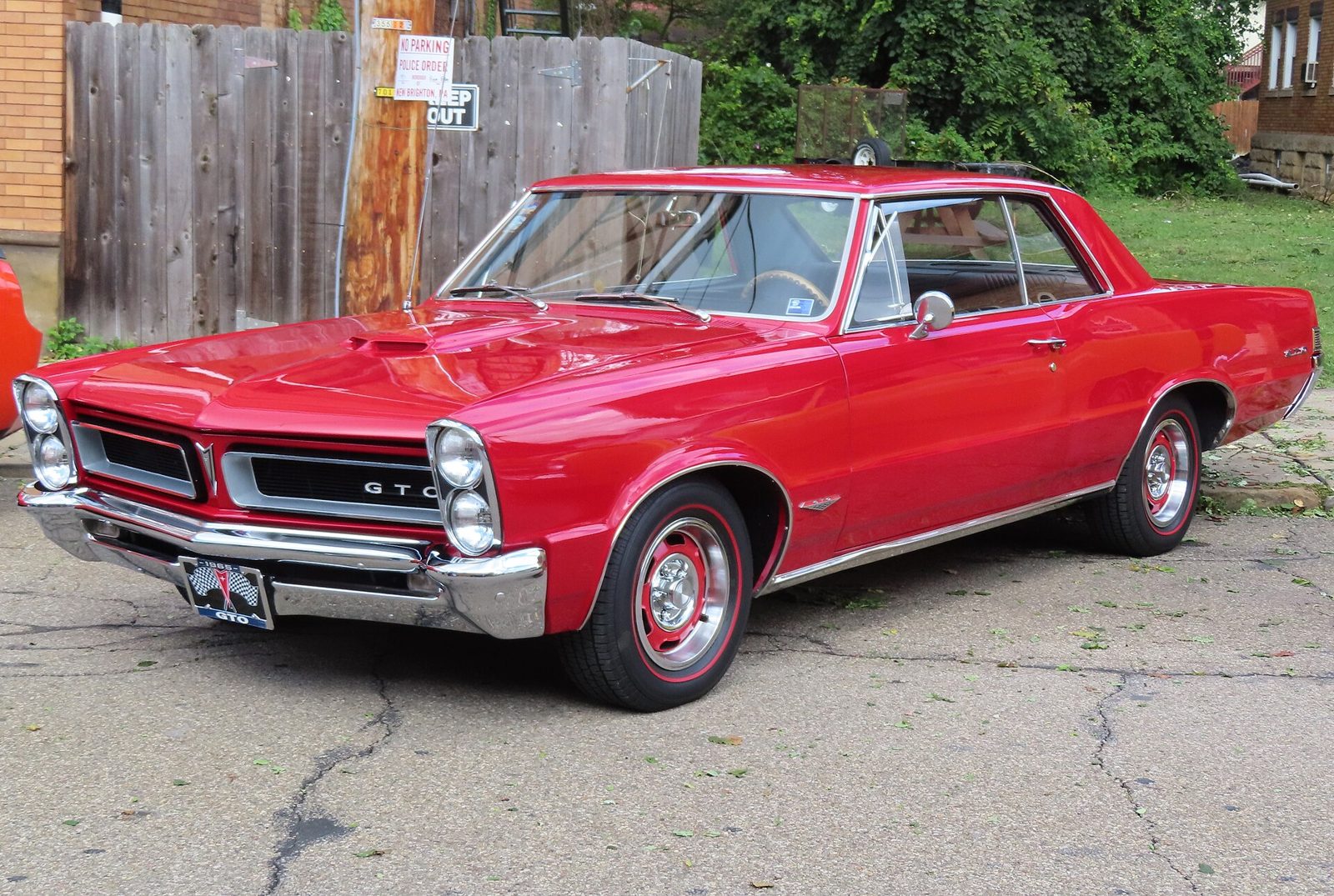
The Pontiac GTO of 1964-1974 began as an option package that General Motors engine policy was not written to allow: a 389 cu in V8 from the full-size line in the new Tempest LeMans intermediate, about $295 extra and approved on an initial limit of 5,000 cars. Pontiac built 32,450 in the first model year and 96,946 in 1966, the peak, when the GTO became a model of its own. The 1968 body moved to a 112-inch wheelbase with a body-color Endura nose, and 1969 brought The Judge and the Ram Air IV, a 400 rated at 370 hp gross that period testers were told made more. From 1971 compression fell for low-lead fuel, the car returned to option status on the LeMans for 1972 and 1973, and the 1974 GTO was a $461 package on the compact Ventura with a 200 hp 350. The 2004-2006 GTO was a rebadged Holden Monaro built in Australia and is a different car. For a buyer the central fact is that five of the eleven model years cannot be proved from the VIN, which is why Pontiac's surviving billing records carry so much of the value.
History
A Loophole in the Engine Policy
In January 1963 General Motors ended its divisions' racing programs, and Pontiac, which had sold on performance, needed another outlet. Hagerty's account has John DeLorean, Bill Collins and Russ Gee putting a prototype 1964 LeMans on a lift at the Milford Proving Grounds and deciding the 389 from the big cars would bolt straight in. The obstacle was corporate policy, which the sources describe two ways: Wikipedia as a 330 cu in ceiling on the A-body intermediates, Hagerty as a rule of 10 lb of car per cubic inch. Either way it covered models, not options. Pete Estes approved the car as a LeMans package, sales manager Frank Bridge capped the first run at 5,000, and the name was lifted from the Ferrari 250 GTO. Production began on 3 September 1963.
The Option Years, 1964 and 1965
The $295 package bought a 389 rated at 325 hp on a Carter four-barrel, a floor-shifted three-speed, stiffer springs, redline tires and GTO badges; Tri-Power, three Rochester two-barrels, was rated at 348 hp. Car Life's Tri-Power car, checked over by Pontiac Engineering first, ran 0-60 mph in 6.6 seconds and the quarter mile in 14.8 seconds at 99 mph. Car and Driver's famous 4.6-second car was later found to be running a 421 prepared by Royal Pontiac. Slow steering and ordinary Tempest drums drew most of the complaints. Sales reached 32,450, and for 1965 the stacked-headlamp car rose to 335 and 360 hp and roughly 75,000 sales.
A Model of Its Own, 1966 and 1967
For 1966 the GTO became Pontiac model 242 on the new Coke-bottle body, and 96,946 were built, the most of any year. Tri-Power was dropped partway through the season. For 1967 the 389 was bored to 400 cu in with a Quadrajet in economy, standard and HO forms, the two-speed automatic gave way to the Turbo Hydra-Matic with Hurst's dual-gate shifter, and front discs joined the options. A 400 Ram Air was cataloged at the same 360 hp as the HO.
Endura, The Judge and Ram Air, 1968 to 1970
The 1968 car moved to a 112-inch wheelbase with a body-color Endura bumper, took Motor Trend's Car of the Year award and sold 87,684. The Judge followed for 1969, pitched by Jim Wangers as a stripped Road Runner rival and delivered as a dearer GTO in Carousel Red with the Ram Air engine, spoiler and decals; 6,833 were built. The Ram Air IV, officially 370 hp with hydraulic lifters, ran 14.45 seconds at 97.8 mph for Car Life, whose hosts said the rating was set to satisfy GM and the insurers. For 1970 GM lifted the 400 cu in ceiling and the 455 arrived at 360 hp and 500 lb-ft, yet Car Life's four-speed Ram Air 400 still beat an automatic 455 through the quarter mile. Sales fell to 40,149.
Low Compression and the Last Two Bodies
For 1971 compression fell to 8.2:1, the 400 read 300 hp gross and 255 net, and the 455 HO topped the list; Pontiac stopped taking Judge orders after 1 March 1971. The GTO became a $353.88 LeMans option for 1972 at 5,807 cars, then a Colonnade car for 1973 at 230 hp and 4,806 sales. The 1974 GTO was a $461 package on the compact Ventura with a 200 hp 350; 7,058 were sold before the name lapsed.
Common Problems
Rust is the whole story on most of these cars. Hagerty names the lower quarters behind the rear wheels, the metal around the windshield and rear glass, the floors and the trunk as the usual rot on all GM A-bodies. A CarTech restoration guide traces the order: water gets past the windshield and backlight seals into the cowl and trunk, a vinyl top traps it until the roof is holed beneath the covering, and road salt works on the rockers, quarters, floors and, most importantly, the frame rails, which can rot from the inside out. Hagerty notes that short of a new frame essentially every part is reproduced; the CarTech author adds that the 1973 car has almost nothing reproduced and its body panels are getting hard to find. Hard use leaves marks: cracks around the frame rails and motor mounts from launches, doors that bind and roofs that are tweaked. Many cars have lost original drivetrains, and replacing the 1964-1966 two-speed automatic with a Turbo 350 or 400 has been a common swap since the late 1960s. Tri-Power earned a reputation for being hard to tune, though Hagerty's restorer found it trouble-free once rebuilt and set up. Period testers found the early cars short of brakes and steering: 24:1 manual steering, four turns lock to lock with power, and drums that faded. Car Life found the Ram Air IV almost powerless below 3,000 rpm and hard to launch, the 1969 Judge's brakes locking early, and the 1970 test cars' hoods fitting poorly enough that the hood pins earned their keep.
What to Look For
Start with what the car can prove. The 1964 and 1965 GTO was an option on the LeMans, so the VIN carries only the LeMans series and nothing separates a real car from a converted Tempest. From 1966 to 1971 the VIN begins 242, the GTO model number. For 1972, 1973 and 1974 the GTO was a package again and the VIN is silent once more. For those years the evidence is Pontiac's own billing record: PHS (formerly Pontiac Historic Services) holds it for every Pontiac from 1961 and supplies a copy of the factory invoice and a letter decoding the options. Hagerty quoted the service at $75 a car. A 1964-1965 body tag may carry accessory code 5N from the Pontiac and Kansas City plants, and owners report checking inside the rear quarters for filled holes where LeMans louvers were removed. Both are forum lore, not factory proof. Paperwork can be moved too. A restoration text on these cars describes cars whose VIN and cowl tags were transplanted to a better body and caught by the hidden VINs on body and frame. The same author estimates at least half the GTOs for sale no longer have their original engine, and says Pontiac built at least one service replacement block for every Ram Air IV installed, so a stamped block is a start rather than an answer. Color is part of the check. The 1969 Judge launched in Carousel Red and Orbit Orange was the 1970 feature color, and a claimed Judge in either should still agree with the billing copy. Hagerty put a concours-correct Tri-Power installation at $3,000 to $5,000. Structure comes before all of it: a GTO is body on frame, and it needs to be seen on a lift.
Market Notes
As of September 2026, classic.com puts the average price of a first-generation (1964-1967) GTO at $63,253 with 70 cars for sale, and a second-generation (1968-1972) car at $81,345 with 88 for sale. Its benchmark for standard second-generation variants is $57,184; for the 1969-1971 Judge it lists 20 cars for sale and publishes no benchmark at all, which says something about how varied Judge prices are. The lowest recorded sales it shows, $1,344 for a 1967 project in December 2023 and $11,500 for a 1969 car in October 2025, mark the floor rather than the market. The top is set by engine and body documentation. Hagerty reported a 1970 Judge Ram Air IV convertible, one of seven with an automatic, sold for $1.1 million at Mecum's 2023 Kissimmee sale, the most paid for any Pontiac GTO and nearly twice Hagerty's own $562,000 condition #1 value. Jalopnik records a 1969 Ram Air IV automatic convertible without Judge stripes at $297,000 at Mecum in 2024 and a four-speed 1967 Ram Air convertible at $110,000 at Mecum in 2022, and notes asking prices of $480,000 to $650,000 for 1970 Judge Ram Air IV convertibles consigned to Mecum as of August 2026; those are asks, not sales. For first-generation cars Hagerty's buyer's guide puts a four-speed at about 15 percent over an automatic and factory air at another 15 percent.
Where sources differ
The General Motors policy the GTO circumvented is described differently by different sources, as a displacement ceiling on intermediates or as a weight-per-cubic-inch rule; all agree it did not govern optional engines.
Wikipedia states the policy limited the A-body intermediate line to a maximum of 330 cu in. Hagerty, in two separate articles, states it as a minimum of 10 lb of vehicle weight per cubic inch of displacement. The two rules are not the same rule, and no source consulted here quotes the GM policy text, so the difference is unresolved.
Published totals for 1965 GTO production differ by ten cars.
Wikipedia gives 75,342 GTOs for 1965. The New Hampshire GTO Association tables and Muscle Car Club, the latter citing the Standard Catalog of Pontiac, give 75,352, and their body-style figures of 8,319, 55,722 and 11,311 sum to 75,352. No source consulted here explains the ten-car difference, so it is left unresolved and productionTotal is null.
Sources disagree on the rating of the 1967 two-barrel economy 400.
Wikipedia rates the 1967 economy engine at 265 hp at 4,400 rpm. Hagerty's buyer's guide and Muscle Car Club both give 255 hp for 1967, and Muscle Car Club gives 265 hp for the 1968 version. The sources may be describing different years, but none says so, and the 1967 figure is unresolved.
The two-speed automatic offered on 1964-1966 GTOs is named differently by the sources consulted.
Hagerty's buyer's guide calls the 1964-1966 GTO automatic a two-speed Powerglide. Wikipedia calls it the Super Turbine 300. Powerglide is a Chevrolet name; a reader comment beneath the Hagerty article makes the same correction, but a comment is not a source, so the difference is recorded as unresolved.
The mid-1968 Ram Air II is recorded with two different official ratings.
Wikipedia states that the Ram Air II, introduced mid-year 1968 with round-port heads and the 041 cam, kept the earlier official rating, which was 360 hp. Muscle Car Club lists the Ram Air II at 366 hp and 445 lb-ft. Jalopnik agrees it was built for under five months but gives no rating. Unresolved by the sources consulted.
The price of the 1969 Judge package over a standard GTO is given two ways.
Wikipedia and Jalopnik put the Judge package at $332 over a standard GTO. Curbside Classic's notes to the March 1969 Car Life test break the tested car's $3,493 base price into a $3,156 hardtop plus $337.02 for the WT1 package. The gap may be a mid-year price change, but no source consulted says so, and it is unresolved.
Of 72,287 GTOs built for 1969, 6,833 carried the Judge package; the number fitted with the Ram Air IV is published two ways.
Curbside Classic and Jalopnik give 759 Ram Air IV cars for 1969, and the New Hampshire GTO Association tables break that into 549 manual and 151 automatic hardtops and 45 manual and 14 automatic convertibles. The CarTech restoration text states that Pontiac made only 549 Ram Air IV GTOs that year. 549 matches the manual hardtop count alone, which suggests a misreading, but no source consulted here says which is correct, so the conflict is recorded as unresolved.
Of 40,149 GTOs built for 1970, 3,797 were Judges, but the published body-style split of the year's hardtops and convertibles is reversed between sources.
The New Hampshire GTO Association tables list 3,629 Judge hardtops and 3,615 non-Judge convertibles for 1970, which with 168 Judge convertibles gives the 3,797 Judge total that Wikipedia also states. Muscle Car Club lists 3,615 Judge hardtops and 3,629 non-Judge convertibles, which would make 3,783 Judges. No source consulted here resolves which table transposed the figures.
Sources disagree on how many 1970 Judge convertibles had the Ram Air IV and how they divide by transmission.
Wikipedia counts 18 Ram Air IV Judge convertibles for 1970 and states that six of the 13 automatic Ram Air IV convertibles received the Judge option. Hagerty counts seven automatics and ten four-speeds, 17 in all, and Jalopnik also gives 17 with seven automatics. No source consulted here resolves the difference.
The Judge's final year is recorded with two different totals.
Wikipedia states that 357 Judges were sold for 1971 including 17 convertibles. The New Hampshire GTO Association tables list 357 Judge hardtops and 17 Judge convertibles for a total of 374, the figure Curbside Classic also gives. The difference looks like 357 being read as the whole year rather than the hardtops, but no source consulted here states that, so it is unresolved.
Sources
- Historic Information for Pontiac Owners, Collectors, and Restorers, PHS Automotive Services · registry
- Pontiac GTO, Wikipedia · encyclopedia
- The GTO Origin Story, Hagerty Media · journalism
- Your definitive 1964-67 Pontiac GTO buyer's guide, Hagerty Media · journalism
- Vintage Car Life Road Test: 1964 Pontiac GTO - "Honest In Performance"?, Curbside Classic · journalism
- Vintage Car Life Review: 1969 Pontiac GTO Ram Air IV - Here Come "The Judge", Curbside Classic · journalism
- Vintage Car Life Road Test: 1970 Pontiac GTO 455 And 400 Ram Air - There IS A Substitute For Cubic Inches, Curbside Classic · journalism
- 1964 Engine Codes & Production Totals, New Hampshire GTO Association · registry
- Pontiac GTO - Year-by-Year: History, Engines, Production, & More, Muscle Car Club · specialist
- Mastering GTO Restorations: How to Select a Project, CarTech Books · specialist
- How can I tell a GTO from a Le Mans, Pro-Touring.com · club-forum
- All Rise for the Judge: $1.1M Ram Air IV is world's most expensive GTO, Hagerty Media · journalism
- 7 Of The Rarest Pontiac GTOs And What They're Worth, Jalopnik · journalism
- Pontiac GTO - 1st Gen Market, classic.com · market-data
- Pontiac GTO - 2nd Gen Market, classic.com · market-data
Synthesized from the sources above and cross-checked. We cite and link out; we do not republish other databases verbatim.
Fully Sorted is an independent publisher and is not affiliated with, endorsed by or sponsored by Pontiac. Pontiac and the model names on this page are trademarks of their respective owners and are used here only to identify the cars being described.
Chassis register
Nobody has recorded a car here yet. Own one, or know one? Chassis number, what you can prove about it, and a source if there is one. Every entry is reviewed before it appears.
Nerd Notes
What owners know that the sources don't. Every note is read and checked before it appears here.
Key Specs
- Power
- 325-360 hp gross for the 389; 335-370 hp gross for the 1967-1970 400s; 360 hp gross for the 1970 455; SAE net from 1972, falling to 200 hp for 1974. Gross and net figures are not comparable
- Brakes
- Four-wheel drums with optional metallic linings; front discs optional from 1967
- Engine
- Pontiac V8 of 389 cu in (1964-1966), 400 cu in (1967-1973), 455 cu in (1970-1973) or 350 cu in (1974), cast-iron block and heads
- Layout
- Front engine, rear-wheel drive
- Torque
- 431 lb-ft at 3,200 rpm (1965 four-barrel 389); 445 lb-ft at 3,900 rpm (Ram Air IV); 500 lb-ft at 2,700 rpm (1970 455); 295 lb-ft at 2,800 rpm (1974 350)
- Weight
- No sourced curb weight for the range; Car Life's 1964 test car carried 44 percent of its weight on the rear tires, and the 1968 car was about 75 lb heavier than the 1967
- Chassis
- Separate perimeter frame, body on frame (GM A-body intermediate 1964-1973; compact Ventura body for 1974)
- Steering
- 24:1 manual or 17.5:1 power (four turns lock to lock) on early cars; optional variable-ratio power steering from 1970
- Top speed
- 114 mph observed at the 6,000 rpm redline in Car Life's 1965 Tri-Power test (single source)
- Wheelbase
- 115 in (2,921 mm) for 1964-1967; 112.0 in (2,845 mm) for two-door A-bodies from 1968
- Suspension
- Coil springs all round with a live rear axle; rear anti-roll bar added for 1970
- Compression
- 10.75:1 for the 1964-1966 389; 10.5:1 on the 1970 Ram Air engines; 8.2:1 (400) and 8.4:1 (455 HO) for 1971; 8.0:1 for 1973; 7.6:1 for 1974
- Final drive
- Safe-T-Track limited slip optional, with ratios to 4.33:1 in the 1960s
- Acceleration
- 0-60 mph in 6.6 seconds and the quarter mile in 14.8 seconds at 99 mph (Car Life, 1964 Tri-Power); 6.2 seconds and 14.45 at 97.8 mph (Car Life, 1969 Judge Ram Air IV); 6.0 seconds and 14.60 at 99.55 mph (Car Life, 1970 400 Ram Air four-speed)
- Transmission
- Three-speed manual standard with a Hurst shifter; Muncie four-speeds optional; two-speed automatic 1964-1966, Turbo Hydra-Matic 400 from 1967
- Identification
- 1964-1965 cars carry LeMans VINs (22 and 237 prefixes); 1966-1971 VINs begin 242; 1972-1974 GTOs were packages again and carry no VIN evidence
Notable Variants
1964 GTO option on the Tempest LeMans
The first year, a roughly $295 package that Pontiac's sales manager expected to sell 5,000 times and sold 32,450. Nothing in the VIN says GTO, so the car is only as good as its paperwork.
Tri-Power 389 (1964-1966)
Three Rochester two-barrels, 348 hp in 1964 and 360 hp in 1965-1966, dropped partway through 1966. Once swapped off for a four-barrel as hard to tune, now the configuration collectors pay extra for.
1967 400 Ram Air
The first 400 with a hood scoop that actually fed the carburetor, rated at the same 360 hp as the HO. Two sources agree on 751 cars, 56 of them convertibles.
Ram Air II (spring 1968)
Round-port heads and the 041 cam, built for less than five months. One source counts 246 cars; the sources disagree on whether Pontiac rated it at 360 or 366 hp.
The Judge, RPO WT1 (1969-1971)
Conceived as a cheap Road Runner fighter and sold as a dearer GTO with the Ram Air engine, spoiler, stripes and a T-handle Hurst shifter. 6,833 in 1969, 3,797 in 1970, and either 357 or 374 in 1971.
Ram Air IV (1969-1970)
The hottest Pontiac 400, officially 370 hp gross and widely held to make more. 759 cars in 1969 by most counts and 804 in 1970; the Judge convertibles with it are the most valuable GTOs sold.
455 HO (1970-1972)
The torque engine: 500 lb-ft in 1970 form, and in 1971 and 1972 the strongest engine on a low-compression order sheet. A 1972 pillared coupe with it is a ten-car rarity by one count.
1974 Ventura GTO (WW3)
A $461 package on the compact Ventura with a 200 hp 350 and a shaker hood, sold as coupe or hatchback. The final year, and a better seller than 1973 at 7,058 cars.
Value Trajectory
New, the first GTO was a $295 package, and a 1969 Judge hardtop listed at $3,493 before options; Car Life's two 1970 test cars each stickered for more than $5,000. The collector market now sorts these cars by what they can document rather than by the badge. As of September 2026 classic.com averages $81,345 for the 1968-1972 cars against $63,253 for the 1964-1967 cars, and no benchmark exists for the Judge, whose results range too widely to average. At the top, the $1.1 million paid at Mecum Kissimmee in 2023 for a 1970 Judge Ram Air IV automatic convertible set the record for the model at nearly twice Hagerty's condition #1 value of $562,000 at the time. Below it, Jalopnik's reported sales of $297,000 for a 1969 Ram Air IV automatic convertible in 2024 and $110,000 for a 1967 Ram Air convertible in 2022 show how steeply value falls away from the rarest engine and body pairings. The 1973 and 1974 cars have no published market figure in the sources consulted here, and no claim is made for them.
Next
Shopping for one?
Browse Pontiac listings, or decode a VIN before you buy.