
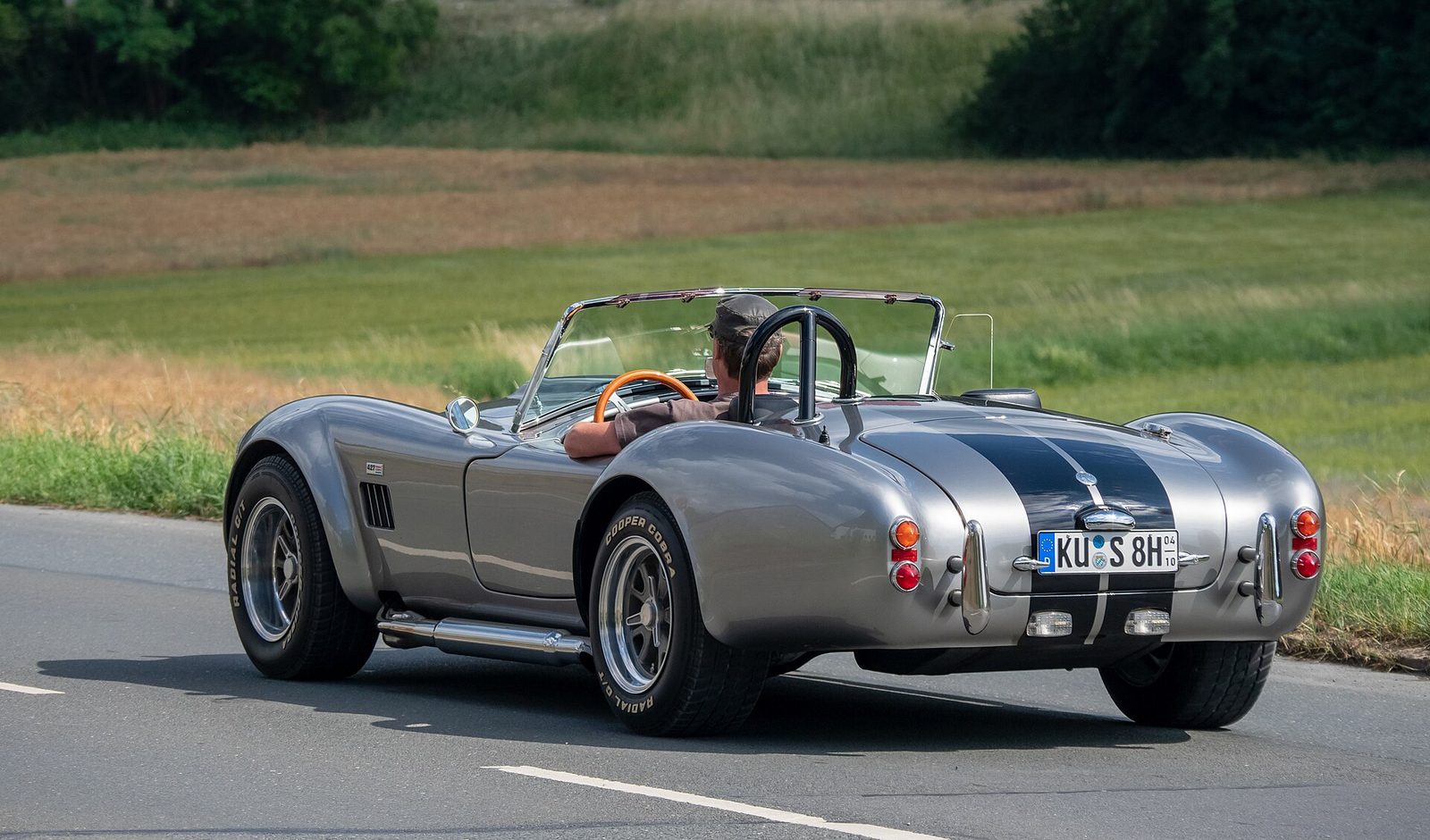
The Shelby Cobra began as an English sports car with an American engine dropped into it. AC Cars of Thames Ditton had lost the Bristol engine that powered its Ace; Carroll Shelby had access to a Ford V8. The prototype, CSX2000, was built from a reinforced Ace, shipped to California without an engine in February 1962 and engined at Dean Moon's shop before appearing at the New York show that April. What followed divides in two. The leaf-spring cars, 655 of them, ran 260 and then 289 engines and carried Shelby American to the GT world championship in 1965 with help from Pete Brock's Daytona Coupe. The coil-spring CSX3000 cars, rebuilt with Ford's assistance around the 427 FE, were a far more brutal machine, and the homologation program they existed for collapsed before it began. Fewer than a thousand originals were built against many thousands of replicas, which is why identity documentation dominates this market.
Cobra
CSX2000 leaf-spring and CSX3000 coil-spring cars
History
An English Chassis Looking for an Engine
AC Cars of Thames Ditton had a problem at the start of the 1960s: the Bristol engine that powered its Ace was going out of production and there was no obvious replacement. Shelby American's own account is that Carroll Shelby approached AC once he had secured an engine manufacturer, and that AC agreed. The engine came from Ford. The prototype, CSX2000, was built at Thames Ditton as a substantially reinforced Ace - limited-slip Salisbury rear end, inboard rear discs, stiffened suspension, thicker-wall main tubes - completed in late February 1962, shipped to California without an engine and fitted with one of the first 260 cu in Ford V8s at Dean Moon's shop.
The Leaf-Spring Cars
Production cars kept the Ace's twin-tube frame and its transverse leaf-spring suspension, in which the leaf doubles as the upper link. The first 75 carried the 260; the 289 replaced it, and in 1963 Shelby American also abandoned the worm-and-sector steering box for a rack and pinion. That change, more than the engine, is what collectors use to divide the leaf-spring run. Around 528 Mark II cars followed to the summer of 1965, giving 655 small-block cars across the CSX2000 to CSX2602 range. They were quick, aerodynamically hopeless and effective in American club racing.
Daytona and the Championship
The shape cost the car top speed on the long European circuits, so Shelby American employee Pete Brock drew a fastback coupe body for the existing running gear. It first ran at Daytona and the press named it accordingly. The coupes took a GT class win and fourth overall at Le Mans in 1964, and on 4 July 1965 the Cobra won the World Manufacturers' GT Championship against Ferrari, the GT III class taken by nineteen points. How many were built is contested: six is the usual figure, but Sports Car Market states eight.
The 427 and a Homologation That Failed
For 1965 the car was rebuilt around Ford's 427 FE. Main frame tubes went from three inches to four, the chassis widened by five inches, and coil springs replaced the transverse leaves all round, with Ford's engineering department assisting. The intention was to homologate a competition version, which required 100 cars; they were not built in time. Unsold competition chassis accumulated, and a batch was detuned, given windshields and road equipment and sold as S/C - semi-competition - cars. The street car that followed is the one most people picture, though much of the second CSX3000 batch left with the cheaper 428 Police Interceptor. The last four dozen or so reverted to a single-carburetor 427, and CSX3360 left in October 1967.
Replicas, Continuations and the Problem of Identity
No other collector car has been copied on this scale. Kit and component cars have been built since the 1970s - one firm alone made between 154 and 170 slab-side replicas in the early 1980s - and Shelby's answer was to issue further CSX numbers to authorized continuation cars through the CSX4000, CSX6000, CSX7000 and CSX8000 series. The boundary has been tested: a 1991-92 program to complete nine cars on original-series chassis numbers ended with the California DMV ruling them not street legal, and a 1993 counterfeiting case involved 43 duplicate titles for cars that did not exist. The consequence is that the SAAC World Registry of Cobras and GT40s, rather than the car in front of you, establishes whether an original is an original.
Common Problems
The mechanical faults are the least of it. The Ford FE and small-block V8s are simple, robust and thoroughly supported, and there is no rare bespoke component in either driveline. Trouble comes from the environment around them. The first CSX3000 street car ran an underbody exhaust and was plagued with heat radiating into the cabin, which is why side pipes became standard; cooling and cockpit heat remain live concerns on big-block cars used in traffic. Aluminum panels over a steel frame make a galvanic-corrosion pairing, and the bodies are hand-formed, so accident damage is expensive and rarely invisible afterwards. The larger problem is provenance: clones are regularly offered as originals, and the record includes a 1993 counterfeiting case running to 43 duplicate titles for cars that did not exist, and a 1991-92 completion program whose nine cars the California DMV ruled not street legal. Restoration histories are long and often opaque, and the registry is the only reliable arbiter.
What to Look For
Identity comes before condition here. The SAAC World Registry of Cobras and GT40s holds documentation on every serial number built, and a car whose history does not match its registry entry is a different and much cheaper proposition however well it presents. Establish what the chassis number implies first: CSX2000-2602 is a leaf-spring small-block, CSX3001-3053 competition series, CSX3101-3360 a coil-spring street car, and CSX4000, 6000, 7000 and 8000 numbers are authorized continuations built decades later. Within the leaf-spring cars, confirm whether the steering is worm-and-sector or rack-and-pinion and whether that matches the chassis number rather than the advertisement. Within the CSX3000 street cars, establish whether the car left with a 427 or a 428 Police Interceptor - roughly a hundred had the 428, many have since been re-engined, and paperwork rather than a block casting settles it. Ask whether the aluminum body is original and whether the frame has been repaired, because a rebodied original occupies a gray area that moves value. For an S/C or competition car, look for the hardware - larger rotors, heavy-duty calipers, bronze bushings - and a documented racing record rather than an asserted one.
Market Notes
The Cobra heading on classic.com is a replica market with a few originals in it: as of August 2026 it carries 213 replica listings averaging $63,561, against a single original 427 for sale and two 289s. The sub-markets must be read separately. As of August 2026 the Cobra 289 carries a benchmark of $1,026,770 against an average sale of $1,156,295 and is trending down; results run from $478,000 for a 1963 car in February 2025 to EUR 792,500 for a 1964 car in January 2026. As of August 2026 the 427 average sale is $1,675,368 with a single car for sale, split into $1,542,656 for base cars, $2,462,143 for competition and $2,960,000 for semi-competition; the highest recorded result is $3,300,000 in January 2026, the lowest $660,000 in January 2023. Mecum's January 2026 Kissimmee sale took $3,300,000 and $1,540,000 for two 427s and $1,298,000 for a Stage III 289 Dragonsnake, while two 289 roadsters went unsold on high bids of $1,000,000 and $1,200,000. Continuation cars average $228,984 as of August 2026 across 19 listings.
Where sources differ
Total coil-spring CSX3000 production is not agreed across the sources consulted, so no overall production figure is asserted here.
Wikipedia and the Great Lakes Cobra Club both state 343 coil-spring cars, giving 998 originals in total. RM Sotheby's catalog copy for CSX3102 states 'just over 300 were built'. The Shelby American Collection's component figures - 260 street, 31 S/C, 19 competition - sum to 310. Cobra Authority states approximately 1,000 originals but only 160 'genuine 427' cars. No source consulted here reconciles these, so productionTotal is null.
The number of 427 S/C semi-competition cars is not agreed between sources.
Hagerty states that 28 Cobras were sold in S/C configuration; Wikipedia states that 31 unsold competition models were detuned and fitted with windshields for street use. No source consulted here resolves the difference.
The number of 427 competition Cobras is not agreed, with counts differing according to whether chassis laid down, cars completed in race trim, or cars sold are being counted.
The Shelby American Collection states 19 competition cars. RM Sotheby's states 53 competition chassis produced, of which 23 were completed in full race trim and sold to private teams. Hagerty refers to 50 'production' competition roadsters, only 16 sold by November 1965. Wikipedia states only 56 of the 100 homologation cars were built. Not resolved by any source consulted here.
The number of Daytona Coupes built is disputed.
Wikipedia and the Great Lakes Cobra Club both state six coupes built for racing in 1964-65. Sports Car Market's model profile states 'Number Produced: 8'. Neither explains the difference, and no source consulted here resolves it.
Published output for the street 427 differs between sources and no single figure is asserted.
Wikipedia gives 425 hp at 6,000 rpm and the Shelby American Collection refers to a '425-hp 427' for street cars generally, but the same museum lists CSX3269 at 410 hp and Supercars.net gives 410 hp at 6,000 rpm. Both agree on 480 lb-ft at 3,700 rpm. The gap is not explained by any source consulted here.
Sources
- AC Cobra, Wikipedia · encyclopedia
- Shelby Daytona, Wikipedia · encyclopedia
- Shelby American History, Shelby American, Inc. · manufacturer
- 1962 260 Cobra CSX2000, Shelby American Collection · specialist
- 1967 427 Cobra CSX3269, Shelby American Collection · specialist
- Your handy 1965-67 Shelby 427 Cobra buyer's guide, Hagerty Media · journalism
- Shelby Cobra 289 Market, classic.com · market-data
- Shelby Cobra 427 Market, classic.com · market-data
- Shelby Cobra Continuation Market, classic.com · market-data
- Shelby Cobra Replica Market, classic.com · market-data
- 1962 Shelby 260 Cobra 'CSX 2000', Monterey 2016, RM Sotheby's · auction-house
- 1965 Shelby 427 Competition Cobra, Arizona 2023, RM Sotheby's · auction-house
- 1966 Shelby 427 Cobra, Monterey 2018, RM Sotheby's · auction-house
- 1965 Shelby 289 Cobra, Monterey 2025, RM Sotheby's · auction-house
- 1965 Shelby Cobra Daytona Coupe, Sports Car Market · journalism
- Genuine or replica, the only wrong Cobra is one that isn't driven, Great Lakes Cobra Club · club-forum
- The Shelby Cobra Program, Cobra Authority · specialist
- Seven Figure Automobiles at Mecum Kissimmee 2026, eClassicAutos · journalism
- 1965 Shelby Cobra 427 Roadster: History, Specifications and Performance, Supercars.net · specialist
Synthesized from the sources above and cross-checked. We cite and link out; we do not republish other databases verbatim.
Fully Sorted is an independent publisher and is not affiliated with, endorsed by or sponsored by Shelby. Shelby and the model names on this page are trademarks of their respective owners and are used here only to identify the cars being described.
Chassis register
Nobody has recorded a car here yet. Own one, or know one? Chassis number, what you can prove about it, and a source if there is one. Every entry is reviewed before it appears.
Nerd Notes
What owners know that the sources don't. Every note is read and checked before it appears here.
Key Specs
- Power
- 260 hp (260 cu in) and 271 hp (289 cu in) for the small-blocks; the street 427 given as either 410 or 425 hp at 6,000 rpm depending on source; competition tune 485-500 hp; the 428 at 360 hp
- Brakes
- Four-wheel discs; inboard rear discs on the prototype, larger rotors and heavy-duty calipers on competition cars
- Engine
- Ford V8 in 260, 289, 427 FE side-oiler and 428 FE Police Interceptor forms
- Layout
- Front-mounted V8, rear-wheel drive, two-seat open roadster
- Torque
- 480 lb-ft at 3,700 rpm for the 427; no comparable small-block figure appears in the sources consulted
- Weight
- 2,282 lb quoted curb weight for the 427; published, not re-measured
- Chassis
- Twin-tube steel ladder frame by AC Cars, Thames Ditton, with hand-formed aluminum panels; 3-inch main tubes on leaf-spring cars, 4-inch tubes and a frame five inches wider on CSX3000 cars
- Steering
- Worm-and-sector on the earliest cars, rack-and-pinion from 1963
- Price new
- Approximately $7,500 for the 427 in 1965
- Wheelbase
- 90 in; track 55.0 in front and 54.0 in rear on the 427
- Acceleration
- 0-60 mph in 4.2 s and a standing quarter mile in 12.4 s for the 427 - published period figures, not a modern instrumented test
- Transmission
- Four-speed manual; the two Super Snakes used a three-speed automatic
- Chassis numbers
- CSX2000-CSX2602 leaf-spring; CSX3000 series coil-spring, competition at CSX3001-3026 and CSX3028-3053, street from CSX3101 to CSX3360
- Top speed quoted
- 164 mph for the 427 street car, 185 mph for the S/C; not independently verified
- Suspension coil spring
- Independent coil springs and wishbones all round (CSX3000 cars)
- Suspension leaf spring
- Independent front and rear by transverse leaf spring, the leaf doubling as the upper link
Notable Variants
260 Cobra (1962-1963)
The first 75 Mk1 cars, with the 260 cu in Ford V8 and worm-and-sector steering. CSX2000 itself, the AC-built prototype, is the most valuable car the marque has produced.
289 Cobra (Mark I and Mark II)
The bulk of leaf-spring production. Collectors divide these on steering rather than engine: worm-and-sector cars sit below the rack-and-pinion cars adopted with the 289 in 1963.
Daytona Coupe
Pete Brock's fastback body on Cobra running gear, built to find the top speed the roadster lacked in Europe. Counts differ between six and eight. Class win at Le Mans in 1964; GT title in 1965.
427 Cobra street car (CSX3000)
The coil-spring car: wide body, 4-inch main tubes, five inches wider than a leaf-spring car. Around 260 built, a substantial batch with the 428 Police Interceptor rather than the 427.
427 S/C (semi-competition)
Unsold competition chassis detuned for the road with a windshield and road equipment. Counts run from 28 to 31. classic.com's semi-competition benchmark sits well above the street car's.
427 Competition Cobra
Full race specification: larger rotors, heavy-duty calipers, bronze bushings. Built for a homologation program that failed; counts range from 19 to 50.
427 Super Snake
Two cars, with twin Paxton superchargers and a three-speed automatic. One was destroyed after a fatal single-car accident attributed to a stuck throttle; the survivor was Carroll Shelby's own.
Value Trajectory
The Cobra has had two re-ratings. The first was violent: by Hagerty's account 427 Cobras went from $75,000 cars to over $500,000 in less than 24 months around 1990. That spike is also what made forgery worth attempting. The second came in the first half of the 2010s, when the whole 1960s sports-racing cohort re-rated; Hagerty describes big-block values as quiet since 2015, with most top-condition cars between $1 million and $2 million and rough examples holding at least $750,000. The classic.com picture as of August 2026 fits a market that has stopped climbing and started sorting: the 289 benchmark of $1,026,770 is trending down, two 289 roadsters failed to sell at Mecum in January 2026 on seven-figure high bids, and yet a documented 427 made $3,300,000 in the same room. The extremes are set by singular cars - CSX2000 made $13,750,000 at RM Sotheby's Monterey in August 2016, and a Daytona Coupe $7,685,000 including buyer's premium at Mecum Monterey in August 2009.
Next
Shopping for one?
Browse Shelby listings, or decode a VIN before you buy.