
The Shelby GT350 began as a homologation exercise rather than a marketing one. Lee Iacocca wanted a Mustang with a competition record, and from August 1964 Carroll Shelby's Venice premises took incomplete Wimbledon White fastbacks from Ford's San Jose plant and turned them into cars the SCCA would accept in B-Production. The 1965 run of 562 was barely civilized: a 306 hp 289, a four-speed and nothing else, side-exit exhaust, relocated suspension pick-ups, no rear seat. Everything after that was a retreat from the brief. For 1966 came colors, an automatic option and roughly a thousand black-and-gold Hertz rental cars; for 1967, glassfiber styling and Ford's own designers; for 1968, assembly by A.O. Smith in Ionia, Michigan and a 250 hp 302 in place of the K-code 289; and by 1969 a 351-powered cruiser with imitation teak on the dash. There was no 1970 production at all - unsold 1969 cars were re-serialled as 1970 models under FBI supervision. The value divide follows that story almost exactly.
GT350
Shelby Mustang GT350
History
Homologation, Not Marketing
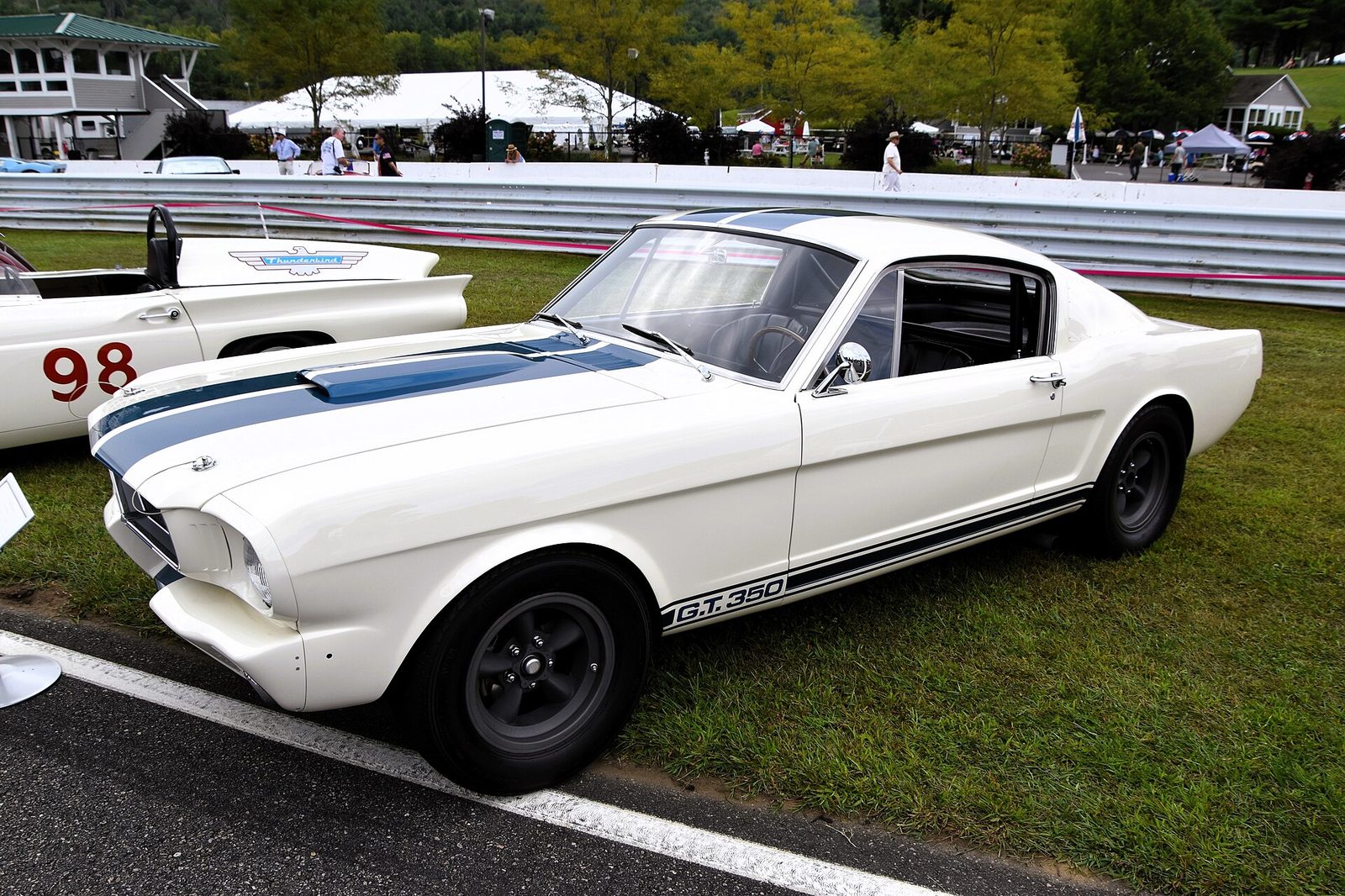
Ford had a Mustang that sold in enormous numbers and won nothing. Lee Iacocca's remedy was to ask Carroll Shelby whether the car could be given a competition image, and the answer took the shape of an SCCA B-Production homologation program approved in August 1964. In late December Ford's San Jose plant shipped incomplete Wimbledon White K-code fastbacks to Shelby American's Venice shop, where they were rebuilt: lowered upper A-arm pivots, an export brace and Monte Carlo bar, over-ride traction bars, a Detroit Locker axle, glasspack side exhausts, a glassfiber hood, and the rear seat removed so the car could be registered as a two-seater. The engine gained an aluminum Cobra inlet, a Holley 715 and Tri-Y headers for a quoted 306 hp. The class rules, not the customer, dictated the specification.
The R-Models and What They Won
Alongside the street cars Shelby built a competition version, the R-model: caged, stripped, plexiglass-glazed, with the interior and most of the trim simply absent. Sources put the number at 34, 35 or 36. What is not in dispute is the result - the GT350 took the B-Production national championship three years running, which was precisely what Ford had paid for, and the R-models have since detached from the street-car market entirely.
Carryovers, Colors and a Fleet of Rental Racers
For 1966 Shelby American bought 252 leftover 1965 K-code Mustangs to keep the line running through Ford's San Jose retooling shutdown. Those carryover cars, serials 6S001 to 6S252, wear 1966 bodywork over 1965 mechanicals and are the most sought-after of the year. The rest of 1966 saw the car softened: four extra colors, a fold-down rear seat, an automatic option, quarter windows in place of the extraction louvres, rear-exit exhaust. The defining event was Peyton Cramer's proposal to Hertz, which became an order of around a thousand GT350H rental cars, mostly Raven Black with gold stripes. Renters treated them as advertised, raced them at weekends and returned them with components missing.
Ford Takes the Pen
The 1967 car was the first designed with Ford's involvement rather than around a rulebook. A glassfiber nose, hood, spoilered trunk lid and functional brake ducts lengthened and softened it; the 289 stayed at 306 hp but headers and straight-through mufflers became options. It was outsold nearly two to one by the new big-block GT500. By mid-1967 Shelby American's quality and capacity problems, plus the loss of its airport lease, had persuaded Ford to move the work: in August 1967 it went to A.O. Smith at Ionia, Michigan, where matched-metal molding finally produced glassfiber panels that fitted. The 1968 cars came part-built from Ford's Metuchen, New Jersey plant, wore Cobra badging, offered a convertible for the first time, and swapped the K-code 289 for a hydraulic-cammed 302 rated at 250 hp.
The End, and the Cars That Were Not Built
By 1969 the GT350 had a 351 Windsor, a three-scoop hood, imitation teak trim and a tape deck, and Shelby's involvement had thinned to a name; he asked Ford to end the agreement in the summer of 1969. That left unsold cars in stock and no 1970 model. Ford's answer was to re-serial them: the leading VIN digit changed from 9 to 0, new door and windshield plates, revised distributors, a chin spoiler and two black hood stripes - carried out, every source agrees, under FBI supervision. How many cars were treated this way is not agreed.
Common Problems
The underlying car is a mid-1960s Ford unibody and it rusts where those rust. Overlapping lap joints trap moisture and salt, and specialists single out the shock towers and frame rails as the repairs hardest to put right and easiest to disguise; floors, door bottoms, trunk lid and the surrounds of both screens follow. Water ingress at the windshield is routine, usually thin replacement glass and poor-quality seals rather than a structural fault, though it becomes one if ignored. Brakes are the mechanical weak point: the original front discs and rear drums are undersized, which is why upgrades to 1967 Thunderbird front rotors and larger truck rear drums are so common on driven cars. Suspension is better than its reputation provided the original specification is respected; several reproduction parts use pressed-in rather than spot-welded ball joints and are a downgrade. On 1967 and 1968 cars the glassfiber is a maintenance item in itself, hand-fitted and wavy when new on the California-built cars. The 1965 cars have their own quirks: the early boot-mounted battery was abandoned mid-year after complaints of fumes, and Detroit Locker axles, while durable, are audible in a way that unsettles anyone expecting a normal differential.
What to Look For
Identity comes before condition here. The Shelby serial appears on a plate riveted to the inner wing, and the SAAC Shelby Registry carries a serial-by-serial history for every 1965, 1966 and 1967 car; a car whose registry entry does not match what is in front of you is a different proposition from one whose entry does. Check that the Ford VIN and the Shelby number agree with each other and with the title, and that the engine block number matches the chassis. On 1965-67 cars the T-10 case should be aluminum rather than cast iron, a quick and useful tell. Establish which sub-group the car belongs to, because the money follows the group: a carryover sits at serials 6S001 to 6S252; a Hertz car is worth less than an equivalent private-sale car of the same year; a documented period Paxton installation is worth having and a later retro-fit is not. On a 1970-titled car, look for the re-serialling paperwork and the changed plates rather than taking the VIN at face value. Structurally the priority areas are shock towers, frame rails, floors, door and boot bottoms and the metal around both screens; glassfiber repairs or heavy filler there are a reason to walk away.
Market Notes
As of August 2026 classic.com records a benchmark of roughly $331,500 for 1965-66 GT350s, average near $338,600, rising, with tracked results from about $68,300 for a 1966 car in August 2025 to $1,100,000 for a 1965 car in May 2026. The Hertz cars sit well below that: a benchmark of about $198,800 and an average near $192,600 as of August 2026, with a high of $462,000 at Scottsdale in January 2026. The Ford-built cars are cheaper again: as of August 2026 an average of roughly $162,500 for 1967-68 cars, topping out at $275,000 in May 2026, and a benchmark of about $103,300 with an average near $107,600 for 1969-70 cars, high of $187,000 in May 2026. Competition cars are a separate market: the GT350R benchmark stands at roughly $1,753,800 as of August 2026, with a 1965 car at $2,750,000 at Mecum in May 2026. Individual results follow the pattern: RM Sotheby's sold 5S137 for $500,000 at Monterey in August 2025 and the carryover 6S176 for $351,500 at Monterey in 2023, while the ceiling for a non-R 1965 street car was set by 5S039 at a $1 million hammer, $1.1 million including buyer's premium, at Mecum Indianapolis. Premium sits on top of hammer at these houses.
Where sources differ
Four independent sources agree that Shelby American built 562 GT350s for the 1965 model year, but no two agree on how that total divides between street, competition, drag and prototype cars.
RM Sotheby's and TheShelbyCars.com both state 562 for the year. TheShelbyCars.com, from registry serial data, splits it 515 street, 35 competition, nine drag, one street prototype and two competition prototypes. The Shelby American Collection states 521 production models, Supercar Nostalgia 526, autoevolution 526 street plus 36 R-models. Not resolved by any source consulted here.
The number of 1965 GT350R competition cars is given variously as 34, 35 and 36 by credible sources and is not settled here.
Wikipedia states 34 R-models. Registry-derived serial data at TheShelbyCars.com gives 35 competition cars plus two competition prototypes. Autoevolution states 36. Part of the gap may lie in whether the prototypes are counted, but no source consulted here says so, and the question is unresolved.
Total 1966 GT350 production is stated as 2,378 by one source and 2,388 by another, with different internal breakdowns, and no single figure is asserted here.
Wikipedia states 2,378 including two prototypes and four drag cars, with 1,372 to private buyers and about 1,003 fastbacks to Hertz. Supercar Nostalgia states 2,388: 1,368 standard, 1,001 Hertz, six convertibles and eleven supercharged. Not resolved by any source consulted here.
The 1966 Hertz GT350H fleet, proposed by Shelby American general manager Peyton Cramer in September 1965 and delivered from February 1966, is given as 1,000, 1,001 or 1,003 cars depending on the source, and the number delivered with four-speed manual gearboxes before the automatic took over is given as either 85 or 100.
MotorCities states 1,000 cars with the first 100 as four-speeds; Hagerty Media and Supercar Nostalgia both state 1,001; Wikipedia states approximately 1,003 fastbacks and that the first 85 were four-speeds. No source consulted here reconciles either figure, so neither is asserted.
Two sources give near-identical but non-matching figures for 1967 GT350 production, one stating 1,175 cars and the other 1,174.
Revology states 1,175 GT350s within a 3,225-car Shelby year alongside 2,048 GT500s. Heacock Classic states 1,174 alongside 2,050 GT500s. Neither source explains the difference and it is not resolved here.
No GT350s were built for the 1970 model year; unsold 1969 cars were reissued with 1970 identification numbers under FBI supervision, the leading VIN digit changed from 9 to 0 with new door and windshield plates, a chin spoiler, two black hood stripes and emissions work, but the number of cars so treated is given as 789 by two sources and 601 by a third.
Wikipedia and conceptcarz both state 789 cars re-VINed as 1970 models. MotorCities states 601 units produced as 1970 models. Neither figure is broken down between GT350 and GT500 by any source consulted here, and the discrepancy is not resolved.
Sources
- Shelby Mustang, Wikipedia · encyclopedia
- The History of Carroll Shelby and Shelby American, Shelby American, Inc. · manufacturer
- 1965 Shelby Mustang GT350, Shelby American Collection · specialist
- 1965 GT 350 Serial & Vin Numbers, TheShelbyCars.com · registry
- Unique Features - 1966 GT350 Carryover Cars, carryovergt350.com · registry
- Remembering the 1966 Shelby Mustang GT350H Rent-a-Racer, MotorCities National Heritage Area · specialist
- The 1968 Shelby Mustang and the A.O. Corporation, MotorCities National Heritage Area · specialist
- Remembering the 1969 Mustang Shelby GT 350/500 Models, MotorCities National Heritage Area · specialist
- Ford Shelby Mustang GT350 '65MY & '66MY Guide, Supercar Nostalgia · specialist
- 1967 Shelby GT350: Full Model Guide and Key Details, Revology Cars · specialist
- 1967 Shelby GT350 - More & Less, Heacock Classic · journalism
- 1968 Shelby GT350 Mustang: Ultimate In-Depth Guide, Mustang Specs · specialist
- 1969 Shelby GT350: Ultimate In-Depth Guide, Mustang Specs · specialist
- 1970 Shelby Mustang GT350, conceptcarz.com · encyclopedia
- Your handy 1965-66 Shelby GT350 buyer's guide, Hagerty Media · journalism
- Cobra Automotive's Curt Vogt: How to make a Shelby GT350 even better, Classic Motorsports · specialist
- 1965 Shelby GT350, Monterey 2025, RM Sotheby's · auction-house
- 1966 Shelby GT350 'Carryover', Monterey 2023, RM Sotheby's · auction-house
- Ford Shelby Mustang GT350 - 1st Gen (1965-1966) Market, classic.com · market-data
- Ford Shelby Mustang GT350H - 1st Gen (1965-1966) Market, classic.com · market-data
- Ford Shelby Mustang GT350 - 1st Gen (1967-1968) Market, classic.com · market-data
- Ford Shelby Mustang GT350 - 1st Gen (1969-1970) Market, classic.com · market-data
- Ford Shelby Mustang GT350R - 1st Gen (1965-1966) Market, classic.com · market-data
- 1965 Shelby GT350 Breaks Into Seven-Digit Record at Mecum, Nails $1M Hammer Price, autoevolution · journalism
Synthesized from the sources above and cross-checked. We cite and link out; we do not republish other databases verbatim.
Fully Sorted is an independent publisher and is not affiliated with, endorsed by or sponsored by Shelby. Shelby and the model names on this page are trademarks of their respective owners and are used here only to identify the cars being described.
Chassis register
Nobody has recorded a car here yet. Own one, or know one? Chassis number, what you can prove about it, and a source if there is one. Every entry is reviewed before it appears.
Nerd Notes
What owners know that the sources don't. Every note is read and checked before it appears here.
Key Specs
- Power
- 306 hp at 6,000 rpm (1965-67); 250 hp (1968); 290 hp at 4,800 rpm (1969-70) - period gross SAE ratings, manufacturer claims rather than measured figures
- Brakes
- Front discs, rear drums; specialists regard the original specification as undersized
- Engine
- 289 cu in K-code Windsor V8 (1965-67); 302 (1968); 351 Windsor (1969-70)
- Layout
- Front V8, rear-wheel drive; two-seat or 2+2 cabin depending on year
- Torque
- 329 lb-ft at 4,200 rpm (1965-67); 310 lb-ft (1968); 385 lb-ft at 3,400 rpm (1969-70)
- Weight
- About 2,790-2,800 lb for a 1965 car; 3,146 lb curb quoted for the 1968, the gain reflecting bodywork, a rear seat and trim
- Chassis
- Ford Mustang unitary steel body-frame, modified: 1965-66 cars gained lowered upper A-arm pivots, an export brace and a Monte Carlo bar; later cars carried more glassfiber over the same structure
- Exhaust
- Side-exit glasspack mufflers for 1965; conventional rear-exit dual system from 1966
- Bodywork
- Steel shell with a glassfiber hood from 1965; by 1967-68 the nose, hood, front wings, scoops and trunk lid were glassfiber, molded at Shelby American and then A.O. Smith
- Induction
- Holley 715 cfm on the 289; Holley 600 cfm on the 1968 302; optional Paxton supercharger 1966-67
- Price new
- $4,547 (1965); $4,117 fastback and $4,238 convertible (1968); $4,434 fastback and $4,753 convertible (1969)
- Top speed
- Approximately 129-140 mph depending on year and source; period figures, not re-verified
- Suspension
- Unequal-length front wishbones with relocated upper pivots, live rear axle on leaf springs; over-ride traction bars on 1965 and carryover cars only
- Final drive
- Ford nine-inch axle with Detroit Locker no-spin differential on the 1965 cars
- Acceleration
- 0-60 mph in roughly 6.5-7.1 s across the run: about 7.0 s (1965), 6.6 s (1966 Hertz), 7.1 s (1967 test), 6.5 s (1969)
- Transmission
- Aluminum-case Borg-Warner T-10 four-speed only for 1965; three-speed automatic optional from 1966 (C4 on the Hertz cars, FMX by 1969)
- Wheels tires
- 15-inch painted steel or Cragar/Shelby magnesium-center rims on Goodyear Blue Dot tires for 1965; Magnum 500 and ten-spoke cast-aluminum options followed
Notable Variants
GT350 (1965 street car)
The homologation car proper: Wimbledon White only, Guardsman Blue rocker stripes, an aluminum-case T-10 four-speed as the only gearbox, Detroit Locker axle, side-exit exhaust, no rear seat. Early cars carried the battery in the trunk until fume complaints ended it mid-year.
GT350R (1965 competition model)
Caged, stripped, plexiglass-glazed racer built to take the Mustang into SCCA B-Production, where it won the championship three years running. Counts differ between 34, 35 and 36. R-models trade in a market wholly separate from the street cars.
GT350 'Carryover' (first 252 cars of 1966)
Serials 6S001 to 6S252, built from 1965 K-code Mustangs bought to bridge Ford's San Jose shutdown. They keep 1965 running gear - lowered A-arms, traction bars, black engine blocks, 1965 interior - under 1966 bodywork, and are rated above ordinary 1966 cars.
GT350H (1966 Hertz cars)
Around a thousand cars supplied to Hertz for the Rent-a-Racer program, mostly Raven Black with gold stripes. The earliest had four-speed manuals, most of the rest automatics. Renters raced them and returned them short of parts, and they trade well below a private-sale 1966 car.
GT350 with Paxton supercharger (1966-1967)
Centrifugal blower quoted at roughly 380-400 hp, fitted by dealers as well as the factory; eleven supercharged cars are cited for 1966. Documented period installations carry a premium, later retro-fits do not.
GT350 (1967)
First year of Ford's design involvement and of extensive glassfiber: new nose, hood, spoilered trunk lid and brake ducts on the same 306 hp 289. The first year the GT350 was outsold by its big-block sibling, and the last built in California.
GT350 convertible (1968-1970)
Introduced when A.O. Smith took over assembly, with a padded roll bar carrying eyelets advertised for surfboards and skis. The scarcer body in every year offered, and it trades above the fastback.
1970 model-year cars
Not built as 1970s at all: unsold 1969 stock re-serialled under FBI supervision, the leading VIN digit changed from 9 to 0, with new plates, a chin spoiler, two black hood stripes and emissions work. Paperwork matters more here than anywhere else in the run.
Value Trajectory
The GT350 market has separated into layers that no longer move together, and the dividing line is who built the car. Shelby American's own 1965 and 1966 cars have run far ahead of the Ford-built ones: as of August 2026 classic.com's 1965-66 benchmark of roughly $331,500 is more than three times the 1969-70 benchmark of about $103,300, with the 1967-68 cars in between at an average near $162,500. Within the early group the hierarchy is settled: R-models first, then early two-digit 1965 street cars, then ordinary 1965s, then 1966 carryovers, then standard 1966s, with the Hertz cars last of the Shelby American era. The direction has been upward across every group tracked as of August 2026, and the top of the 1965 range has moved sharply: the record for a non-R street car reached a $1 million hammer, $1.1 million with premium, against a prior ceiling in the mid-to-high $900,000s. The R-models have decoupled entirely. Documentation now accounts for more of the spread than condition does.
Next
Shopping for one?
Browse Shelby listings, or decode a VIN before you buy.