
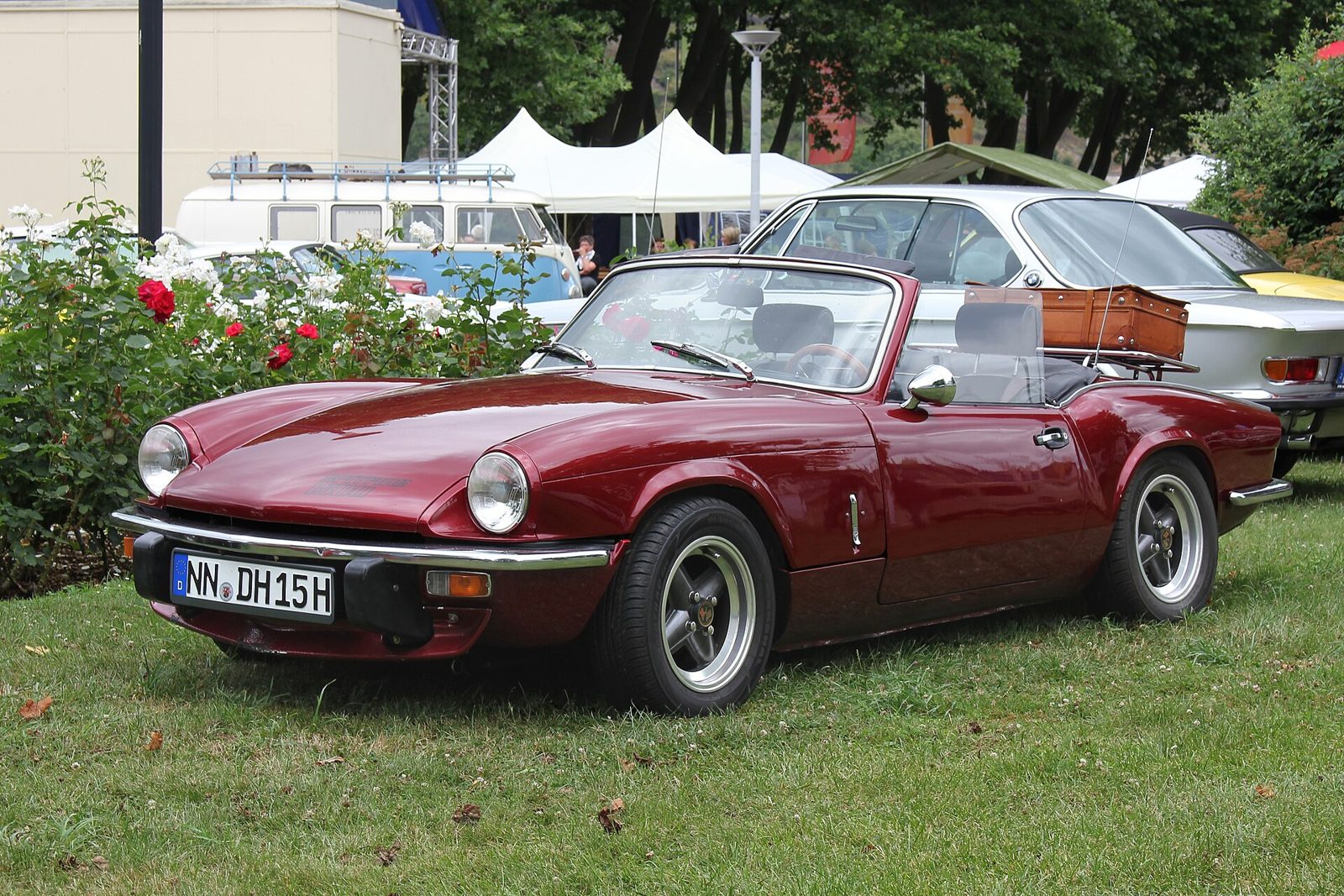
The Triumph Spitfire was Standard-Triumph's answer to the Austin-Healey Sprite: a two-seat roadster built on a shortened Triumph Herald backbone frame, with Herald running gear, a Giovanni Michelotti body and, unusually for the money, roll-up windows, front disc brakes and independent rear suspension. It arrived in the United States as a 1963 model at just under $2,200 and stayed on sale here through the 1980 model year, across five versions: Spitfire 4 (Mk I), Mk II, Mk III, Mk IV and 1500. The American car diverged from the home-market car early. US Spitfires got the raised front bumper with the Mk III, a federal dashboard and lower compression from 1969, a single Zenith-Stromberg carburetor on the Mk IV, the 1,493 cc engine two years before Britain, and black rubber bumpers for 1979-80. The United States was its largest market by a wide margin. Total production is usually given as a little over 314,000, but the sources consulted here do not agree on the exact figure, and one puts it above 325,000.
Spitfire
History
A Sprite Fighter From the Parts Bin
Standard-Triumph began the car in 1957 under the code name Bomb, to answer the Austin-Healey Sprite. Where the Sprite borrowed Austin sedan running gear, Triumph took the separate backbone frame of its Herald, shortened it, removed the outer rails and rear outriggers, and built structural sills into the body to recover the stiffness. Giovanni Michelotti, who had styled the Herald, drew the body, with a one-piece front that tilted forward for engine access. Financial trouble at Standard-Triumph stalled the project; Wikipedia records that after Leyland Motors took the company over, its officials found Michelotti's prototype under a dust sheet in a corner of the factory and approved it. The car was shown in October 1962 and reached American showrooms as a 1963 model with a 1,147 cc four, twin SU carburetors and 63 hp.
Five Versions, Two Markets
The Mk II of 1965 brought a few more horsepower and carpet in place of rubber mats. The Mk III, which reached US roads in 1967, took the 1,296 cc engine and 75 hp, a proper folding top, and a front bumper raised to meet bumper-height rules; Hagerty calls it the most powerful Spitfire sold here. From 1969 the US car was federalized: compression dropped to 8.5:1, output to a quoted 68 hp, and the instruments moved in front of the driver. The 1970 US cars carried a one-year Spitfire badge over an RAF roundel. Michelotti's Mk IV followed for the 1971 model year with a cut-off tail, a hood without seams along the fenders, and in North America a single Zenith-Stromberg carburetor that Moss Motors says left the engine under 50 hp.
The Swing Axle Question
The Herald's rear suspension came along unchanged: swing axles located by a transverse leaf spring, with a universal joint only at the differential. Pushed hard into a corner, the rear could jack into extreme positive camber and the inside tire tuck under, the source of the car's reputation for sudden oversteer. The fix was cheap. For the Mk IV only the bottom leaf was clamped to the differential and the rest of the stack could pivot, an arrangement Triumph called the swing spring. The 1500 added longer axles, a lower spring mount for more negative camber and a wider track. When Road & Track tested nine showroom-stock sports cars in April 1973, all on 165-section radials, the GT6 set the fastest lap and the Spitfire was judged the most fun to drive.
Federal Years
For the United States the 1,493 cc engine arrived for the 1973 model year, two years before Britain, in Mk IV bodywork with 1500 badges and FM-prefix commission numbers. It traded revs for torque: a single Zenith-Stromberg, compression cut to 7.5:1 for unleaded fuel (9.1:1 for 1976 only, per Wikipedia), and an official 57 hp that Hagerty points out was an SAE net figure. A better-shifting single-rail gearbox came in 1975. Bumper law then reshaped the car: large overriders on the chrome bumpers, and for 1979 and 1980 one-piece black rubber bumpers built to the five-mile-per-hour standard. Commission numbers gave way to VIN-format numbers late in 1979 at US insistence.
An American Car Built in Coventry
Of the first 100,000 Spitfires, completed in February 1968, 45 percent went to the United States. A researcher who worked from the build records at Gaydon puts total US deliveries at 139,719. Moss Motors says the Spitfire outsold the Midget and Sprite every year except 1969, when a strike cut Triumph's output, and it won SCCA national championships in F and G Production. Production ended at Canley in August 1980. The Vintage Triumph Register blames British Leyland management, US safety and emissions rules, and the exchange rate. The last car built, an Inca Yellow home-market car with hardtop and overdrive, was never sold to the public and sits in the British Motor Museum.
Common Problems
The 1,147 and 1,296 cc engines are sturdy, with one known weakness: crankshaft thrust washers, the same issue as the TR6, named by Moss Motors, Hagerty and Classic Motorsports alike. Smoke, low oil pressure and a clatter at startup point to bearings, and Hagerty stresses the correct oil filter with a non-return valve. The 1,493 cc engine has a weaker record; Wikipedia calls it rough and more prone to failure, and Hagerty notes ring and crankshaft wear. Its gearbox has the better reputation, though careless engagement of reverse on the 1975-80 single-rail box damages the teeth and can take the layshaft and synchros with it. The front trunnions wear quickly without regular lubrication, and a UK specialist sells a conversion that eliminates them. Rear wheel bearings, leaf springs, lower ball joints, rear U-joints and bushings all wear, and Moss Motors says to expect a full suspension and driveline rebuild. A whine from the rear can simply be low differential oil. Overdrive solenoids fail. Zenith-Stromberg idle and flat-spot complaints are often a split diaphragm or an empty dashpot. Electrical faults are usually frayed wiring and corroded grounds. Whether the frame itself rots is a point the sources do not agree on: Hagerty includes the backbone chassis among the rust areas, while a British specialist quoted by Hagerty UK says the chassis does not tend to rot and the sills and floors do.
What to Look For
Rust decides the car, and it can be anywhere. Hagerty lists sills, fender arches, trunk floors, main floors, the cowl, the windshield frame and the backbone frame. Classic Motorsports adds front floor pans rotted by water leaking in around the master cylinder openings, and says rot at the bottom of the windshield frame on Mk IV and 1500 cars is hard and expensive to repair. A sagging door can be worn hinge pins or a rotten lower A-post. The sills are structural, standing in for the Herald's outriggers, so the quality of any sill repair matters more than on most cars. On 1971 and later cars the frame extensions to the rear bumper are open ended and collect water. The tilting front end is easily damaged, so panel gaps and kinks in the frame ahead of the suspension towers tell a story. On the engine, fore-and-aft play at the crank pulley means thrust washers; Classic Motorsports puts ideal end float at 0.006 inch. Reverse gear teeth on the 1975-80 single-rail box are often chipped. The commission plate states what the car was: FK for a US 1300, FM for a US 1500, U for US specification, UC for California, O for overdrive. Paint codes went from numbers to three letters in March 1977, so Pimento Red is 72 or CAB, Carmine Red 82 or CAA, Java Green 85 or HAB and Inca Yellow 94 or FAB. On year, Moss Motors names the 1973 1500 as a favored model, while Hagerty finds little value spread across versions. On cost, Hagerty put a full interior refurbishment under $2,000 and a wood dash at $240 in 2025, and Moss Motors quoted a gearbox rebuild under $500 in 2009.
Market Notes
As of September 2026, classic.com gives an average Triumph Spitfire sale price of $10,120, and its recent US results bracket that figure: a 1966 Mk II sold for $12,000 in New Hampshire on August 21, 2026, and a 1979 car for $4,200 in Bend, Oregon, on August 19, 2026, while another 1979 car went unsold in Idaho that week. The lowest result it records is $100 for a 1971 car in December 2025, a parts-car price. Hagerty's 2025 buyer's guide, read as of September 2026, placed condition 2 (excellent) cars at $16,600 to $17,400 and condition 3 (good) cars at $7,300 to $8,200, and said all versions sit within a thousand or two dollars of each other, with a show car or low-mileage original stretching past $20,000 but not by much. Rare colors, a factory hardtop and overdrive carry a premium. The auction record at the top is thin: RM Sotheby's offered a restored and modified 1974 Spitfire 1500, chassis FM16659U, at its Open Roads online sale in March 2021 at a $25,000-$30,000 estimate and it did not sell, and a 1970 car estimated at $8,000-$12,000 went unsold at RM's Santa Monica sale in 2016. Neither lot page gives a high bid. classic.com mixes UK results in pounds with US results; only the dollar results are used here.
Where sources differ
The 1,493 cc engine reached US Spitfires before the rest of the world, but one source dates its US arrival a year later than the others.
Moss Motors, the Triumph Spitfire and GT6 Information Warehouse, Hagerty and Wikipedia date the US Spitfire 1500 to the 1973 model year, and Road & Track tested a Spitfire 1500 in its April 1973 issue as reprinted by Curbside Classic. Classic Motorsports states that the change came for 1974. The dated test supports 1973, but no source consulted explains the Classic Motorsports date, so the discrepancy is recorded rather than resolved.
Published output for the US Spitfire 1500 differs: 57 hp in Hagerty and in Curbside Classic's account of the 1975 Road & Track test, 53 hp DIN in Wikipedia.
Hagerty gives 57 hp as the official SAE net figure and Curbside Classic calls the 1975 test car a 57 hp Spitfire. Wikipedia gives 53 hp DIN for the US engine with catalytic converter and exhaust gas recirculation. The figures use different rating conventions and no source consulted ties either to specific model years, so the difference is not resolved here.
Published Spitfire production totals do not agree: 314,342, 314,332, over 314,000, approximately 315,000 and over 325,000 all appear, so no single figure is asserted.
Moss Motors gives 314,342. A Vintage Triumph Register e-zine quoted on the Spitfires mailing list gives 314,332, the figure a list member working from BMIHT Gaydon build records also uses, and Wikipedia's per-version table sums to the same 314,332 while its text says approximately 315,000. The Vintage Triumph Register's own page says over 314,000 and Hagerty UK says 314,000. Hagerty's US buyer's guide says over 325,000. No source consulted explains the ten-car difference or supports the higher Hagerty figure, so the total is unresolved and productionTotal is null.
Sources differ on whether the backbone frame itself is prone to rot.
Hagerty's US buyer's guide lists the backbone chassis among the Spitfire's potential rust areas. Specialist David Aspinall, quoted in Hagerty UK's buying guide, says the chassis does not tend to rot while sills and floors do. Neither source gives data on frame failure rates, so the disagreement is not resolved by any source consulted here.
Sources
- Triumph Spitfire, Wikipedia · encyclopedia
- Triumph Spitfire: Mark IV & 1500, Moss Motoring (Moss Motors) · specialist
- Spitfire & GT6 Models and Options, Triumph Spitfire & GT6 Information Warehouse (North American Triumphs) · specialist
- Exterior Paint & Interior Trim (fabric) Codes, Triumph Spitfire & GT6 Information Warehouse (North American Triumphs) · specialist
- Triumph Spitfire Color codes, Paul Tegler (teglerizer.com) · club-forum
- Vintage R&T Track Test: Nine Showroom Stock Sports Cars - Swing Axles FTW!, Curbside Classic · journalism
- Road & Track 1975 Vintage Review: Sports Sedans vs Sports Cars, Curbside Classic · journalism
- Spitfire - Triumph Club - Vintage Triumph Register, Vintage Triumph Register · registry
- Spitfire build quantity : Spitfires List Archive, The Triumph Experience (Spitfires mailing list archive) · club-forum
- Your Handy 1962-80 Triumph Spitfire Buyer's Guide, Hagerty · journalism
- Triumph Spitfire: Buy one now?, Classic Motorsports · journalism
- Triumph Spitfire Market, classic.com · market-data
- 1974 Triumph Spitfire 1500 Mk IV, Open Roads, March, RM Sotheby's · auction-house
- 1970 Triumph Spitfire, Santa Monica 2016, RM Sotheby's · auction-house
- Buying Guide: Triumph Spitfire (1962-1980), Hagerty UK · journalism
- Spitfire Bumpers: Smaller is Better, Classic Motorsports · journalism
Synthesized from the sources above and cross-checked. We cite and link out; we do not republish other databases verbatim.
Fully Sorted is an independent publisher and is not affiliated with, endorsed by or sponsored by Triumph. Triumph and the model names on this page are trademarks of their respective owners and are used here only to identify the cars being described.
Chassis register
Nobody has recorded a car here yet. Own one, or know one? Chassis number, what you can prove about it, and a source if there is one. Every entry is reviewed before it appears.
Nerd Notes
What owners know that the sources don't. Every note is read and checked before it appears here.
Key Specs
- Body
- Steel two-seat roadster body by Giovanni Michelotti, bolted to the frame; one-piece hood and fenders tilt forward
- Power
- 63 hp (Mk I, UK spec); 67 hp (Mk II); 75 hp claimed (Mk III); 68 hp quoted for 1969 US cars; under 50 hp for US Mk IV per Moss Motors; 57 hp SAE net for the US 1500 per Hagerty, 53 hp DIN per Wikipedia
- Brakes
- Front discs, rear drums; dual-circuit system on US cars from the 1968 model year
- Engine
- Standard SC overhead-valve inline-four: 1,147 cc (Mk I, Mk II), 1,296 cc (Mk III, Mk IV), 1,493 cc (1500; US from 1973)
- Layout
- Front-mounted longitudinal inline-four, rear-wheel drive
- Torque
- 67 lb-ft at 3,500 rpm (Mk I, UK spec); 75 lb-ft at 4,000 rpm (Mk III, claimed); Moss Motors says the 1500 added about 10 lb-ft. No US-specification torque figure was found in the sources consulted
- Weight
- 1,568 lb (Mk I, UK spec) rising to 1,875 lb for the 1980 car, per Wikipedia citing Robson; manufacturer and period figures, not weighed here
- Chassis
- Shortened Triumph Herald steel backbone frame with the outer rails and rear outriggers removed; the body's structural sills make up the stiffness
- Steering
- Rack and pinion, from the Herald
- Overdrive
- Optional overdrive on third and top
- Top speed
- About 90 mph (Hagerty), 91 mph (Moss Motors) or 92 mph (Wikipedia) for the Mk I; just under 100 mph for the Mk III per Hagerty
- Suspension
- Front: coil springs and wishbones. Rear: swing axles with transverse leaf spring; swing-spring arrangement from the Mk IV; longer axles, lower spring mount and wider track on the 1500
- Fuel system
- Twin SU carburetors on Mk I-III and home-market cars; single Zenith-Stromberg on US Mk IV and 1500
- Paint codes
- Numeric codes until March 1977, three-letter codes after: Pimento Red 72 / CAB, Carmine Red 82 / CAA, Java Green 85 / HAB, Inca Yellow 94 / FAB
- Acceleration
- 0-60 mph in about 15 s for the Mk I per Hagerty (16.4 s per Wikipedia, UK spec); about 13 s for the Mk III per Hagerty; 16.3 s for the US 1500 per Wikipedia
- Transmission
- 4-speed manual; all-synchromesh from the Mk IV per Moss Motors; single-rail gearbox from 1975
- Identification
- Commission numbers until late 1979, then VIN format. FK prefix for US 1300s, FM for US 1500s; U suffix US, UC California, O overdrive
Notable Variants
Spitfire 4 (Mk I), US model years 1963-1964
The original low-bumper body, 1,147 cc and 63 hp, rubber floor mats, a top whose frame the owner assembles, and the unmodified swing-axle rear. Wire wheels, overdrive and a rounded hardtop were the only real options.
Spitfire Mk II, 1965-1967
A few more horsepower (67 hp per Wikipedia), carpet for the first time and a revised grille. Hagerty calls it the last Spitfire to keep Michelotti's original design intact, before the bumper was raised.
Spitfire Mk III, 1967-1970
1,296 cc and 75 hp, a folding top and the raised front bumper. Hagerty calls it the most powerful Spitfire sold in the US. From 1969 US cars were federalized, and 1970 US cars carried a one-year Spitfire badge over an RAF roundel on the hood.
Spitfire Mk IV (US 1971-1972, 1,296 cc)
Michelotti's cut-off tail and seamless hood, plus the swing-spring rear that tamed the handling. In US form a single Zenith-Stromberg and 8.5:1 compression left it under 50 hp by Moss Motors' account.
US Spitfire 1500, 1973-1974 (FM prefix)
Mk IV bodywork with 1500 badges and the 1,493 cc engine, two years before the rest of the world got it. Moss Motors names the 1973 1500 as a favored model for its revised suspension and smallest bumper guards.
Spitfire 1500, 1975-1978
Single-rail gearbox from 1975, large overriders on chrome bumpers, and for 1976 only a 9.1:1 compression ratio per Wikipedia. Paint codes changed from numbers to three letters in March 1977, so a car's code tells you roughly when it was painted.
Spitfire 1500, 1979-1980 rubber-bumper cars
One-piece black rubber bumpers built for the five-mile-per-hour federal standard, and at 1,875 lb for 1980 the heaviest Spitfire. Many have been converted to earlier chrome bumpers, which Classic Motorsports says weigh roughly 80 lb less.
Factory hardtop and overdrive cars
Hagerty names a factory hardtop and overdrive as the options that command a premium, alongside rare colors. Working overdrive matters on any car that sees highway use.
Value Trajectory
The Spitfire has always been the cheap way into a British roadster. Moss Motors in 2009 described a decent car at about $1,000 and a do-it-yourself restoration for under $5,000. By 2025 Hagerty's price guide had condition 3 cars at $7,300 to $8,200 and condition 2 cars at $16,600 to $17,400, and as of September 2026 classic.com's average sale sits at $10,120. That is real growth from a low base, but the ceiling has stayed close: Hagerty puts even show cars only a little past $20,000, and both RM Sotheby's lots traced here, estimated at $8,000-$12,000 in 2016 and $25,000-$30,000 in 2021, went unsold. The spread between versions is narrow, which leaves condition, the quality of rust repair, overdrive, a factory hardtop and color as what moves price. Professional restoration costs well above finished value, as the 1974 car with nearly $60,000 in invoices shows, and Hagerty's own conclusion is that paying more for a solid car beats buying a cheap one with needs.
Next
Shopping for one?
Browse Triumph listings, or decode a VIN before you buy.