
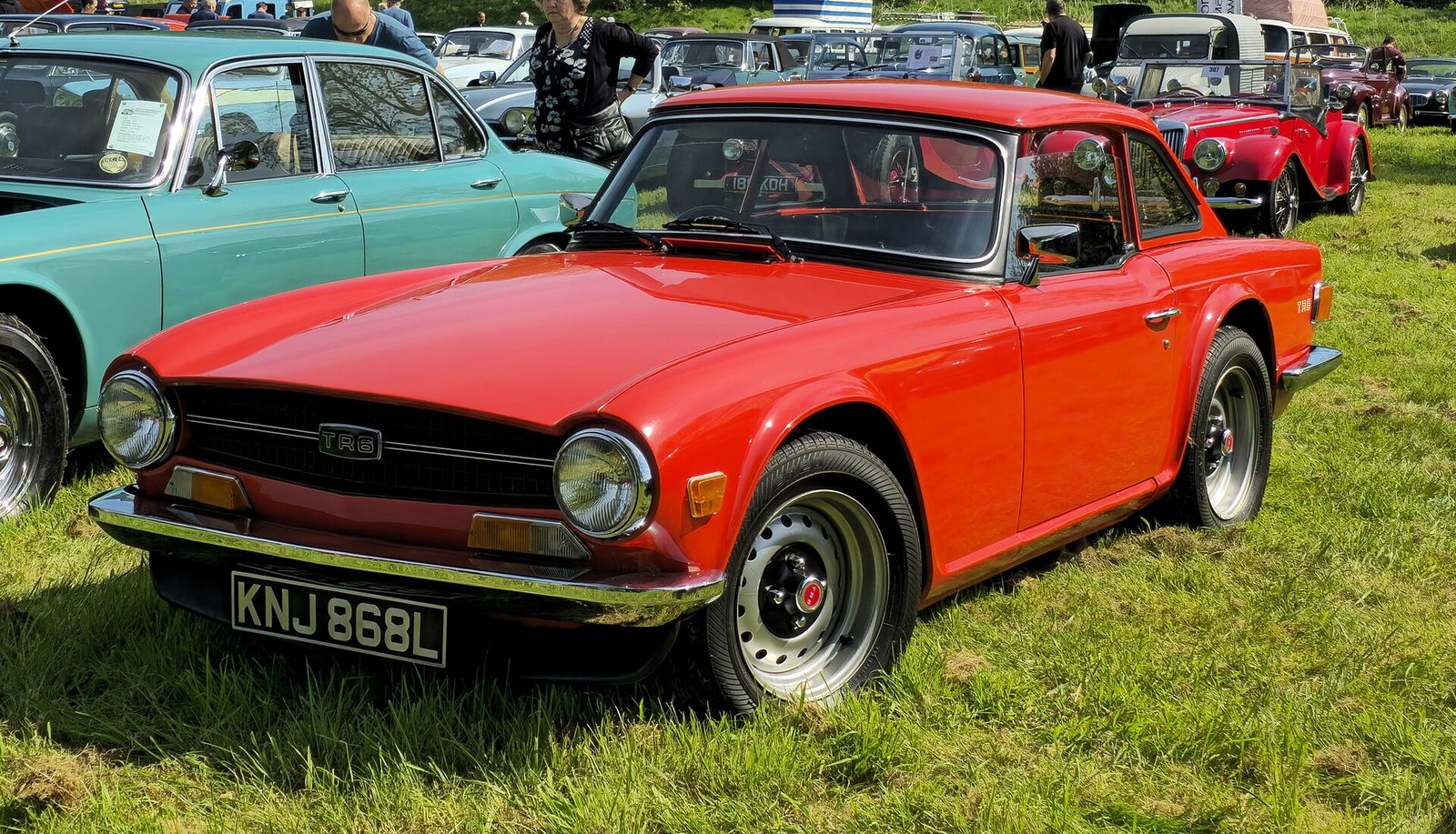
The Triumph TR6 (1968-1976) was the last of the separate-chassis TRs and by a wide margin the best-selling of them: a Karmann reskin of Michelotti's TR4 and TR5 body, laid over the same frame, running gear and 2,498 cc straight-six. It was really two cars sold under one name. Britain and Europe got the Lucas mechanical gasoline injection carried over from the TR5, quoted at 150 hp; North America, where the Lucas system could not be made to satisfy emissions law, got twin Zenith-Stromberg carburetors and 104 hp. The gap on paper was never quite the gap on the road, and from 1973 the injected cars were re-rated at 125 hp after a change of camshaft that the sources do not cleanly separate from a change of measurement convention. Roughly nine cars in ten were exported and the great majority went to the United States, which is why a TR6 is a familiar sight in California and a scarce one in Coventry. Values today turn far less on which engine a car has than on whether its chassis has survived.
History
A New Skin on an Old Frame
By 1968 the TR4 body Giovanni Michelotti had drawn for Triumph in 1961 was seven years old and had already been carried over, essentially unchanged, to the TR4A, the injected TR5 and the carbureted TR250. British Leyland had neither the money nor the time for a new car, so the job of making the old one look new went to the West German coachbuilder Karmann, and specifically to Gerhard Giesecke, working with input from Triumph's North American sales organization. What Karmann delivered was a squared-off front and rear clip - new wings, hood, trunk lid, grille and tail panel - grafted onto an unchanged frame, suspension, drivetrain, doors, screen surround and body tub. It went from clay to production in a little over a year. The result looked like a different decade from the front and was mechanically the TR5 underneath.
Two Cars, One Badge
The central fact about the TR6, and the one most often garbled, is that the engine you got depended on where you lived. Home and European cars kept the Lucas mechanical gasoline injection of the TR5: a belt-driven metering unit, an electric pump and a system running at 110 psi, rated at 150 hp at 5,500 rpm with 164 lb-ft. North American cars could not have it, because the Lucas system could not be metered finely enough to meet United States emissions law - an inversion of the usual story in which injection is the compliance technology. Those cars ran twin Zenith-Stromberg constant-depression carburetors and 104 hp, with California-bound examples reduced further to a single carburetor. The difference was real but smaller in practice than the badges suggested. Road & Track recorded 10.7 seconds to 60 mph and 109 mph in 1969; Motor got 8.5 seconds and 117 mph from an injected car the same year.
The 1973 Re-rating
For 1973 the commission prefixes changed from CP and CC to CR and CF, and the injected engine was quoted at 125 hp rather than 150. Rimmer Bros and Wikipedia attribute the change to a milder camshaft adopted to improve behavior in traffic; Ate Up With Motor is more specific, saying Rover-Triumph substituted the shorter-duration camshaft from the federalized cars after complaints about rough idling, and gives the new figure as 124 hp. Auto Express attributes the detune to emissions requirements. Hagerty UK argues that the paper drop overstates the real one, because the convention for quoting output changed at the same time. All four cannot be simultaneously correct about cause, and none of them separates the mechanical loss from the arithmetic one. The same year brought a front air dam, revised instruments and horn arrangements, and headrests; overdrive became standard for 1974.
Built for Somebody Else
The TR6 was a British sports car built almost entirely for export. Every source consulted agrees that only 8,370 were sold in the United Kingdom. Estimates of United States deliveries run from Hagerty's 76,470 to Auto Express's approximately 77,000, against total production variously given as 91,849, 91,850 or 94,619. Peak North American sales came in 1974, at roughly 14,000 cars, by which point the federal engine carried a carbon canister, an anti-run-on valve, lowered compression and, from 1975, air injection and rubber overrider blocks. The consequence is that most surviving TR6s are left-hand-drive carburetor cars, and a genuine home-market PI car is scarcer than the totals alone suggest.
Quality, Reputation and the End
Period ownership was not uniformly happy. Motor Sport's long-term TR6, bought in February 1973 with hardtop, overdrive and soft top, went through a broken gearbox spacer washer at 15,400 miles, repeated tire and brake trouble, water into the footwells, excessive crankshaft end float and a factory service at which the tappets, timing, greasing and brake adjusters were all found wrong. The injection itself, once rebuilt by the factory, gave no further trouble. Injected production ended in July 1975 and the last federal car was built on 14 July 1976, by which time the TR7 had arrived with a closed body, four cylinders and a monocoque. The TR6 was the last Triumph sports car with a separate chassis.
Common Problems
The crankshaft thrust washers are the engine's defining weakness. They are steel with a thin copper-nickel facing, they carry the load of a heavy clutch spring, and once the facing wears through the steel wears rapidly, the washer can drop into the sump and the crankshaft then bears directly on the main bearing cap - which turns a cheap job into a crankshaft or a block. Riding the clutch, resting on the pedal at junctions and starting the engine with the clutch depressed all accelerate it. Solid alloy replacements are the accepted fix. The Lucas injection is not fragile so much as intolerant: the original pump cavitates when hot, the fuel vaporizing in the pump so that it spins without delivering, which stops the engine without warning, and modern unleaded fuel makes this worse. RevingtonTR notes that most surviving pumps have been rebuilt at least once with second-hand parts, and that Bosch pumps rated for the same 110 psi are widely substituted, mounted as low as possible to keep them flooded. Metering units wear and their oil seal to the block leaks. Elsewhere: differential mounts crack, driveshafts and their splines wear, gearbox layshaft bearings whine in the lower gears, clutch release bearings can last only 12,000 to 20,000 miles in hard use, rear hub bearings need specialist rebuilding, differentials leak, and overheating is common. Period build quality was poor enough that Motor Sport's own long-term car needed an independent specialist to correct what the factory service had left wrong.
What to Look For
The chassis decides the car. The frame is spot-welded from sheet steel pressings and rots from the inside, so surface condition tells you little. The rear trailing arm mounting brackets, the cruciform where the inner rails meet, the rear outriggers and the T-shaped pressing over the rear axle are the areas that matter, and swelling around the trailing arm bolts indicates rot working outward. The forward differential mountings crack and, left alone, tear their studs out of the frame; a clunk from the back of the car under power is the warning. Body corrosion follows the usual TR pattern - sills, floors, trunk floor, front wings behind the headlamps, rear wing tips, the back of the B-post and the rear lip of the trunk lid - and the three-layer sandwich where the rear wing meets the body traps debris. A recent respray on a car with no documented chassis work deserves suspicion rather than credit. Check the commission number against the claimed specification: CP and CR denote gasoline injection, CC and CF carburetors, with L, U and O suffixes for left-hand drive, United States specification and overdrive. The commission plate stays with the bodyshell while engines and gearboxes move around, so it is the only reliable statement of what the car left Coventry as. Many PI cars were converted to carburetors when the Lucas system fell out of favor; establish whether the original metering unit and pump are present or merely stored. Have crankshaft end float measured before purchase. Confirm which overdrive is fitted and that it engages on the gears it should.
Market Notes
As of August 2026, classic.com records a Triumph TR6 market benchmark of $20,037 against an average recorded sale of $20,727, with tracked results running from $1,850 in August 2024 to $54,980 in July 2026 and around fifty cars listed for sale. Recent US results clustered close to the benchmark: $22,797 for a 1969 car in Massachusetts and $24,991 for a 1976 car in Pennsylvania, both in August 2026, against $13,500 for a 1974 car in May 2026. The top of the market is thin and specific: RM Sotheby's sold chassis CF56401U, a 1976 car with 2,854 miles from new, original paint, interior and Michelin red-band tires and a British Motor Industry Heritage Trust certificate, for $50,400 at Monterey in 2024. Classics World also notes left-hand-drive imports trading 10 to 20 per cent below equivalent UK cars, which is the clearest available price on the injection-versus-carburetor distinction.
Where sources differ
For 1973 the commission prefixes changed from CP and CC to CR and CF, and the injected engine was re-rated from 150 hp to about 125 hp, but the sources do not agree on why.
Rimmer Bros and Wikipedia attribute the drop to a milder camshaft fitted for better traffic manners. Ate Up With Motor states Rover-Triumph substituted the shorter-duration camshaft from the federalized cars after complaints of rough idling and gives the new figure as 124 hp. Auto Express attributes the detune to emissions requirements. Hagerty UK argues the paper drop overstates the mechanical one because the convention for quoting output changed at the same time. No source consulted here separates the mechanical loss from the change of measurement standard, so the cause is not resolved.
Published TR6 production totals do not agree: 91,849 or 91,850 is given by several sources and 94,619 by others, so no single figure is asserted here.
Wikipedia gives 91,850, the Vintage Triumph Register 91,850 and Hagerty (UK and US) 91,849 with a breakdown of 13,702 injected and 78,147 carbureted cars. Ate Up With Motor gives 94,619, Auto Express 94,619 and Classic Car Hub nearly 95,000. The export figures compound it: Wikipedia's 83,480 exported plus 8,370 UK equals 91,850, while the Vintage Triumph Register's 86,249 exported plus the same 8,370 equals 94,619. No source consulted here explains the 2,769-car difference, so productionTotal is left null.
The factory hardtop was a one-piece detachable structure combining the rear screen and B-post windows in a single section, replacing the TR4-to-TR250 Surrey Top arrangement, so a TR6 was either a fixed-head coupe or fully open with no intermediate configuration; the design's authorship is not settled.
John Skinner (Manufacturing) Ltd, which makes replacement tops, attributes the TR6 one-piece hardtop to Karmann. Ate Up With Motor states it was designed by Triumph's own in-house styling team as a cheaper replacement for the TR4's two-piece Surrey arrangement. Both agree it superseded the Surrey Top and offered no intermediate configuration; the attribution itself is not resolved by any source consulted here.
Sources
- Triumph TR6, Wikipedia · encyclopedia
- Grandfather's Ax: The Many Evolutions of the Triumph TR4, Part 2: TR5, TR250, and TR6, Ate Up With Motor · specialist
- Triumph TR6: Buying guide and review (1968-1976), Auto Express · journalism
- The Full English: Triumph TR6, Hagerty UK · journalism
- In defense of the Triumph TR6, Hagerty · journalism
- Triumph's TR6 is an E-Type for the masses, Hagerty · journalism
- TR6 - Vintage Triumph Register, Vintage Triumph Register · registry
- Triumph TR6 Vehicle Information, Rimmer Bros · specialist
- Triumph TR250 & TR6 Vehicle Identification, Moss Motors · specialist
- Triumph TR6 buyer's guide, Classics World · journalism
- Buyers Guide: Triumph TR6, Hagerty UK · journalism
- A Weak Differential Mount: Fixing a Common TR6 Problem, Moss Motoring · specialist
- Triumph TR6 Thrust Washer Fix Explained, British Car Week · club-forum
- IS0006 Replacing Lucas Gasoline Injection Pumps with Bosch Fuel Pumps, RevingtonTR · specialist
- Triumph TR5, Wikipedia · encyclopedia
- Vintage R&T Road Test: 1969 Triumph TR-6, Curbside Classic · journalism
- The continuing tale of a TR6, Motor Sport · journalism
- Triumph TR6 - John Skinner (Manufacturing) Ltd, John Skinner (Manufacturing) Ltd · specialist
- Triumph TR6 Market, classic.com · market-data
- Triumph TR6 For Sale & Price Guide, The Classic Valuer · market-data
- 1976 Triumph TR6, Monterey 2024, RM Sotheby's · auction-house
Synthesized from the sources above and cross-checked. We cite and link out; we do not republish other databases verbatim.
Fully Sorted is an independent publisher and is not affiliated with, endorsed by or sponsored by Triumph. Triumph and the model names on this page are trademarks of their respective owners and are used here only to identify the cars being described.
Chassis register
Nobody has recorded a car here yet. Own one, or know one? Chassis number, what you can prove about it, and a source if there is one. Every entry is reviewed before it appears.
Nerd Notes
What owners know that the sources don't. Every note is read and checked before it appears here.
Key Specs
- Power
- 150 hp at 5,500 rpm claimed for CP injection cars; 125 hp at 5,500 rpm for CR cars from 1973; 104 hp for early CC carburetor cars and 106 hp at 4,900 rpm quoted for 1972-onward US tune
- Brakes
- Front discs, rear drums, servo-assisted
- Engine
- 2,498 cc overhead-valve straight-six, cast-iron block and head; compression quoted at 8.5:1 early, lowered to 7.75:1 in 1972 per the Vintage Triumph Register and to 7.5:1 for 1974 per Hagerty
- Layout
- Front-mounted longitudinal straight-six, rear-wheel drive
- Torque
- 164 lb-ft quoted for early injected cars; 143 lb-ft at 3,500 rpm for early carburetor cars; 133 lb-ft at 3,000 rpm recorded for a 1972 US car
- Weight
- Approximately 2,156 lb recorded for a 1972 US-specification car, with 51/49 front-to-rear distribution
- Wheels
- 15-inch, widened from 5 to 5.5 inches for 1970; wire wheels and pressed-steel disc wheels both offered
- Chassis
- Separate steel ladder frame with cruciform bracing, spot-welded from sheet pressings, carrying a bolted steel body
- Fuel pi
- Lucas mechanical gasoline injection, metering unit driven from the engine, system pressure 110 psi (CP and CR cars, home and European markets)
- Steering
- Rack and pinion
- Overdrive
- Laycock de Normanville, optional then standard from 1974; A-type on early cars (about 22 per cent, second/third/top), J-type later (about 28 per cent, third/top)
- Top speed
- 117-120 mph recorded for injected cars; 107-109 mph for US carburetor cars
- Suspension
- Independent front by coil springs and wishbones; independent rear by semi-trailing arms and coil springs
- Valvetrain
- Single camshaft in block, pushrods and rockers, two valves per cylinder; shorter-duration camshaft adopted for CR and CF engines from 1973
- Acceleration
- 0-60 mph in 8.2 s (Autocar) to 8.5 s (Motor, 1969) for injected cars; 10.7 s recorded by Road & Track for the 1969 US carburetor car - all independent test figures, not manufacturer claims
- Transmission
- 4-speed all-synchromesh manual
- Fuel carburettor
- Twin Zenith-Stromberg constant-depression carburetors (CC and CF cars, North America); single carburetor for California
Notable Variants
TR6 PI (CP series, 1968-1972)
The original Lucas mechanical gasoline injection car for Britain and Europe, rated 150 hp at 5,500 rpm. The most sought-after specification, and the one most often faked by fitting PI badges to a carbureted shell.
TR6 (CC series, 1968-1972)
Twin Zenith-Stromberg carburetors for North America, 104 hp. Road & Track measured 10.7 seconds to 60 mph and 109 mph in 1969 against the injected car's 8.2-8.5 seconds. The version most buyers actually encounter.
TR6 PI (CR series, 1973-1975)
Shorter-duration camshaft, revised injection metering and a re-rating to 125 hp. Smoother in traffic, quieter at idle, and cheaper to buy than a CP car for reasons that are partly real and partly a change of measurement convention.
TR6 (CF series, 1973-1976)
The final federal cars, with front air dam, revised instruments, headrests and from 1975 large rubber overrider blocks. Overdrive became standard fitment for 1974. The last TR6 of all was a CF car built on 14 July 1976.
California-specification cars
Cars bound for California ran a single carburetor rather than the twin Strombergs used elsewhere in North America, with a further loss of power. A California car is not a federal car and should not be valued as one.
CKD cars assembled in Belgium
Roughly 3,600 of the injected cars were shipped as knocked-down kits and assembled in Belgium. They are part of why the published production totals do not reconcile.
Factory hardtop cars
The detachable one-piece steel top with rear screen and B-post windows in a single section replaced the TR4-to-TR250 Surrey arrangement. Original tops are increasingly scarce, awkward to store and add real money to a car.
Overdrive cars (A-type, then J-type)
Laycock de Normanville A-type gave about 22 per cent on second, third and top; the later J-type gave about 28 per cent on third and top only. Either transforms the car at speed, and a non-overdrive car is worth less.
Value Trajectory
The TR6 spent decades as the affordable entry to classic British sports car ownership, its values held down by the sheer number built and by the reputational drag of British Leyland-era quality. It has re-rated since, helped by its appearance on Hagerty's 2022 Bull Market list, but it has not detached from its own supply: as of August 2026 the classic.com benchmark of $20,037 and average sale of $20,727 sit close together, which is the signature of a deep, liquid market rather than a speculative one. The Classic Valuer's 76 per cent sell-through, read in August 2026, says the same thing. What has changed is the spread. Restoration now costs more than most finished cars are worth, so the gap between a car with documented chassis work and one without has widened faster than the headline figure, and the extremes have pulled apart - $1,850 at the bottom of the classic.com range against $54,980 at the top, and RM Sotheby's $50,400 for a 2,854-mile original car at Monterey in 2024. Home-market injection cars and cars with original hardtops and overdrive carry a premium; the abundant left-hand-drive carburetor imports set the floor, trading 10 to 20 per cent below equivalent UK cars.
Next
Shopping for one?
Browse Triumph listings, or decode a VIN before you buy.