
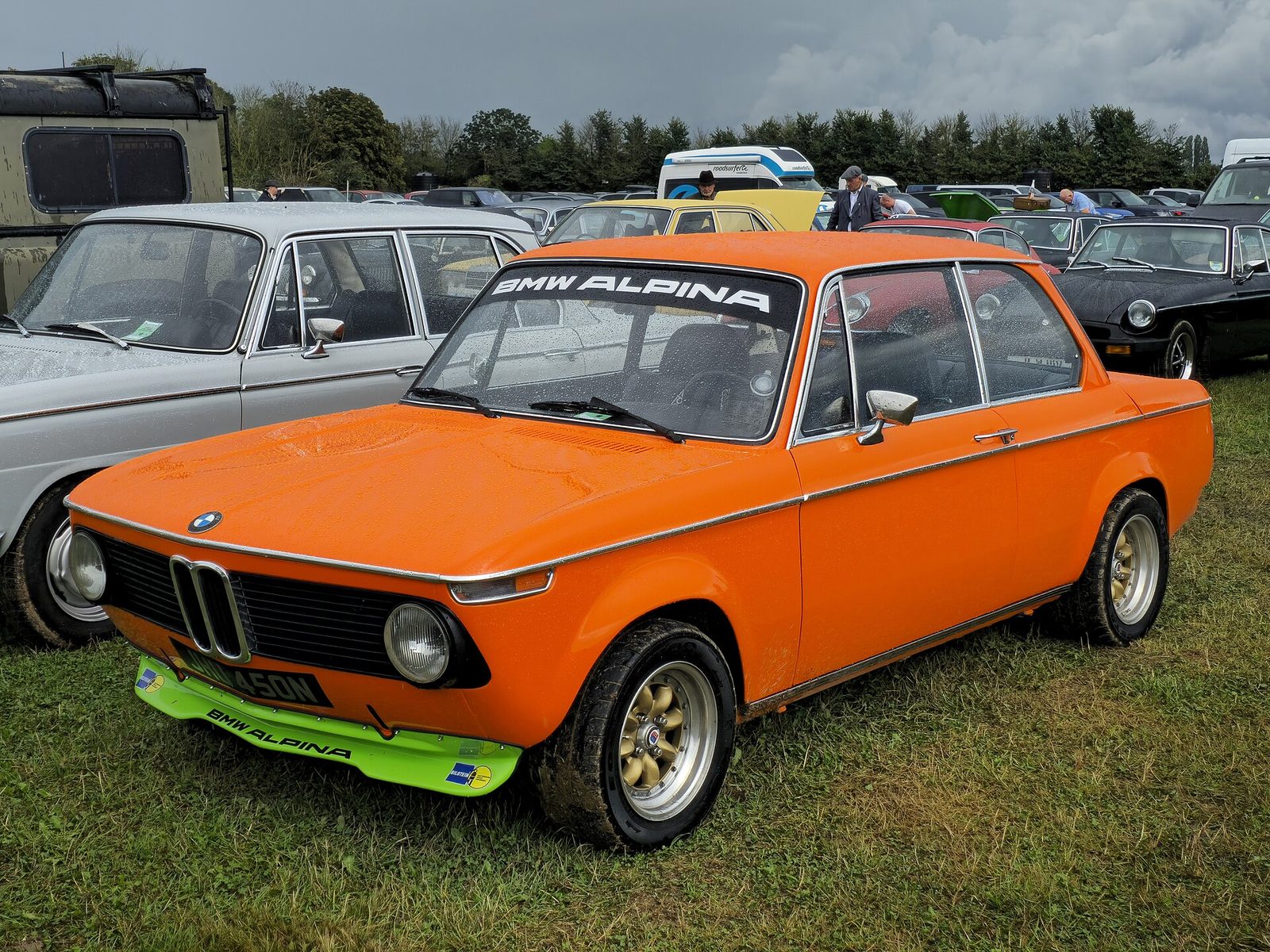
The BMW 2002 began as an improvisation. Alex von Falkenhausen, who ran engine development, and Helmut Werner Bonsch, who ran product planning, had each quietly fitted the two-liter M10 from the 2000 sedan into his own 1602, discovered the coincidence and put the case to the board; the American importer Max Hoffman wanted more power than the 1600ti, which could not meet United States emissions law, and the larger engine could. What emerged in 1968 was a plain two-door sedan on a 98.4 in (2,500 mm) wheelbase with a single-carburetor 99 hp engine, and within two model years it had changed BMW's standing in America. Above it sat the twin-carburetor ti, the Kugelfischer-injected tii and, from the 1973 Frankfurt show, the 2002 turbo, which BMW records as the first series-produced European car with an exhaust turbocharger. Round rear lamps gave way to square ones in September 1973, a distinction the market still prices.
History
Two Engineers and an Importer
The 1600-2 was announced in March 1966 on a shortened New Class floorpan with a 98.4 in (2,500 mm) wheelbase, the '-2' denoting two doors: light, upright, struts at the front and semi-trailing arms at the back, and not aimed at America. In mid-1967 Alex von Falkenhausen and Helmut Werner Bonsch each fitted the 1,990 cc M10 from the 2000 sedan into his own 1602, found the other had done the same, and took a joint proposal to the board. The commercial case came from New York: Max Hoffman wanted a faster car, the 1600ti could not pass United States emissions rules, and the two-liter already could.
Turn Your Hymnals to 2002
In April 1968 Car and Driver published David E. Davis Jr's review under that title, and BMW of North America still credits the article, read by roughly a million subscribers, with changing the company's American trajectory. Davis quoted $2,850, 114 hp at 5,800 rpm, sixty in second and eighty in third, and a top speed 'a shade over a hundred'. The 114 hp does not match BMW's 99 hp DIN rating and the piece names no standard, so the two should not be read against each other. BMW's American sales tell the rest: 1,253 cars in 1966, 4,564 in 1967, 9,172 in 1968 and 11,638 in 1969, the last limited by what Munich could build rather than by demand.
ti, tii and the Kugelfischer Pump
The sporting versions arrived in sequence. The twin-Solex 2002 ti made 118 hp from 1968 and was never federalized. In April 1971 the tii replaced it, using the Kugelfischer mechanical pump already fitted to the 2000 tii and taking 130 hp at 5,800 rpm, with 1.81 in (46 mm) inlet valves, 10.1 in (256 mm) front discs, boxed rear trailing arms and half-inch wider wheels. BMW priced it at DM 12,765 in Germany, some DM 2,000 above a standard car, with no US list price documented in the sources used here, and called it the wolf in sheep's clothing. Motor Sport, driving a Group 1 tii in July 1972, recorded 143 hp from a prepared engine - at least 13 hp over the production DIN rating - found power falling away beyond 6,000 rpm, and reported a car that would run rings round the opposition on bumpy circuits while kicking its rear wheels up under provocation.
Roundies, Squares and the Emissions Years
The 02 changed twice. A 1971 revision brought wraparound bumpers, revised rear lamps and a two-piece instrument cluster. The larger break came from September 1973, when a new rear panel carried square lamps with built-in reflectors; American cars took the change for the 1974 model year, and the Touring kept round lamps to the end. Alongside ran a slow strangulation of the United States engine: EGR replaced the air pump mid-1972, 1975 brought a thermal reactor, air pump, EGR and lower compression together, and 1976 deleted the reactor for a cylinder head from the coming E21.
The Turbo and the Oil Crisis
BMW showed the 2002 turbo at Frankfurt in September 1973 and records it as the first series-produced European car with an exhaust turbocharger, the KKK unit adding forty horsepower to the tii's engine for 170 hp and a claimed 131 mph. It had riveted arch extensions, a front air dam, a ZF limited-slip differential and, at first, 'turbo' in mirror script across the spoiler so that drivers ahead would read it correctly. The fuel crisis broke over the launch, the script was deleted after objection, and BMW concedes the car remained marginal. Left-hand drive only, because the exhaust manifold left no room for a right-hand column, it was gone by the middle of 1975.
Common Problems
Corrosion dominates and is the expensive fault: rear shock towers, front floors, frame rails fore and aft, rockers, front wing corners and the spare wheel well. A shell that has lost its shock towers is a restoration project regardless of how the engine sounds. Worn valve guides show as blue smoke on deceleration, and oil weeps from the main seals, valve cover, distributor and sump are close to universal. Solex carburetors give trouble; on the tii the Kugelfischer pump can need a rebuild only a handful of specialists will attempt. The four-speed gearbox loses second-gear synchromesh and leaks from its shaft seals, behind a flex disc that cracks and a center support bearing that sags. Emissions-era United States cars carry their own driveability problems, the 1975 combination of thermal reactor, air pump, EGR and reduced compression being the least loved specification of the run. The rest are small but tedious: heater blowers that need the dashboard out, cracked dash tops, expensive sunroof cables, and air-conditioning compressors Hagerty describes as beyond saving.
What to Look For
Structure first, and from underneath. The rear shock towers are the fault that ends cars: they rot from inside the trunk and take the upper spring perch with them. Check the front floors, the frame rails from the front crossmembers back to the floor and again under the fuel tank, the rockers, which are structural rather than cosmetic here, and the upper corners of the front wings behind the indicators. Fresh undercoating on a car being sold is a question, not a reassurance.
Then establish what the car is. Round or square rear lamps sets the year band and a large part of the price. A ti or tii is worth confirming against chassis and engine numbers rather than badges, since the mechanical difference from a base car is modest and the money difference is not. A turbo should be left-hand drive and originally Chamonix White or Polaris Silver; RM Sotheby's disclosed on one Munich car that earlier bodywork had removed the original chassis stamp, the sort of thing that surfaces only in a catalog addendum.
Mechanically, blue smoke on the overrun points at valve guides, second-gear synchromesh is the gearbox's weak point, and the driveshaft flex disc and center bearing are consumables. On a tii the Kugelfischer pump governs everything: the Tii Register publishes BMW North America's dealer manual for the system precisely because a rebuild still needs a specialist with the right tools and test equipment, and there are few of them.
Market Notes
As of August 2026, classic.com's 2002 page shows how completely specification governs price: the base 2002 benchmarks at $24,600, the tii coupe at $35,325 and the turbo at $118,720, against a page-level average sale of $32,659 from 29 listings. The floor is genuinely low - the cheapest recorded 2002 is $1,750 for a 1976 project on 18 June 2023 - and the ceiling a 1974 turbo advertised at $225,000 in July 2026. The tii page, as of August 2026, gives a benchmark of $36,139 from eleven listings, original cars between $35,325 and $38,947 and modified cars from $8,802 to $74,000, with a lowest recorded sale of $2,600 in May 2025. Turbo money sits in a separate and rising market: as of August 2026 classic.com records an average sale of $111,972 against the $118,720 benchmark, with results of $127,000 in December 2025, $124,000 in February 2026, $155,500 in March 2026 and EUR 126,500 in October 2025, against a low of $40,000 in December 2024. RM Sotheby's sold chassis 4291234, a 1974 turbo showing 39,043 miles, for $140,000 at Miami on 28 February 2025, and chassis 4291147 for EUR 126,500 at Munich in October 2025; both are the house's published results rather than hammer prices.
Where sources differ
The 2002 turbo's compression ratio and boost pressure are reported inconsistently and no figure is asserted here.
Silodrome and Supercar Nostalgia both state 6.9:1, Supercar Nostalgia adding that it was cut from the tii's 9.5:1 and giving KKK boost at 0.55 bar. Classic & Sports Car states 8.5:1 against 9.5:1 for the tii and boost of 1.0 to 1.2 bar. The accounts cannot both be right, and no source consulted here resolves it. Unresolved.
No single total for 2002 production is asserted, because the published figures disagree by roughly sixty thousand cars.
Wikipedia's model table gives 339,092 2002 sedans for 1968-1975 within an 02 Series total of 837,038. Silodrome's history states almost 400,000 2002s over the same period. Neither states a basis and nothing consulted reconciles them. Unresolved, so productionTotal is left null.
Published totals for the 2002 tii differ materially and no single figure is asserted.
Wikipedia gives 38,703 tii sedans plus 5,783 tii Tourings. The UK 02 register publishes a breakdown summing to 44,478 tii of all types, of which 38,697 are sedans - six fewer than Wikipedia - and Classic Register repeats 44,478. Curbside Classic states roughly 27,500 in total, matching neither. BMW gives no number. Unresolved.
The 2002 turbo total is reported as 1,672, approximately 1,671 or 1,660 depending on the source, and the production window differs again.
Wikipedia, Classic & Sports Car, Silodrome, Supercar Nostalgia, Hagerty and classic.com state 1,672; the BMW 2002 FAQ states about 1,671 through June 1975; RM Sotheby's Miami catalog states 1,660. On dates, BMW Group Classic records October 1973 to June 1975, Supercar Nostalgia twelve pre-production cars in late 1973 then series build from January 1974 to July 1975, and Hagerty the whole run in 1974. Unresolved.
Sources
- BMW 02 Series, Wikipedia · encyclopedia
- BMW 2002 tii, BMW Group Classic · manufacturer
- BMW 2002 turbo, BMW Group Classic · manufacturer
- BMW of North America marks 50 years of 'Turn Your Hymnals to 2002', BMW of North America · manufacturer
- Turn Your Hymnals to 2002 (Car and Driver, April 1968, reprinted), Dean's Garage · journalism
- A brace of BMWs and a look into the Munich marque's competition future, Motor Sport · journalism
- Your definitive 1968-76 BMW 2002 buyer's guide, Hagerty Media · journalism
- BMW 2002 turbo: induction ceremony, Classic & Sports Car · journalism
- Curbside Outtake: 1971-73 BMW 2002 tii - These Happy Golden Years, Curbside Classic · journalism
- The BMW 2002 - A Quick Guide, Silodrome · specialist
- The BMW 2002 Turbo - BMW's First Turbocharged Production Car, Silodrome · specialist
- BMW E20 2002 Turbo Guide, Supercar Nostalgia · specialist
- Info Guide: 1971-1975 BMW 02 Series 2002 Tii Coupe, Classic Register · specialist
- Tii - BMW 2002 Register, BMW 2002 Register (UK) · club-forum
- The BMW 2002 Production Run, BMW 2002 FAQ · club-forum
- The BMW 2002tii Fuel Injection System Manual & Video, The Tii Register · registry
- BMW 2002 Market, classic.com · market-data
- BMW 2002tii Market, classic.com · market-data
- BMW 2002 Turbo Market, classic.com · market-data
- 1974 BMW 2002 Turbo sold at RM Sotheby's Miami (2025), classic.com · market-data
- 1974 BMW 2002 Turbo, Miami 2025, RM Sotheby's · auction-house
- 1975 BMW 2002 Turbo, Munich 2025, RM Sotheby's · auction-house
Synthesized from the sources above and cross-checked. We cite and link out; we do not republish other databases verbatim.
Fully Sorted is an independent publisher and is not affiliated with, endorsed by or sponsored by BMW. BMW and the model names on this page are trademarks of their respective owners and are used here only to identify the cars being described.
Chassis register
Nobody has recorded a car here yet. Own one, or know one? Chassis number, what you can prove about it, and a source if there is one. Every entry is reviewed before it appears.
Nerd Notes
What owners know that the sources don't. Every note is read and checked before it appears here.
Key Specs
- Power
- 99 hp in the 2002, 118 hp in the ti, 130 hp at 5,800 rpm in the tii, 170 hp at 5,800 rpm in the turbo - manufacturer DIN claims
- Brakes
- Servo front discs and rear drums; 10.1 in (256 mm) front discs on the tii; four-piston front calipers on the turbo
- Engine
- 1,990 cc M10 SOHC inline-four, iron block and alloy head; type M31 when turbocharged
- Layout
- Front longitudinal engine, rear-wheel drive
- Torque
- 177 lb-ft at 4,000 rpm for the turbo; 130 lb-ft for the tii per Hagerty
- Weight
- 2,072-2,381 lb curb per Wikipedia; the turbo at 2,381 lb per Supercar Nostalgia and 2,324 lb per Silodrome
- Chassis
- Unitary steel monocoque, shortened New Class floorpan, 98.4 in (2,500 mm) (98.4 in) wheelbase
- Suspension
- MacPherson struts front, semi-trailing arms rear; 0.79 in (20 mm) front and 0.63 in (16 mm) rear anti-roll bars on the turbo
- Compression
- 9.5:1 for the tii per Classic & Sports Car and Supercar Nostalgia; the turbo figure is contested
- Acceleration
- 8.3 s to 60 mph for the tii per the UK 02 register; the turbo about 7 s to 62 mph per Supercar Nostalgia and 7.5 s to 60 mph per Classic & Sports Car
- Fuel systems
- Single Solex (2002), twin Solex (ti), Kugelfischer injection (tii), the same with a KKK turbocharger (turbo)
- Transmission
- Four-speed Getrag manual or automatic from 1969; optional five-speed dogleg Getrag on the turbo
- Price when new
- Car and Driver quoted $2,850 for a US 2002 in April 1968; DM 12,765 for the tii and DM 18,720 for the turbo in Germany, with no US list price documented here and the turbo not sold new in the US
- Top speed claimed
- 118 mph for the tii per BMW against 115 mph in Wikipedia's table; 131 mph for the turbo - manufacturer claims
Notable Variants
2002 round tail (1968-1973)
The 'roundie'. Circular rear lamps, and from the 1971 revision wraparound bumpers and a two-piece instrument binnacle. Hagerty places round-tail cars a clear step above square-tail equivalents, the largest price line inside the carbureted range.
2002 square tail (1974-1976)
Square lamps with integral reflectors on a new rear panel from September 1973, reaching the United States for the 1974 model year. The cheapest way in, and the cars most often modified.
2002 ti (1968-1971)
Twin-Solex 118 hp car, never federalized because the related 1600ti could not meet US emissions law. Replaced by the tii in April 1971. Easy to fabricate from a base car, so paperwork carries the value.
2002 tii (1971-1975)
Kugelfischer injection, 130 hp at 5,800 rpm, 1.81 in (46 mm) inlet valves, 10.1 in (256 mm) front discs, boxed rear trailing arms and wider wheels. BMW called it the wolf in sheep's clothing. The strongest sustained demand short of the turbo.
2002 turbo (1973-1975)
By BMW's account Europe's first series-produced turbocharged car: KKK turbocharger, 170 hp, riveted arch extensions, front air dam, ZF limited-slip differential. Left-hand drive only, in Chamonix White or Polaris Silver.
2002 Touring and Baur cabriolet
The three-door Touring (1971-1974) was never sold in the United States and kept round rear lamps after the sedan went square. Baur built full convertibles to 1971, then a targa-top cabrio coach; rust in a converted shell is worse again.
Value Trajectory
The 2002 was cheap for a long time. Hagerty's buyer's guide describes pricing as flat until 2015, after which base round-tail cars rose about 45 per cent and tii values by between 143 and 160 per cent, the tii adding a further 55 per cent over the two years before the guide was written before cooling towards single-digit annual growth. The same guide records a knock-on at the top: turbo prices climbed far enough that buyers priced out of them moved to the tii, which is much of why tii money separated from base-car money rather than rising with it. As of August 2026 that stratification is visible in classic.com's figures, where a base 2002 benchmarks at $24,600 against $35,325 for a tii coupe and $118,720 for a turbo, the last trending upward. The gap that matters most now is not between variants but between a sound shell and a rusty one, because replacing shock towers and floors has not become cheaper.
Market Snapshot
4 recorded sales, too few for a median worth standing behind, so here is the range instead.
Range $28,000 – $44,000
Shopping for one?
Browse BMW listings, or decode a VIN before you buy.