
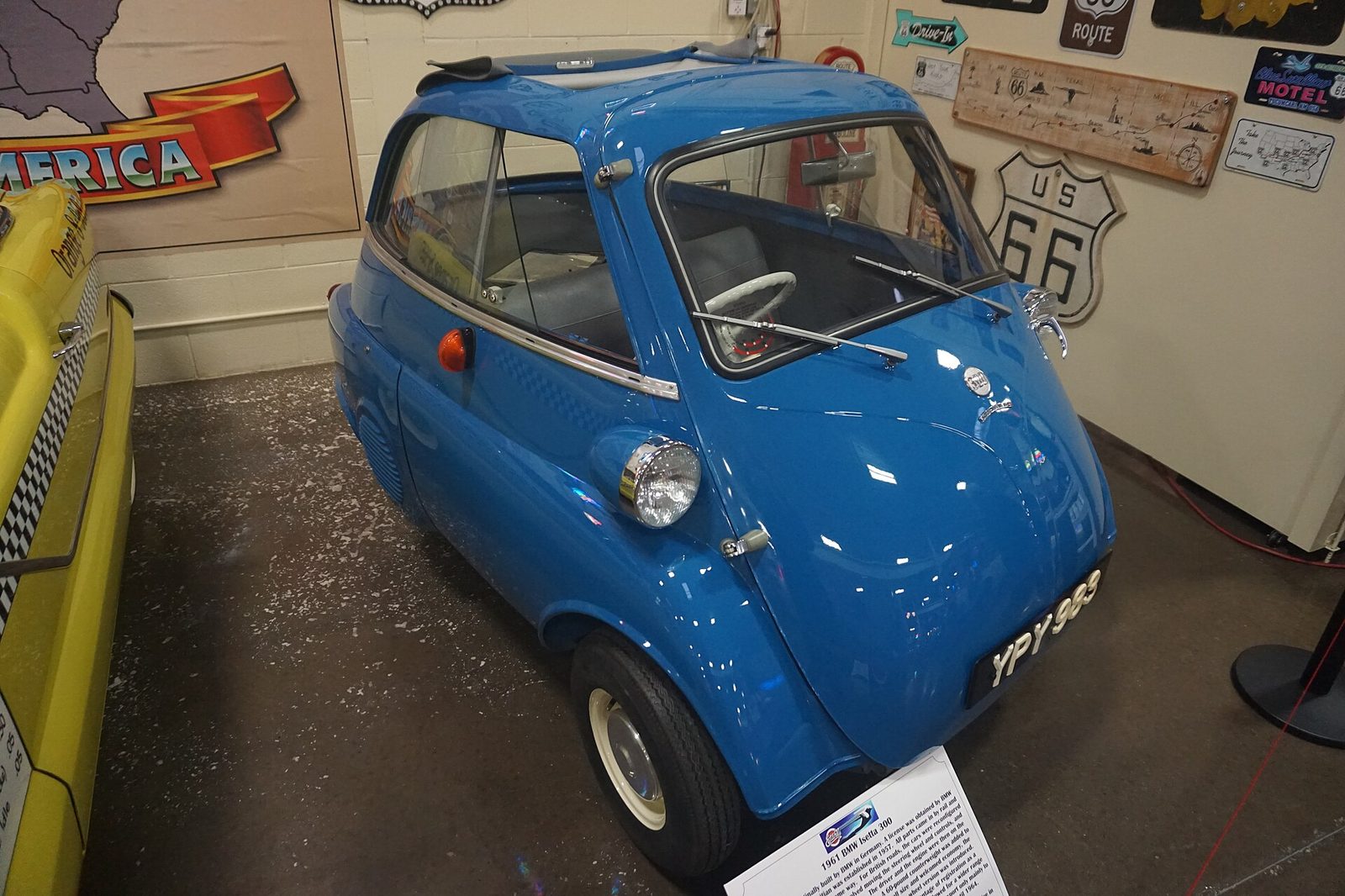
The BMW Isetta was not a BMW design. It began as the Iso Isetta, drawn for Renzo Rivolta's Milanese refrigerator and motorcycle firm by the engineers Ermenegildo Preti and Pierluigi Raggi, and it failed in Italy. BMW, cash-starved and selling too few 501 V8 sedans to matter, took the license and the body tooling from Iso in 1954, replaced the Italian two-stroke with the four-stroke single from the R25 motorcycle, and built a 12 hp two-seater entered through a single front-hinged door that a West German motorcycle license covered. The 250 became the 300 when the licensing rules changed, bubble windows gave way to sliding glass in October 1956, Brighton built three-wheelers to suit British tax law, and a stretched four-seat 600 introduced the semi-trailing arm rear suspension BMW would use for thirty years. Something near 161,728 were built in Germany, and the money bought the company the time it needed.
Isetta
Isetta 250 / 300 and BMW 600
History
Milan, Not Munich
The Isetta was Italian before it was German. Renzo Rivolta had built refrigerators, then motorcycles and scooters, at Iso in Bresso north of Milan, and he set the engineers Ermenegildo Preti and Pierluigi Raggi on the problem of a vehicle small enough to be cheap and useful enough to be a car. What they produced was an egg on four wheels, about 7 feet 6 inches (2.29 meters) long, entered through a single front-hinged door that carried the steering column out with it, its rear wheels close enough together that no differential was needed. Accounts of the launch differ - Wikipedia dates the introduction to November 1953, BMW Blog to the Turin show of 1952 - but the outcome does not. Around a thousand were built. Rivolta's better idea was to sell the license abroad, to Velam in France, Romi in Brazil, De Carlo in Argentina, a British concern and BMW.
The License and the Motorcycle Engine
BMW in 1954 was in serious trouble: the 501 V8 was not selling, much of the pre-war manufacturing base lay behind the inner German border, and Goodwood's account has a Glas takeover looking plausible. BMW took its license from Iso that year - its press office places the agreement at the Geneva show, Wikipedia says mid-1954 and adds that BMW bought the complete body tooling as well as the rights. The decisive change was under the tail: out went Iso's two-stroke, in went the air-cooled four-stroke single from the R25 motorcycle, 247 cc and 12 hp. That made it a BMW in the only sense that mattered to a Munich accountant.
250, 300 and the Windows
The 250 sold immediately: BMW Group Classic records more than ten thousand in the first year, BMW's press office 12,911, and BMW Blog car number 10,000 on 20 November 1955. Then German licensing law moved, and BMW answered with a 297 cc engine giving 13 hp at 5,200 rpm - more torque rather than more speed, since the quoted 53 mph did not change. From October 1956 the bubble windows gave way to sliding side windows on the Moto Coupe DeLuxe, and from 1957 an Export specification added a fixed roof, a revised chassis and optional right-hand drive. The peak year was 1957, near forty thousand cars.
Brighton, and the Third Wheel
British production began on 23 April 1957 at the former Brighton Locomotive Works, taken on by Dunsfold Tools Ltd and later renamed Isetta of Great Britain. The site had no road access, only a flight of steps, so cars left by rail, three to a wagon; engines, transmissions and Bavarian-pressed panels arrived the same way each Saturday. The first thousand were left-hand-drive four-wheelers for Canada. Three-wheelers followed from 1959, because a three-wheeled vehicle attracted lower British tax and could be driven on a motorcycle license, and right-hand-drive cars needed a 60 lb counterweight on the left.
The 600, and What It Bought BMW
The 600 of 1957 stretched the wheelbase to 66.9 in (1,700 mm), widened the rear track, added a second door on the right and fitted the 582 cc flat-twin from the R67. Lane Motor Museum records a United States price of $1,398 for it. More significantly, it carried BMW's first semi-trailing arm rear suspension, which the company then used on almost every car it built until the 1990s. It did not sell: Below the Radar records BMW borrowing seven million marks against hopes of 400,000 cars a year, and the 600 pushing it further into the red instead. What it did was provide the platform stretched into the 700, which sold 188,121 examples and carried BMW to the Neue Klasse.
Common Problems
The single-cylinder engine is simple and rebuildable, but the crankshaft and aluminum connecting-rod assembly is the known weak point and breaks; steel replacements are the usual remedy, and microcar.org treats this as expected rather than exceptional. Push-rod tube seals leak at both head and block, and the o-ring seals between the suspension casting and the swing arms leak so consistently that dry ones are the surprise. There is no oil filter, so oil changes are frequent and a hundred-mile change after a rebuild is standard. Overheating follows a failed cooling fan and destroys the engine quickly. Brakes are the other recurring theme: wheel cylinders freeze on cars that have stood, leaking fluid contaminates the linings, and previous owners have fitted non-original master cylinders that complicate repair. Transmission linkage bushes wear. Corrosion concentrates in the wheel arches and the battery box, and after fifty years most fasteners are seized. Parts supply in the United States is better than the size of the car suggests: microcar.org's directory lists American suppliers for the consumable end of a rebuild, with stainless brake hoses quoted at $25 each from Bavarian Autosport, a steering damper at around $16, correct 4.80 x 10 tires from Coker and a replacement windshield at just under $300 before crating and shipping, alongside named specialists for engine, transmission, chain-drive and brake-cylinder work.
What to Look For
Establish which car is in front of you first. A 250 and a 300 are not the same object to the market, the bubble-window and the October 1956 sliding-window cars are visually distinct, and a Brighton-built three-wheeler is a different vehicle again - the Dare to Dream result shows how far a documented British car can separate from the benchmark. Chassis and engine numbers should be legible and agree with the paperwork. Steel is the main worry: wheel arches suffer, particularly on cars that saw British winters, and the battery box corrodes on almost everything. Because the whole front is one hinged door, check that it shuts and seals evenly and that neither the hinge nor the articulating steering column has been shimmed to disguise a sagging shell. Check the fabric sunroof works: it is the emergency exit, not a luxury. Underneath, look at the chain case for leaks and at the o-ring seals between the suspension castings and the swing arms. On a 600, the second door and rear seat area rot unseen, and an invoice file matters: the Monterey car that made $73,920 carried over a hundred invoices and close to $70,000 of work, and the $27,500 Hershey Isetta nearly $6,000 of mechanical work alone.
Market Notes
As of September 2026 classic.com's benchmark for the BMW Isetta line stands at $31,450, with eleven cars listed for sale, a recorded low of $7,000 (a 1957 car, 3 February 2024) and a high of $56,500 asked for a 1957 car in Medina, Ohio. The line splits by variant, and as of September 2026 all three sub-markets read downward: $20,966 for the 250 on an average sale of $24,229, $30,852 for the 300 on an average sale of $31,289, and $32,073 for the 600 on an average sale of $34,967. The 300 is the liquid part of the market, with three results in the six weeks to mid-August 2026 at $37,000 (a 1956 car, 28 July), $34,250 (a 1957 car, 4 August) and $30,800 (a 1958 car sold by Broad Arrow in Monterey County, 14 August). Hagerty's Isetta market piece, read in September 2026, works in condition grades rather than benchmarks: a median of $38,500 for a #2 Excellent car against a January 2017 peak of $44,500, about $29,300 for a #3 Good 300 of 1957-62, and the high $25,000s for a #3 250. Auction evidence brackets that band. RM Sotheby's sold a 1957 Isetta 300, chassis 570827, for $27,500 hammer at Hershey on 9-10 October 2024, and a Brighton-built car in Team Brecht livery, chassis A 11752, for $58,800 at Dare to Dream in Toronto on 31 May - 1 June 2024. A three-wheeled 1959 Export car made $40,250 at the Bruce Weiner Microcar Museum sale in February 2013, and a restored 1959 BMW 600 made $73,920 at RM Sotheby's Monterey in August 2024.
Where sources differ
The Isetta was designed in Italy for Renzo Rivolta's Iso of Bresso, near Milan, by Ermenegildo Preti and Pierluigi Raggi, but its debut is dated differently by different sources and no single launch date is asserted here.
Wikipedia states the Iso Isetta was introduced in November 1953. BMW Blog states it debuted at the 1952 Turin Motor Show. Nothing consulted here reconciles the two dates.
The Iso original used a two-stroke motorcycle engine, but its displacement, cylinder configuration and output are stated inconsistently across sources.
Wikipedia describes a 236 cc two-stroke split-single of 9.5 hp and Hagerty UK likewise gives 236 cc. The Museo Nazionale dell'Automobile gives a 198 cc single-cylinder two-stroke of 8 hp. Nothing consulted here resolves the displacement or output.
German Isetta production totals are stated as 161,728, 161,360 or 161,000 depending on the source, so no single figure is asserted here.
BMW Group PressClub states 161,728, as do Wikipedia, the Museo Nazionale dell'Automobile and Goodwood. BMW Group Classic's own page states 161,000, as does Hagerty UK. BMW Blog states 161,360, which Wikipedia notes some sources cite. The 368-car difference is unexplained by anything consulted here, so productionTotal is left null.
The launch chronology is not settled: the start of production is given as March 1955 or April 1955, and the Isetta 300's introduction as December 1955, February 1956, 1956 generally, or the same year as the 250.
BMW Group Classic dates production from March 1955 and calls the 250 and 300 same-year launches. BMW Blog and RM Sotheby's both give April 1955, and BMW Blog dates the 300 to December 1955. Wikipedia dates the 300 to February 1956, BMW's press office to 1956. Two BMW-authored sources disagree, and nothing consulted here resolves it.
No reliable total for British Isetta production was established: Blood and Custard's account of the Brighton works claims 'over 300,000 in total', which exceeds BMW's entire German output.
Blood and Custard states peak output of some three hundred cars a week at Brighton and 'over 300,000 in total'. Hagerty UK puts all non-German licensed production at roughly 41,000 cars, and BMW's German total is 161,728. The Brighton figure reconciles with neither, and nothing consulted here supplies a corrected British total, so none is stated.
Quoted power for the BMW 600 ranges from 19.5 to 26 hp, and no single figure is asserted.
Wikipedia states 19.5 hp at 4,500 rpm and Below the Radar 19.5 hp at 4,000 rpm. Lane Motor Museum and Octane give 20 hp. RM Sotheby's Monterey 2024 catalog rates the same engine at 26 hp, and quoted top speeds vary between 59 and 65 mph. Nothing consulted here reconciles the range.
BMW 600 production is stated as 34,813 by Wikipedia and Below the Radar and as 34,318 by Lane Motor Museum, with Wikipedia's own text saying 'about 35,000'; no figure is asserted.
Wikipedia's infobox and Below the Radar both give 34,813 cars for 1957-1959, while Wikipedia's own text says 'about 35,000'. Lane Motor Museum gives 34,318. The 495-car difference is unaddressed by anything consulted here.
The line benchmark classic.com shows for the 300 sub-market on its BMW Isetta landing page and the benchmark on the Isetta 300 page itself do not agree as of September 2026, so the 300 figure is stated from the model page.
The classic.com BMW Isetta landing page lists the 300 sub-market benchmark at $31,061 as of September 2026, while the dedicated Isetta 300 market page gives $30,852 on a downward trend for the same date. Neither page explains the difference, and nothing consulted here reconciles the two.
Sources
- BMW Isetta model series, BMW Group Classic · manufacturer
- 50 Years of BMW Isetta, BMW Group PressClub · manufacturer
- Isetta, Wikipedia · encyclopedia
- BMW 600, Wikipedia · encyclopedia
- BMW Isetta Market, classic.com · market-data
- BMW Isetta 300 Market, classic.com · market-data
- BMW Isetta 250 Market, classic.com · market-data
- BMW Isetta 600 Market, classic.com · market-data
- The plucky 1955-62 BMW Isetta isn't going anywhere, Hagerty Media · journalism
- Isetta Tech - Parts, microcar.org · club-forum
- 65 years of the BMW Isetta bubble car, BMW BLOG · journalism
- BMW Isetta buying guide, history and model review, Octane · journalism
- Small Miracles: The story of BMW's Isetta, Hagerty UK · journalism
- Axon's Automotive Anorak: Isetta - the terrible car that saved BMW, Goodwood Road & Racing · journalism
- Storia, tecnica e stile: BMW Isetta 300, Museo Nazionale dell'Automobile, Turin · specialist
- Brighton Works - Isettas by rail, Blood and Custard · specialist
- BMW 600 Saloon - 1958, Lane Motor Museum · specialist
- The story of the BMW 600 microcar, Below the Radar · specialist
- Isetta Restoration for the Mechanically Challenged, microcar.org · club-forum
- 1957 BMW Isetta 300, Hershey 2024, RM Sotheby's · auction-house
- 1957 BMW Isetta 300, Dare to Dream Collection, RM Sotheby's · auction-house
- 1959 BMW Isetta 300 Export, The Bruce Weiner Microcar Museum, RM Sotheby's · auction-house
- 1959 BMW 600, Monterey 2024, RM Sotheby's · auction-house
Synthesized from the sources above and cross-checked. We cite and link out; we do not republish other databases verbatim.
Fully Sorted is an independent publisher and is not affiliated with, endorsed by or sponsored by BMW. BMW and the model names on this page are trademarks of their respective owners and are used here only to identify the cars being described.
Chassis register
Nobody has recorded a car here yet. Own one, or know one? Chassis number, what you can prove about it, and a source if there is one. Every entry is reviewed before it appears.
Nerd Notes
What owners know that the sources don't. Every note is read and checked before it appears here.
Key Specs
- Power
- 12 hp at 5,800 rpm on the 250 and 13 hp at 5,200 rpm on the 300, both manufacturer figures; the BMW 600 is quoted between 19.5 and 26 hp
- Engine
- 247 cc air-cooled single-cylinder four-stroke from the BMW R25 in the 250; 297 cc from 1956 in the 300; 582 cc air-cooled flat-twin from the R67 in the BMW 600
- Layout
- Rear-mounted engine driving closely spaced rear wheels by enclosed chain; single front-hinged door taking the steering column with it
- Torque
- 14 lb-ft at 4,600 rpm for the Isetta 300; no consistent BMW 600 figure was found
- Weight
- About 772 lb for the Isetta 300 per the Museo Nazionale dell'Automobile
- Chassis
- Tubular steel frame with steel body; folding fabric sunroof doubling as the emergency exit
- Top speed
- 53 mph claimed by BMW for both 250 and 300 - a manufacturer claim; Octane quotes 47 mph for the earliest 250. The BMW 600 is given as 62 mph, 62 mph or 59 mph by three sources
- Dimensions
- Isetta 90.2 in (2.29 m) long; BMW 600 on a 66.9 in (1,700 mm) wheelbase, eight inches longer between the axles, tracks 48.0 and 45.7 in (1,220 and 1,160 mm)
- Suspension
- Hydraulic drums all round. The BMW 600 introduced semi-trailing arms at the rear, the first BMW use of the arrangement, though museum and auction descriptions of its layout differ; the Isetta's rear wheels sit about 18.9 in (480 mm) apart, removing the need for a differential
- Bore stroke
- 72 x 73 mm for the 297 cc single per Wikipedia, on 7.0:1 compression raised from 6.8:1; RM Sotheby's and Hagerty call the same engine 298 cc
- Acceleration
- No period 0-62 mph figure for the Isetta was located; Below the Radar records 24.8 seconds to 50 mph for the BMW 600
- Transmission
- Four-speed manual, enclosed chain final drive to a rigid rear axle; the BMW 600's was fully synchronized, with an optional Saxomat semi-automatic clutch
- Fuel consumption
- 3 L/62.1 miles (94 mpg imperial) for the 250 by 1955; Hagerty quotes about 50 mpg in use
Notable Variants
Isetta 250 (bubble window)
247 cc and 12 hp, with fixed curved side windows and a fabric sunroof that doubled as the way out if the single door jammed. In West Germany it could be driven on a motorcycle license, which was most of its commercial argument.
Isetta 300 / Moto Coupe DeLuxe
The 297 cc engine arrived when German licensing rules changed, and from October 1956 sliding side windows replaced the bubbles. Top speed did not move; torque did. From 1957 the Export added a fixed roof, revised chassis and right-hand drive to order, cataloged by RM Sotheby's as a distinct specification. This is the version the market has settled on.
Three-wheel Isetta
Built at Brighton for British tax and licensing, and by BMW for other markets that counted wheels. RM Sotheby's sold a 1959 BMW-built example, chassis 604283.
Isetta of Great Britain (Brighton)
Assembled from April 1957 in the former Brighton Locomotive Works by Dunsfold Tools Ltd, later renamed Isetta of Great Britain. Right-hand-drive cars carried a 60 lb counterweight on the left.
BMW 600
The four-seat stretch: 582 cc flat-twin, a second door on the right, and the first semi-trailing arm rear suspension BMW built. Roughly 34,000 sold against expectations of far more.
Value Trajectory
The Isetta's collector career has been built on charm and on the scarcity of good cars rather than on performance. The Bruce Weiner Microcar Museum dispersal in February 2013 was the moment microcars were priced as a category rather than as curiosities, and the $40,250 paid there for a three-wheeled Export car still reads strongly a decade later. The recent direction is gently down: as of September 2026 classic.com marks the 300 at $30,852 on a downward trend against an average sale of $31,289, and Hagerty reports #2 Excellent cars at a median of $38,500 having peaked at $44,500 in January 2017. The floor has not moved much, a recorded $7,000 in February 2024, roughly the price of a project, and the gap between that and a $56,500 finished car is the whole story: restoration cost here is effectively fixed regardless of what the car cost, so a cheap Isetta is rarely cheap. The 600 is the thinnest market of the three, carrying a $32,073 benchmark as of September 2026 with nothing listed for sale, yet restored cars have cleared twice that at auction. Premiums attach to Brighton-built cars, documented Export specification and complete restoration files.
Shopping for one?
Browse BMW listings, or decode a VIN before you buy.