
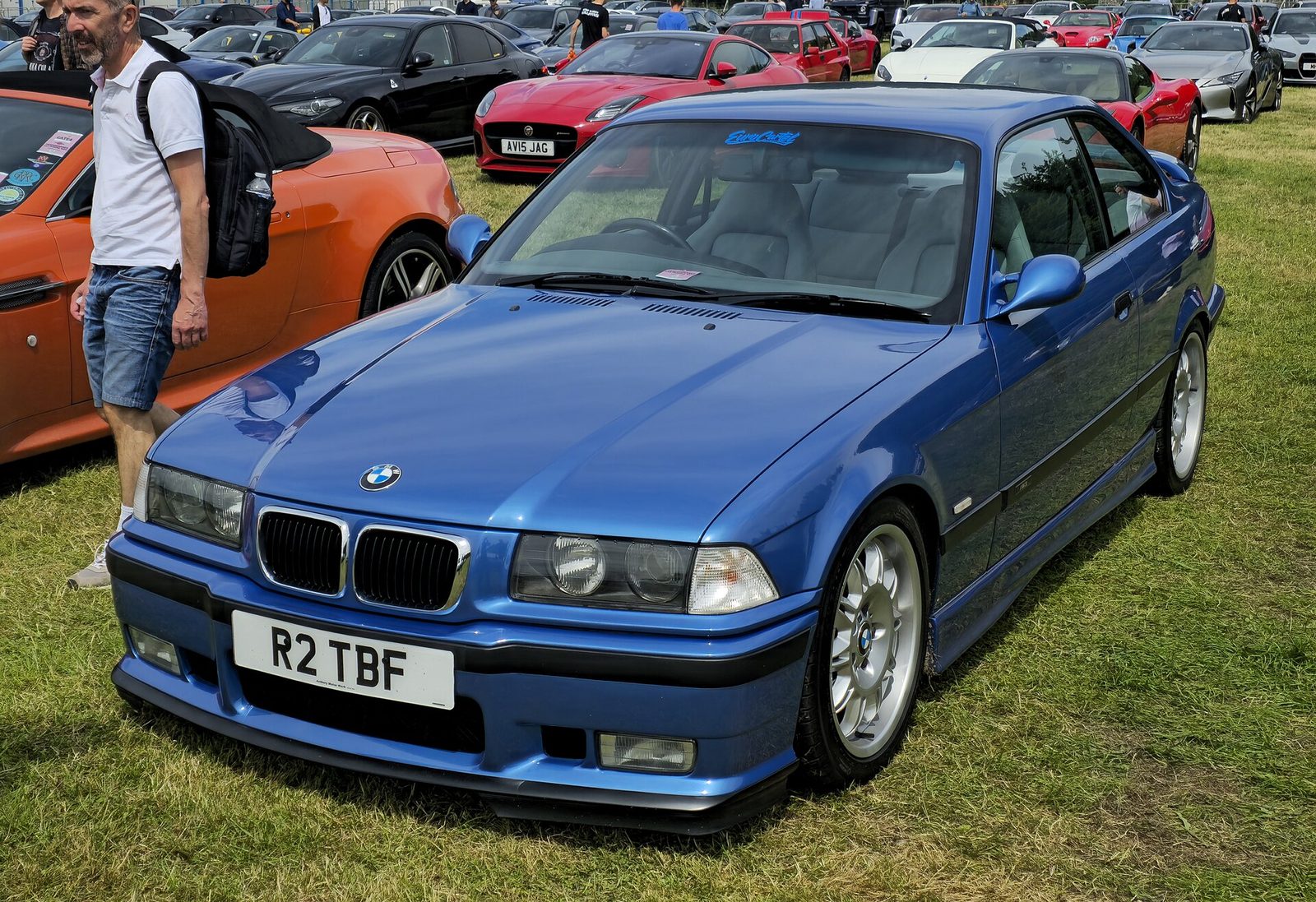
The E36 M3 (1992-1999) is where BMW M stopped building homologation specials and started building a product line. Where the E30 M3 was a four-cylinder Group A racing car sold with license plates, the E36 was a smooth 3.0-liter straight-six coupe with VANOS variable valve timing, offered from 1994 as a sedan and a convertible as well, and built in roughly three and a half times the volume of its predecessor. Europe got 282 hp, then 317 hp from the 3.2-liter double-VANOS S50B32 of late 1995. North America got a different engine entirely - first the M50-derived S50B30US, then the S52B32US, both rated at 240 hp - a decision that made the car affordable in the United States and has been argued about by owners on both continents ever since. Europe also got the 356-car M3 GT homologation special; America got the 126-car Lightweight instead. Values now split along exactly those lines.
History
Not Another Homologation Special
The E30 M3 existed because BMW needed to win Group A, and everything about it - the four-cylinder S14, the flared arches, the bolted-on trunk lid - followed from that. The E36 M3 followed from something else. Supercar Nostalgia dates the coupe's public debut to the Paris Motor Show in October 1992; Wikipedia gives a November 1992 launch. Either way, what arrived was a car built to be sold rather than to be raced: a 2,990 cc straight-six in place of the S14, no flared bodywork, and roughly 71,000 cars built against about 18,000 E30s. BMW M's own retrospective concedes the point, describing the E36 as having traded its predecessor's rebelliousness for something cultivated.
Two Cars Called M3
The European S50B30 was a genuine M engine: individual throttle bodies, a ported alloy head, 10.8:1 compression, VANOS acting on the inlet camshaft, and 282 hp at 7,000 rpm. North America received the S50B30US instead - the same 2,990 cc but with the M50's simpler head and two-position VANOS, no individual throttle bodies, 10.5:1 compression and 240 hp at 6,000 rpm. The published explanations do not agree. autoevolution attributes the substitution to federal emissions standards; Prestige & Performance Car attributes it to the octane rating of American pump fuel; Wikipedia describes it as a compromise reached so that the M3 could be sold in America affordably at all. The 1996 facelift widened rather than closed the gap: Europe got the 3,201 cc double-VANOS S50B32 at 317 hp and a six-speed gearbox, while America got the S52B32US - 3,152 cc despite the name, still 240 hp, still five speeds, sharing its block and head with the ordinary 328i. American cars also went without the two-piece floating front discs, the oil temperature gauge and the larger differential.
Coupe, Sedan, Convertible
For the first time an M3 came in more than one shape. The sedan arrived in 1994 and lasted only until December 1997; the convertible arrived the same year and outlived everything else, running to December 1999. Neither was sold in North America until the S52 facelift, and both are scarcer than the coupe in right-hand drive - 694 right-hand-drive sedans against several thousand right-hand-drive coupes. A sequential SMG gearbox was offered in Europe, from 1996 by BMW M's account and from March 1997 by Supercar Nostalgia's.
GT, Lightweight, and What Each Market Was Given
Homologation did not disappear, it just became a side project. In 1995 BMW built the M3 GT for mainland Europe: British Racing Green only, left-hand drive only, a 264-degree inlet cam and shortened intake manifold for 295-296 hp, a baffled dual-pickup sump, aluminum doors and adjustable aerodynamics, all to homologate parts for FIA and IMSA GT competition. North America could not have it, so BMW of North America commissioned the M3 Lightweight - 126 cars built between August and October 1995, stripped of air conditioning, radio, sunroof and sound deadening, with aluminum door skins and a set of race parts shipped loose in the trunk. It kept the 240 hp US engine, and Prototype Technology Group, which ran BMW's American racing effort, handled its delivery.
The Long Tail
Coupe production ended in 1998 and the convertible in December 1999, and the E46 replaced the line with an engine sold in the same specification worldwide. That decision reads, in retrospect, as an admission about the E36. The generation's reputation has since been rebuilt from the bottom up by owners rather than by the factory, and the argument over the American engine has never quite been settled - only restated, each time one of these cars changes hands.
Common Problems
VANOS is the defining fault and it takes two forms. On the European S50B30 the intake rod cup seal is Buna rubber that Beisan Systems reports hardening, shrinking and flattening within roughly 20,000 miles, with the Teflon piston seal then wearing unevenly and the solenoid O-rings shredding under oil pressure; the result is lost power below 3,000 rpm, bogging and surging around 3,000 rpm, a lumpy idle and worse fuel consumption. On the two-position units fitted to the S50B30US and S52 - shared with M50TU and M52 engines - the failure is mechanical rather than hydraulic: wear in the helical gears on camshaft, sprocket and splined shaft opens axial play that the rotating cam then rattles against, and performance camshafts make it worse. A seal kit is the cheap route and a full specialist rebuild the thorough one. Cracking of the floor around the rear subframe mounts is endemic. Corrosion is the biggest financial risk on European cars. Cooling system plastics - expansion tank, thermostat housing, water pump impeller - go brittle with age and an overheat takes the head gasket with it. European S50 engines use shim-adjusted valve clearances at 20,000 to 30,000 mile intervals, steering vagueness from worn front wishbone bushes is routine at this age, and North American cars have a reputation for smaller rear differentials failing at the bearings and flanges.
What to Look For
Establish which car it actually is before anything else. European S50B30 and S50B32 cars, North American S50B30US and S52B32US cars, UK GT Individual cars wearing GT bodywork on standard mechanicals, and genuine mainland GTs are four different propositions with four different values, and the visual cues overlap. A GT is British Racing Green, left-hand drive and carries aluminum doors; an Imola Individual is Imola Red on Evolution mechanicals; a Lightweight is Alpine White III with aluminum door skins, no sunroof and no air conditioning, and its boot should still contain the loose race parts if the car is untouched. Structure comes next. The floor around the four rear subframe mounting points tears on hard-driven and lowered cars, the passenger-side front mount first; look underneath for cracking, previous welding or fitted reinforcement plates, and treat a car with none of these and a track history with skepticism. Rust is the other structural issue - rear arches, sills, jacking points, battery tray, front inner wings and the rear screen surround - and putting a badly corroded shell right costs more than most cars are worth. Listen for a VANOS rattle at idle and check for a flat spot below 3,000 rpm. On European S50 cars ask when the valve clearances were last shimmed, and check the cooling system's plastic components and their replacement dates.
Market Notes
As of August 2026, classic.com's benchmark for the E36 M3 as a whole is $29,824, with 37 cars listed for sale. The sub-model benchmarks show how sharply body style and gearbox separate the ordinary cars: manual coupe $28,939, manual convertible $28,049, manual sedan $21,578, automatic coupe $19,221, automatic sedan $16,543 and automatic convertible $16,513. The same page records a low of $7,000 for a 1997 sedan in June 2022. The two homologation specials sit in a different market entirely. classic.com's M3 GT benchmark is $174,059 against an average recorded sale of $132,563, with a low of $45,000 in October 2022; RM Sotheby's sold chassis WBSBF99030EA40098 for 275,000 euros at Munich in October 2025, that figure being the house's advertised sold price rather than hammer. The M3 Lightweight benchmark is $180,650 against an average of $167,374 and trending upward, with a range from $85,001 in December 2024 to $257,600 in August 2026; RM Sotheby's sold chassis WBSBF9328SEH07955 for $179,200 at Monterey in August 2025. For context on the climb, Gooding & Company sold a 7,500-mile Lightweight for $145,750 including buyer's premium at Amelia Island in March 2017, and Sports Car Market recorded specialist dealer sales in the $115,000-$135,000 band around that period.
Where sources differ
Sources give different starting points for the E36 M3: Supercar Nostalgia dates the coupe's public debut to the Paris Motor Show in October 1992 while Wikipedia gives a November 1992 launch.
Supercar Nostalgia states a Paris Motor Show debut in October 1992; Wikipedia states a November 1992 launch. One may describe the show debut and the other the start of customer sales, but no source consulted here reconciles them and the point is not resolved.
Published explanations for why North America received a different engine do not agree: autoevolution attributes it to federal emission standards, Prestige & Performance Car to the octane rating of American pump fuel, and Wikipedia to a cost compromise made so the M3 could be sold in the United States affordably.
autoevolution states the substitution was made to meet federal emission standards, Prestige & Performance Car that it was made to tolerate lower-octane American fuel, and Wikipedia that it was a compromise to bring the M3 to America affordably. Three different causes for one decision, and no source consulted here resolves which was decisive.
Sources disagree on the S50B30's torque peak and on the S50B32's exact displacement.
Wikipedia's S50 article gives the S50B30 243 lb-ft at 3,500 rpm; Supercar Nostalgia and Prestige & Performance Car both give 236 lb-ft at 3,600 rpm. For the S50B32, Wikipedia states 3,201 cc and Supercar Nostalgia 3,210 cc. Neither discrepancy is addressed by any source consulted here and both remain unresolved.
No single production total for the E36 M3 is asserted here: BIMMERtips's tabulated breakdown totals 71,241 cars while Prestige & Performance Car states 71,242, which is also the sum of Wikipedia's body-style figures.
BIMMERtips totals 71,241 from a table broken down by engine, market, body and transmission. Prestige & Performance Car states 71,242, matching the sum of Wikipedia's 46,525 coupes, 12,114 convertibles and 12,603 sedans. The one-car difference is not resolved by any source consulted here, so productionTotal is left null.
The North American share of production is materially disputed: Wikipedia gives 18,961 US coupes, 7,760 sedans and 6,211 convertibles, while the table published by BIMMERtips adds to substantially more coupes and sedans.
Wikipedia states 18,961 US coupes, 7,760 sedans and 6,211 convertibles. The BIMMERtips table gives 8,515 manual plus 1,705 automatic S50B30US coupes and 11,793 S52 coupes, 4,574 manual plus 4,036 automatic sedans and 2,252 manual plus 4,017 automatic convertibles. No source consulted here reconciles the two sets, so no US total is asserted.
The M3 GT was built for mainland Europe only, in left-hand drive and in British Racing Green only, but its production count is stated as either 350 or 356 depending on whether pre-production cars are included.
BMW M states 356 including five pre-production models, and RM Sotheby's and classic.com both state 356. Supercar Nostalgia states 350 customer cars built February to June 1995 plus six prototypes from December 1994, and BIMMERtips lists 350. Whether the figure is 350 or 356, and whether five or six prototypes exist, is not resolved by any source consulted here.
Sources
- The BMW M3 E36: Big footsteps and new paths to tread, BMW M GmbH · manufacturer
- The BMW E36 M3 GT, BMW M GmbH · manufacturer
- BMW M3, Wikipedia · encyclopedia
- BMW S50, Wikipedia · encyclopedia
- BMW M52, Wikipedia · encyclopedia
- BMW E36 M3 3.0 Guide, Supercar Nostalgia · specialist
- BMW E36 M3 3.2 Evolution Guide, Supercar Nostalgia · specialist
- BMW E36 M3 3.0 GT Guide, Supercar Nostalgia · specialist
- BMW E36 M3 3.0 Lightweight Guide, Supercar Nostalgia · specialist
- BMW M3 (E36) buyer's guide, Prestige & Performance Car · journalism
- BMW S50 engine tech guide, Prestige & Performance Car · journalism
- BMW S50 EU-Spec: The M3's First Six-Cylinder, autoevolution · journalism
- 8 Ways American E36 M3 Buyers Got Completely Screwed Over, Car Throttle · journalism
- Euro S50 Single Vanos (Euro E36 M3), Beisan Systems · specialist
- Single Vanos Rattle 6-cyl, Beisan Systems · specialist
- E36 Rear Subframe/Chassis Reinforcement Kit, Turner Motorsport · specialist
- BMW E36 M3 Common Problems - Known Issues & Buying Guide (1992-1999), CarWise · specialist
- BMW E36 Production Data Numbers, BIMMERtips · specialist
- BMW M3 - E36 Market, classic.com · market-data
- BMW M3 GT - E36 Market, classic.com · market-data
- BMW M3 Lightweight - E36 Market, classic.com · market-data
- 1995 BMW M3 Lightweight, Monterey 2025, RM Sotheby's · auction-house
- 1995 BMW M3 GT, Munich 2025, RM Sotheby's · auction-house
- 1995 BMW M3 Lightweight, Sports Car Market · journalism
Synthesized from the sources above and cross-checked. We cite and link out; we do not republish other databases verbatim.
Fully Sorted is an independent publisher and is not affiliated with, endorsed by or sponsored by BMW. BMW and the model names on this page are trademarks of their respective owners and are used here only to identify the cars being described.
Chassis register
Nobody has recorded a car here yet. Own one, or know one? Chassis number, what you can prove about it, and a source if there is one. Every entry is reviewed before it appears.
Nerd Notes
What owners know that the sources don't. Every note is read and checked before it appears here.
Key Specs
- Power
- 282 hp at 7,000 rpm and 317 hp at 7,400 rpm claimed by BMW for the European engines; 240 hp at 6,000 rpm for both North American engines
- Brakes
- Ventilated discs all round; two-piece floating front discs with aluminum hubs in Europe, solid one-piece rotors in North America
- Engine
- S50B30 2,990 cc / S50B32 3,201 cc straight-six (Europe); S50B30US 2,990 cc / S52B32US 3,152 cc (North America)
- Layout
- Front-engined, longitudinal, rear-wheel drive
- Torque
- 236 lb-ft at 3,600 rpm quoted for the S50B30 by most sources and 243 lb-ft at 3,500 rpm by others; 258 lb-ft at 3,250 rpm (S50B32); 225 lb-ft at 4,250 rpm (S50B30US); 236 lb-ft at 3,800 rpm (S52B32US)
- Weight
- 3,219 lb (European 3.0 coupe) and 3,175 lb (3.2 Evolution coupe) per Supercar Nostalgia; 3,340 lb curb quoted by Wikipedia for a 1996 European coupe; 2,950 lb for the Lightweight
- Chassis
- Unitary steel monocoque on the E36 3 Series shell, with M-specific geometry, bracing and brakes
- Top speed
- 155 mph limited in Europe; North American cars reported as limited to about 137 mph
- Suspension
- MacPherson struts front, multi-link Z-axle rear, with M-specific springs, dampers and anti-roll bars
- Valvetrain
- DOHC, four valves per cylinder; single VANOS on the inlet camshaft for 3.0 cars, double VANOS on the 3.2 Evolution
- Bore stroke
- 86.0 x 85.8 mm (S50B30, S50B30US); 86.4 x 91.0 mm (S50B32); 86.4 x 89.6 mm (S52B32US)
- Compression
- 10.8:1 (S50B30), 11.3:1 (S50B32), 10.5:1 (both North American engines)
- Acceleration
- 0-62 mph in 5.5 s (European 3.0) and 5.3 s (3.2 Evolution) claimed by BMW; 5.8 s for the Lightweight; about 6.1 s 0-60 mph reported for North American cars
- Transmission
- Five-speed manual on all 3.0 and all North American cars; six-speed with overdrive sixth from the 3.2 Evolution; SMG sequential optional in Europe; five-speed ZF automatic optional in North America
Notable Variants
M3 Coupe 3.0 (European S50B30)
The launch car: 2,990 cc, individual throttle bodies, single VANOS, 282 hp at 7,000 rpm, five-speed manual, 3,219 lb. Recessed kidney grilles and orange indicators identify the pre-facelift shell. The reference point against which every other E36 M3 is argued.
M3 (North America, S50B30US then S52B32US)
A different car under the hood: 240 hp in both 1995 and 1996-99 form, five-speed only, solid rather than two-piece floating front discs, no oil temperature gauge, a smaller differential and plastic rather than glass headlamp lenses. Cheap when new, and the reason US and European values have never converged.
M3 GT (1995)
Left-hand-drive, mainland Europe only, British Racing Green over Mexico Green leather. A 264-degree inlet cam, shortened intake manifold, baffled dual-pickup sump, aluminum doors, adjustable splitter and split-level rear wing, all to homologate FIA and IMSA GT parts. Now the most valuable E36 M3 by some distance.
M3 Lightweight (1995, North America)
BMW of North America's answer to not getting the GT: air conditioning, radio, sunroof, sound deadening, toolkit and spare deleted, aluminum door skins, Alpine White III with M flag graphics, and a box of non-street-legal race parts in the trunk. 126 built, listed at $47,470, homologated for IMSA showroom-stock racing.
M3 Evolution 3.2 (1995-1999)
The facelift: 3,201 cc, double VANOS, 11.3:1 compression, 317 hp at 7,400 rpm, a six-speed derived from the E34 M5 with an overdrive sixth, and 44 lb saved through aluminum doors. Widely described as the first BMW production engine past 100 hp per liter.
GT-bodied run-out cars (GT Individual and Imola Individual)
Two separate things frequently conflated. Supercar Nostalgia records 50 UK 'M3 mit GT-Optik' cars, model code BF92, wearing the GT package on the standard 286 hp engine; Prestige & Performance Car describes a 1998 GT2 in Imola Red on Evolution mechanicals. Neither is a factory GT, and documentation matters more here than badges.
M3-R (Australia, 1994)
Fifteen cars built for Australian showroom-stock racing, quoted at 322 hp, four going straight to competition teams and eleven to private buyers. The smallest official E36 M3 series and effectively untraded outside Australia.
Value Trajectory
For most of its life the E36 M3 was simply a used BMW, and in America a cheap one - the engine argument that annoyed enthusiasts in 1995 kept prices down for two decades. Sports Car Market records Lightweights changing hands at around $25,000 in the mid-2000s, which puts the floor for ordinary cars a good deal lower still. The recovery has been uneven and it has followed rarity rather than the generation as a whole. As of August 2026 the Lightweight benchmark of $180,650 is trending upward against a $257,600 high recorded that month, and the M3 GT benchmark of $174,059 sits above an average recorded sale of $132,563, meaning the best cars are pulling away from the mean. Ordinary cars have moved far less: a manual coupe benchmark of $28,939 against an automatic sedan at $16,543 describes a market that still prices these as fast old cars rather than collectibles. The gap that matters is not European against American but documented against undocumented, and unrusted against welded. Attrition through corrosion, track use and engine swaps has been heavy enough that the supply of honest standard cars is falling faster than demand is rising.
Market Snapshot
Range $42,000 – $118,000
Shopping for one?
Browse BMW listings, or decode a VIN before you buy.