
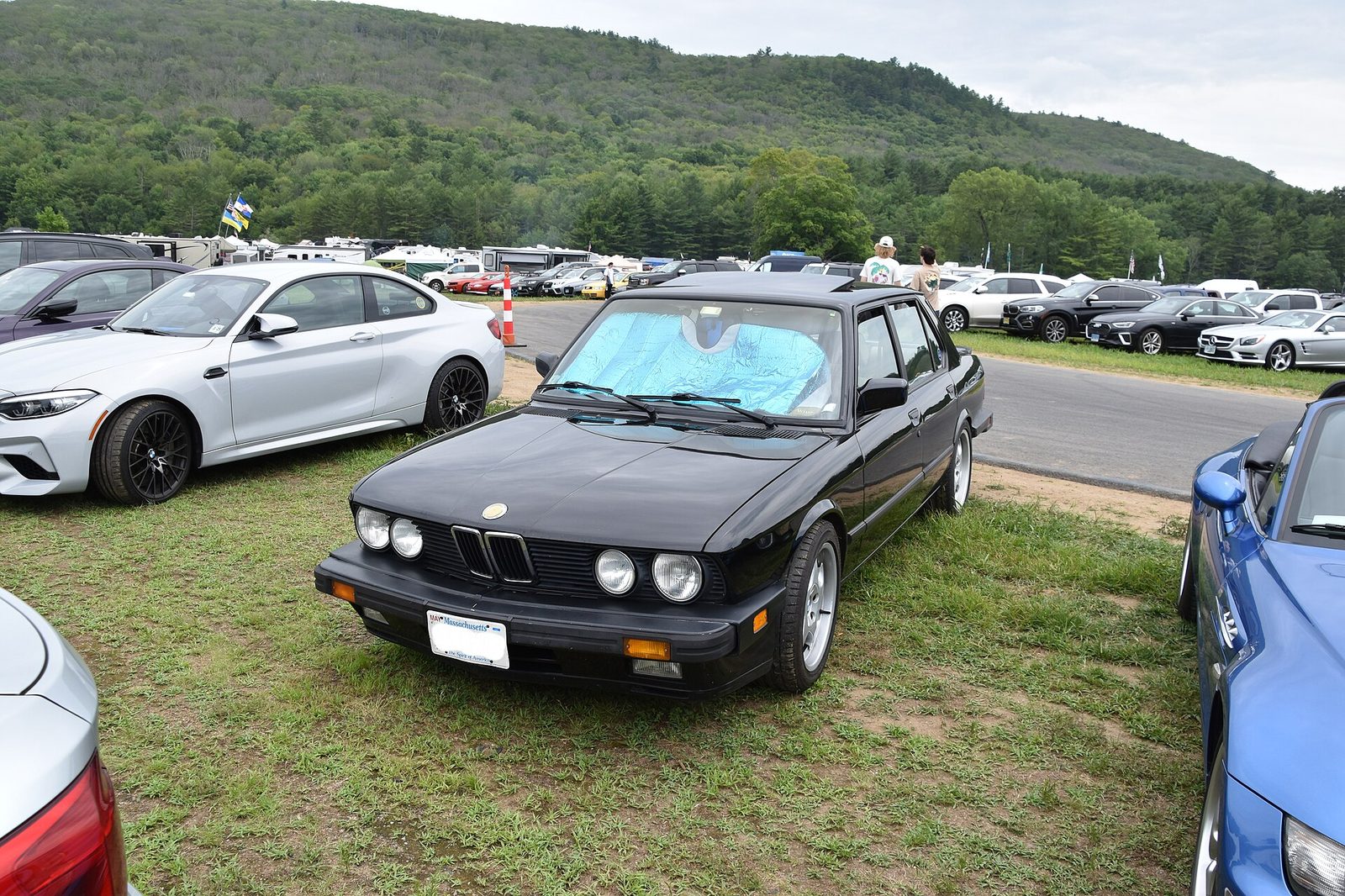
The BMW M5 (E28, 1985-1988) was the first car to wear the badge and the car that created the super-sedan class. It was a plain four-door body, assembled by hand at BMW Motorsport GmbH, carrying the 3,453 cc twenty-four-valve straight-six developed for the mid-engined M1. In European M88/3 form it produced a claimed 282 hp at 6,500 rpm and made the M5 the fastest production sedan in the world at launch, capable of 151 mph in independent testing while looking very largely like a 528i. North America and Japan received the S38B35 instead, lower in compression, fitted with a catalytic converter and quoted at somewhere between 252 and 256 hp. BMW M puts total production at 2,241 cars built from late 1984, divided between European left- and right-hand-drive cars, a large single-year North American allocation, thirty for Japan and a small run assembled from kits at Rosslyn in South Africa - the only place outside Germany where an E28 M5 was put together. It was expensive, understated and slow to build, and it set a template BMW has followed ever since.
History
An M1 Engine in Search of a Body
The M88 was designed for the mid-engined M1 of 1978, a homologation car built in tiny numbers for a racing category that evaporated around it. BMW Motorsport was left with an expensive twenty-four-valve straight-six and no volume car to put it in. The M88/3 that reached the M5 was the road-adapted answer: still 3,453 cc, still twin camshafts, four valves per cylinder and six individual throttle butterflies, but converted from the M1's dry sump to a wet sump, given Bosch Motronic management and run at 10.5:1 compression. The M635CSi had the engine first; the M5 put it into a four-door bodyshell that advertised nothing beyond a deeper front airdam, a small boot spoiler and blacked-out brightwork.
Hand Assembly at Preussenstrasse
The M5 was not built on a production line. BMW Motorsport GmbH assembled the cars by hand at its Preussenstrasse premises in Munich, moving to Daimlerstrasse in Garching around the summer of 1986 as volumes grew. That method set the shape of everything that followed. Output was low - Motor Sport reported in October 1986 that only about 250 cars a year were planned - the options list was short, and by the time the North American allocation was being built the practical answer to color choice was black.
Amsterdam, 1985, and the Fastest Sedan in the World
Production began at the end of 1984 and the car was shown publicly at the Amsterdam Motor Show in February 1985. It was, at that point, the fastest production sedan in the world, and cost accordingly: $46,500 in the United States and 86,000 Deutschmarks in Germany. Motor Sport's road test of October 1986 recorded 0-60 mph in 6.3 seconds, 0-100 mph in 17.1 seconds, 151 mph and 19.7 mpg, and noted approvingly that the car looked like just another 5-series. That combination - a supercar's pace in a shape that drew no attention at all - is the whole of the super-sedan idea, and the E28 M5 is where it starts.
The Catalyst Cars: America, Japan and the S38
Markets requiring emissions equipment could not take the M88/3, so BMW Motorsport produced the S38B35: same capacity, compression dropped to 9.8:1, a simplified exhaust manifold, shorter camshaft duration, a catalytic converter and, usefully for surviving cars, a dual-row chain in place of the M88/3's single row. Quoted output falls between 252 and 256 hp depending on which source is doing the quoting. North American production ran from November 1986 to November 1987 and sold as a single 1988 model year at $46,500, every car black, almost every interior Natur tan. BMW had indicated around 500 would come; roughly 1,340 did, and some early buyers who had paid for exclusivity went to law about it. Japan took thirty cars in early 1987.
Rosslyn, and the End of the Run
Right-hand-drive European production began in March 1986 and accounted for 187 cars. South Africa was the exception to everything else: 96 M5s were assembled from CKD kits at BMW's Rosslyn plant, the only assembly point for the model outside Germany, and specified more richly than any of them, with Highline Nappa leather normally reserved for the 6- and 7-Series, M-Technic bodywork and cross-spoke 16-inch wheels. German assembly finished in November 1987 by the market tables, though Wikipedia and Motor1 both run production to June 1988; Rosslyn was still building into late 1988. The E34 M5 that replaced it was built in larger numbers, on a line, with a bigger engine - and every generation since has been measured against the first.
Common Problems
The M88/3's single-row timing chain is the defining risk of a European car; Classic Trader records chains breaking well before the 100,000-mile replacement interval, and the North American and Japanese S38B35 with its dual-row chain is the more durable arrangement in this one respect. On both engines the plastic chain guides and the tensioner deteriorate with age and should be inspected whenever the front of the engine is open. Mechanical valve clearances need checking at roughly 30,000-mile intervals, and neglect runs from rough running to valvetrain damage. Six individual throttle bodies must be synchronized or the car idles unevenly and feels flat in the mid-range; perished vacuum hoses produce the same symptoms and are cheaper to cure. Oil leaks appear first at the cam cover gasket, then the sump and main seals. Cooling is the quiet danger on a high-mileage car: a failed water pump or thermostat can overheat an engine that is expensive to rebuild and whose parts are hard to find. Elsewhere the faults are those of a 1980s E28 - corrosion in the footwells, trunk floor, sills and window surrounds, tired bushes and dampers producing wandering and an unsettled rear, cracked dashboards, worn leather, failing instrument-cluster electronics and an ABS system that costs real money to service. Gearbox synchros rarely fail outright, but clutch replacement is a substantial bill.
What to Look For
Establish which engine the car has and whether it is the one it left the factory with. An M88/3 car and an S38B35 car are different propositions, and conversion of a US car to European specification is common enough that European-looking bumpers prove nothing. Written proof of timing chain replacement is the most valuable document on an M88/3 car: the single-row chain can let go before the nominal 100,000-mile interval and the consequences are terminal. Ask when the valve clearances were last set: they are shim-and-bucket, need doing on a schedule, and neglect shows up first as poor running and later as damage. A clean idle and a strong mid-range both depend on six throttle butterflies being in balance, so an uneven idle is a synchronization question before it is anything more expensive. On the body, look at footwells, trunk floor, sills and the corners of the front and rear window frames, and treat quick MOT-season patching as evidence of what is behind it. Inside, cracked dashboards, tired leather and a failing service-interval cluster are usual rather than remarkable, but trim is slow and costly to source, and the ABS costly to put right. Records of real, continuous use are worth more than a low odometer reading with nothing behind it.
Market Notes
As of August 2026, classic.com records a BMW M5 (E28) market benchmark of $58,257 against an average sale of $52,618, on a rising trend, with tracked results running from $8,000 for a 1988 project car in January 2023 to $183,000 for a 9,000-mile 1988 car in March 2026. The highest public result recorded anywhere is more recent still: $195,810 on Hagerty Marketplace on 2 April 2026 for a single-owner, all-original 9,800-mile US car from the Enthusiast Auto Group collection carrying roughly $91,000 of 2020-2025 refurbishment. RM Sotheby's sold a US-specification 1988 car from the Youngtimer Collection at Essen in 2019 for a published 57,500 euros; the catalog does not separate hammer from buyer's premium. South African cars trade in their own market, quoted locally in 2026 at 450,000 to 750,000 rand and above 900,000 rand for the best.
Where sources differ
European output is quoted differently depending on the source and the unit used, and no single English-language figure can be treated as settled.
BMW M states 286 hp at 6,500 rpm, which Motor Sport's 1986 road test renders directly as 286 hp. Supercar Nostalgia, Classic Trader and BMWBlog convert the same engine to 282 hp. evo publishes 278 hp at 6,500 rpm. The gap is at least partly PS-to-hp conversion, but no source consulted here states which figure is measured and which is converted, and the discrepancy is not resolved by any source consulted.
The catalyzed S38B35 fitted to North American and Japanese cars is quoted at between 252 and 256 hp at 6,500 rpm depending on the source consulted.
Supercar Nostalgia, RM Sotheby's, BMWBlog and BMW's own US press material all state 256 hp. Wikipedia's S38 entry states 255 hp. Conceptcarz states 252 horsepower. Torque is more consistent at 243 lb-ft at 4,500 rpm. No source consulted here reconciles the three power figures, and the point is unresolved.
Total production is stated as 2,241 cars by BMW M and repeated by every general reference consulted, but the published market-by-market splits do not all reconcile with that figure and no single total is asserted here.
BMW M, Wikipedia, Supercar Nostalgia, Classic Trader, classic.com and The Classic Valuer all state 2,241; Motor1 gives approximately 2,200. The published market table (588 LHD Euro, 187 RHD Euro, 1,340 North America, 30 Japan, 96 South Africa) sums exactly to 2,241, but AutoAdvisor states South Africa received 100 cars of which 96 were Rosslyn CKD builds. Wikipedia and Motor1 also run production to June 1988 where the market table ends German assembly in November 1987. Neither the South African count nor the closing date is resolved by any source consulted here; the conflict is unresolved and productionTotal is left null.
Sources
- The BMW M5 E28 from 1985, BMW M GmbH · manufacturer
- BMW M5, Wikipedia · encyclopedia
- BMW S38, Wikipedia · encyclopedia
- BMW E28 M5 Guide, Supercar Nostalgia · specialist
- Road Test: BMW M5, October 1986, Motor Sport Magazine · journalism
- BMW M5 E28 - history, review and specs, evo · journalism
- The BMW E28 M5 Buying Guide, Classic Trader · specialist
- BMW E28 M5 price and buyers guide: the original super-sedan, Collecting Cars · specialist
- 1988 BMW M5 Retro Review - The E28 is where it all began, Autoblog · journalism
- Rare E28 BMW M5 Sets Record With $195K Sale, Autoblog · journalism
- BMW M5 - E28 Market, classic.com · market-data
- Sold: 1988 BMW (E28) M5 - LHD, The Classic Valuer · market-data
- 1988 BMW M5, Essen 2019, RM Sotheby's · auction-house
- 1988 BMW M5, Conceptcarz · encyclopedia
- BMW M5 (E28, 1984-1987): The first super five, Motor1 · journalism
- 1987 BMW M5 E28, AutoAdvisor South Africa · journalism
- Mzansi's amazing Fives - history of the BMW 5 Series in SA, News24 · journalism
- BMW S38 Engine Guide: Specs, Reliability, and Tuning, BMWBlog · journalism
- Look Back at M Origins With BMW Group Classic's E28 M5, BMWBlog · journalism
- E28 BMW M5: The Family-Hauling Sedan With M1-Derived Power, autoevolution · journalism
Synthesized from the sources above and cross-checked. We cite and link out; we do not republish other databases verbatim.
Fully Sorted is an independent publisher and is not affiliated with, endorsed by or sponsored by BMW. BMW and the model names on this page are trademarks of their respective owners and are used here only to identify the cars being described.
Chassis register
Nobody has recorded a car here yet. Own one, or know one? Chassis number, what you can prove about it, and a source if there is one. Every entry is reviewed before it appears.
Nerd Notes
What owners know that the sources don't. Every note is read and checked before it appears here.
Key Specs
- Power
- 282 hp at 6,500 rpm claimed by BMW M for the M88/3, rendered as 282 hp by most English-language sources and 278 hp by evo; catalyzed S38B35 quoted between 252 and 256 hp at 6,500 rpm
- Brakes
- Ventilated discs front and rear with ABS as standard equipment
- Engine
- 3,453 cc 24-valve DOHC straight-six with six individual throttle butterflies - M88/3 for Europe and South Africa, catalyzed S38B35 for North America and Japan
- Layout
- Front-mounted longitudinal engine, rear-wheel drive, four-door sedan
- Torque
- 251 lb-ft at 4,500 rpm (M88/3); 243 lb-ft at 4,500 rpm (S38B35)
- Weight
- 3,153 lb curb per BMW M; 3,155 lb quoted by evo
- Chassis
- Unitary steel E28 bodyshell; MacPherson strut front, semi-trailing arm rear, uprated springs and firmer damping than the M535i
- Top speed
- 152 mph claimed; 151 mph recorded by Motor Sport, October 1986
- Valvetrain
- Twin overhead camshafts, four valves per cylinder, shim-and-bucket mechanical clearances requiring periodic adjustment
- Bore stroke
- 93.4 mm x 84.0 mm as published for the S38B35; the M88/3 shares the 3,453 cc capacity
- Compression
- 10.5:1 (M88/3); 9.8:1 (S38B35 with catalytic converter)
- Final drive
- 3.91:1 on North American cars, a shorter ratio than the European specification
- Lubrication
- Wet sump, in place of the dry-sump arrangement of the M1 engine it derives from
- Acceleration
- 6.5 s to 62 mph claimed by BMW M; 6.3 s to 60 mph recorded by Motor Sport in October 1986 and by Car and Driver's 1987 fifth-wheel test of a US car
- Differential
- Limited-slip differential, quoted at 25 per cent locking effect
- Transmission
- Getrag five-speed manual; no automatic was offered
- Fuel ignition
- Bosch Motronic; ML3.1 quoted for the S38B35
Notable Variants
M5 (European LHD, M88/3)
The original specification and the one without a catalytic converter: 588 cars on the published market table, built between October 1984 and September 1987. Highest quoted output of the run and the widest choice of colors and trim, these being cars ordered individually rather than shipped as a homogeneous allocation.
M5 (European RHD, M88/3)
187 right-hand-drive cars from March 1986 to November 1987, the UK's share among them. The scarcest of the volume specifications, and the one UK buyers now pay a premium to keep original.
M5 (North America, S38B35)
1,340 cars for a single model year, all finished in black over Natur leather, with sealed-beam headlights, five-mph impact bumpers, side marker lights, standard M-Technic boot spoiler and Shadowline trim, and a 3.91:1 final drive. BMWBlog states only 101 of them left the factory with black rather than tan interiors.
M5 (Japan, S38B35)
30 cars built in a three-month window in early 1987 - the smallest official allocation. Mechanically as North America but without the impact-absorbing bumpers and side markers, and offered only in Diamond Black with Anthracite leather.
M5 (South Africa, Rosslyn CKD)
96 cars assembled from kits at Rosslyn, the only place outside Germany where an E28 M5 was put together. Uncatalyzed M88/3, Highline Nappa leather extending to door cards, console, dash and headlining, M-Technic bodywork, Shadowline and cross-spoke 16-inch wheels; a sunroof was effectively the only option left to tick.
M535i (E28)
Not an M car in the sense the M5 is, and the source of most misidentification. It used the 535i drivetrain with M-Technic suspension and bodywork and was built on the standard E28 lines rather than by hand at BMW Motorsport - the difference that matters when a listing calls a car an M5.
Value Trajectory
For most of its life the E28 M5 was simply a fast old BMW, and it was bought and used as one; most surviving cars are past 100,000 miles, and many North American examples were driven hard through the 1990s when they were worth less than their maintenance. The re-rating came with the wider 1980s analogue cohort in the 2010s and has not stopped. Classic Trader described values as firm and rising several years ago, and as of August 2026 the classic.com benchmark of $58,257 is still trending upward. What has changed more than the middle of the market is the top of it: the $183,000 recorded in March 2026 and the $195,810 Hagerty Marketplace result in April 2026 both belong to sub-10,000-mile, single-ownership, unmodified cars, and both sit at roughly three times the benchmark. The spread between a documented original car and a tired one is now very wide indeed. Specification is beginning to matter in the same way: uncatalyzed M88/3 cars, the 187 European right-hand-drive cars and the 96 South African CKD cars are all scarcer than the North American allocation that supplies most of the public sales record.
Shopping for one?
Browse BMW listings, or decode a VIN before you buy.