
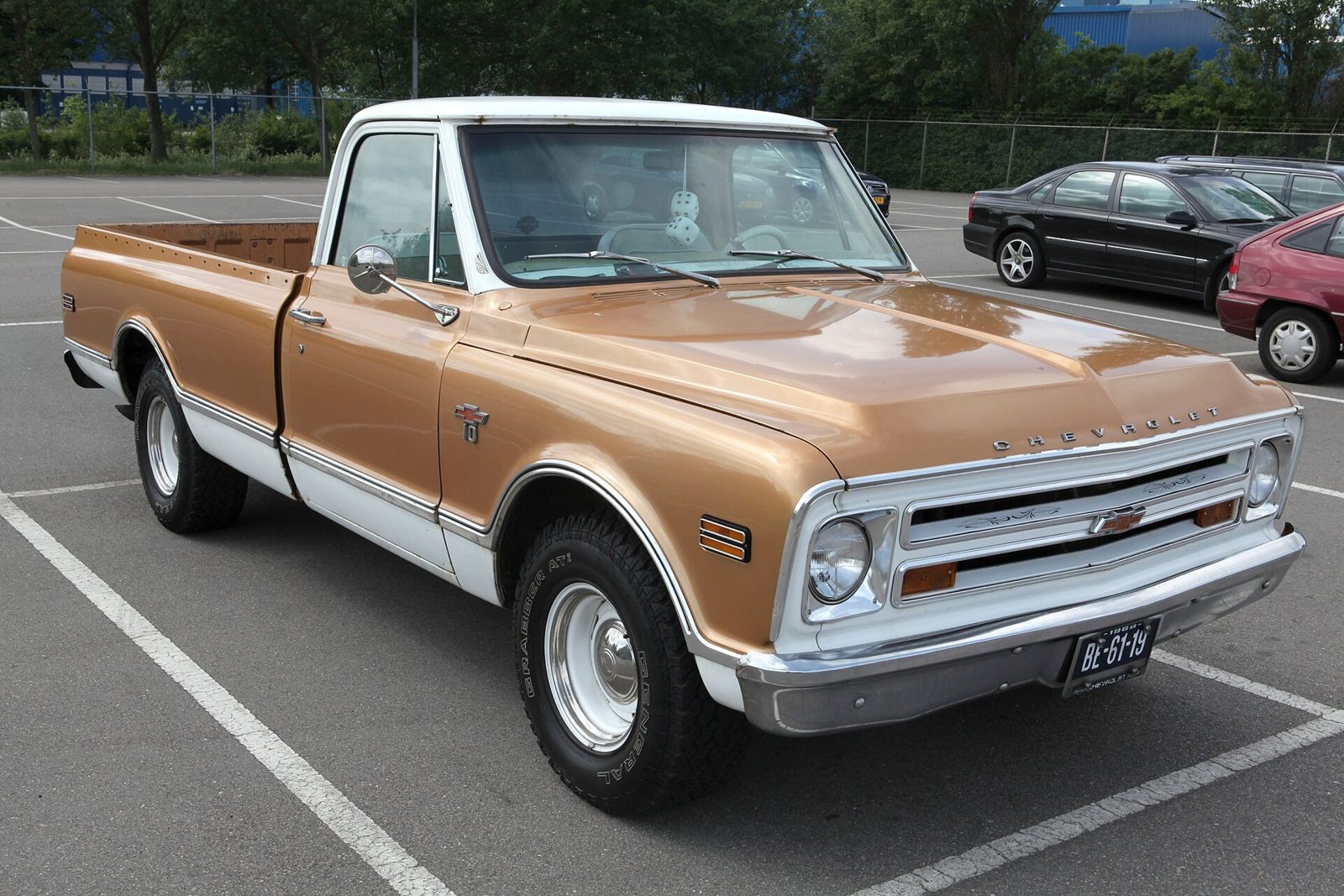
The 1967-1972 Chevrolet C10 is the half-ton, two-wheel-drive pickup of the generation General Motors sold as the Action Line, built alongside the four-wheel-drive K10 and a GMC twin. It kept the coil-sprung independent front end and coil-sprung trailing-arm rear of the 1960-66 trucks, wrapped them in a lower, cleaner body, and offered carpet, bucket seats, air conditioning, woodgrain and two-tone paint to buyers who were no longer only farmers and contractors. Two beds, the smooth-sided Fleetside and the fendered Stepside, came in 6.5 ft and 8 ft lengths on 115 in and 127 in wheelbases, and the trim ladder climbed from a base truck through Custom and CST to the Cheyenne of 1971. Engines ran from the 250 cu in six to a big-block V8, and front disc brakes arrived for 1971. Chevrolet built these trucks at close to 300,000 or more a year, most of them long-bed work trucks, and that volume explains the market today: the short-bed Fleetside is the truck people want, nearly every panel is reproduced, and originality is harder to establish than on almost any other collector vehicle.
C10
History
A Work Truck Built for the Driveway
When the second-generation C/K was drawn up, Chevrolet still treated its pickups as a commercial line for tradesmen, businesses and farms. The 1967 truck was nonetheless redesigned from the ground up to be usable as personal transportation, with more comfort and convenience than any pickup had needed before, and Chevrolet's advertising said so plainly, selling the trucks as fun for family activities rather than only as work horses. The styling was part of the argument. Against the taller, flatter Ford F-100 the Chevrolet sat low, with a clean shoulder line and a rounded roof, and GM gave the generation the Action Line name. Hagerty's buyer's guide credits the approach with keeping GM ahead of Ford through the mid-1970s, and the trucks sold in numbers that never fell far below 300,000 half-tons a year.
Coil Springs at Both Ends
Under the new body the chassis was largely carried over from 1960-66: a drop-center ladder frame, short-and-long-arm independent front suspension on coil springs, and at the rear a live axle on two coil-sprung trailing arms located by a Panhard bar, with rear leaf springs on the option list. That rear layout is the reason a C10 rides differently from its contemporaries, and the reason the aftermarket builds coilover conversions around it rather than replacing it. The K10 was a different truck underneath, with a live front axle and leaf springs at all four corners. GMC reversed Chevrolet's choice at the rear, fitting leaf springs as standard and coils as the option. Brakes were drums all round until 1971, when front discs became standard on every light-duty truck.
Year by Year, 1967 to 1972
The 1967 truck is the only one with the small rear cab window, and sources disagree over whether it was the standard glass or the option. For 1968 federal rules added side marker lamps at all four corners, the 3/4-ton Longhorn arrived with an 8.5 ft Fleetside bed, and a 50th Anniversary package marked Chevrolet's half-century of trucks in white and gold. For 1969 the hood was reshaped with a blunter front, the grille was redesigned, and a foot-operated parking brake replaced the hand lever. The 1970 truck is a close copy of the 1969. For 1971 the egg-crate grille arrived with the bowtie at its center, the parking lamps moved into the bumper, front discs became standard, and a tilt column and factory AM/FM radio were offered. The 1972 truck gained molded door panels and a windshield-mounted mirror, and is otherwise so close to the 1971 that the serial number is the reliable way to tell them apart.
From CST to Cheyenne
From 1967 through 1970 the Chevrolet ladder ran from an unnamed base truck through Custom to the CST, the Custom Sport Truck, which could be had with bucket seats and a folding center armrest and from 1969 wore woodgrain-banded lower trim. A Custom Comfort and Convenience interior package sat between base and CST from 1969. For 1971 the names moved up a rung: base became Custom, Custom became Custom Deluxe, and the CST became the Cheyenne, with a Cheyenne Super added during the year carrying woodgrain dash trim and full instrumentation. The Cheyenne name is still on GM trucks. GMC ran Deluxe, Custom and Super Custom, and for 1972 added the Sierra and Sierra Grande. Hagerty's contributors are blunt that trim now matters less than it should, because the trucks were built to order from hundreds of RPO codes and almost any part can be bought new.
Sixes, Small-Blocks and the Big-Block
The 250 and 292 cu in sixes ran for all six years. The V8 list moved quickly: the 283 for 1967 only, replaced by the 307 for 1968; the 327 through 1968, replaced by the 350 for 1969; and from 1968 a 396 big-block, the first in a light-duty GM truck. GMC also offered its own 305 and 351 cu in V6s until 1970. The sources do not agree on the big-block's output or on whether the 402, badged 400, arrived for 1970 or 1971, and even the small-block ratings differ by up to 20 hp between references. Transmissions ran from a column-shift three-speed through four-speed manuals to the Powerglide and the Turbo-Hydramatic 350 and 400.
Common Problems
Corrosion is the defining fault, and it is structural rather than cosmetic. These were built as working trucks with little sealing against moisture, and the repair panels sold today copy the original construction, so a truck restored without seam sealer and weld-through primer will rust again in the same places. Rocker and floor rot usually runs into the cab supports and door pillars, and a truck with rot in all of them has become a floor-pan replacement job, which is how one project truck was done.
Hidden repairs are the second theme. Owners report silicone pushed into rusted drip rails and painted over, and one Hagerty contributor found a beer can in a rocker under body filler. Paint alone says little about what is beneath it.
Mechanically the trucks are simple. Hagerty's contributors single out failed fuel gauge senders as a common fault and treat every belt, hose and bushing as due for replacement on age alone. Trucks built before 1971 have four-wheel drums, so a pre-1971 truck carrying a modern V8 on original brakes is under-braked, and front discs are the usual retrofit. On big-block trucks the 396 and 400 labels were used loosely enough that the displacement a truck actually carries, and whether it is original, cannot be read from a fender badge. No NHTSA recall or complaint data for this generation was consulted, so none is stated.
What to Look For
Rust first, and the places are consistent. The lower body has cup-shaped pockets that fill with dirt and hold water, so the outer rockers, the inner rockers formed by the floor edge, the cab corners behind them and the cab supports beneath the floor go together; one shop calls rocker replacement almost a certainty on any unrestored truck. Then the door pillar bottoms, the toe board where it meets the rocker, the small drain holes at the front of the cab, the drip rails (look for caulk pushed into the gutter and painted over), the pockets ahead of and behind the front wheel openings, the inner fender corners, the core support and the battery tray. A cab cut open for floor work must be braced or it moves.
Almost every panel is reproduced, up to complete cabs, so the question on a restored truck is how the metal was fitted rather than whether it could be found. On the bed, a Fleetside left the factory with a steel floor as standard and wood as an option; a Stepside came with wood. Wood kits are sold for both, and Fleetside-to-Stepside conversions are common.
Identity takes paperwork. The SPID sticker in the glove box lists RPO codes, the door-jamb plate carries the VIN, and a partial VIN is stamped on the driver-side frame rail near the transmission. The engine carries no VIN, so no truck here can be proven numbers-matching. Published VIN decoders disagree on the layout (see claims). Paint codes are reused across years by GM, so a code means nothing without the build year. No US shop in the sources consulted publishes a whole-truck restoration cost; the only figure is about $1,000 to replace aged rubber, from Hagerty's contributors.
Market Notes
All classic.com figures here were read as of September 2026. The average price classic.com records for the second-generation C10 is $37,419, with 130 trucks offered for sale at the time. The K10 averages $58,791 on a far thinner population of 22 listed, and the generation as a whole, including three-quarter and one-ton trucks, averages $51,142. The retrieved pages do not publish a highest recorded sale for any of the three, and every listing shown on the generation page carried an asking price rather than a completed result, so these averages describe what the market is recording rather than a ceiling.
The floor is low and old. The lowest recorded C10 sale is $4,400 for a 1968 long bed in October 2021; the lowest K10 is $4,250 for a 1970 long-bed 4x4 in October 2025; the generation's lowest is $1,400 for a 1969 C20 Longhorn in October 2022. Averages this far above those floors come from the mix: restomods with modern engines, coilover suspension and air conditioning sit in the same population as unrestored long-bed work trucks. The configuration that commands money is consistent across sources. Short-bed trucks draw the most, the more powerful engines add to it, and enough long beds have been shortened to imitate them that a short-bed truck's frame and bed deserve the same scrutiny as its paint. Hagerty's contributors add that a modern LS engine does not necessarily cost a truck value in this market, which is the reverse of how a matching-numbers car is judged.
Where sources differ
The small rear cab window was available only for 1967, but sources disagree on whether it was the standard window with the full-view window optional, or the option.
Wikipedia and the Classic Industries identification guide both state the small back window was standard in 1967 with the wider full-view window optional. Aldan American describes the small window as the option, added for a coupe-like look and rejected by buyers. Hagerty says only that 1967 was the one year the small window could be had. No factory order guide was retrieved, so this is not resolved here.
The year the 402 cubic-inch big-block, badged 400, replaced the 396 in these trucks is given as 1970 by one source and 1971 by two others.
Classic Industries lists 1970 as the first year for the optional 402. Wikipedia states the 396 was enlarged to 402 for 1971 and its engine table dates the 396 to 1968-1970, and Hagerty says the 396 carried on until 1971. Aldan American muddies it further by calling the truck engine an L35 396 that actually displaced 402. Not resolved by any source consulted here.
Published gross output for the 396 big-block in these trucks differs: 310 hp and 400 lb-ft in one source, 325 hp and 410 lb-ft in two others.
Hagerty gives 310 hp and 400 lb-ft for the 396 offered from 1968. Wikipedia's engine table gives 325 hp at 4,800 rpm and 410 lb-ft at 3,200 rpm, and Aldan American gives 325 hp and 410 lb-ft. No factory specification sheet was retrieved, so the figure is not resolved and neither is preferred.
Gross ratings for the small-block V8s also differ between sources: the 327 at 220 hp or roughly 240 hp, and the 350 at 250 hp or 255 hp.
Wikipedia's table gives the 327 at 220 hp at 4,400 rpm and the 350 at 250 hp at 4,600 rpm. Hagerty gives the 327 at roughly 240 hp and the 350 at 255 hp. More than one state of tune may have been offered, but no source consulted says so. Not resolved.
The base list price and shipping weight of a 1968 C10 short-bed Fleetside differ between two editions of the Standard Catalog of American Light-Duty Trucks as reported by the pages that reproduce them.
Indie Auto, citing the second edition (1993), gives the 1968 short-bed Fleetside with the 250 six at $2,317 and 3,333 lb. The Out In The Shop transcription of the third edition lists the 1968 short Fleetside (model CE10734) at $2,468 and 3,467 lb, and shows $2,371 and 3,333 lb against the 1967 truck instead. Whether the gap is a six against V8 listing, an edition correction or a transcription slip is not established by either page, and neither book was consulted directly. Not resolved.
The 1967 C10's new price is given as $2,221 by one source without a body style, while the Standard Catalog tables as transcribed start at $2,223 for the chassis and cab and $2,333 for the cheapest pickup, the short Step-Side.
HotCars states an MSRP of $2,221 for the 1967 C10. The third-edition Standard Catalog figures reproduced by Out In The Shop list $2,223 for the 1967 C10 chassis and cab, $2,333 for the short Step-Side and $2,371 for the short Fleetside. HotCars names no body or engine, so its figure cannot be matched to a line. Not resolved.
Sources describe the 1967-1972 VIN differently: one as two letters followed by digits for weight rating, wheelbase and body style (07 or 09, then 04 Stepside or 34 Fleetside), another as a single body digit (4 Fleetside, 6 Stepside), a single model-year digit and a plant letter.
Hagerty describes a VIN beginning with the C or K and E or S letters followed by GVW, wheelbase and body-style digits, matching the model-code form (for example CE10906) that Classic Industries says follows the prefix letters. Rust Belt Offroad instead decodes an example, CE140S123456, as series, body digit, year digit and plant letter, and calls it a 13-character VIN although the example has 12. The two layouts cannot both describe the same plate, and no GM decoding document was retrieved. Not resolved.
Sources
- Chevrolet C/K (second generation), Wikipedia · encyclopedia
- Your definitive 1967-72 Chevrolet C/K pickup buyer's guide, Hagerty Media · journalism
- 67-72 Chevy production numbers, Out In The Shop · specialist
- Was the 1967-68 Chevrolet C10 the 'first modern pickup'?, Indie Auto · journalism
- Here's What The 1967 Chevrolet C10 Costs Today, HotCars · journalism
- 1960-1972 Chevy Truck Model Years Identification Guide (2026 Update), Classic Industries · specialist
- How to Decode a 1967-1972 Chevy C10/K10 VIN Number, Rust Belt Offroad · specialist
- 67-72 C10 Rust Repair: Cab Floor & Rocker Panel Replacement, Speedway Motors · specialist
- Cab Corner & Rocker Panel Rust Repair With Speedway Motors, Chevy Hardcore · journalism
- 1967-1972 Chevy C10 History: The First Modern Pickup, Aldan American · specialist
- Street Truck Showdown: The 1967-1972 Chevrolet C10 vs. Ford F-100, Velocity Restorations · specialist
- Classic Chevrolet C10 Paint Colors & Factory Codes (1960-1972), Classic Cars Arena · specialist
- Chevrolet C10 - 2nd Gen Market, classic.com · market-data
- Chevrolet K10 - 2nd Gen Market, classic.com · market-data
- Chevrolet C/K - 2nd Gen Market, classic.com · market-data
Synthesized from the sources above and cross-checked. We cite and link out; we do not republish other databases verbatim.
Fully Sorted is an independent publisher and is not affiliated with, endorsed by or sponsored by Chevrolet. Chevrolet and the model names on this page are trademarks of their respective owners and are used here only to identify the cars being described.
Chassis register
Nobody has recorded a car here yet. Own one, or know one? Chassis number, what you can prove about it, and a source if there is one. Every entry is reviewed before it appears.
Nerd Notes
What owners know that the sources don't. Every note is read and checked before it appears here.
Key Specs
- Power
- Gross: 250 six 155 hp at 4,200 rpm; 292 six 170 hp; 283 175 hp; 307 200 hp; 327 220 or about 240 hp and 350 250 or 255 hp depending on source; 396 310 or 325 hp depending on source; 402 300 hp
- Brakes
- Drums at all four wheels through 1970; front discs standard on light-duty trucks from 1971
- Engine
- 250 and 292 cu in sixes throughout; 283 V8 (1967), 307 V8 (from 1968), 327 V8 (1967-68), 350 V8 (from 1969), 396 big-block (from 1968), 402 badged 400 (1970 or 1971, see claims); GMC 305 and 351 V6s through 1969
- Layout
- Front-engine, rear-wheel drive (C10); part-time four-wheel drive on the K10
- Torque
- 250 six 235 lb-ft and 292 six 275 lb-ft, both at 1,600 rpm and both from a single encyclopedia table; 396 400 or 410 lb-ft depending on source. No torque figure for the small-block V8s is repeated here
- Weight
- Catalog shipping weight 3,333 lb for a 1967 short-bed Fleetside with the six, rising to 3,506 lb (short) and 3,605 lb (long) for 1970-72, per the transcribed Standard Catalog; one source gives 3,333 lb for 1968 instead (see claims)
- Chassis
- Drop-center ladder frame with separate cab and bed, carried over in concept from 1960-66
- Price new
- 1967 short-bed Fleetside $2,371, long-bed $2,408; 1972 short-bed Fleetside $2,680, long-bed $2,715, per the transcribed Standard Catalog; other figures disagree (see claims)
- Wheelbases
- 115 in (2,921 mm) with the 6.5 ft bed; 127 in (3,226 mm) with the 8 ft bed; 133 in (3,378 mm) for the 3/4-ton Longhorn and the 9 ft Stepside
- Bed lengths
- Fleetside and Stepside in 6.5 ft and 8 ft; 9 ft Stepside on heavier series; 8.5 ft Longhorn Fleetside on the 3/4-ton from 1968
- Acceleration
- No period instrumented road test was retrieved, so no 0-60 mph time is stated
- Transmission
- Three-speed column-shift manual standard; three-speed overdrive and four-speed manuals optional; two-speed Powerglide and three-speed Turbo-Hydramatic 350 and 400 automatics
- Rear suspension
- Live axle on two coil-sprung trailing arms with a Panhard bar on Chevrolet C10s, rear leaf springs optional; GMC made leaf springs standard; the K10 uses leaf springs
- Front suspension
- Independent short-and-long-arm with coil springs on the C10; live axle on leaf springs on the K10
Notable Variants
Base and Custom (1967-1970)
The working specification most of these trucks left the plant in. An unmodified base long-bed is now scarcer than its production numbers suggest, because trucks like it were driven until they were used up.
CST (Custom Sport Truck), 1967-1970
Chevrolet's top trim before 1971: bucket seats and a folding center armrest available, bright side moldings, and from 1969 woodgrain-banded lower trim. Fender emblems read CST/10 from 1969, which makes a badge easy to add and the SPID sticker the better evidence.
Cheyenne and Cheyenne Super (1971-1972)
The CST renamed for 1971, with the Cheyenne Super added during the year: woodgrain dash trim, full instrumentation, headliner and embossed vinyl. One owner's loaded 1971 Cheyenne Super cost $2,700, with air conditioning a $500 option he did not take.
Short-bed Fleetside (115 in wheelbase)
The truck the market wants. In 1972 Chevrolet built 39,730 short Fleetsides against 273,249 long ones, and many long beds have since been shortened to imitate it, so the frame deserves as much attention as the bed.
Stepside
The fendered bed with a wood floor and steel skid strips, typically ordered in low trim for fleets. The long-bed Stepside fell to 7,269 trucks by 1971. Stepside conversions of Fleetside trucks have been common enough to make a Stepside's provenance worth checking.
K10 four-wheel drive
Live front axle and leaf springs at both ends. Only 1,046 short-bed K10 Fleetsides were built for 1967 and 6,069 for 1972, and classic.com's K10 average sits well above the C10's as of September 2026.
1968 50th Anniversary package
A one-year option marking Chevrolet's 50 years of truck building, with an exclusive white-gold-white paint scheme. Paint alone is easy to copy; the documentation is what separates a real one.
GMC C1500 (sibling)
Same cab, different truck in detail: GMC's own 305 and 351 V6s through 1969, rear leaf springs standard, Wideside and Fenderside beds, and Sierra and Sierra Grande trims for 1972.
Value Trajectory
These trucks were cheap for a long time, which is why so many were used up. In September 2018 Hagerty put a driver-quality 1967 six-cylinder truck at about $7,500, a V8 a couple of thousand more, and the best completely stock 1972 V8 at about $35,000. As of September 2026 classic.com records an average of $37,419 for the C10 and $58,791 for the K10. The two measures are not the same thing, Hagerty's being a condition estimate for stock trucks and classic.com's an average of recorded results that includes restomods, so the gap between them cannot be read as a percentage rise. What both sources support is the direction and the split: stock, honest trucks remain within reach, while short-bed and four-wheel-drive trucks, and professionally built restomods, pull the average up. Because trim and even body style can be changed with catalog parts, the premium follows condition, configuration and build quality more than the badge.
Next
Shopping for one?
Browse Chevrolet listings, or decode a VIN before you buy.