
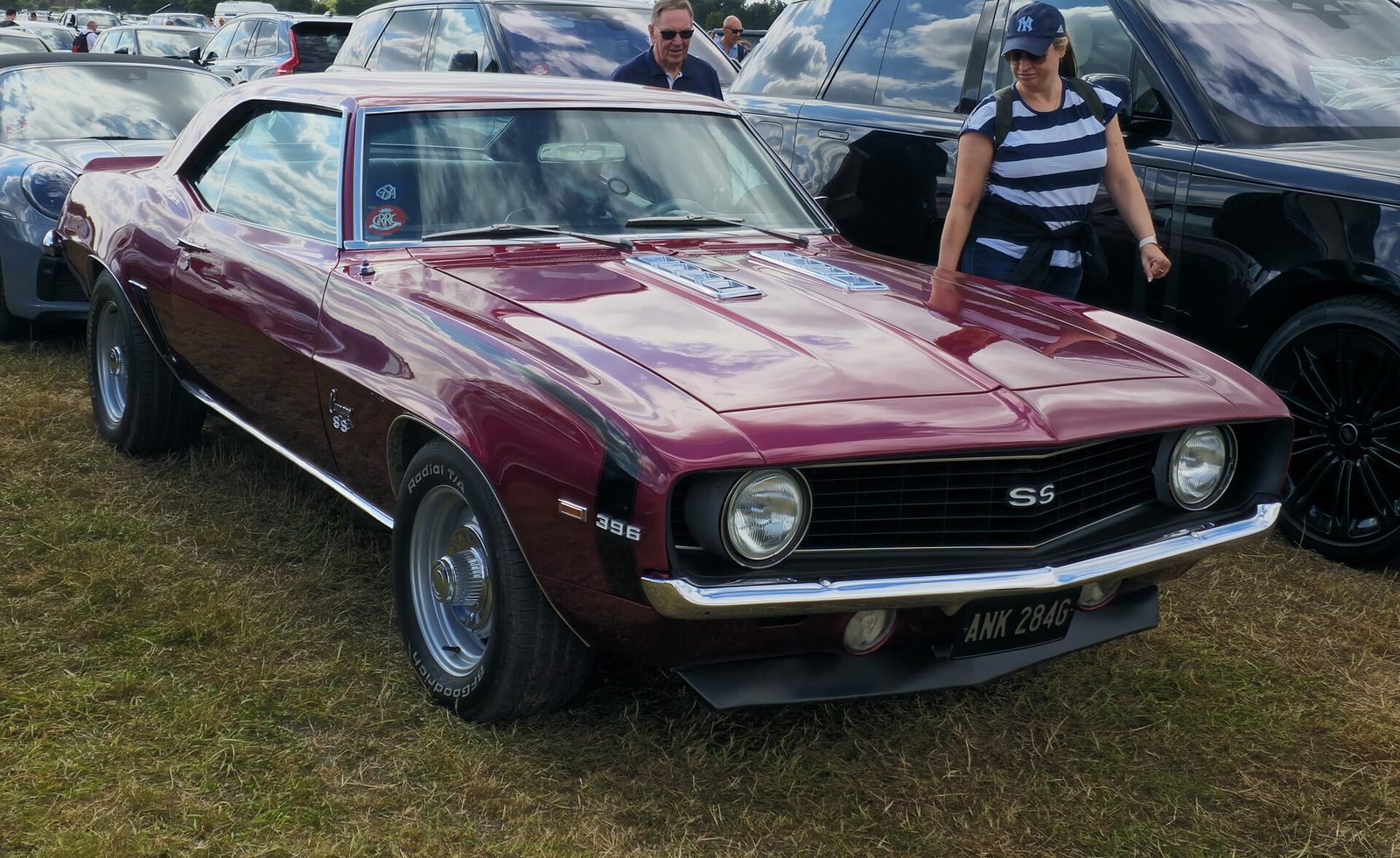
Chevrolet met the Ford Mustang three years late, and with more engine. The Camaro was shown to the press in Detroit on 12 September 1966 and reached dealers on 29 September as a 1967 model, on the new rear-drive F-body it shared with the Pontiac Firebird: a unitized body carrying a bolt-on front subframe for the engine and front suspension, offered as a sport coupe or a convertible. Chevrolet's general manager Pete Estes gave reporters the description that has followed the car ever since, a small vicious animal that eats Mustangs. Across three model years the catalog ran from a 140 hp 230 cu in six to a 430 hp all-aluminum 427, taking in the Rally Sport appearance package with its hidden headlights, the Super Sport with 350 and 396 engines, and the Z/28, a 302 cu in car built in the numbers the Trans-Am rulebook demanded. The 1969 cars were restyled and their model year ran on into November 1969 because the second-generation car was late. Behind all of it sat the COPO order system, through which a handful of dealers obtained 427s that Chevrolet did not officially sell.
Camaro
First generation
History
The Answer to the Mustang
Ford had put the Mustang on sale in April 1964 and Chevrolet had nothing to answer it with. Its reply was drawn internally as the F-car styling project under chief designer Henry Haga, with Charles Jordan and Irvin Rybicki contributing under Dave Holls and the interior by Suzanne Vanderbilt and Cathy Kascur. The press saw it in Detroit on 12 September 1966 and it went on sale on 29 September at $2,572 for the sport coupe and $2,809 for the convertible. Pete Estes, then running Chevrolet, supplied the quotable version of the brief: a small vicious animal that eats Mustangs. Chevrolet's own retrospective account is more measured, recording fifteen colors and eight engines.
Three Model Years, Three Different Cars
Structurally the Camaro was a semi-unibody, a unitized passenger cell with a bolt-on front subframe that carried the engine and front suspension and ended under the doors. For 1968 the vent windows went, replaced by Astro Ventilation, side marker lights were added to meet federal rules, and the tail lights, grille and console were restyled. For 1969 the body was reworked at the nose, fenders, quarters and tailpan, with triple-lens tail lights and the ignition moved to the steering column. That model year then ran long, into November 1969, because the second-generation car was not ready - one reason 1969 is the largest and the most collected of the three.
Z/28: Homologation Written Into the Order Book
RPO Z28 arrived in December 1966, first deliveries in January 1967, and is generally credited to Vince Piggins of Chevrolet's product promotion office. The SCCA's Trans-Am sedan class capped displacement at five liters, so Chevrolet assembled one: a 327 block with a 283 crankshaft, 302 cu in, 11.0:1, a single Holley four-barrel and a rating of 290 hp at 5,800 rpm that almost nobody has taken at face value. The package was coupe only, four-speed only, without air conditioning and with power front discs mandatory. A cross-ram twin four-barrel manifold was sold over the dealer parts counter but never installed on the line, and for 1969 came the cowl-induction hood and, briefly, RPO JL8 four-wheel discs.
COPO: A Racing Engine Sold Through the Order Desk
A corporate rule kept engines above 400 cu in out of Chevrolet's intermediate cars, so the 427s reached the Camaro through the Central Office Production Order system, meant for fleet and special equipment. COPO 9561 bought the iron-block L72 at 425 hp for $489.75, cheaper than an SS 396/375. COPO 9560 bought the all-aluminum ZL1: the engine option alone was $4,160.50 and cars stickered above $7,300. Fred Gibb Chevrolet of La Harpe, Illinois ordered fifty on the understanding the cost would be far lower, could not shift them, and sent some back to be redistributed; sixty-nine were built in all. Don Yenko, swapping 427s into Camaros himself since 1967, ordered his 1969 cars this way instead.
Trans-Am, and the Title That Was Kept
Penske Racing and Mark Donohue took the over-two-liter manufacturers' championship for Chevrolet in 1968 and again in 1969, but the second season is remembered for what followed: Donohue's Camaro was found to be under the class minimum weight, the wins were to be stripped and awarded to Ford, and General Motors is recorded as having threatened to pull its money out of the series. The result stood, and the title is still credited to Chevrolet.
Common Problems
Corrosion is the defining problem and it is structural rather than cosmetic. The subframe-to-body mounting points, rocker panels, rear fenders, floor pans, trunk pan and rear shock tower mounts are the recognized sites, and heavy filler is common in place of proper repair. The semi-unibody was never especially stiff; period testers noted body roll and a rear end that moved around when pressed, and a shell cut about for a larger engine, or repaired without attention to the firewall and subframe mounts, will flex. Fifty-year-old wiring is a recurring source of trouble, and a new harness is generally cheaper than chasing faults through the old one. The RS vacuum headlight doors were awkward when new, particularly in ice, and Chevrolet added slots to them for 1969 as a workaround. The engines are the least of it - conventional Chevrolet small- and big-blocks wanting little more than routine ignition and fuel service - though the solid-lifter units, the Z/28 302, the L78 396 and the COPO 427s, need periodic valve adjustment and were never offered with air conditioning. JL8 disc components are scarce, and reproduction panel quality is inconsistent enough that what a restoration is worth depends heavily on which parts went into it.
What to Look For
Identity comes first, because the Camaro is among the most copied cars in the American hobby and the parts to build a convincing fake are all reproduced. The cowl tag and VIN together establish plant, build week and body, but neither encodes the engine, so a Z/28 claim rests on the DZ block casting and stamping, on a twelve-bolt axle, and ideally on paperwork. For COPO cars the standard of proof is higher: the ZL1 consigned to Mecum's Indianapolis sale in May 2026 came with copies of the chassis and body broadcast sheets and the shipping and sales invoices, and that is now what the market expects rather than what it hopes for. Any ZL1 claim is checked against the VIN list Vince Piggins kept at Chevrolet, published in Super Chevy in August 1981. Structurally, look at the points where the front subframe bolts to the unitized rear structure, at the rocker panels, rear fenders, floor pans, trunk pan and the mounts for the rear shock absorbers. It is common to find both rear quarters, the floors and the trunk metal replaced; the question is how well. On an RS, work the vacuum headlight doors through several cycles from cold.
Market Notes
As of August 2026 classic.com puts the average price of a first-generation Camaro at $80,870 across 419 cars listed, with the lowest recorded sale at $11,000 for a 1969 pro-street car on 9 April 2026 - a spread reflecting a market containing everything from six-cylinder coupes to aluminum-block COPOs. The site publishes separate benchmarks by variant, all trending upward: the Z/28 benchmark is $103,174 against an average sale of $109,633, with a high of $330,000 for a 1969 RS Z/28 on 23 January 2026; the COPO benchmark is $186,834 against an average of $176,193, with a high of $440,000 at Barrett-Jackson on 24 January 2026; the ZL-1 benchmark is $894,749 against an average of $710,900, ranging from $159,500 in July 2022 to $1,430,000 at Mecum Indianapolis on 16 May 2026. Lot evidence fills in the shape: RM Sotheby's sold ZL1 number 53 of 69 for $404,250 at Fort Lauderdale in 2016, and a Z11 pace car replica made $53,350 from the John Staluppi Collection in 2012, both as published totals rather than hammer prices. The gap between a documented COPO and a well-presented Z/28 is now roughly an order of magnitude.
Where sources differ
Published model-year production totals for the first-generation Camaro do not agree, and no generation total is asserted here.
The Camaro Research Group and Classic Industries both give 220,906 for 1967, 235,147 for 1968 and 243,085 for 1969. Wikipedia's first-generation article gives 121,051, 159,087 and 150,078 for the same years, and Classic Industries states its own figures are not exact. The gap is not resolved by any source consulted here, so productionTotal is left null.
The transmission split within the 69 ZL1 Camaros is stated differently by different sources and is not settled here.
RM Sotheby's catalog states 47 four-speed manuals and 22 automatics. GM Authority states that only twelve of the 69 were ordered with the heavy-duty four-speed, which may refer to the M22 alone rather than to four-speeds generally. The two accounts are not resolved against one another by any source consulted here, so no split is asserted.
No production record for COPO 9561, the iron-block L72 427 Camaro, has ever surfaced, and the commonly quoted totals are derived by arithmetic rather than recorded.
The Camaro Research Group derives approximately 997 cars by subtracting the 69 ZL1s from a recorded L78 total of 4,889, and separately notes engine records of 822 MN and 193 MO units totalling 1,015, some of them service and warranty stock. Its model page calls 997 'believed'; Wikipedia states 'around 1,000'. Because COPO 9561 production records have not surfaced the figure is not resolved, and no count is asserted.
The number of 1969 Yenko Camaros ordered through COPO 9561 is given as either 198 or 201 depending on the source.
The Camaro Research Group states that Don Yenko sold 198 cars directly and gives 198 as its 1969 estimate. Wikipedia's Yenko Camaro article gives 201, split as 171 four-speed and 30 automatic, and Wikipedia's first-generation Camaro article says Yenko ordered 201. The three-car difference is not resolved by any source consulted here.
Sources
- General Info - Camaro FAQ, Camaro Research Group · registry
- Camaro - 67-69 Camaro Model Information, Camaro Research Group · registry
- The First-Generation Camaro Z28 - CRG Research Report, Camaro Research Group · registry
- CRG Research Report - COPO 427, Camaro Research Group · registry
- CRG Research Report - 69 Pace Cars and Z10's, Camaro Research Group · registry
- 1967-69 Chevrolet Camaro Regular Production Options (RPOs), Camaro Research Group · registry
- Chevy's Legacy: Camaro, Chevrolet (General Motors) · manufacturer
- Chevrolet Camaro (first generation), Wikipedia · encyclopedia
- Yenko Camaro, Wikipedia · encyclopedia
- 1969 Trans-American Sedan Championship, Wikipedia · encyclopedia
- 1967-2002 Camaro Production Numbers: First-Gen to Fourth-Gen, Classic Industries · specialist
- Chevrolet Camaro - 1st Gen Market, classic.com · market-data
- Chevrolet Camaro Z/28 - 1st Gen Market, classic.com · market-data
- Chevrolet Camaro - 1st Gen - ZL-1 Market, classic.com · market-data
- Chevrolet COPO Camaro - 1st Gen Market, classic.com · market-data
- 1969 Chevrolet Camaro ZL1, Fort Lauderdale 2016, RM Sotheby's · auction-house
- 1969 Chevrolet Camaro Indy Pace Car Replica, The John Staluppi Collection, RM Sotheby's · auction-house
- Ultra Rare 1969 Chevy Camaro ZL1 Bound For Indy Auction, GM Authority · journalism
- 1967-'69 Chevrolet Camaro: Buy one now?, Classic Motorsports · journalism
- 1969 Chevrolet Camaro Z28 - The Other Pony Car, Heacock Classic · specialist
- Remembering the First Generation 1967 Chevrolet Camaro, MotorCities National Heritage Area · specialist
- September 12, 1966 - The press meets the Chevrolet Camaro, This Day In Automotive History · journalism
- 1969 Chevrolet Camaro Fact Sheet, Over-Drive Magazine · specialist
- 1969 Z/28 Specifications, Z28.net · specialist
Synthesized from the sources above and cross-checked. We cite and link out; we do not republish other databases verbatim.
Fully Sorted is an independent publisher and is not affiliated with, endorsed by or sponsored by Chevrolet. Chevrolet and the model names on this page are trademarks of their respective owners and are used here only to identify the cars being described.
Chassis register
Nobody has recorded a car here yet. Own one, or know one? Chassis number, what you can prove about it, and a source if there is one. Every entry is reviewed before it appears.
Nerd Notes
What owners know that the sources don't. Every note is read and checked before it appears here.
Key Specs
- Power
- Manufacturer SAE gross ratings from 140 hp (230 six) to 430 hp (ZL1 427). Z/28 302 rated 290 hp at 5,800 rpm; SS 396 L78 375 hp; COPO L72 425 hp at 5,600 rpm
- Brakes
- Drums standard; power front discs optional and mandatory on the Z/28. RPO JL8 four-wheel discs offered in 1969 only, 206 cars, at $500.30
- Engine
- 230 and 250 cu in inline-sixes; 302, 307, 327, 350 and 396 cu in V8s, plus the special-order 427 - eight engines cataloged for 1967, ten for 1968 and twelve for 1969
- Layout
- Front longitudinal engine, rear-wheel drive
- Torque
- Z/28 302: 290 lb-ft at 4,200 rpm. SS 396 L78: 415 lb-ft at 3,600 rpm. COPO L72: 460 lb-ft at 4,000 rpm. All manufacturer claims
- Weight
- Approximately 3,135 lb shipping weight for a 1969 Z/28 coupe; no curb figure is given by the sources consulted
- Chassis
- Semi-unibody: unitized passenger cell with a bolt-on front subframe carrying engine, gearbox and front suspension, ending under the doors
- Induction
- Single Holley four-barrel on the Z/28; a cross-ram twin four-barrel manifold was sold over the parts counter and never fitted on the assembly line
- Rear axle
- Ten-bolt standard; twelve-bolt on Z/28, Super Sport and COPO cars, with 4.10:1 Positraction on the COPO 427s
- Wheelbase
- 108.0 in (2,743 mm); 186.0 in long and 74.0 in wide for 1969
- Bore stroke
- Z/28 302: 4.00 in x 3.00 in, quoted as 4.002 x 3.005 in by the Camaro Research Group
- Acceleration
- Period magazine tests of the 1969 Z/28 recorded 0-60 mph in 7.1-7.4 s and quarter-miles of 14.34-15.12 s
- Transmission
- Three-speed manual standard; Muncie M20, M21 and heavy-duty M22 four-speeds; Powerglide, Torque-Drive and Turbo Hydra-Matic automatics. Z/28 four-speed only
Notable Variants
RS (Rally Sport, RPO Z22)
An appearance package rather than a performance one, orderable alongside anything else: hidden headlights behind a full-width grille, revised tail lights, extra trim. Listed at $100 for 1967-68 and $125 for 1969, when 37,773 were fitted. The vacuum headlight doors are its standing weakness.
SS (Super Sport)
The 350 cu in L48 was a Camaro exclusive in 1967 at 295 hp; the 396 big-blocks ran L35, L34 and L78, with L89 aluminum heads for 1968-69. The L78 with those heads is the rarest ordinary route to a big-block, at 272 cars in 1968 and 311 in 1969.
Z/28
Built to put the Camaro into SCCA Trans-Am. Coupe only, four-speed only, no air conditioning, power front discs mandatory. 602 cars in 1967 against 20,302 in 1969, so a 1967 is a different proposition in rarity and in carrying no badging beyond the stripes.
COPO 9561 (L72 427)
Iron-block 427 at 425 hp, ordered through Chevrolet's Central Office Production Order system to sidestep the corporate limit on engine size. At $489.75 it undercut an SS 396/375. No factory production record has ever surfaced.
COPO 9560 (ZL1 427)
All-aluminum 427 at a rated 430 hp, 12.5:1 compression and a 103-octane appetite. The engine option alone was $4,160.50 and stickers passed $7,300, which is why Fred Gibb Chevrolet could not sell the fifty it ordered.
Yenko sYc 427
Don Yenko swapped L72 427s into SS Camaros in 1967 and 1968 before ordering them factory-built through COPO 9561 for 1969, adding stripes, badging and sYc headrest embroidery. The 1969 count is given as either 198 or 201.
Z11 Indy Pace Car replica (1969)
Dover White convertible with Hugger Orange stripes, orange houndstooth trim and a ducted hood, the striping package listed at $35 on top of the convertible and RS/SS content. 3,675 built across Norwood and Los Angeles.
Value Trajectory
First-generation Camaro values have followed the broader American muscle market: a long climb through the 2000s, a correction after 2008, and a renewed rise since the middle of the last decade that has been sharply uneven between specifications. As of August 2026 classic.com shows all of the benchmarks it publishes for the generation trending upward, but at very different levels - an average first-generation car at $80,870, a Z/28 benchmark at $103,174, a COPO at $186,834 and a ZL-1 at $894,749 - and the ZL-1 figure has been pulled hard by a $1,430,000 sale at Mecum Indianapolis in May 2026 against a $159,500 result as recently as July 2022. The effect is stratification rather than a general lift: documented, correctly optioned cars are separating from the rest faster than the rest are moving at all, while ordinary six-cylinder and small-block coupes remain worth roughly what a good restoration costs, which caps them. Because the factory kept no record of option combinations, and no production record for COPO 9561 has been found, provenance paperwork rather than the car itself increasingly sets the price at the top.
Market Snapshot
5 recorded sales, too few for a median worth standing behind, so here is the range instead.
Range $46,000 – $72,000
Next
Shopping for one?
Browse Chevrolet listings, or decode a VIN before you buy.