
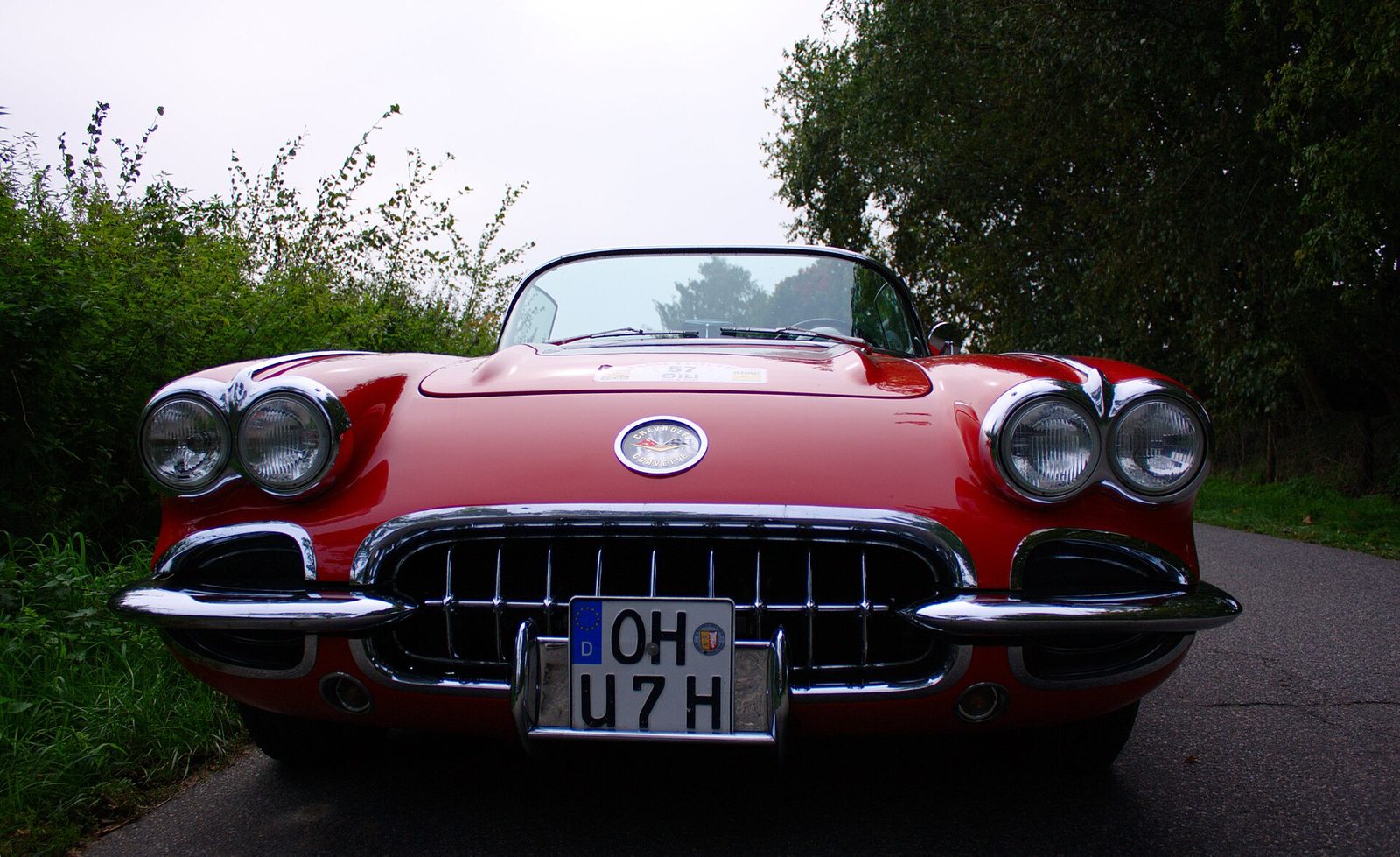
The Chevrolet Corvette C1 (1953-1962) began as a Motorama show car and spent its first two seasons close to cancellation. The 300 cars built largely by hand at Flint in 1953 were all Polo White over red, carried a 235.5 cu in Blue Flame six breathing through three sidedraught Carters and drove through a two-speed Powerglide; there was no manual gearbox and no wind-up glass. The 265 cu in V8 arrived for 1955 and rescued the program, the 1956 restyle brought real doors and glass, and Rochester Ramjet fuel injection followed in 1957, taking the 283 cu in V8 to one horsepower per cubic inch. From there the car earned its billing: heavy-duty brake and suspension packages drawn from Sebring, a class win at Le Mans in 1960 with Briggs Cunningham's privately entered cars, and a 360 hp injected 327 in the ducktailed 1962 run-out model. Ten model years produced 69,015 cars, the last of them on the solid rear axle that the Sting Ray would replace.
History
Motorama to Flint
The Corvette was a Harley Earl show car before it was a product. General Motors exhibited it at the Motorama at the Waldorf-Astoria in New York in January 1953, and GM's own heritage record dates the first production car to 30 June 1953, built largely by hand at a pilot facility in Flint, Michigan. Three hundred were made, serialled E53F001001 to E53F001300, every one Polo White over a red interior with a black canvas top, at a base price GM states as $3,498. The reinforced plastic body was adopted as an expedient to get a show car built quickly and then kept for production, which is the root of both the car's identity and its restoration problems.
Two Years of Near-Failure
The 1953 car was slow by the standards of the imports it was aimed at, had side curtains rather than glass, and leaked. Production moved to St. Louis for 1954 and 3,640 cars were built, of which around 1,500 were still unsold at dealers at the end of the year. The National Corvette Museum credits Don MacDonald's December 1953 Motor Trend road test, which set the car against MG, Jaguar and Triumph and found it equal or better, with shifting showroom perception at the moment Chevrolet most needed it.
The V8 That Saved It
For 1955 the 265 cu in V8 went in, rated 195 hp at 5,000 rpm and 260 lb-ft, identified by an enlarged gold V in the fender script and accompanied by a 12-volt system where the surviving sixes kept 6-volt. Only 700 cars were built, and a three-speed manual arrived late in the year on roughly 75 of them. The 1956 restyle gave the car wind-up windows, the scalloped bodyside coves, a power soft top and an optional bolt-on hardtop, and dropped the six altogether; outputs ran 210, 225 and 240 hp, the last on the RPO 449 high-lift camshaft. In January 1956 a modified car recorded a two-way 150.583 mph at Daytona Speed Weeks.
One Horsepower Per Cubic Inch
The 283 cu in V8 followed for 1957 and with it Rochester's Ramjet continuous-flow mechanical injection, developed by a GM engineering team rather than by Rochester itself. In solid-lifter form it was rated 283 hp at 6,200 rpm on 10.5:1 compression. A Borg-Warner four-speed became available on 9 April 1957 at $188.30. RPO 684, at $780.10, packaged the 1956 Sebring program's finned and scooped drums, cera-metallic linings, Positraction, stiffer springs and a 16.3:1 steering adapter; a further 43 cars added the hand-laid fiberglass cold-air plenum known as the airbox, which cost them the heater and the radio. Period Road & Track testing of a 283 hp four-speed recorded 0-60 mph in 5.7 seconds and the standing quarter in 14.3. The injection was capable but unforgiving, and a great many units were removed by mechanics who did not understand them.
Chrome, Le Mans and the Ducktail
1958 added quad headlamps, simulated hood louvres and chrome boot spears, 9.2 inches of length and enough mass to pass 3,000 lb; it was also the first Corvette model year to make money for GM. 1959 deleted the louvres and spears and added trailing radius rods. 1960 broke 10,000 cars, and in June of that year Briggs Cunningham entered three Corvettes at Le Mans without factory backing, GM's racing ban having also removed Duntov from the driver list; the number 3 car of John Fitch and Bob Grossman finished eighth overall and won the 4,000-5,000 cc class. For 1961 the tail was reworked into the boat-tail taken from Bill Mitchell's XP-700 and the Stingray racer, with four round lamps. 1962 brought the 327, deleted the cove chrome, and closed the solid-axle era.
Common Problems
The recurring faults are corrosion and past repair rather than mechanical fragility. Frame rot at the rear kick-up, corrosion of the steel body-mounting structure, and delamination or replacement of the fiberglass bonding strips are the three that cost real money, and all three stay hidden until the car is on a hoist. Fiberglass ages: stress cracking around screen posts, arch lips and panel cut-outs is normal in moderation and a sign of exposure or accident repair when extensive. Early cars leak, and the bodies have not improved with age. Mechanically, the Rochester Ramjet injection is the defining liability. It was described in period as finicky, suffered drive-cable problems and had no fuel shut-off solenoid, so hydraulic lock was a known risk, and many units were removed and replaced with carburetors by mechanics who could not set them up. Most of those weaknesses were reduced over the system's nine-year run, so a late unit on an early car is a question worth asking. Four-wheel drums are the other constant: adequate for the traffic of 1955, marginal behind 283 or 360 hp, and the reason the finned, scooped and cera-metallic RPO 684 and 687 packages existed. Aluminum cylinder heads trialled for 1960 warped when overheated and never reached retail.
What to Look For
Get the car on a lift. The steel frame rusts, and specialists single out the section where it kicks up over the rear axle; the light steel inner structure the body panels bond to rots in parallel and takes the bonding with it. On the body, the fiberglass bonding strips are the tell. Mismatched, missing or unusually smooth strips, and interior panel surfaces tidier than the factory ever made them, indicate that panels have been off. Stress cracks gather around windshield posts, panel cut-outs and wheel arch lips. Uneven gaps are not conclusive on their own, because 1950s Corvette panel fit was variable when new, but they justify a closer look. Establish the driveline before the paint. Not every C1 is a four-speed car: the three-speed manual and the two-speed Powerglide were both common, and the four-speed only appeared in April 1957 on 664 cars that season. Matching engine and chassis numbers are widely reported to move value by twenty to thirty per cent, and many early cars lost theirs during 1970s restorations. On a car sold as fuel-injected, confirm the Rochester unit is the correct RPO for the year and that it works; complete systems are quoted from $5,000 upward. Documentation carries the weight it does on any car with reproduction bodywork available: a 1953 replica sold for $24,200 in January 2026 against six-figure results for genuine cars. NCRS Top Flight requires 94 per cent of 4,500 points and the Duntov Mark of Excellence 97 per cent plus a running performance test, so those awards say something specific.
Market Notes
As of August 2026 classic.com records an average sale of $114,984 across the C1 generation, with 158 cars listed, a lowest tracked result of $11,000 for a 1961 in April 2023 and a highest of $294,675 for a customized 1958 convertible with hardtop in August 2026. The spread within a single year is wider than the spread between years, and specification does almost all of the work. A 1957 Big Brake Fuelie with the airbox, VIN E57S105065, was recorded at $715,000 at Mecum Kissimmee on 18 January 2025; an ordinary 1957 with the 250 hp injected engine and a four-speed made $75,900 in RM Sotheby's Ron and Sarah Jury Grand National Collection sale, held online from Blenheim, Ontario between 30 October and 6 November 2024. On the 1962 injected cars, RM Sotheby's sold one for $112,000 in the Dare to Dream Collection at Toronto on 31 May to 1 June 2024, while Gooding & Company achieved $285,500 at Pebble Beach in August 2019 for a Bloomington Gold certified, NCRS Top Flight and Duntov Award big-brake tanker. For the 1953 cars, RM Sotheby's sold chassis E53F001245 for $184,800 at Monterey in August 2018, and classic.com records Mecum results of $302,500 in January 2026 and $368,500 in March 2026 against $24,200 in January 2026 for a replica. Premium arrangements differ between houses; these are the published results as each house or classic.com records them.
Where sources differ
Estimates of how many 1953 Corvettes survive do not agree: CorvSport puts the figure at fewer than two hundred while Wikipedia states that over two hundred are known to exist.
CorvSport estimates that fewer than two hundred 1953 Corvettes still exist; Wikipedia states that over two hundred are known to exist today. The two straddle the same round number in opposite directions and the difference is not resolved by any source consulted here.
Published weights for the 1953 car differ substantially: General Motors' own heritage record gives 2,705 lb while Wikipedia's specification table gives 2,886 lb.
GM's heritage page states 2,705 lb; Wikipedia's C1 table gives 2,886 lb for 1953-1954. Neither says whether the figure is dry, curb or shipping weight, and the difference is not resolved by any source consulted here.
Only 700 Corvettes were built for 1955, and the number fitted with the six-cylinder engine rather than the new 265 cu in V8 is not settled: VetteFacts states seven sixes against 693 V8s, while CorvSport reports that published sources give six or seven.
VetteFacts tabulates 7 six-cylinder cars and 693 V8s for 1955. CorvSport says all but six, or seven, took the V8 and notes explicitly that sources vary, and separately distinguishes 700 built from 674 sold. The six-cylinder count is not resolved by any source consulted here.
Published counts of 1957 fuel-injected Corvettes disagree. VetteFacts, Sports Car Market and Wikipedia all give 1,040 out of 6,339; Vette Vues' RPO table sums to 938 because it omits the RPO 579C row; CorvSport states 240.
VetteFacts breaks 1957 fuel injection into RPO 579A 182, 579B 713, 579C 102 and 579E 43 for 1,040, matching Sports Car Market and Wikipedia. Vette Vues prints the same table without the 579C row and sums to 938. CorvSport states 240. The 240 figure is not resolved against the RPO tabulations by any source consulted here.
Published fuel-injection ratings for the 1960 model year do not agree: VetteFacts tabulates RPO 579 at 250 hp and RPO 579D at 290 hp, while CorvSport lists the 1960 injected engines as 275 and 315 hp.
VetteFacts gives 1960 injected outputs of 250 hp (100 cars) and 290 hp (759 cars). CorvSport lists 275 hp and 315 hp for the same year, which are the ratings Wikipedia and VetteFacts both assign to 1961. The discrepancy is not resolved by any source consulted here, so both are reported.
Sources
- Chevrolet Corvette (C1), Wikipedia · encyclopedia
- 1953 Chevy Corvette | GM Heritage, General Motors · manufacturer
- 1953 Chevrolet Corvette Guide: History, Performance, & More, CorvSport · specialist
- 1954 C1 Corvette Guide, CorvSport · specialist
- 1955 C1 Corvette Guide: Specs, VIN Info, Paint, Recalls & More, CorvSport · specialist
- 1956 C1 Corvette Guide, CorvSport · specialist
- 1958 C1 Corvette Guide, CorvSport · specialist
- 1959 C1 Corvette Guide, CorvSport · specialist
- 1960 C1 Corvette Guide, CorvSport · specialist
- 1961 C1 Corvette Guide, CorvSport · specialist
- The 1953-1962 C1 Corvette Buyers Guide, CorvSport · specialist
- The 1955 Chevrolet Corvette, VetteFacts · specialist
- The 1957 Chevrolet Corvette, VetteFacts · specialist
- The 1960 Chevrolet Corvette, VetteFacts · specialist
- The 1962 Chevrolet Corvette, VetteFacts · specialist
- 1957 Corvette Specifications & Options: Fuel Injection, 4-Speed, RPOs, Colors, Pricing, Vette Vues · specialist
- Automotive History: 1957 Chevrolet Fuel-Injected 283 V8 - Ahead Of Its Time And The Competition, Curbside Classic · journalism
- '57 Fuelie: Instant Racer, Just Add High Test (1957 Corvette RPO 684 / RPO 579E), Remember Road · specialist
- NCRS Judging Awards, National Corvette Restorers Society · registry
- Corvette buyer beware, Hagerty Media · journalism
- Corvette Online's C1 Buyers Guide, LSX Magazine · journalism
- Today's Photo Story - Corvette's first class win at Le Mans in 1960, Automobile Club de l'Ouest · journalism
- 1957 283/283 Fuel-Injected Convertible, Sports Car Market · journalism
- Chevrolet Corvette - C1 Market, classic.com · market-data
- 1957 Chevrolet Corvette Big Brake Fuelie W/ Airbox Convertible sold at Mecum Kissimmee (2025), classic.com · market-data
- 1953 Chevrolet Corvette, Monterey 2018, RM Sotheby's · auction-house
- 1957 Chevrolet Corvette 'Fuel-Injected', The Ron and Sarah Jury Grand National Collection, RM Sotheby's · auction-house
- 1962 Chevrolet Corvette 'Fuel-Injected', Dare to Dream Collection, RM Sotheby's · auction-house
- 1962 Chevrolet Corvette 327/360 Fuel-Injected Roadster, Pebble Beach 2019, Gooding & Company · auction-house
- 1953 Chevrolet Corvette - C1 Market, classic.com · market-data
- 1953 Corvette Production Numbers, CorvSport · specialist
Synthesized from the sources above and cross-checked. We cite and link out; we do not republish other databases verbatim.
Fully Sorted is an independent publisher and is not affiliated with, endorsed by or sponsored by Chevrolet. Chevrolet and the model names on this page are trademarks of their respective owners and are used here only to identify the cars being described.
Chassis register
Nobody has recorded a car here yet. Own one, or know one? Chassis number, what you can prove about it, and a source if there is one. Every entry is reviewed before it appears.
Nerd Notes
What owners know that the sources don't. Every note is read and checked before it appears here.
Key Specs
- Power
- 150 hp at 4,200 rpm (1953-1955 six); 195 hp (1955 V8); 210-240 hp (1956); 220-283 hp (1957); 230-290 hp (1958-1960); 230-315 hp (1961); 250-360 hp (1962). All are gross SAE ratings of the period, not comparable with modern net figures
- Brakes
- Four-wheel hydraulic drums throughout the run; RPO 684 (1957-1959) and RPO 687 (1960-1962) added finned drums with air scoops and cera-metallic linings
- Engine
- Blue Flame 235.5 cu in inline six 1953-1955; 265 cu in V8 1955-1956; 283 cu in V8 1957-1961; 327 cu in V8 1962
- Layout
- Front-mounted longitudinal engine, rear-wheel drive
- Torque
- 260 lb-ft at 3,000 rpm (1955 265 V8); 270 lb-ft (1956 base 265); 290 lb-ft at 4,400 rpm (1957 fuel-injected 283)
- Weight
- 2,705 lb per GM's own 1953 record against 2,886 lb in the Wikipedia specification table; 2,805 lb (1955), 2,849 lb (1957), 2,926 lb (1958), 3,065 lb (1962)
- Chassis
- Steel box-section perimeter frame with an X-brace, carrying a glass-reinforced plastic (fiberglass) body on a steel cowl and inner structure
- Assembly
- Flint, Michigan (1953 and the first cars of 1954); St. Louis, Missouri thereafter
- Steering
- Recirculating ball, 21.0:1 standard; a 16.3:1 quick-ratio adapter formed part of the heavy-duty package
- Wheelbase
- 102 in (2,591 mm) throughout; overall length 167.3 in (1953-1955) rising to 177.2 in (1958-1962)
- Suspension
- Independent front by unequal-length wishbones and coil springs; live rear axle on longitudinal semi-elliptic leaf springs, with trailing radius rods added for 1959
- Engine 1957
- 283 cu in V8 with Rochester Ramjet continuous-flow mechanical injection, 10.5:1 compression on the solid-lifter version
- Engine 1962
- 327 cu in V8, hydraulic lifters on the 250 and 300 hp ratings, solid lifters on the 340 and 360 hp ratings
- Fuel system
- Carter sidedraughts (six); single and twin four-barrel carburetors; Rochester Ramjet mechanical fuel injection from 1957, priced at $484.20 in its standard form
- Acceleration
- 0-60 mph in 11.2 s and the standing quarter in 17.9 s at 77 mph for the 1953 six per CorvSport; 0-60 in 5.7 s and 14.3 s for the quarter in the period Road & Track test of a 1957 283/283 four-speed
- Transmission
- 2-speed Powerglide automatic only (1953-1954); 3-speed manual from late 1955; Borg-Warner T-10 4-speed manual from 9 April 1957, in close- and wide-ratio forms
- Engine 1953 1955
- 235.5 cu in overhead-valve six, three Carter YH sidedraught carburetors, solid lifters, 8.0:1 compression
Notable Variants
1953 (hand-built, 300 cars)
Serials E53F001001 to E53F001300, assembled largely by hand at Flint from 30 June 1953. Every car Polo White over Sportsman Red, Blue Flame six and Powerglide only. Panel fit and press-molded front-end parts vary car to car, which is why build dates and serials carry weight.
1955 V8 (gold V, 12-volt)
The 265 cu in V8 arrived on an enlarged gold 'V' in the fender script with a 12-volt system where sixes kept 6-volt. Roughly seven sixes were built out of 700. A three-speed manual appeared late on about 75 cars and is the scarcest driveline in the generation.
1957 RPO 579B - 283/283 'Fuelie'
Rochester Ramjet injection rated 283 hp at 6,200 rpm on 10.5:1 compression, one horsepower per cubic inch. 713 cars took this RPO at $484.20. The benchmark carburetor-versus-injection distinction for the whole generation.
1957 RPO 579E / RPO 684 'Airbox Big Brake'
43 cars are believed to have combined the hand-laid fiberglass cold-air plenum with the $780.10 racing package: finned scooped drums, cera-metallic linings, Positraction, a 16.3:1 steering adapter and stiffer springs. No heater and no radio. The most valuable ordinary-production C1 specification.
1958 (quad headlamps, washboard hood)
Nine inches longer, two wider and over 3,000 lb for the first time, with simulated hood louvres and chrome boot spears used this year only. 1958 was also the first Corvette model year to turn a profit for GM. Collectors treat the extra chrome as either the point or the problem.
1960 Cunningham Le Mans cars
Three Corvettes entered privately by Briggs Cunningham with no factory support, GM's racing ban having also cost Duntov his drive. The number 3 car of Fitch and Grossman finished eighth overall and won the 4,000-5,000 cc class. The aluminum heads that failed retail quality control went to this team.
1961 (ducktail, last dual-quad)
The boat-tail rear from Mitchell's XP-700 and the Stingray racer brought four round tail lamps, a treatment the Corvette has kept since. Last year for contrasting cove paint at $16.15, for the twin four-barrel engines and for the 283. An aluminum crossflow radiator became standard.
1962 327/360 fuel injection and RPO 488
1,918 cars took the 360 hp injected 327 and 65 took the 24-gallon tank. Cove chrome and contrasting cove paint were deleted, giving the cleanest C1 body. The last solid rear axle and the last exposed headlamps until 2005.
Value Trajectory
The C1's value is a story about specification rather than about the generation. The 1953 cars are the fixed point: 300 built and consistent six-figure results. Above them sit the small-volume performance options, and the gap has widened. A 1957 airbox big-brake car recorded $715,000 at Mecum Kissimmee in January 2025 against an average sale of $114,984 across the whole generation on classic.com as of August 2026 - roughly six times the generation average for a $780.10 option box that 43 cars ticked. Ordinary cars have moved far less. A 250 hp 1957 fuelie with a four-speed made $75,900 in an RM Sotheby's collection sale in late 2024, and classic.com's tracked C1 results as of August 2026 still run down to $11,000. The pattern rewards documentation over cosmetics: judged cars with NCRS or Bloomington Gold status and verifiable engine numbers clear the field, while cosmetically restored cars with replaced bodywork and no paperwork sit near the bottom of their year. Customs and restomods now trade in a separate column, the highest classic.com C1 result as of August 2026 being a modified 1958 at $294,675.
Market Snapshot
4 recorded sales, too few for a median worth standing behind, so here is the range instead.
Range $72,000 – $148,000
Next
Shopping for one?
Browse Chevrolet listings, or decode a VIN before you buy.