
The second-generation Corvette (1963-1967) replaced the C1's leaf-sprung live axle with an independent rear end on a shorter 98-inch wheelbase, and added a closed coupe to the range for the first time. Bill Mitchell's Sting Ray body carried a divided rear screen for 1963 only; period reviewers disliked the blind spot it created and it was gone by 1964, which is why that one detail now separates the most valuable ordinary C2 from the rest. Chevrolet built 117,964 cars across five model years, 72,418 of them convertibles. The engine bay moved from Rochester-injected 327 small-blocks to Mark IV big-blocks: 396 cubic inches from mid-1965, 427 from 1966, and from February 1967 the L88, twenty cars with aluminum heads and no heater. Four-wheel disc brakes became standard for 1965 and mechanical fuel injection was dropped at the end of the same year. It is the shortest Corvette generation, and the one where the option sheet rather than the model year decides what a car is worth.
Corvette
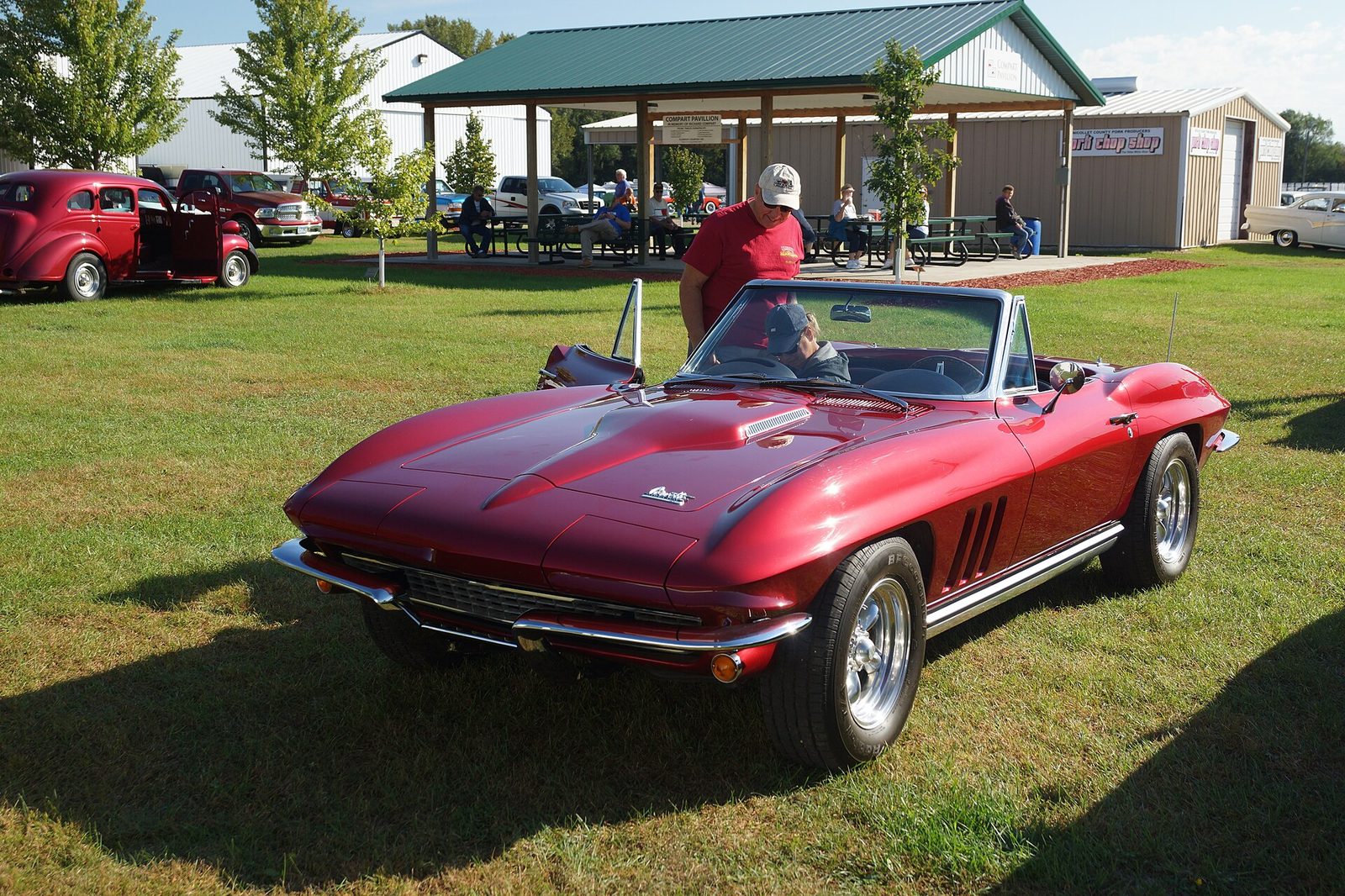
C2 Sting Ray
117,964 built · 2-door Sport Coupe (split rear window 1963 only, one-piece rear glass 1964-1967) · 2-door Convertible (RPO C07 auxiliary hardtop optional)
How rare is it?
With about 117,964 built, the Chevrolet Corvette is rarer than a 240Z (~160k) yet more common than a DeLorean (~9k).
Approximate total production placed on a log scale against well-known reference cars, for scale only. Figures and any disputes are detailed in the production notes and sources.
History
A New Chassis Under a Show Car Body
The C2 was the first complete redesign of the Corvette since 1953, and General Motors' own heritage record frames it that way: a new chassis, an independent rear suspension, and the first coupe body the model line had ever been given. The wheelbase came down to 98.0 inches and the frame gained a welded steel 'birdcage' around the cockpit beneath bonded fiberglass panels. The independent rear end, with trailing arms locating the wheels, was the substantive change, and contemporary judgement was that traction and handling had moved on decisively from the live-axle cars. Bill Mitchell had driven the styling from his own Stingray racer; Zora Arkus-Duntov drove the engineering, and the two men did not agree about the roof.
The Window That Lasted One Year
Mitchell wanted the coupe's rear screen divided by a body-color spine running the length of the deck. Duntov objected that it blocked the view, and much of the press agreed once cars reached the road. Mitchell relented for 1964, and a single piece of glass has been fitted to every Corvette coupe since. Chevrolet went further and sold conversion glass through its dealers, so a proportion of the 10,594 split-window coupes built were quietly modernized by their first or second owners. The market has since reversed that judgement hard enough that unpicking a 1960s conversion is now routine restoration work.
Fuel Injection, Then Cubic Inches
The 1963 range was four versions of the 327 small-block: 250 and 300 hp on hydraulic lifters, a 340 hp solid-lifter L76, and the L84 with Rochester Ramjet mechanical fuel injection at 360 hp for $430.40. Injection was the halo option and 2,610 buyers took it. Then the Mark IV big-block arrived part-way through 1965 - 396 cubic inches, 425 hp, and cheaper than the fuelie at $292.70 against $538.00. L84 sales fell to 1,325 in 1964 and 771 in 1965, and Chevrolet dropped injection at the end of that year; it did not return to a Corvette for twenty. The 427 replaced the 396 for 1966 in mild 390 hp L36 and hard-edged 425 hp L72 form, and for 1967 a 427 with three two-barrel carburetors joined the range.
Racing by Option Code
General Motors had signed up to the AMA's 1957 withdrawal from motorsport, so Duntov sold competition equipment as option codes instead. RPO Z06 for 1963 bundled sintered-metallic Al-Fin brakes, a dual master cylinder, stiffer springs and a larger front bar, available only on a fuel-injected four-speed coupe with Positraction; 199 people bought it and 63 of those added the 36.5-gallon tank. The Grand Sport was the unsanctioned version of the same idea: a lightweight competition Corvette, roughly a thousand pounds under a production Sting Ray, with an intended run of 125 cars for homologation. GM stopped it at five, and those three coupes and two roadsters beat the Cobras at Nassau in December 1963.
The Last Year, and the L88
The C2 ran a fifth season before the C3 arrived, and 1967 gave the generation both its widest engine list and its smallest: 22,940 cars, four 427 codes on the order sheet, and cast aluminum wheels that had been knock-offs in 1966 now sold as bolt-ons. In February 1967 Chevrolet released the L88 - aluminum heads, 12.5:1 compression, a single 850 cfm Holley, a mandatory heavy-duty gearbox, brakes, suspension and ignition, a compulsory heater delete and no radio or air conditioning available at all. It was rated at 430 hp, a number the factory chose rather than measured. Twenty were built, at $947.90 on a $4,240.75 convertible.
Common Problems
Frame and birdcage corrosion is the defining structural fault and the only one that writes a car off economically; the rear kick-ups, the number three body mount area and the base of the windshield pillars are where it is found, and none of it is visible without a lift. Fiberglass stress cracking around the screen surround, arch lips and panel cut-outs is near-universal, and is routinely buried under fresh paint along with poor bonding-strip repairs. The four-wheel disc brakes fitted from 1965 corrode internally in lines and calipers to the point that a stainless replacement industry grew up around them. The Rochester Ramjet unit on L84 cars is the other specialist liability: a mechanical injection system that fell out of general workshop knowledge for decades, so correct rebuilding is small-specialist work. Period testers already complained that the sintered-metallic linings needed warming and would grab if used cold. The most expensive fault is documentary: an undocumented car sold on a claimed rare engine code.
What to Look For
The structure is steel and it is hidden. The birdcage - the welded cage around the screen and door hinges - rots from the inside at the base of the windshield pillars, where nothing above it can rust because the panels are fiberglass. Owners on CorvetteForum name the rear frame kick-ups behind the seats, the gussets by the number three body mount and the transmission crossmember as the areas that fail structurally, and note that corrosion works outward from inside the section, so surface appearance understates it. Insist on a lift, a torch and a wire brush on anything that looks scaled. On the body, a smooth, over-finished inner surface where a fiberglass bonding strip should be is evidence of accident repair. On paperwork: verify the VIN, trim tag and stamped engine pad before believing any claim about an L84, L78, L72, L71 or L88 car, because the price difference between a genuine one and a tribute is a large multiple of the cost of fitting the correct engine. The NCRS Historic Document Service supplies a shipping data report for 1962-1975 cars at $50, giving dealer code, dealer name and address and the production date - but explicitly not the option list.
Market Notes
As of August 2026, classic.com records an average sale price of $131,977 across the whole C2 market with 284 cars listed for sale - a deep, liquid market by classic-car standards. The spread within it is what matters. The base 327/250 carries a market benchmark of $86,035 and the L75 327/300 $89,592, the realistic entry point; the L79 327/350 sits at $85,009 and the 427/425 L72 at $112,351. Above that the injected cars and the rare option codes separate out, with the L84 327/360 at $191,483 and the 1967 L71 427/435 at $169,579. The 1963 Z06 is its own market: a $622,770 benchmark on a rising trend against a $559,478 average, with a recorded high of $1,100,000 at Barrett-Jackson in January 2026 and a low of $235,000 in April 2023. The L88 benchmark is $1,394,859 against an average of $1,855,840, with nothing listed for sale; the most recent L88 datum classic.com records is a $2,700,000 high bid at Mecum Kissimmee on 17 January 2026 that did not meet reserve. Figures quoted here are advertised sale totals inclusive of buyer's premium.
Where sources differ
The 1965 model-year total is given as either 23,562 or 23,564 cars depending on the source, a two-car difference in the convertible column.
Corvette Action Center states 8,186 coupes and 15,376 convertibles for 23,562; Wikipedia and LSX Magazine agree. CorvSport states 15,378 convertibles for 23,564, cites a VIN range ending 123564, and notes two cars built after production closed. Not resolved by any source consulted here.
The 1963 model year produced 21,513 cars, split 10,594 coupes to 10,919 convertibles.
Corvette Action Center, Vette Vues and Wikipedia all give 10,594 coupes and 10,919 convertibles, summing to the agreed 21,513. CorvSport gives 10,396 and 10,918, summing to 21,314 and contradicting the total on its own page. Not resolved by any source consulted here.
Published figures for the engine speed at which the 1963 L84 made its rated 360 hp do not agree, and the manufacturer's own figure is the outlier.
GM's heritage record states '327 cid, ohv V8, 360 hp @ 5,000 rpm'. Corvette Action Center states 360 hp at 6,000 rpm. CorvSport states 360 hp at 6,400 rpm. Not resolved by any source consulted here.
Sources disagree on what RPO Z06 cost a buyer in 1963, and two catalog entries from the same auction house give different figures.
RM Sotheby's Amelia Island 2022 catalog states $1,293.35. RM's own Arizona 2020 catalog, Corvette Action Center's RPO table and CorvSport all state $1,818.45, with the tank separate as RPO N03. Not resolved by any source consulted here.
Published weights for the 1963 Grand Sport differ by roughly 250 lb, and neither source states how the car was weighed.
RM Sotheby's catalog for chassis 30837X100003 states roughly 1,900 lb against about 3,200 lb for a standard 1963 car. The Revs Institute states 2,150 lb. Not resolved by any source consulted here.
Sources
- 1963 Chevrolet Corvette Sting Ray, General Motors · manufacturer
- Chevrolet Corvette (C2), Wikipedia · encyclopedia
- C2 Corvette Production Figures, CorvSport · specialist
- The 1963 Corvette Guide: History, Performance, & More, CorvSport · specialist
- 1965 Chevrolet Corvette: History, Performance, & More, CorvSport · specialist
- 1963 Corvette Production Numbers and Performance Numbers, Corvette Action Center · specialist
- 1963 Corvette Specifications, Corvette Action Center · specialist
- 1964 Corvette Production Numbers and Performance Numbers, Corvette Action Center · specialist
- 1965 Corvette Production Numbers and Performance Numbers, Corvette Action Center · specialist
- 1966 Corvette Production Numbers and Performance Numbers, Corvette Action Center · specialist
- 1967 Corvette Production Numbers and Performance Numbers, Corvette Action Center · specialist
- 1967 - 1969 L88 Corvette Options and Production Numbers, Corvette Action Center · specialist
- 1963 Corvette Sales Brochure: Split-Window Sting Ray Production, Options & Prices, Vette Vues Magazine · journalism
- What Is an L88 Corvette? Specs, Production, Value & History, Vette Vues Magazine · journalism
- Road Test - Chevrolet Corvette Sting Ray, April 1964, Motor Sport · journalism
- Chevrolet Corvette - C2 Market, classic.com · market-data
- Chevrolet Corvette Z06 327/360 - C2 Market, classic.com · market-data
- Chevrolet Corvette L88 (427/430) - C2 Market, classic.com · market-data
- 1963 Chevrolet Corvette Sting Ray Z06 Coupe, Amelia Island 2022, RM Sotheby's · auction-house
- 1963 Chevrolet Corvette Sting Ray Z06 'Big Tank' Coupe, Arizona 2020, RM Sotheby's · auction-house
- 1963 Chevrolet Corvette Grand Sport, The Monterey Auction 2026, RM Sotheby's · auction-house
- 1963 Chevrolet Corvette Grand Sport Coupe, Revs Institute · specialist
- Historic Document Service, National Corvette Restorers Society · registry
- The Corvette Online C2 Buyer's Guide, LSX Magazine · journalism
- C2 Frame rust, CorvetteForum · club-forum
Synthesized from the sources above and cross-checked. We cite and link out; we do not republish other databases verbatim.
Fully Sorted is an independent publisher and is not affiliated with, endorsed by or sponsored by Chevrolet. Chevrolet and the model names on this page are trademarks of their respective owners and are used here only to identify the cars being described.
Chassis register
Nobody has recorded a car here yet. Own one, or know one? Chassis number, what you can prove about it, and a source if there is one. Every entry is reviewed before it appears.
Nerd Notes
What owners know that the sources don't. Every note is read and checked before it appears here.
Key Specs
- Power
- 250 hp at 4,400 rpm base in 1963, rising to a rated 435 hp for the 1967 L71 and a nominal 430 hp at 5,200 rpm for the L88, a rating widely held to be deliberately understated
- Brakes
- 11 in drums all round 1963-1964 with sintered-metallic and Al-Fin options; four-wheel discs standard from 1965, with a $64.50 drum credit taken by 316 cars
- Engine
- 327 cu in small-block V8 throughout; 396 cu in Mark IV from mid-1965; 427 cu in Mark IV from 1966
- Layout
- Front engine, rear-wheel drive
- Torque
- 350 lb-ft at 2,800 rpm base in 1963; 352 lb-ft at 4,000 rpm for the L84 fuel-injected 327
- Weight
- 3,048 lb curb for the 1963 coupe and 3,030 lb for the convertible per Corvette Action Center; GM's heritage record lists 2,859 lb, which reads as a shipping figure
- Chassis
- Ladder frame with a welded steel 'birdcage' cockpit structure under bonded fiberglass panels
- Assembly
- St. Louis, Missouri
- Dimensions
- 98.0 in wheelbase, 175.3 in long, 69.6 in wide, 49.8 in high; track 56.3/57.0 in
- Suspension
- Independent front suspension with coil springs; independent rear located by trailing arms - the first IRS on a Corvette, and the change period testers credited for the traction gain
- Bore stroke
- 4.00 in x 3.25 in (327 cu in)
- Compression
- 10.5:1 base and L75; 11.25:1 for L76 and L84 in 1963; 12.5:1 for the 1967 L88
- Fuel system
- Four-barrel carburetor; Rochester Ramjet mechanical injection on L84 cars 1963-1965; a 427 with three two-barrel carburetors new for 1967
- Acceleration
- 0-60 mph in 6.0 sec and 0-100 mph in 14.3 sec for a 360 hp car tested by Motor Sport, April 1964; Road & Track recorded 6.3 sec for a 1965 L84 and 5.7 sec for a 1965 L78 396
- Transmission
- 3-speed manual standard; M20 four-speed optional and taken by most buyers; M22 heavy-duty close-ratio four-speed from 1967; Powerglide automatic optional
- Fuel capacity
- 20.0 US gallons standard; 36.5-gallon RPO N03 fiberglass tank optional on coupes
Notable Variants
1963 Sport Coupe 'split-window'
Fitted for one model year only, on all 10,594 coupes built for 1963. Period reviewers disliked the blind spot and Chevrolet sold one-piece replacement glass through dealers, so an unmolested split screen is a documentation question.
RPO Z06 Special Performance Equipment (1963)
199 built, coupe only, and only with the L84 engine, a four-speed and Positraction. Sintered-metallic Al-Fin drum brakes, dual master cylinder, stiffer springs, larger front bar. 63 of the 199 also took the N03 36.5-gallon tank.
L84 Rochester Ramjet fuel injection (1963-1965)
360 hp in 1963, 375 hp for 1964-1965. Take-up collapsed once the big-block arrived: 2,610 cars, then 1,325, then 771. Chevrolet dropped injection after 1965 and did not fit it again for twenty years.
L71 427/435 with L89 aluminum heads (1967)
The 1967 range-topper short of the L88, at 435 hp and 3,754 cars for $437.10. Only 16 buyers added the L89 aluminum heads at $368.65, which makes a genuine L71/L89 car one of the rarest street combinations of the generation.
L88 427 (1967)
Twenty cars, in production from February 1967. Aluminum heads, 12.5:1 compression, a single 850 cfm Holley; mandatory M22 gearbox, J56 brakes, F41 suspension, K66 ignition and C48 heater delete. Rated 430 hp, which nobody believed.
Grand Sport (1963)
The competition Corvette Duntov could not get built. 125 were planned; GM's racing prohibition stopped the program at five cars, three coupes and two roadsters, roughly a thousand pounds under a production Sting Ray.
Value Trajectory
The C2 became blue-chip long before most of its contemporaries, and the movement since has been about widening gaps rather than a rising tide. As of August 2026 the classic.com benchmarks describe a market stretched across more than an order of magnitude: base-engine cars in the mid-to-high $80,000s, the L72 427/425 at $112,351, the fuel-injected L84 at $191,483, the 1963 Z06 at $622,770 on a rising trend and the L88 at $1,394,859 with nothing at all listed for sale. The generation average of $131,977 sits well above the volume cars because the top of the range drags it there. Two forces set the shape. The floor is held down by a very large surviving population of carbureted convertibles - 72,418 were built, and 284 C2s were listed for sale on a single day in August 2026 - which caps what an ordinary good car can do. The ceiling is set by counts that cannot change: 199 Z06s, 20 L88s, five Grand Sports. Documentation is doing almost all of the work at the top and very little at the bottom.
Market Snapshot
4 recorded sales, too few for a median worth standing behind, so here is the range instead.
Range $72,000 – $148,000
Next
Shopping for one?
Browse Chevrolet listings, or decode a VIN before you buy.