
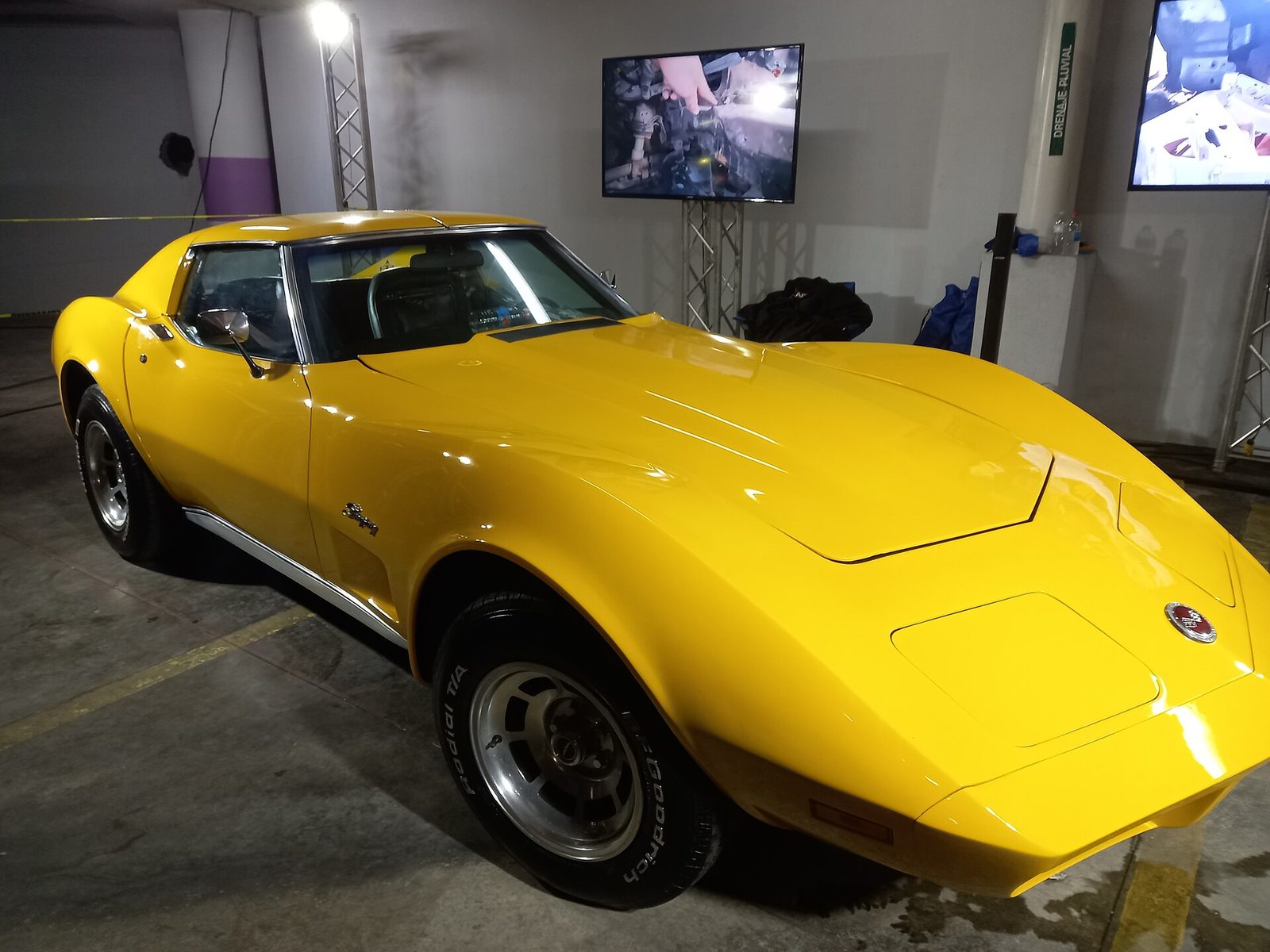
The third-generation Corvette (1968-1982) took the Mako Shark II show car's waisted, high-fendered shape into production and then carried it, largely unchanged in silhouette, through fifteen model years and roughly 542,000 cars - the longest Corvette generation to date. It spans two almost unrelated cars. The 1968-1972 chrome-bumper models are late-muscle-era machinery: 427 and 454 big-blocks, the solid-lifter LT-1, removable rear windows and gross horsepower ratings. From 1973 federal 5 mph bumper standards brought urethane nose and tail sections, compression fell for low-lead fuel, and the 1972 switch from SAE gross to SAE net ratings made the advertised collapse in output look worse than the mechanical reality. Convertibles ended in 1975 and did not return until 1986. The market splits hard at the 1972/73 bumper line, which is precisely why the C3 remains one of the cheapest routes into a genuine classic American sports car.
Production by variant
How the Corvetterun breaks down, and which variants are the scarce ones. Approximate figures from this model’s cited sources.
Rarest of the bunch: the LS6 454 (1971 only), only about 188 built, roughly 1 in every 36 Corvettes. If provenance and rarity drive your buy, this is the one to hunt.
Figures approximate; see Sources below.
History
Mako Shark II to Production
The C3's shape came almost directly from the Mako Shark II (XP-755), a Bill Mitchell-directed show car unveiled at the New York International Automobile Show in April 1965 and drawn by a studio team including Larry Shinoda, Henry Haga, David Holls, Ken Eschebach and Art Carpenter. Two were built, only one of them running. Its high-crowned fenders, pinched waist, hidden headlamps and tunnelled rear window survived into the 1968 production car with remarkably little dilution; the show car itself was later reworked into the Manta Ray concept around the time the production Corvette launched. The 1968 car kept the Sting Ray chassis and running gear beneath the new body, adding removable T-top roof panels with a central brace and a rear window that lifted out entirely. Build quality did not keep pace with the styling: Car and Driver famously declared the 1968 Corvette 'unfit to road test', citing fit and finish, ventilation, noise and a cramped, hot cockpit. It sold 28,566 units anyway, a record at the time.
Chrome Bumpers and the Peak of the Big Blocks
The 1968-1972 cars are the ones the market treats as a separate model. Chrome bumpers front and rear, egg-crate grille, fender vents and - through 1972 - a removable rear window. The engine list in this window is the generation's high-water mark. For 1968 the base 327 made 300 hp gross, with 427 big-blocks from 390 to 435 hp and the off-catalog L88 nominally rated at 430 hp gross, a figure understood at the time to be deliberately conservative. Only 115 L88s were built in 1968 and 116 in 1969, plus two all-aluminum ZL1 cars in 1969, the year the 350 replaced the 327 and the Stingray name returned as one word. In 1970 the solid-lifter LT-1 350 arrived with 11:1 compression and a 6,500 rpm redline at 370 hp gross; 1,287 were built. The 454 replaced the 427, and for 1971 alone the aluminum-head LS6 offered 425 hp gross - 188 cars, of which twelve carried the ZR2 package.
The Ratings Change and the Long Middle
Two things happened at once in the early 1970s and buyers still conflate them. First, compression ratios were genuinely cut from 1971 to suit 91-octane low-lead fuel ahead of catalytic converters. Second, and separately, the industry moved from SAE gross ratings - measured on a stripped engine with open exhaust and no accessories - to SAE net, measured as installed with production intake, exhaust and ancillaries. For 1972 the base 350 went from 270 hp gross to 200 hp net and the LT-1 from 330 gross to 255 net without a corresponding mechanical collapse. Contemporary analysis of the switch across the industry suggests the methodology change accounted for the larger share of the apparent drop, with real detuning making up the remainder. From 1973 a federally mandated 5 mph urethane front bumper replaced the chrome, the rear following for 1974. The 454 LS4 ended after 1974, and 1975 brought the catalytic converter, a 165 hp base L48 and the last C3 convertible - 4,629 cars, about 12 percent of the year - retired in anticipation of rollover standards that never arrived. The soft-top did not return until 1986.
Fastbacks, Anniversaries and the End of the Run
With performance stalled, Chevrolet sold style and volume, and it worked: 1976, 1977 and 1979 were all bigger years than any of the muscle-era ones, and 1979's 53,807 cars remains the highest-volume Corvette model year ever. For 1978 the car received a fastback rear window in place of the tunnelled backlight, plus two commemorative packages for the 25th anniversary: RPO B2Z Silver Anniversary two-tone paint at $399, taken by 15,283 buyers, and the RPO Z78 Indy 500 Pace Car replica at $13,653.21, roughly $4,300 over a base car, built to a run of 6,502 so that essentially every Chevrolet dealer received one. Heavily speculated on when new, Pace Cars were widely stored rather than driven and have never commanded the premium their original buyers expected. Assembly moved from St. Louis to Bowling Green, Kentucky in 1981, and 1982 closed the generation with a throttle-body-injected 350 and a Collector Edition whose lift-up rear hatch glass previewed the C4.
Common Problems
Structural corrosion is the defining C3 issue - birdcage, frame kick-ups over the rear axle, front frame horns, body mounts and floors - and it is invisible from above because the panels above it are fiberglass and never rust. Fiberglass itself cracks around wheel-arch lips and at stress points, and poor past repairs are routinely buried under fresh paint. T-top and rear-window seals leak, a complaint present from the 1968 launch. First-year 1968 cars carried well-documented assembly-quality problems including poor fit and finish, weak ventilation, high cabin noise and unreliable hidden-headlamp and wiper-door vacuum systems. Later cars trade those for emissions-era driveability: low compression, lean calibration, heat soak and a general lack of urge, particularly 1975-1980. Suspension bushes, trailing-arm bearings and brake calipers are consumables at this age. The most expensive fault is not mechanical at all - buying an undocumented car sold as a rare-option original.
What to Look For
Inspect the steel structure, not the fiberglass. The 'birdcage' - the welded steel frame around the windshield and door hinges - rots from the inside at the base of the A-pillars and under the windshield corners where it cannot be seen, and repairing it is a body-off job. A common field test is to lay a white towel in the footwells and slam the doors a few times: rust flakes falling onto the towel indicate serious decay. Also check the frame where it kicks up over the rear axle, the front frame horns, body mount points, floors and footwells, trailing arms and the brackets behind the bumpers; put the car on a lift with a torch before any money changes hands. On the body, feel the inner wheel-arch lips for cracks and look inside the wheel wells for evidence of botched repairs hidden under paint. T-tops leak and always have. For anything claiming a big-block, LT-1, L88 or ZL1, treat the claim as unproven until documented: check the VIN, trim tag and block casting and stamped numbers, and note that a plausible engine swap costs a fraction of the price difference between a real car and a tribute. For 1962-1975 cars the NCRS Historic Document Service can supply a GM shipping data report giving build date and original selling dealer, though it does not list options; NCRS also offers a document validation service for owners holding factory paperwork. Manual cars and correct original drivetrains carry the premium; heavily modified cars and automatics discount.
Market Notes
As of August 2026, classic.com shows an average sale price of roughly $38,100 across all C3 variants with about 427 cars listed for sale at once, and roughly $29,200 for standard-variant cars from a pool of about 345 listings - among the highest listing volumes for any classic sports car, and a reliable indicator of a liquid, buyer's market. The floor is genuinely low: classic.com's lowest recorded C3 sale is $2,800 for a 1972 car in February 2026. Value is concentrated almost entirely in specification and paperwork rather than year. The LT-1 carries a classic.com market benchmark of about $56,300 and an average sale near $55,000, with results spanning roughly $14,500 to $179,000 - a spread that reflects condition and documentation rather than model variation. At the top, classic.com's L88 benchmark sits around $420,000. The practical market line is 1972/73: chrome-bumper cars trade at a clear premium to urethane-bumper cars of otherwise similar condition, and 1976-1982 coupes are the cheapest entry point into the generation. Hagerty has separately made the case that the 1973-74 big-block cars, which combine 454 displacement with unloved bumper styling, are the value anomaly of the range.
Where sources differ
Total C3 production is approximately 542,861 cars across the 1968-1982 model years, but no single exact figure is agreed across published tabulations.
Corvette Central's table sums to 542,861 with 1978 as 46,776; CorvSport states 542,862 by listing 1978 as 40,275 coupes plus 6,502 Pace Cars (46,777). Vette Vues publishes the same yearly rows but states 542,078, which does not reconcile with its own columns. The spread is one to two cars in substance and an arithmetic error in the third case.
Sources
- Chevrolet Corvette (C3), Wikipedia · reference-book
- C3 Corvette Production Figures, CorvSport · specialist
- C3 Production Numbers, Corvette Central Tech Blog · specialist
- C3 Corvette Production Numbers by Year (1968-1982), Vette Vues Magazine · journalism
- Remembering A Concept Car Legend, The Mako Shark II, MotorCities National Heritage Area · specialist
- 1968-82 Chevrolet Corvette (C3) buyers guide, Hagerty · journalism
- The last big block Corvettes are a bargain, Hagerty · journalism
- Understanding Gross Versus Net Horsepower Ratings, Ate Up With Motor · journalism
- 1968 C3 Corvette: Specifications, VIN & Options, CorvSport · specialist
- 1969 C3 Corvette: Specifications, VIN & Options, CorvSport · specialist
- 1971 C3 Corvette: Specifications, VIN & Options, CorvSport · specialist
- 1972 C3 Corvette: Specifications, VIN & Options, CorvSport · specialist
- 1975 Corvette Overview, Vette Vues Magazine · journalism
- 1978 Corvette Overview: Pace Car, Specs, Colors & Production, Vette Vues Magazine · journalism
- 1978 Corvette Indy Pace Car, CorvSport · specialist
- C3 Corvette Rust and Corrosion Trouble Spots, Corvette-C3.com · club-forum
- Ten Rules For Buying Your First C3 Corvette, CorvSport · specialist
- Historic Document Service, National Corvette Restorers Society · club-forum
- Chevrolet Corvette - C3 Market, classic.com · market-data
- Chevrolet Corvette - Standard Variants - C3 Market, classic.com · market-data
- Chevrolet Corvette LT1 - C3 Market, classic.com · market-data
Synthesized from the sources above and cross-checked. We cite and link out; we do not republish other databases verbatim.
Fully Sorted is an independent publisher and is not affiliated with, endorsed by or sponsored by Chevrolet. Chevrolet and the model names on this page are trademarks of their respective owners and are used here only to identify the cars being described.
Chassis register
Nobody has recorded a car here yet. Own one, or know one? Chassis number, what you can prove about it, and a source if there is one. Every entry is reviewed before it appears.
Nerd Notes
What owners know that the sources don't. Every note is read and checked before it appears here.
Key Specs
- Roof
- Removable T-top roof panels; removable rear window on 1968-1972 coupes; fixed fastback rear glass from 1978
- Brakes
- Four-wheel disc brakes
- Layout
- Front engine, rear-wheel drive
- Bumpers
- Chrome front and rear 1968-1972; 5 mph urethane front bumper from 1973; urethane rear from 1974
- Assembly
- St. Louis, Missouri; Bowling Green, Kentucky from 1981
- Emissions
- Catalytic converter and unleaded fuel from 1975; compression ratios cut from 1971 for 91-octane low-lead
- Peak power
- 435 hp gross (L71 427, 1968-69); L88 nominally 430 hp gross and understood to be understated
- Construction
- Fiberglass body over a welded steel 'birdcage' cockpit structure and a full perimeter frame
- Transmission
- 3- and 4-speed manuals (including close-ratio boxes) or Turbo Hydra-Matic automatic
- Base power 1968
- 327 cu in, 300 hp gross
- Base power 1971
- 350 cu in, 270 hp gross
- Base power 1972
- 350 cu in, 200 hp SAE net (same basic engine, new measurement standard)
- Base power 1975
- L48 350 cu in, 165 hp SAE net
- Base power 1978
- L48 350 cu in, 185 hp SAE net; L82 220 hp SAE net
- Base power 1982
- 350 cu in, throttle-body fuel injection, 200 hp SAE net
Notable Variants
L88 / ZL1 (1968-1969)
Off-catalog racing 427s deliberately under-rated at 430 hp gross. 115 L88s in 1968, 116 in 1969, and just two all-aluminum ZL1 cars. The blue-chip end of the generation and the reason documentation matters.
LT-1 (1970-1972)
Solid-lifter 350 with 11:1 compression and a 6,500 rpm redline; 370 hp gross in 1970, 330 in 1971, 255 SAE net in 1972. No air conditioning in 1970-71. The small-block driver's pick and the strongest sub-big-block money.
LS6 454 (1971 only)
Aluminum-head 454 rated 425 hp gross / 325 hp net, 188 built at $1,221. Uniquely for the period it could be ordered with an automatic. 12 of those cars carried the ZR2 package.
Silver Anniversary (1978)
RPO B2Z two-tone silver-over-gray paint marking the Corvette's 25th year; 15,283 cars, $399. A paint option, not a limited edition, and priced accordingly.
Indy 500 Pace Car Replica (1978)
RPO Z78, 6,502 built - roughly one per Chevrolet dealer - in black over silver with a red pinstripe, front and rear spoilers, glass T-tops and a long standard-equipment list. $13,653.21, about $4,300 over a base car. Widely speculated on when new and consequently plentiful, low-mileage and unremarkable in value.
Collector Edition (1982)
Run-out model with a lift-up rear hatch glass that previewed the C4, sold at roughly $4,000 over base.
Value Trajectory
The C3 is the outlier in classic Corvette appreciation: while C1 and C2 cars became blue-chip, most of the C3 run stayed cheap, and that remains true as of August 2026 with average sale prices around $38,000 across all variants and roughly $29,200 for standard cars. Growth has been concentrated at the extremes rather than the middle. Rare-option early cars - L88, ZL1, LS6, LT-1 - have followed the wider muscle-car market upward, with classic.com benchmarks of roughly $420,000 for the L88 and $56,300 for the LT-1, while ordinary 1976-1982 coupes have moved little in real terms and continue to sell for the price of a used commuter car. The chrome-bumper premium has widened rather than narrowed, making the 1968-1972 cars the segment most likely to keep appreciating. The clearest identified upside is the 1973-1974 big-block, which Hagerty has argued is undervalued purely because it wears the wrong bumpers. Against that, the sheer supply - over half a million cars built, hundreds listed at any moment - caps upside for the generic car, and rising restoration costs mean a cheap C3 with birdcage rust is a liability rather than an entry point.
Market Snapshot
4 recorded sales, too few for a median worth standing behind, so here is the range instead.
Range $72,000 – $148,000
Next
Shopping for one?
Browse Chevrolet listings, or decode a VIN before you buy.