
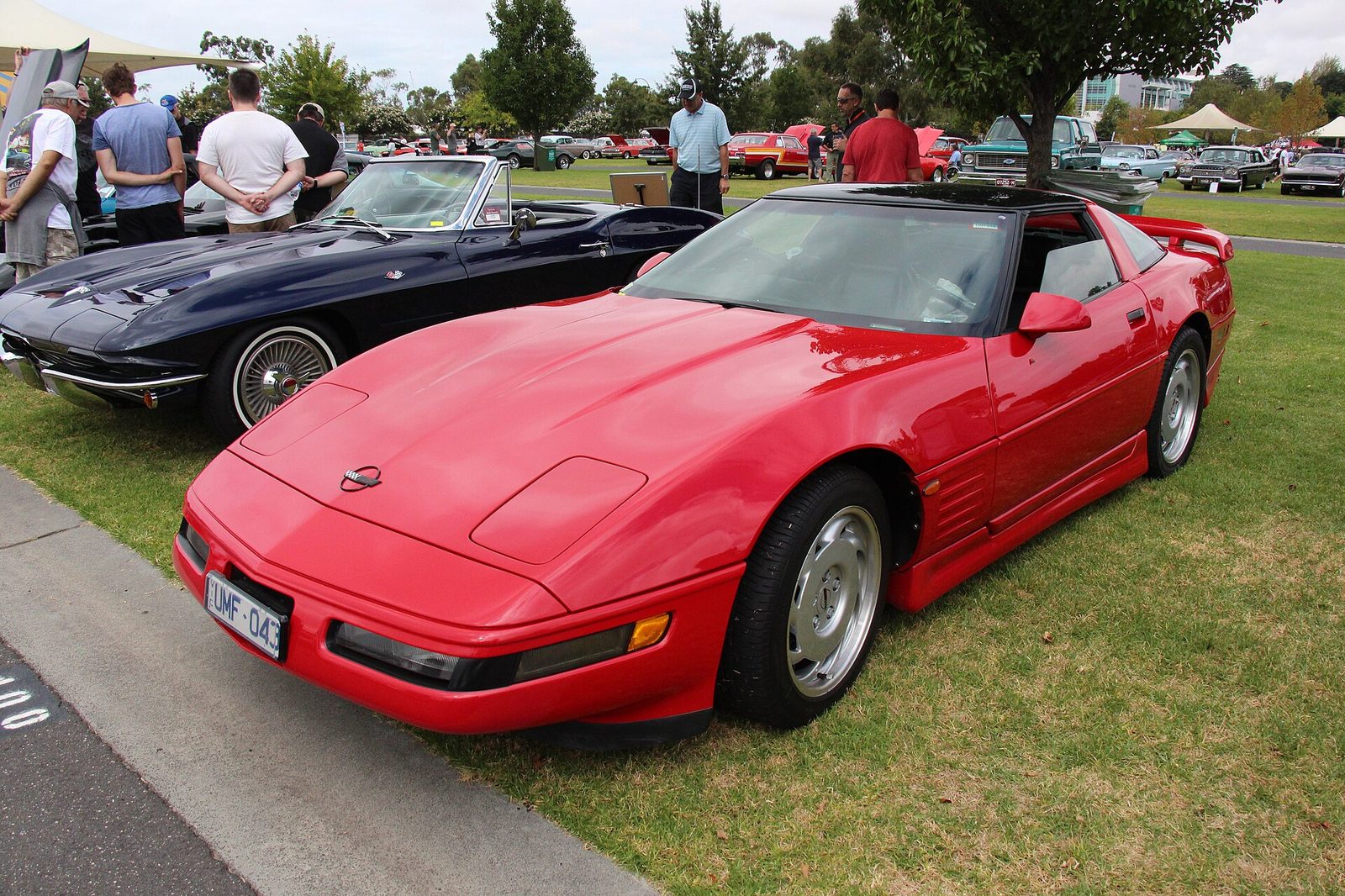
The Corvette ZR-1 was the option that turned a Chevrolet into a 175 mph car. Announced for 1989, delayed a year and sold from 1990 to 1995, it was built around the LT5: an all-aluminum 5,727 cc V8 with four camshafts and 32 valves, designed by Lotus Engineering after General Motors bought the firm in 1986 and hand-assembled by Mercury Marine at Stillwater, Oklahoma. It made 375 hp at first and 405 hp after a 1993 rework of the heads and valvetrain, and it breathed through a two-stage induction whose second set of ports could be locked out by a key switch on the console - the valet setting. To clear 315-section rear tires the ZR-1 was given a tail three inches wider than a standard Corvette, with a convex fascia and square lamps; for 1991 Chevrolet handed that tail to the whole range, costing the car most of its visible claim on a $27,000 option premium. In March 1990 a near-standard example took the 24-hour and 5,000-mile world speed records in Texas. Roughly 6,939 were built, though the split by year is not agreed.
History
A Lotus Engine for a Chevrolet
Chevrolet's difficulty in the mid-1980s was that the C4's pushrod L98 had run out of room, and the answer came from outside the company. Lotus engineer Tony Rudd had sketched a 350 hp four-cam V8 in 1984; General Motors bought Lotus in 1986, partly for exactly this kind of capability; and the program that became the LT5 was approved in August 1985, with the first engine running on 1 May 1986. CorvSport's account has Lotus asking for wider cylinder bores than GM would sanction, which is why the target slid from 400 hp to 375. What emerged was an all-aluminum 5,727 cc V8 with Nikasil-coated liners, four camshafts, 32 valves and 11.0:1 compression - an engine sharing nothing with the small-block but its approximate displacement.
Built by a Boat Company
Volumes were far too low for a Chevrolet engine plant, so assembly went to Mercury Marine's MerCruiser facility at Stillwater, Oklahoma, chosen for its ability to hand-build to tight tolerances in small numbers. Mercury's own account records that the line earned GM's GP3 Level 1 quality certification and that LT-5 production ended in 1994, a year before the last car was built. Finished engines went to Bowling Green. The induction was the LT5's cleverest feature and its most misunderstood: sixteen intake ports and sixteen injectors, of which only eight of each work below roughly a third throttle. A key switch on the console selected normal or full power, and in normal the secondary port throttles stayed shut, which CorvSport puts at about 200 hp. It was sold as a valet key. It was also doing quiet work for emissions and economy.
Fort Stockton, March 1990
On 1-2 March 1990 a near-standard ZR-1 ran for more than a day on the 7.712-mile tire proving ground oval near Fort Stockton, Texas, with eight drivers - John Heinricy, Tommy Morrison, Scott Allman, Jim Minneker, Don Knowles, Kim Baker, Scott Lagasse and Stuart Hayner - taking 80-minute stints. It averaged 175.885 mph for 24 hours, covering 4,221 miles and displacing Ab Jenkins' 161.180 mph mark of 1940. It took the 5,000 km (3,107 mile) record at 175.710 mph and 5,000 miles at 173.791 mph, the latter in 28 hours 46 minutes 12.426 seconds. Seven FIA-verified records were logged in all. A companion L98-engined Corvette took the six-hour record at 170.887 mph before being withdrawn.
Three Inches, and Then Given Away
Carrying 315/35ZR-17 rear tires on 17 x 11-inch wheels meant a wider tail: 74.0 inches across, about three inches broader than a standard car, with a convex rear fascia and four square lamps in place of the round ones. In 1990 that was the only outward sign that a buyer had added $27,016 to a $31,979 Corvette. For 1991 Chevrolet restyled the entire range around the same tail, leaving the ZR-1 identifiable by its badge, its rear track, its wheels and a center high-mounted stop lamp. Hagerty's archived assessment is blunt that this decision did more lasting damage to ZR-1 values than the price ever did.
405 Horsepower and a Shrinking Reason to Exist
For 1993 the heads, ports, valves, cam timing and exhaust were reworked and four-bolt main caps fitted, lifting output to 405 hp at 5,800 rpm and 385 lb-ft at 5,200 rpm. It arrived a year after the base Corvette got the 300 hp LT1, which had closed much of the gap for a fraction of the money, and sales fell away accordingly - from four figures a year to 448. Chevrolet general manager Jim Perkins cited that internal competition and the cost of certifying the LT5 for 1996 emissions when the option was dropped. The last car, a Torch Red coupe, left Bowling Green on 28 April 1995.
Common Problems
The LT5 has a good reputation for durability, and the recurring faults are ancillary rather than structural. Gasket and seal work dominates: the oil pan is prone to leaking at the front and rear, the intake plenum gasket is thin enough that the specialist aftermarket sells a thicker replacement, and valve stem seals and head gaskets are cataloged as routine service items by suppliers to the ZR-1 Net Registry. Injector gumming across the sixteen-injector set is the classic symptom of a car that has been stood rather than driven. Oil cooler line failure is common enough that braided replacements are sold as a matter of course, at around $332.85 a set, and the twin fuel pump arrangement is a known wear point. Away from the engine the faults are C4 faults: air conditioning and audio that have stopped working, seat bolster wear, headlight bushings, degraded window weatherstrip and stress marking around the removable roof panel. Parts for the engine come from a small specialist trade rather than a dealer network, which is the practical constraint on running one.
What to Look For
Establish which engine is in the car before anything else: 375 hp cars are 1990 to 1992, 405 hp cars 1993 to 1995, and the later engine carries four-bolt main caps as well as the reworked heads. Confirm the power key works and that the full-power indication actually appears, because the secondary port system depends on vacuum actuation and a failure there leaves the car running on eight ports with no obvious warning. Sixteen injectors is twice the usual bill, and cars that have stood gum them up; The Autopian puts primaries at about $62.50 each and secondaries at about $87, which is manageable individually and less so in a set. Look underneath for oil and coolant seepage: the front and rear of the oil pan are the recognized weak points, to the extent that specialist gaskets are made wider there than the factory item. Oil cooler lines fail with age. Check the removable roof panel and its surround for stress marks, the headlight bushings, the door weatherstrip and whether the air conditioning still cools. Original paint carries real weight in this market, so establish repaint history. Service records matter more than mileage on a car whose engine no dealer network was set up to rebuild, and a long-stored example is not automatically the better buy.
Market Notes
As of August 2026, classic.com's benchmark for the C4 ZR-1 stands at approximately $37,598 against an average recorded sale of about $40,158, with the trend arrow pointing down and 22 cars listed for sale. Tracked results run from $12,100 for a 1990 car in April 2024 to a 680-mile 1990 example advertised at $67,500 for a September 2026 sale. The 1993 sub-market, tracked separately, shows a benchmark of roughly $37,541 across fifteen sales between August 2025 and June 2026, most clustering between $40,000 and $57,000, with a 203-mile car at $85,000 in November 2025 at the top and a modified car at $36,000 in October 2025 at the bottom; 40th Anniversary cars transact above plain ZR-1s of the same year. A 15,000-mile 1995 car made $43,000 at Mecum's Florida Summer Special on 10 July 2024. Against that, an archived Hagerty piece written some years earlier cites a $48,600 high for a 1995 car at Mecum in January 2015 and a general $20,000-$35,000 band, and The Autopian recorded three ordinary-mileage cars between $20,750 and $24,000 in February 2024. The spread between a 200-mile 405 hp car and a 60,000-mile repainted one is now four or five to one.
Where sources differ
Published performance figures for the ZR-1 vary widely, with 0-60 mph quoted between 4.3 and 4.9 seconds and top speed between 175 and 180 mph depending on the source and the model year tested.
CorvSport's ZR-1 overview states 4.3 seconds to 60 mph; The Autopian cites Car and Driver at 4.5 seconds and roughly 180 mph; CorvetteBlogger gives 4.5 seconds and 175 mph; CorvSport's 1993 specification page gives 4.9 seconds and 179 mph for the 405 hp car. The spread is not resolved by any source consulted here and no single figure is asserted.
Total C4 ZR-1 production is most commonly given as 6,939 cars, but LSXmag and CorvetteBlogger both state 6,922; no production total is asserted here.
Wikipedia, CorvSport, Vette Vues, classic.com, Vettes of Atlanta and Hagerty all state 6,939. LSXmag states 6,922 sold and CorvetteBlogger 6,922 produced. The seventeen-car difference is not resolved by any source consulted here, so productionTotal is left null.
The year-by-year split most often published is 3,049 (1990), 2,044 (1991), 502 (1992) and 448 in each of 1993, 1994 and 1995, but the 1990 figure and the 1993 figure are both contradicted elsewhere.
Vette Vues' ZR-1 history, Corvette Story and Hagerty all give 3,049 for 1990. Vette Vues' own 1995 guide instead states 3,032 delivered in 1990. CorvetteBlogger attributes 1,344 cars to 1993 alone, exactly the 1993-1995 sum at 448 a year. The split remains unresolved by the sources consulted here.
Sources
- Chevrolet Corvette (C4), Wikipedia · encyclopedia
- 1990-1995 ZR-1 Corvette, CorvSport · specialist
- 1990 Corvette Performance & Specifications, CorvSport · specialist
- 1993 Corvette Performance & Specifications, CorvSport · specialist
- 1995 C4 Chevrolet Corvette: Specifications, VIN, & Options, CorvSport · specialist
- A Marriage of Legends: The Mercury Joint Effort with Corvette, Mercury Marine · manufacturer
- A Look At The C4 ZR-1's Jewel-Like, All-Aluminum DOHC LT5 Engine, LSXmag · journalism
- Crate Engine: A Rare ~400 hp Chevrolet LT5 Phase 5 V8, Silodrome · journalism
- C4 Corvette ZR-1 History: The Dawn of an American Supercar (1990-1995), Vette Vues Magazine · journalism
- Ultimate Guide to the 1995 Corvette Specs, Production Numbers, Pace Car and ZR1, Vette Vues Magazine · journalism
- The Corvette C4 ZR-1 Story, Corvette Story · specialist
- 1990 Corvette ZR-1 World Speed Endurance Record, Corvette Action Center · specialist
- Chevrolet Corvette ZR-1 - C4 Market, classic.com · market-data
- 1993 Chevrolet Corvette ZR-1 - C4 Market, classic.com · market-data
- 1995 Chevrolet Corvette ZR1 sold at Mecum Florida Summer Special (2024), classic.com · auction-house
- Why isn't the Chevy Corvette ZR-1 worth more?, Hagerty Media · journalism
- The C4 Corvette ZR-1 Is The Last Affordable '90s Supercar, The Autopian · journalism
- LT5 Gaskets & Seals, ZR-1 Net Registry Forums · club-forum
- C4 Corvette FAQ: LT1/LT4, Grand Sport and ZR-1 (1992-1996), Vettes of Atlanta · specialist
- Why Are 1989 Corvette ZR-1s Worth So Much More Than Other C4 ZR-1s?, Jalopnik · journalism
- The Best Corvettes of the 1990s: No.1 - The C4 Corvette ZR-1, CorvetteBlogger · journalism
Synthesized from the sources above and cross-checked. We cite and link out; we do not republish other databases verbatim.
Fully Sorted is an independent publisher and is not affiliated with, endorsed by or sponsored by Chevrolet. Chevrolet and the model names on this page are trademarks of their respective owners and are used here only to identify the cars being described.
Chassis register
Nobody has recorded a car here yet. Own one, or know one? Chassis number, what you can prove about it, and a source if there is one. Every entry is reviewed before it appears.
Nerd Notes
What owners know that the sources don't. Every note is read and checked before it appears here.
Key Specs
- Power
- 375 hp (1990-1992); 405 hp at 5,800 rpm (1993-1995) - manufacturer ratings
- Brakes
- Four-wheel discs with anti-lock; Bosch ABS with traction control from 1995
- Engine
- 5,727 cc LT5 all-aluminum 90-degree V8 with Nikasil-coated cylinder liners, designed by Lotus Engineering and assembled by Mercury Marine at Stillwater, Oklahoma
- Layout
- Front mid-mounted longitudinal engine, rear-wheel drive
- Torque
- 370 lb-ft at 4,800 rpm (1990-1992); 385 lb-ft at 5,200 rpm (1993-1995) - manufacturer ratings
- Weight
- 3,465 lb curb for the 1990 car
- Chassis
- Steel uniframe with fiberglass and composite panels; widened rear bodywork unique to the ZR-1 until the 1991 restyle
- Induction
- Two-stage port injection: sixteen intake ports and sixteen injectors, of which eight operate at light load; secondary port throttles open on demand and can be locked out by the console power key
- Top speed
- 175-180 mph depending on source; 179 mph quoted for the 405 hp car
- Dimensions
- 177.4 in long, 74.0 in wide, 46.8 in high - about three inches wider across the tail than a contemporary base Corvette
- Valvetrain
- Four overhead camshafts, four valves per cylinder, 32 valves; two-bolt main bearing caps 1990-1992, four-bolt 1993-1995
- Bore stroke
- 3.90 in x 3.66 in (99 mm x 93 mm)
- Compression
- 11.0:1
- Acceleration
- 0-60 mph quoted between 4.3 and 4.9 seconds depending on source and model year; standing quarter mile 13.4 s at 108.5 mph (1990) and 13.1 s at 109.6 mph (1993)
- Transmission
- ZF six-speed manual only; 3.33:1 final drive
- Wheels tires
- 17 x 9.5 in front and 17 x 11 in rear; Goodyear Eagle ZR P315/35ZR-17 at the rear
Notable Variants
1989 pre-production ZR-1
Eighty-four cars built to 1989 specification for engineering and press work when the launch slipped to 1990. None were retailed new. Three sold out of General Motors' Heritage Fleet in 2009 for over $150,000 each, one at $198,000.
ZR-1, 1990-1992 (375 hp LT5)
First-series cars with the original 375 hp engine, open-deck block and two-bolt main bearing caps. The 1990 cars are the only ones whose wide tail and square lamps set them apart from every other Corvette on the road.
ZR-1, 1993-1995 (405 hp LT5)
Reworked heads, valves, cam timing and exhaust, plus four-bolt main caps, for 405 hp and 385 lb-ft. The stronger and more sought-after engine, and the rarer half of the run at 448 cars a year.
ZR-1 40th Anniversary (1993)
Ruby Red anniversary package available on the ZR-1 in the Corvette's fortieth year. classic.com's 1993 sub-market shows anniversary cars transacting above plain ZR-1s of the same model year.
ZR-1 from 1991 (post-restyle)
From 1991 the whole Corvette range adopted the ZR-1's convex tail and square lamps. Identification then rests on the badge below the right-hand lamp, the wider rear track, the 17 x 11-inch rear wheels and a center high-mounted stop lamp the base cars did not get.
1995 final-year ZR-1
The last 448. Production closed on 28 April 1995 with a Torch Red coupe driven off the Bowling Green line and escorted to the National Corvette Museum by Jim Perkins and retired chief engineer David McLellan.
Value Trajectory
The ZR-1's value curve is the least flattering of any fast Corvette. A car that cost around $60,000 in 1990 - roughly twice a base Corvette - was worth a fraction of that within a decade, and Hagerty's archived assessment compares the fall to a 1976 Cadillac Eldorado convertible, with some original buyers still underwater in real terms. The cause was not the engineering but the styling decision: once every 1991 Corvette wore the ZR-1's tail, the option had nothing left to show for its premium, and the 300 hp LT1 of 1992 removed most of the rest of the argument. Recovery has been slow and uneven. As of August 2026 classic.com's benchmark of about $37,598 is trending downward even as individual low-mileage cars clear $60,000 and better, which is the signature of a market sorting itself by condition rather than rising as a whole. The stratification is what matters: 405 hp cars, documented low mileage, original paint and the 448-car final years are pulling away from ordinary drivers. The 1989 pre-production cars, which never entered that market at all, remain an order of magnitude above the rest.
Market Snapshot
4 recorded sales, too few for a median worth standing behind, so here is the range instead.
Range $72,000 – $148,000
Next
Shopping for one?
Browse Chevrolet listings, or decode a VIN before you buy.