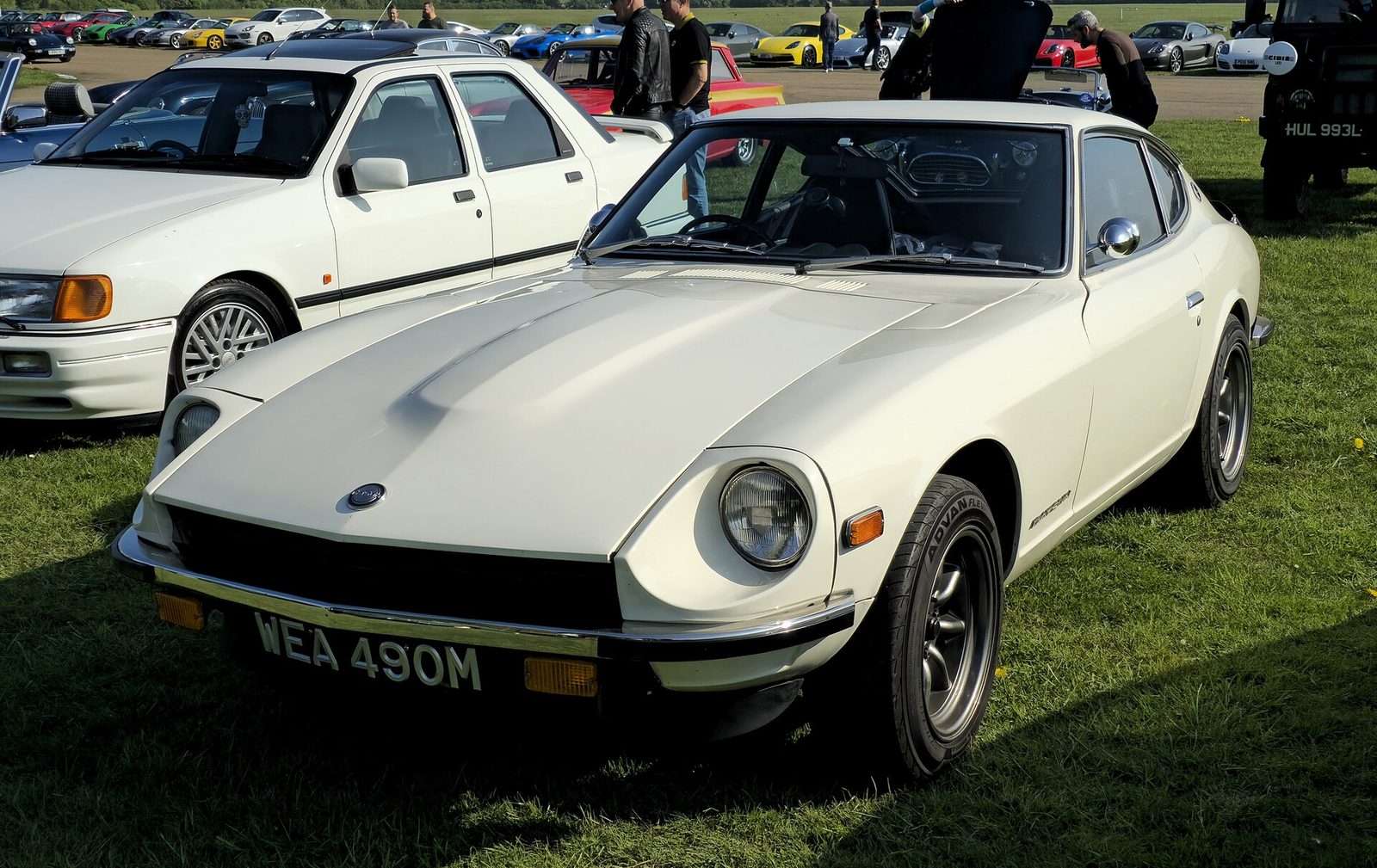
Mister K's idea
The Z was driven into existence by Yutaka "Mister K" Katayama, president of Nissan Motor Corporation U.S.A., who wanted an attainable, youth-oriented sports car for the American market with the look and feel of something far more expensive - his own touchstone was the Jaguar E-Type. The car went on sale in the US as a 1970 model in October 1969, and in Japan as the Nissan Fairlady Z (the "Fairlady" name carried over from Datsun's earlier sports roadster).
The design-credit debate
Who actually styled the S30 is one of the most persistent arguments in collector-car history, so we present it neutrally. The factory and the Nissan enthusiast community credit a team led by Yoshihiko Matsuo, head of Nissan's Sports Car Styling Studio, and there is a well-documented trail of his sketches showing the shape evolving. A competing popular story gives credit to German designer Albrecht Graf von Goertz (of BMW 507 fame), who consulted for Nissan from 1963-1965 on an unrelated two-liter sports-car project (a stillborn Nissan - Yamaha collaboration) that was never produced. In a 1980 letter - written to head off a threatened lawsuit - Nissan stated that the 240Z was the work of its own design staff, while acknowledging that those designers had been "influenced by" and "had the benefit of" Goertz's earlier work for Nissan. Most marque historians today credit Matsuo's team for the production S30 and treat the "Goertz designed the Z" claim as a myth; we record both positions rather than pick a side.
Why it mattered
The 240Z undercut its rivals dramatically while offering things they didn't: an overhead-cam straight-six (not a four), four-wheel independent suspension, front disc brakes, and a comfortable, well-equipped cabin. Period reviewers and buyers responded immediately, and the car generated long waiting lists. It also won on track and in rallying - including the 1973 East African Safari Rally in Shekhar Mehta's hands - and is widely credited, alongside the Datsun 510, with kick-starting the Japanese performance-aftermarket industry in the US.
One car, several names
In export markets the car was the Datsun 240Z (chassis HLS30 for left-hand drive, HS30 for right-hand drive). In Japan it was the Nissan Fairlady Z, normally with the smaller 2.0-liter L20 six so it fell under a lower engine-displacement road-tax band; a 2.4-liter Fairlady 240Z (HS30) was also offered there at a higher tax cost. The Japan-only Fairlady Z432 (PS30) used the Skyline GT-R's exotic S20 twin-cam 24-valve two-liter, with the lightweight Z432-R as a homologation special. The Japan-only 240ZG (HS30-H) wore the aerodynamic "G-nose."
The 240Z ran in the US through the 1973 model year, after which a larger-displacement 260Z (2.6L) took over for 1974, followed by the fuel-injected 280Z (2.8L) - but the 2.4-liter original is the car enthusiasts mean when they say "the Z."