
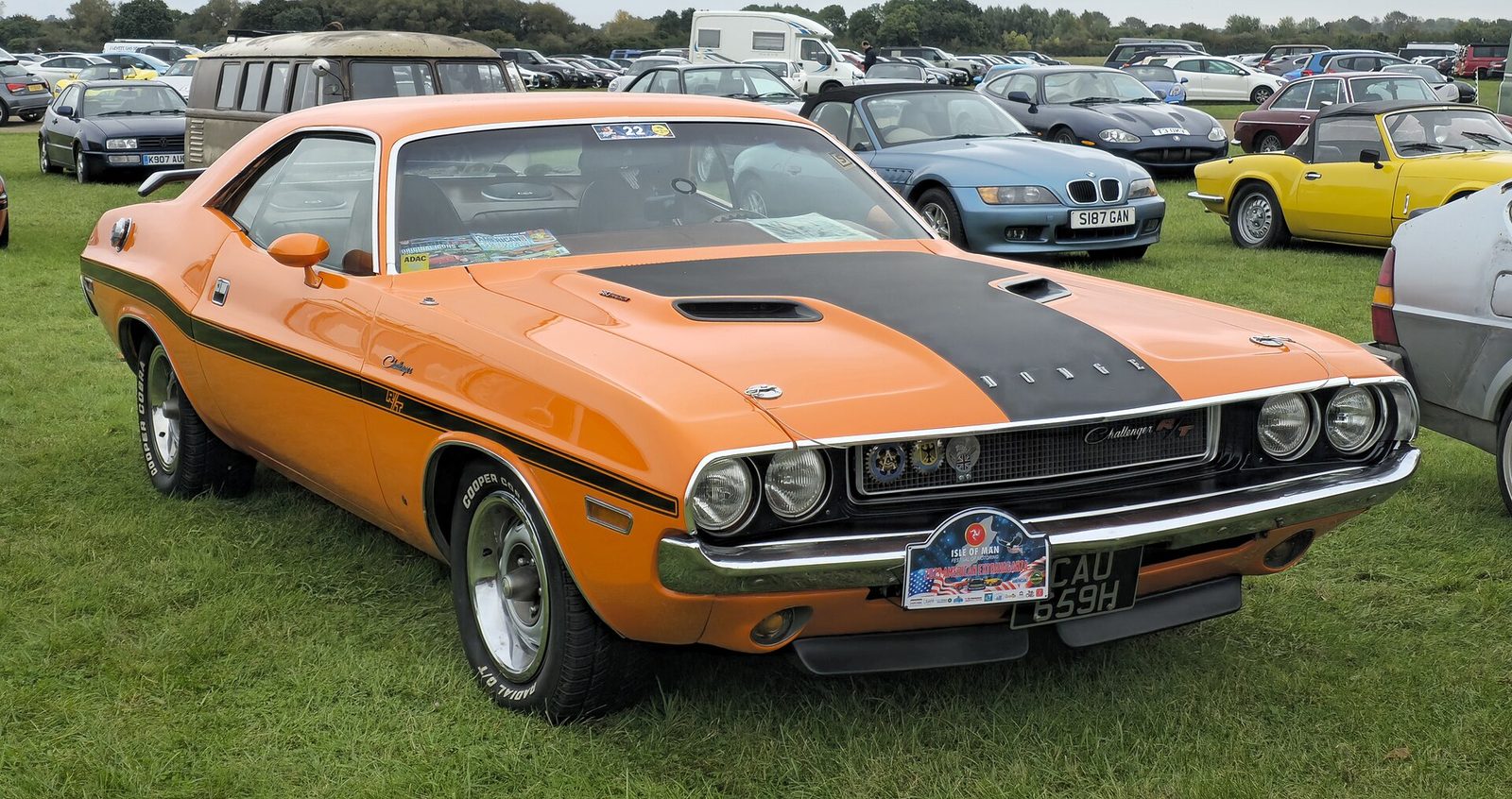
The first-generation Dodge Challenger (1970-1974) was Chrysler's late and expensive entry into the pony car war, and the more upmarket of the two E-body cars it shared with the Plymouth Barracuda. Its 110-inch wheelbase ran two inches longer than the Barracuda's and its sheet metal was entirely its own, the extra length and the plusher cabin aimed at the Mercury Cougar rather than at the Ford Mustang. A cowl structure taken from the B-body Charger let Dodge fit anything in the engine catalog, from a 225 cu in slant-six to the 426 Hemi, and the R/T, the 440 Six Pack and the Trans-Am homologation T/A gave the range a hard performance edge for exactly two model years. Insurance surcharges, emissions rules and a market already turning away from large pony cars then took it apart: sales fell by roughly two-thirds for 1971, the big blocks went in 1972, and production stopped in late April 1974.
Challenger
First generation (E-body)
Production by variant
How the Challengerrun breaks down, and which variants are the scarce ones. Approximate figures from this model’s cited sources.
Rarest of the bunch: the Challenger R/T with the 440 Six Pack (V-code), only about 1,640 built, roughly 1 in every 13 Challengers. If provenance and rarity drive your buy, this is the one to hunt.
Figures approximate; see Sources below.
History
A Pony Car Four Years Late
Chrysler dealers had been asking for a proper answer to the Ford Mustang since the middle 1960s, and president Lynn Townsend eventually authorized one on the condition that it not simply be a rebodied Plymouth Barracuda. The result was the E-body program: two cars sharing a shell and almost no visible panels, the Barracuda styled by John Herlitz and the Challenger by Carl Cameron under Bill Brownlie, with Cameron drawing the grille from an old sketch for a stillborn turbine-engined 1966 Charger. The Challenger reached showrooms in the autumn of 1969, built at Hamtramck and at Los Angeles (Maywood). By then the segment had peaked. Burton Bouwkamp, Dodge's director of product planning, later recalled that the E-body lost so much money that the sight of one was enough to make Chrysler president John Riccardo lose his temper.
Cougar, Not Mustang
The Challenger's 110-inch wheelbase was two inches longer than the Barracuda's 108, its body about 191 inches over the bumpers, and its interior noticeably better trimmed. That was deliberate: Dodge was chasing the 1967 Mercury Cougar and the Pontiac Firebird at the top of the segment, not the base Mustang. Four headlights against the Barracuda's two made the distinction at a glance in every year but 1971. The price of the upmarket brief was mass. The cowl and windshield structure came from the B-body Charger and Coronet, which is why any engine in the catalog would fit and why a big-block car weighed well over 3,800 lb. Period criticism was consistent: understeer, indifferent brakes, poor visibility, and build quality strained by an option list running to thousands of permutations.
R/T, Six Pack and Hemi
The performance series was the R/T, standard with a 335 hp 383 Magnum and open above that to the 375 hp 440 Magnum, the 390 hp 440 Six Pack and the 425 hp 426 Hemi, with a Rallye cluster carrying a 150 mph speedometer and an 8,000 rpm tachometer. Over it sat the High Impact paint range, launched in the summer of 1969 at fifteen dollars: Plum Crazy, Panther Pink, Sublime, Go Mango, Sassy Grass, Top Banana, Hemi Orange. Those codes are now the first thing a buyer reads on a fender tag. The whole edifice lasted two years. Compression came down for 1971 on everything except the Hemi and the high-output 440, and 1971 was the last year for the shaker hood, the Hemi and the factory convertible.
The T/A and One Trans-Am Season
To contest the SCCA Trans-Am championship, Dodge had to sell a street version of its race car, and the 1970 Challenger T/A was it. The racers used a destroked 303.8 cu in version of the 340 on Keith Black internals at around fourteen to one; the road cars took the 340 and added three two-barrel Holleys on an aluminum manifold for a rated 290 hp. Ray Caldwell's Autodynamics of Marblehead, Massachusetts ran the factory effort, building the No. 77 sub-lime car from a T/A pulled off a dealer's showroom floor and completing the No. 76 mid-season from an All American Racers chassis. Sam Posey took thirds at Lime Rock, Road America and Kent, and Dodge finished fourth in points behind Ford and AMC but ahead of Chevrolet, Plymouth and Pontiac. At Laguna Seca the No. 77 had been acid-dipped so thoroughly that a scrutineer's elbow dented its roof. Dodge withdrew at season's end.
The Floor Gives Way
Sales fell by roughly two-thirds between 1970 and 1971, and no single cause explains it. The car had arrived late into a shrinking market; insurance surcharges put the big-engine versions beyond the buyers they were aimed at; the Plymouth Duster was outselling the Barracuda by more than four to one; and a base Challenger cost around 130 dollars more than a comparable Mustang. For 1972 the R/T gave way to the Rallye, the convertible and every big-block engine disappeared, ratings switched to SAE net, and a grille reaching under the front bumper earned the nickname 'sad-mouth'. Federal five-mile-per-hour bumpers arrived for 1973, the slant-six was dropped, and for 1974 the 340 gave way to a 245 hp net 360. 1973 was the strongest year since 1970 at around 27,900 cars, but it was not enough, and production ceased in late April 1974.
Common Problems
Structure is the recurring problem and it is rarely local. Owners restoring E-bodies describe front frame rails, a torsion bar crossmember rusted almost through, inner wings, firewall and lower cowl, A-pillar bases and front floors all needing replacement on the same car, and warn that the unibody is under tension once the rails are cut: crossbracing, a jig and a full set of measurements before any metal comes out are treated as compulsory rather than cautious. Wikipedia's own summary of the model's collectability rests as much on low survivability as on low production, which is the same observation from the other end. The dynamic faults were noted when the cars were new and have not improved. Ate Up With Motor's account of the period reception lists understeer, mediocre braking and poor visibility, all of which follow from a heavy nose, drum brakes as standard equipment on base cars, and a low roofline. The T/A adds its own version: the smaller front tires that gave it its rake also gave it severe understeer in fast corners. Quality control was a known weakness at Chrysler in this period and was made worse here by an option list with thousands of permutations, so trim fit, electrical detail and one-year-only parts are where a restoration overruns. The awkward cases are the one-year-only items: the 1970 Special Edition's formal rear window and overhead console, the shaker hood that disappeared after 1971, and the T/A's fiberglass hood and spoilers.
What to Look For
Paperwork decides the price on this car, because the cheap versions and the expensive versions look alike from ten feet. The fifth character of the VIN carries the engine: R for the 426 Hemi, V for the 440 Six Pack, U for the 440 Magnum, N for the 383 Magnum, H for the 340 and J for the T/A's 340 Six Pack. Auction catalogs for the serious cars quote Galen Govier's registry work or the Challenger Registry rather than the seller, and the fender tag and broadcast sheet together record paint, trim, axle ratio, build date and shipping order. A car offered as an R/T or a T/A without both is a car being sold on its badges. Clones are the normal condition of the market rather than an exception, since 19,938 of the roughly 77,000 to 85,000 cars built in 1970 were R/Ts and only about 2,400 were T/As. On a claimed T/A, check the pinned matte-black fiberglass hood with its full-width scoop, the front air dam and ducktail spoiler, the side-exit megaphone exhausts ahead of the rear wheels and the staggered E60x15 front and G60x15 rear tire sizes; all were unique to the model and all are reproducible. On a claimed 1970 SE, the smaller formal rear window is the tell. High Impact paint is worth confirming against the fender tag code rather than the color on the panel, since FC7 Plum Crazy, FM3 Panther Pink, FJ5 Sublime and the rest were fifteen-dollar options that plenty of cars have acquired since. Underneath, look at the front frame rails, the torsion bar crossmember, the inner wings, the lower cowl and firewall, the A-pillar bases and the floors together rather than one at a time, because on these cars the rot generally runs through all of them.
Market Notes
As of August 2026, classic.com puts the average price of a first-generation Challenger at $87,878 across the whole range, but the range is what matters: the standard-variant submarket sits at $58,434, the 1970-1971 R/T submarket carries a market benchmark of $111,323 on a rising trend against an average sale of $116,730, and the 1970-only T/A benchmark is $112,761 on a rising trend against an average of $114,065. The gap between an ordinary 318 hardtop and a documented R/T is therefore roughly a factor of two before any engine premium is counted. Auction evidence supports the spread. A 1970 R/T convertible sold for $71,500 at Mecum's Houston sale on 5 December 2020; a Plum Crazy 383 R/T hardtop with its broadcast sheet and original window sticker made $61,600 at RM Sotheby's Hershey sale in 2022; and the highest T/A result classic.com tracks is $200,750 at Mecum Indianapolis on 16 May 2026 for an original 4,000-mile car, against a low of $55,000 in December 2022. These are reported sale totals rather than hammer prices. Hemi cars trade in their own market. The highest figure classic.com carries against any first-generation Challenger as of August 2026 is $395,000, dated 23 August 2026 for a 1970 Hemi R/T; the R/T submarket's top entry is $265,000 for a 57,000-mile automatic Hemi car dated 17 August 2026, and both are carried as listings rather than confirmed auction results, so they should be read as asking levels.
Where sources differ
Total 1970 Challenger production is stated variously as 76,935, 83,032 and 85,441, with RM Sotheby's catalog copy saying only 'more than 84,000', and no single figure is asserted here.
Wikipedia's production table and conceptcarz both give 76,935. Muscle Car Facts gives 83,032. Over-Drive Magazine's model-by-model breakdown sums to 85,441. RM Sotheby's Hershey 2022 catalog says 'more than 84,000'. The sources agree that 19,938 of them were R/Ts, but the total itself is not resolved by any source consulted here, so productionTotal is left null.
Total 1971 Challenger production is stated as either 26,299 or 29,883 depending on the source, with one source printing both figures in the same article; all sources agree on 4,630 R/Ts.
Wikipedia's production table gives 26,299. Over-Drive Magazine and Curbside Classic both give 29,883. conceptcarz prints a body-style breakdown totalling 29,803 while quoting 26,299 in its own year-on-year comparison in the same article. The discrepancy is not explained by any source consulted here and remains unresolved.
Total 1972 Challenger production is given as either 22,919 or 26,658, the higher figure including 8,123 Rallye models.
Wikipedia's production table gives 22,919 for 1972, broken down as 842 six-cylinder hardtops, 15,175 V8 hardtops and 6,902 Rallyes. Curbside Classic gives 26,658 including 8,123 Rallyes. Neither source explains the other, and the difference is not resolved by anything consulted here.
Challenger T/A production for 1970 is given as either 2,399 cars or 2,539 cars, and no source consulted reconciles the two.
Wikipedia's narrative text, classic.com, Muscle Cars Illustrated and Over-Drive Magazine all state 2,399, with Muscle Cars Illustrated splitting it 1,410 automatic and 989 manual. Wikipedia's own production table in the same article gives 2,539, as does Supercars.net. The conflict is not resolved by any source consulted here.
Sources
- Dodge Challenger (1970), Wikipedia · encyclopedia
- Mean Machine: The 1970-1974 Dodge Challenger, Ate Up With Motor · specialist
- Mopar VIN Decoder & Fender Tag Decoder: A-Body, B-Body, & E-Body Specs, Classic Industries · specialist
- 1970 Challenger, Muscle Car Facts · specialist
- 1971 Dodge Challenger, conceptcarz.com · specialist
- 1970 Dodge Challenger Fact Sheet, Over-Drive Magazine · journalism
- 1971 Dodge Challenger Fact Sheet, Over-Drive Magazine · journalism
- Dodge High Impact Paint Colors, Dodge (Stellantis) · manufacturer
- Dodge Challenger - 1st Gen Market, classic.com · market-data
- Dodge Challenger T/A - 1st Gen Market, classic.com · market-data
- Dodge Challenger R/T - 1st Gen Market, classic.com · market-data
- 1970 Dodge Challenger R/T Convertible sold at Mecum Houston (2020), classic.com · market-data
- 1970 Dodge Challenger R/T Hemi, Auburn Fall 2015, RM Sotheby's · auction-house
- 1970 Dodge Challenger R/T 'V-Code', Fort Lauderdale 2019, RM Sotheby's · auction-house
- 1970 Dodge Challenger R/T, Hershey 2022, RM Sotheby's · auction-house
- 1971 Dodge Challenger R/T Hemi, Arizona 2013, RM Sotheby's · auction-house
- Dealer Classic: 1972-74 Dodge Challenger 'R/T' - Not Quite The Same, Curbside Classic · journalism
- Richard Goldsmith - 1970 Challenger #77, Historic Trans Am · specialist
- 1970 Dodge Challenger T/A, Muscle Cars Illustrated · specialist
- 1970 Dodge Challenger T/A, Supercars.net · specialist
- 1970 dodge challenger front frame rail replacement, For E Bodies Only Mopar Forum · club-forum
Synthesized from the sources above and cross-checked. We cite and link out; we do not republish other databases verbatim.
Fully Sorted is an independent publisher and is not affiliated with, endorsed by or sponsored by Dodge. Dodge and the model names on this page are trademarks of their respective owners and are used here only to identify the cars being described.
Chassis register
Nobody has recorded a car here yet. Own one, or know one? Chassis number, what you can prove about it, and a source if there is one. Every entry is reviewed before it appears.
Nerd Notes
What owners know that the sources don't. Every note is read and checked before it appears here.
Key Specs
- Power
- 145 hp SAE gross (225 Slant-6) to 425 hp SAE gross at 5,000 rpm (426 Hemi) in 1970-1971 - all gross figures are manufacturer ratings taken without accessories or air cleaner. By 1974 the range topped out at 245 hp SAE net (360 four-barrel)
- Tires
- F70x14 on performance cars; E60x15 front and G60x15 rear Goodyear Polyglas on the T/A, among the first American production cars with staggered tire sizes
- Brakes
- Drums front and rear as standard on base cars; power front discs optional, and standard on the T/A
- Engine
- Nine engine choices for 1970, from the 225 cu in Slant-6 to the 426 Hemi; reduced to three for 1972 and two from 1973
- Layout
- Front-mounted longitudinal engine, rear-wheel drive
- Torque
- 490 lb-ft at 4,000 rpm for the 426 Hemi; 345 lb-ft at 3,400 rpm for the T/A's 340 Six Pack - both manufacturer claims
- Weight
- Roughly 3,000 lb for a slant-six car; Ate Up With Motor puts big-block examples at over 3,800 lb
- Chassis
- Chrysler E-body unitary steel construction with bolted front frame rails; cowl and windshield structure carried over from the B-body Charger and Coronet, which is why the whole Chrysler engine catalog would fit
- Assembly
- Hamtramck, Michigan (Dodge Main) and Los Angeles (Maywood) Assembly, California
- Wheelbase
- 110.0 in (2,794 mm) - two inches longer than the Plymouth Barracuda's 108 in
- Dimensions
- 191.3 in long and 76.1 in wide per Over-Drive Magazine's fact sheet; Wikipedia's infobox gives 191.5 in and 76.5 in, with height about 51 in
- Suspension
- Front unequal-length wishbones with longitudinal torsion bars and an anti-roll bar; live rear axle on semi-elliptic leaf springs. Heavy-duty Rallye suspension with higher-rate rear springs on the T/A
- Vin format
- 13-character VIN, e.g. JS23R0B218064: car line and price class, body style (23 hardtop, 27 convertible), engine code in the fifth position, model year, assembly plant, then a six-digit sequence
- Acceleration
- 13.99 seconds at 100 mph over the standing quarter mile for a T/A, recorded by Hi-Performance Cars in August 1970
- Transmission
- Three-speed manual standard on most engines; four-speed manual with Hurst pistol-grip shifter optional; TorqueFlite three-speed automatic optional and mandatory with the 1970 two-barrel 383
Notable Variants
Challenger R/T (1970-1971)
The performance series, standard with the 335 hp 383 Magnum and optionally the 440 Magnum, 440 Six Pack or 426 Hemi. Carried a Rallye instrument cluster with a 150 mph speedometer, 8,000 rpm tachometer and oil pressure gauge. 19,938 built for 1970, 4,630 for 1971, after which the name was dropped.
Challenger T/A (1970 only)
The SCCA Trans-Am homologation car and the only Challenger with the 340 Six Pack. Fiberglass matte-black pinned hood with a suitcase-sized scoop, front air dam and ducktail spoiler, side-exit megaphone exhausts ahead of the rear wheels, and staggered E60x15 front / G60x15 rear tires. Built for one year only; a 1971 four-barrel version was advertised but never produced.
Challenger R/T with the 426 Hemi
The rarest factory drivetrain in the range and the one the market prices separately. RM Sotheby's, citing Galen Govier's registry, gives 287 US-market 1970 hardtops and 70 cars for 1971. The Hemi was withdrawn after 1971.
Challenger R/T with the 440 Six Pack (V-code)
Three two-barrel carburetors, 390 hp gross for 1970. Approximately 1,640 built for 1970 according to the Challenger Registry as quoted by RM Sotheby's. Frequently preferred to the Hemi by owners for its tractability and lower running cost.
Challenger Special Edition (SE), 1970 only
An appearance and comfort package on either the base car or the R/T: standard vinyl roof with SE pillar medallions, a smaller 'formal' rear window, leather-and-vinyl bucket seats and an overhead console with door-ajar, low-fuel and seatbelt lights. The formal rear window makes an SE identifiable across a car park.
Challenger Deputy (mid-1970) and Challenger Coupe (1971)
The price-leader body, with fixed rear quarter windows and reduced trim. The Deputy was named after a sheriff character used in Dodge advertising; the 1971 Coupe replaced it and was the only Challenger offered with the 198 cu in slant-six.
Challenger Rallye (1972-1974)
Replaced the R/T for 1972 with four simulated front-fender vents trailing matte-black strobe stripes. Top engine was the 340 four-barrel, later the 1974 360. Curbside Classic records 8,123 Rallyes for 1972 - more than the 1971 R/T managed, despite the big blocks having gone.
Value Trajectory
The Challenger was a commercial failure that took thirty years to become a collector car. A 1970 base hardtop listed at $2,851 and an R/T at $3,226; by 1971 the whole range was selling at roughly a third of its first-year volume, and the cars that survived did so despite, not because of, how they were treated. The re-rating that followed has been uneven rather than uniform. RM Sotheby's carried a Plum Crazy Hemi R/T hardtop at Auburn in 2015 against an estimate of $180,000-220,000, a V-code 440 Six Pack car at Fort Lauderdale in 2019 at $150,000-175,000, and a black 1971 Hemi R/T at Arizona in 2013 at $225,000-275,000. None of the three sold, which says something about how far apart buyers and sellers of top-specification cars have been for more than a decade. The ordinary cars have moved more quietly and more steadily. As of August 2026 classic.com shows both the R/T and the T/A submarkets trending upward, at benchmarks of $111,323 and $112,761 respectively, while standard variants sit at $58,434 and a 1974 project car changed hands for $6,600 in April 2026. The practical effect is a market that pays for documentation and for the 1970-1971 specification, and has largely stopped paying for the badge alone.
Next
Shopping for one?
Browse Dodge listings, or decode a VIN before you buy.