
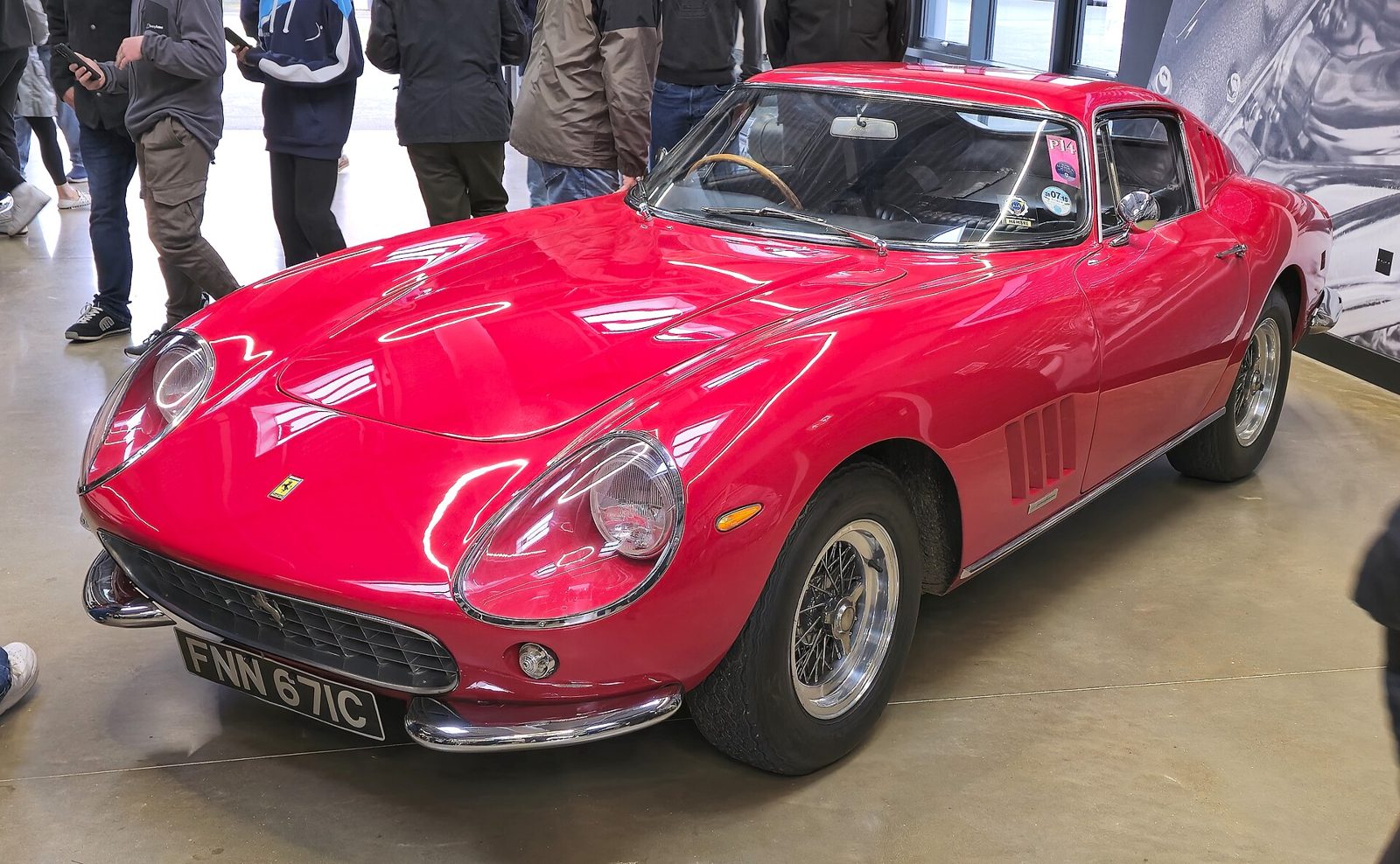
The Ferrari 275 GTB (1964-1968) was the car with which Ferrari's berlinetta stopped being a civilized racing car and became a road car engineered as one. Shown at the Paris Salon in October 1964 as the successor to the 250 GT line, styled at Pininfarina and built by Scaglietti, it brought independent rear suspension and a rear-mounted five-speed transaxle to a road-going Ferrari for the first time. The Colombo V12 grew to 3,286 cc, or 275 cc per cylinder, hence the name. The two-cam car divides into the short-nose Series I and the long-nose Series II, with alloy bodywork and six carburetors as factory options, and was replaced at the 1966 Paris show by the 275 GTB/4, the first production Ferrari with four overhead camshafts, dry-sump lubrication and six Webers as standard. Sources do not agree on how many of either were built: figures for the two-cam run from 440 to 456, and for the four-cam from 330 to 350. Competition derivatives took class wins at Le Mans in 1965 and 1966, and ten open NART Spiders were built for Luigi Chinetti.
275 GTB
275 GTB and GTB/4
History
Replacing the 250
By the early 1960s the 250 GT line was a decade old and cheaper cars, the Jaguar E-type among them, were matching its performance. Ferrari's answer, shown at the Paris Salon in October 1964, was the 275 GTB, named for the 275 cc swept by each of its twelve cylinders. Sources differ on which 250 it replaced: Classic & Sports Car names the 250 GT Lusso, Motor Sport the 250 GT SWB Berlinetta, and in practice it did the job of both. The body was drawn at Pininfarina, credited to Francesco Salamone, and built in steel or optionally aluminum by Scaglietti in Modena. Doug Nye thought the shape looked outdated when new; the verdict has softened since.
The Engineering Step
What mattered was underneath. The 275 GTB was the first road-going Ferrari with independent rear suspension, double wishbones and coil springs at all four corners, and the first with a rear-mounted transaxle, the five-speed gearbox combined with the final drive in the manner of the 250 Testa Rossa racer, which put more weight over the driven wheels. The chassis was the Tipo 563, a ladder of oval-section steel tube. The engine was Gioacchino Colombo's all-aluminum 60-degree V12 at 3,286 cc with a single camshaft per bank, three twin-choke Webers, and a claimed 280 hp at 7,600 rpm; six carburetors were a factory option quoted at 300 to 320 hp. Real output of the three-carburetor car was nearer 240 to 250 hp. Disc brakes were fitted all round and, for the first time on a Ferrari, cast alloy wheels.
Short Nose, Long Nose and the Driveshaft
The first cars, now called Series I or short-nose, had an abbreviated front, a small rear window and an open driveshaft running on a center bearing between engine and transaxle. The shaft was the weak point: with the engine and gearbox mounted separately, alignment drifted and vibration followed, and Goodwood's buyer's guide notes that Ferrari's own history concedes the difficulty. CV joints were added at the end of 1965, and then the driveline was enclosed in a torque tube that tied engine and transaxle rigidly together, with the mounting points reduced from seven to four. At the same time the nose was lengthened by nearly four inches to cure lift at speed, the rear screen enlarged and the trunk lid hinged externally to free luggage space, producing the Series II long-nose. Sources disagree on exactly when the torque tube arrived: Wikipedia and Sports Car Market place it within the two-cam run, while Classic & Sports Car describes it as a GTB/4 addition.
Four Camshafts
At Paris in October 1966 the 275 GTB/4 replaced the two-cam car. Ferrari's own page describes it as the first production Ferrari with the four overhead camshaft V12, derived directly from the P2 prototype. The Tipo 226 engine kept the 77 by 2.3 in (58.8 mm) bore and stroke, narrowed the included valve angle to 54 degrees, added dry-sump lubrication with two scavenge pumps and a roughly 16-liter tank, and ran six Weber 40 DCN carburetors as standard for a claimed 300 hp at 8,000 rpm. The torque tube was universal. Outside, the only giveaway was a raised center section on the hood. Around 330 were built to 1968, though two specialist titles say 350, and about 16 were alloy-bodied. Ten open GTS/4 cars, the NART Spiders, were built for Luigi Chinetti's North American Racing Team, bought at about $8,000 each and listed at $14,400; Road & Track called one the most satisfying sports car in the world.
Competition and Aftermath
Ferrari built four thin-alloy 275 GTB/C Speciale cars for 1965, and chassis 6885 finished third overall at Le Mans that June. For 1966 a lightweight Tipo 590 A run of 11 or 12 275 GTB/C followed, with riveted 0.03 in (0.71 mm) alloy panels and an open driveshaft retained for quick clutch changes; at Le Mans 1966 chassis 09035 was eighth overall and first in class, with 09027 tenth and second in class. Tullio Marchesi won the Italian GT championship in 1966 and 1967 in 09007. Even the 1964 prototype, 06003, was pressed into the 1966 Monte Carlo Rally. The 275's reputation has risen steadily since, with the Speciale 06701 selling for $26.4 million in 2014 and NART Spider 10709 for $27.5 million with premium in 2013.
Common Problems
The two-cam driveline is the model's characteristic fault. On cars without the torque tube, which includes every Series I short-nose, the engine and rear-mounted transaxle are located separately and the open driveshaft's center bearing depends on their alignment; when it drifts the result is vibration and, in Goodwood's words, transmission issues. Ferrari's own history acknowledged the difficulty and the torque tube was the cure, which is one reason later cars are preferred by drivers as well as by the market. The Tipo 226 four-cam engine has what DK Engineering describes as an inherent oil leak design flaw, addressed with in-house modifications during their rebuild of 09475, and a full engine and transaxle rebuild on that car involved new pistons, valves and bearings. Six-carburetor cars, whether two-cam or four-cam, are harder to keep in tune than the three-carburetor version and reward specialist setting-up. Corrosion attacks the oval-tube frame around the body and suspension mounts, the floors and sills of steel-bodied cars and the door hinges, and because the fiberglass floors are commonly left in situ during restoration, hidden frame condition beneath them is not always known. Alloy-bodied cars trade corrosion for the softness of thin aluminum and the cost of correct panel repair. None of these is unusual for a 1960s Ferrari; what distinguishes the 275 is that the outlay to put a poor car right is measured against a seven-figure value, so a documented mechanical history from a known specialist carries real weight.
What to Look For
Identity comes first, because the value spread between configurations is wide and conversions are old and well executed. Ferrari Classiche certification, available to road cars over twenty years old and dependent on the original chassis, is the usual proof that engine, transaxle and body are the ones the factory fitted; both RM Sotheby's Munich 06897 and the Monterey 2025 09931 carried the Red Book, and Motor Sport's guide observes that non-matching, older-restoration cars are the ones that struggle at auction. Nose configuration is the next question. Short-nose cars were converted to long-nose in period and are now being converted back: Tom Hartley Jnr's account of a right-hand-drive 1965 six-carburetor car altered to long-nose in 1966 and returned to short-nose in restoration shows how fluid this is, and a car's nose should match its chassis number and its factory build sheet rather than its badge. Carburetor count and the driveline arrangement should likewise be checked against the build record, since six-carburetor manifolds and torque tubes have both been added later. On the structure, Goodwood flags the tubular frame around body and suspension mounts, floors and sills on steel cars, and door hinges as the corrosion points; DK Engineering's restoration of 09475 mentions that the fiberglass floors are usually left in place, so a fully stripped car is unusual and worth documenting. Color changes are routine, with 09475 spending forty years in red over its original Celeste, and so is a history of respray. A GTB/4 should show a dry-sump system in good order and an engine that does not weep from the cam covers. For competition-badged cars, Goodwood's warning stands: confirm it is a factory GTB/C and not a later conversion of a road car.
Market Notes
As of September 2026, classic.com's market benchmark for the two-cam 275 GTB stands at $2,639,867 on a rising trend, with an average recorded sale of $2,398,765 and the lowest tracked result at $1,125,000 for a 1965 car in May 2024. The most recent results it lists are two RM Sotheby's Monterey sales in August 2026: $2,700,000 for a 1966 long-nose alloy car with six carburetors, chassis 08057, and $2,177,500 for a 1965 car; RM Sotheby's Munich sold the Classiche-certified short-nose 06897 for 2,367,500 euros in October 2025 after about 460,000 euros of recent restoration. The four-cam market sits higher. As of September 2026 classic.com's 275 GTB/4 benchmark is $3,420,641, also rising, with an average sale of $3,372,283, a low of $2,283,125 at RM Sotheby's in April 2026 and a high of $6,050,000 for the alloy-bodied, highly original chassis 10269 at Mecum Kissimmee in January 2026. Between those, Broad Arrow made 3,015,625 euros in October 2025 and $3,415,000 in March 2026, Gooding Christie's $3,030,000 in March 2026 and Mecum $2,860,000 in May 2026, while RM Sotheby's Monterey 2025 failed to sell the Classiche-certified 09931 against a $3.5 to $4 million estimate. Gooding's 2021 results of $3,586,000 for the alloy GTB/4 10025 and $3,662,500 for the one-owner 10443 show the band has moved little for steel cars in five years. All of these are prices with buyer's premium. Sports Car Market's analysis of the alloy six-carburetor long-nose 08311, sold by RM Sotheby's in Paris in February 2019 for $3,258,684 with premium, worked from a base of about $2.56 million for a standard two-cam plus roughly $736,400 for the long nose, the alloy body and the six carburetors.
Where sources differ
Sources differ on which 250 the 275 GTB replaced: Classic & Sports Car names the 250 GT Lusso and Motor Sport the 250 GT SWB Berlinetta.
Classic & Sports Car states the 275 GTB replaced the 250 GT Lusso. Motor Sport states it replaced the 250 GT SWB Berlinetta. Both models ended around the same time and neither source addresses the other; not resolved here.
Published torque figures for the 275 GTB/4 do not agree: 202 lb-ft at 5,500 rpm, 217 lb-ft at 6,000 rpm and 232 lb-ft at 6,000 rpm are each given by a different source.
Forza gives 202 lb-ft at 5,500 rpm, Classic & Sports Car 217 lb-ft at 6,000 rpm, Supercar Nostalgia 232 lb-ft at 6,000 rpm. None cites a test condition or a factory document. Not resolved here.
Sources disagree on when the torque tube was introduced: Wikipedia and Sports Car Market place it within the two-cam Series II run, while Classic & Sports Car attributes the 3.0 in (75 mm) torque tube to the 275 GTB/4.
Wikipedia states the torque tube was installed on Series II two-cam cars; Sports Car Market says fewer than 40 two-cam cars had both six carburetors and the torque tube, implying two-cam fitment; RM Sotheby's describes the GTB/4 as having a revised torque-tube arrangement without saying it was new. Classic & Sports Car states the GTB/4 added the torque tube. Not resolved by any source consulted here.
The number of two-cam 275 GTBs built is stated as 440, 442, 450, 453 or 456 depending on the source, and no single figure is asserted here.
Wikipedia states 442 (236 short-nose, 206 long-nose). Sports Car Market states 440. Classic & Sports Car states 450. RM Sotheby's Munich 2025 catalog states 453 with approximately 250 short-nose. Motor Sport states 456. No source explains the discrepancy, so productionTotal is left null.
Production of the 275 GTB/4 is most often given as 330 cars, of which 27 were right-hand drive, but two specialist titles state 350.
Wikipedia, RM Sotheby's, Supercar Nostalgia and Classic & Sports Car state 330. Forza describes chassis 10017 as the 74th of 350 and Motor Sport states 350. Not resolved by any source consulted here.
Alloy-bodied two-cam cars are counted as 'at least 72' or 'approximately 80', alloy GTB/4s as 16 or 'less than 20', and fewer than 40 two-cam cars are said to have combined six carburetors with the torque tube from new.
Wikipedia says at least 72 alloy two-cams; RM Sotheby's says approximately 80 long-nose alloy two-cams. Gooding & Company says 16 alloy GTB/4s; Supercar Nostalgia says fewer than 20. These are compatible ranges rather than contradictions, but no exact figure is established.
Ferrari built four 275 GTB/C Speciale competition cars for 1965 and a run of 11 or 12 lightweight 275 GTB/C for 1966; ten 275 GTB/4S NART Spiders were built for Luigi Chinetti out of 25 ordered.
Wikipedia and Classic & Sports Car state 12 GTB/C; Motor Sport states 11. All sources agree on four Speciale and ten NART Spiders. The GTB/C count is not resolved here.
The 275 GTB listed at $14,500 in the United States; period UK list prices for 1965 differ by source between 5,699 and 5,973 pounds, with the GTB/4 listed at 6,515 pounds in 1967.
Motor Sport gives 5,699 pounds and Classic & Sports Car 5,973 pounds for the 1965 UK price. The difference may reflect different dates or tax treatment but neither source says so. Not resolved here.
Sources
- Ferrari 275 GTB4 (1966), Ferrari S.p.A. · manufacturer
- Ferrari Classiche works its magic, Ferrari S.p.A. · manufacturer
- Ferrari Classiche: Certification, Ferrari S.p.A. · manufacturer
- Ferrari 275, Wikipedia · encyclopedia
- Ferrari 275 at 60: live fast, die young, Classic & Sports Car · journalism
- Buying Guide: Ferrari 275 GTB, July 2019, Motor Sport · journalism
- Ferrari 275 GTB/GTS buyers' guide, Goodwood Classic Solutions · specialist
- 1966 Ferrari 275 GTB Long Nose, Sports Car Market · journalism
- Ferrari 275 GTB - The Ultimate Guide, Supercars.net · specialist
- Ferrari 275 GTB/4 & 275 GTS/4 Guide, Supercar Nostalgia · specialist
- One for the Road, Forza issue 81, Forza · journalism
- Ferrari 275 GTB/4 Restoration, chassis 09475, DK Engineering · specialist
- Restoration Process of the 1965 Ferrari 275 GTB/6C, Tom Hartley Jnr · specialist
- This Ferrari 275 GTB prototype might be the coolest rally car ever, Hagerty Media · journalism
- Luxurious Predator - 1966 Ferrari 275 GTB, Sports Car Digest · journalism
- Ferrari 275 GTB Market, classic.com · market-data
- Ferrari 275 GTB/4 Market, classic.com · market-data
- 1967 Ferrari 275 GTB/4 Alloy sold at Mecum Kissimmee (2026), classic.com · market-data
- 1966 Ferrari 275 GTB/6C Alloy Berlinetta by Scaglietti, Sports Car Market · journalism
- A Pair of 1967 Ferrari 275 GTB/4s, Sports Car Market · journalism
- 1965 Ferrari 275 GTB by Scaglietti, Munich 2025, RM Sotheby's · auction-house
- 1966 Ferrari 275 GTB Alloy by Scaglietti, The Monterey Auction 2026, RM Sotheby's · auction-house
- 1967 Ferrari 275 GTB/4 by Scaglietti, Monterey 2025, RM Sotheby's · auction-house
- 1967 Ferrari 275 GTB/4 Alloy, Geared Online May 2021, Gooding & Company · auction-house
- 1967 Ferrari 275 GTB/4, Pebble Beach Auctions 2021, Gooding & Company · auction-house
Synthesized from the sources above and cross-checked. We cite and link out; we do not republish other databases verbatim.
Fully Sorted is an independent publisher and is not affiliated with, endorsed by or sponsored by Ferrari S.p.A.. Ferrari and the model names on this page are trademarks of Ferrari S.p.A. and are used here only to identify the cars being described.
Chassis register
Nobody has recorded a car here yet. Own one, or know one? Chassis number, what you can prove about it, and a source if there is one. Every entry is reviewed before it appears.
Nerd Notes
What owners know that the sources don't. Every note is read and checked before it appears here.
Key Specs
- Power
- 280 hp at 7,600 rpm claimed for the three-carburetor two-cam; 300-320 hp quoted for six-carburetor two-cams; 300 hp at 8,000 rpm claimed for the GTB/4. Period and current writers put real two-cam output nearer 240-250 hp
- Brakes
- Four-wheel vacuum-assisted disc brakes
- Engine
- 3,286 cc 60-degree Colombo V12, all-aluminum; Tipo 213 single-cam (275 GTB) or Tipo 226 twin-cam per bank (275 GTB/4)
- Layout
- Front-mounted longitudinal V12, rear-mounted five-speed transaxle, rear-wheel drive
- Torque
- 188 lb-ft at 5,500 rpm (two-cam); GTB/4 quoted variously at 202 lb-ft at 5,500 rpm, 217 lb-ft at 6,000 rpm and 232 lb-ft at 6,000 rpm depending on source
- Weight
- About 2,425 lb quoted for a steel two-cam; alloy two-cam roughly 258 lb lighter; 2,866 lb quoted for a steel GTB/4 (sources vary and none states a test condition)
- Chassis
- Tipo 563 ladder frame of oval-section steel tube; Tipo 590 A lightweight frame for the 275 GTB/C
- Price new
- $14,500 in the United States
- Top speed
- 160 mph quoted for the two-cam and 166-167 mph claimed for the GTB/4; manufacturer and magazine figures, not independently verified here
- Wheelbase
- 94.5 in (2,400 mm)
- Dimensions
- Length 172.0 in (4,369 mm), width 67.0 in (1,702 mm), height 48.5 in (1,232 mm) (two-cam)
- Suspension
- Double wishbones, coil springs and Koni dampers at all four corners; the first road Ferrari with independent rear suspension
- Bore stroke
- 77.0 mm x 58.8 mm
- Compression
- 9.2:1 (quoted for both Tipo 213 and Tipo 226)
- Fuel system
- Three Weber 40 DCZ/6 or 40 DFI/1 (275 GTB); six Weber 40 DCN optional on the two-cam and standard on the GTB/4 (DCN 9, later DCN 17 and DCN 18)
- Lubrication
- Wet sump (275 GTB); dry sump with roughly 16-liter capacity and oil cooler (275 GTB/4)
- Acceleration
- 0-60 mph in about 6.6-6.7 seconds (two-cam) and 6.1 seconds (GTB/4) per Classic & Sports Car and Supercars.net; a September 1967 test of the NART Spider recorded 6.7 seconds
- Transmission
- Five-speed all-synchromesh manual transaxle with limited-slip differential; open driveshaft on a center bearing on Series I, CV-jointed shaft from late 1965, enclosed torque tube on later two-cams and all GTB/4
Notable Variants
275 GTB Series I 'short-nose' (1964-1965)
The original configuration with the abbreviated nose, small rear window and open driveshaft on a center bearing. Fewer were built than long-nose cars and the driveline is the version most prone to alignment trouble, which is why originality of nose and driveline both matter.
275 GTB Series II 'long-nose' (1965-1966)
Nose lengthened by nearly four inches to cure high-speed lift, larger rear screen, external boot hinges, and the torque-tube driveline that fixed the earlier car's vibration and alignment problems. Regarded by Sports Car Market as the most valuable two-cam form.
275 GTB '6C' six-carburetor
Factory option of six Weber 40 DCN carburetors in place of three, quoted at 300-320 hp. More powerful, harder to keep in tune, and now a distinct sub-market; fewer than 40 two-cam cars are said to have combined six carburetors with the torque tube from new.
275 GTB alloy body
Extra-cost aluminum bodywork by Scaglietti saving roughly 258 lb. Counts range from 'at least 72' to 'approximately 80'. A long-nose, six-carburetor alloy car is the specification auction houses now describe as the ultimate two-cam.
275 GTB/4 (1966-1968)
Four-cam Tipo 226 engine with dry sump and six carburetors as standard, torque tube throughout, 300 hp claimed. Visually separated from the two-cam only by the raised center section of the hood. Around 330 built, 27 of them right-hand drive, and about 16 in alloy.
275 GTB/C Speciale and 275 GTB/C
Factory competition berlinettas: four thin-alloy Speciale cars for 1965 (one finished third overall at Le Mans) and a run of 11 or 12 lightweight GTB/C for 1966, which took first and second in class at Le Mans that year. Valued in a different order of magnitude from the road cars.
275 GTB/4S NART Spider
Ten open four-cam cars built for Luigi Chinetti's North American Racing Team, one of which was raced at Sebring in 1967 and one owned by Steve McQueen. The chassis numbers are published and a 2013 sale reached $27.5 million with premium.
Value Trajectory
The 275 GTB has moved from an under-appreciated successor to the 250 into one of the most expensive front-engined Ferraris short of the competition cars. The scale of the move shows in US auction rooms: at RM's Amelia Island sale in March 2010 a pair of GTB/4s made $1,265,000 for the alloy 09501 and $1,650,000 for the steel 09337, both with premium, and the lowest two-cam result classic.com tracks is $1,125,000 in May 2024. Sports Car Market read the market in early 2019 as softer than 2017, when comparable alloy six-carburetor two-cams had changed hands nearer $3.5 million. As of September 2026 classic.com shows both the two-cam benchmark of $2,639,867 and the four-cam benchmark of $3,420,641 trending upward, though the underlying results suggest a market that is stratifying rather than lifting uniformly: steel GTB/4s have sold in roughly the same $3.0 to $3.7 million band since 2021, ordinary two-cams sit at $2.2 to $2.7 million, and the outliers, $6,050,000 for a highly original alloy GTB/4 in January 2026, belong to originality and specification rather than to the model. The likely direction is a widening gap between certified, correctly configured cars with continuous history and the rest.
Next
Shopping for one?
Browse Ferrari listings, or decode a VIN before you buy.