
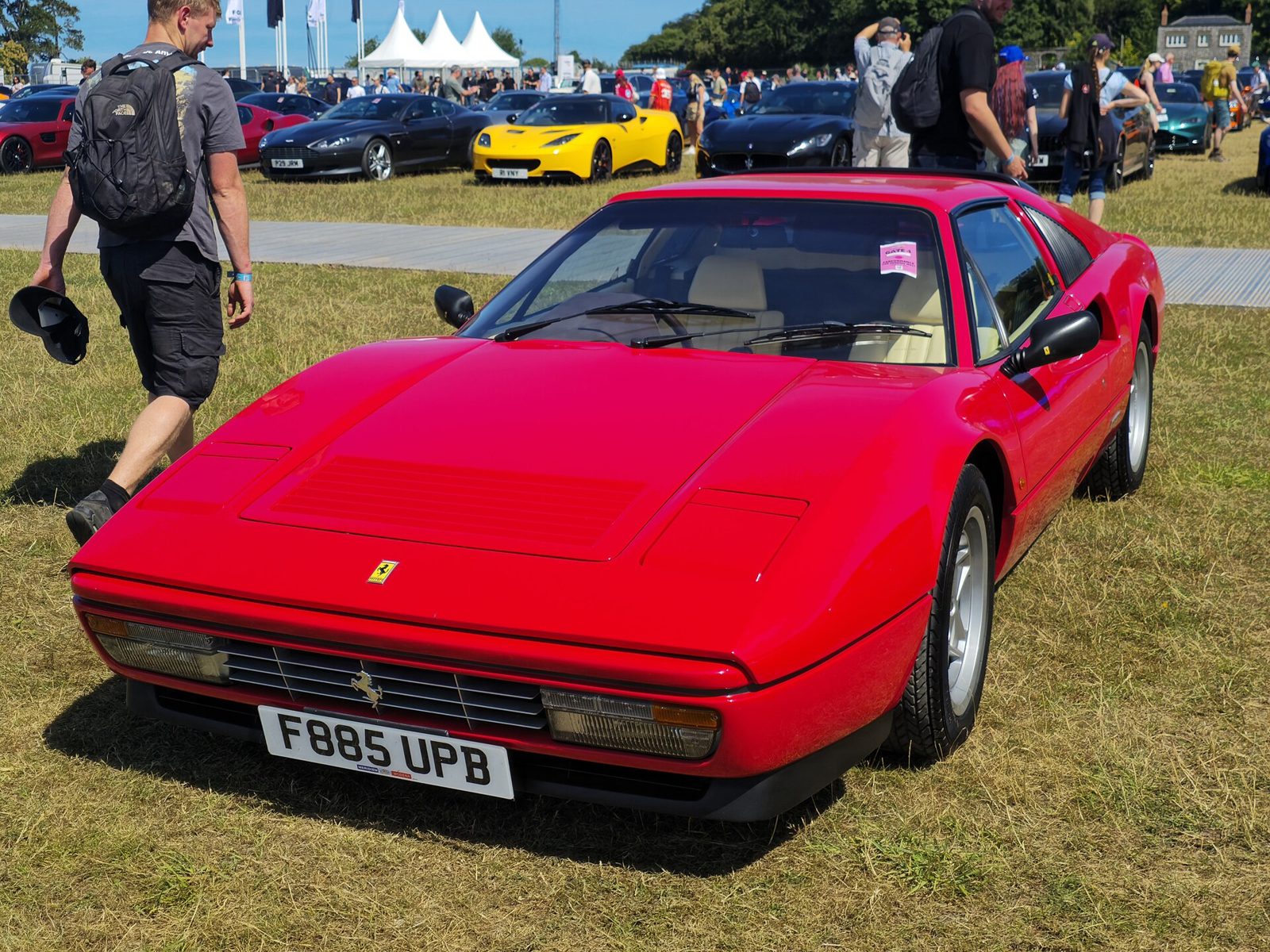
The Ferrari 328 (1985-1989) is the last and most developed form of the transverse-V8 line that began with the 308 GTB in 1975, and it is best read as a refinement of that car rather than a replacement for it. Pininfarina rounded the nose, deleted the louvres behind the headlight pods and replaced the 308's black rubber-faced bumpers with body-colored moldings blended into the valances, aligning the car visually with the Mondial 3.2 and Testarossa. Underneath, the quattrovalvole V8 grew from 2,927 cc to 3,185 cc for 270 hp in European tune, the track was widened, the steering rack was quickened to 288 GTO specification and the bodyshell was galvanized. From February 1988 anti-lock braking became available, bringing a revised front geometry with negative wheel offset and convex wheels in place of the earlier concave pattern. Buyers overwhelmingly chose the targa: 6,068 GTS against 1,344 GTB. Among the older mid-engined Ferrari V8s the 328 carries the strongest reputation for dependability, helped considerably by a cam-belt service that does not require the engine to come out.
328 GTB / GTS
328
7,412 built · 2-door Berlinetta (fixed-roof coupe, GTB) · 2-door Spider/targa with lift-out roof panel and fixed rear buttresses (GTS)
How rare is it?
With about 7,412 built, the Ferrari 328 GTB / GTS is rarer than a DeLorean (~9k) yet more common than a F40 (~1k).
Approximate total production placed on a log scale against well-known reference cars, for scale only. Figures and any disputes are detailed in the production notes and sources.
Production by variant
How the 328 GTB / GTSrun breaks down, and which variants are the scarce ones. Approximate figures from this model’s cited sources.
Rarest of the bunch: the 328 GTB, only about 1,344 built, roughly 1 in every 6 328 GTB / GTSs. If provenance and rarity drive your buy, this is the one to hunt.
Variants shown ≈ 100% of the ~7,412 built. Figures approximate; see Sources below.
History
Refinement, Not Replacement
By 1985 the transverse-V8 Ferrari was a decade old. The 308 GTB had arrived in 1975, acquired fuel injection, then four valves per cylinder in 1982, and had quietly become the company's volume model. Rather than start again, Maranello enlarged the engine, tidied the body and let the design see out the decade. Ferrari's own record has the 328 GTB shown at the Frankfurt Salon in the autumn of 1985 and replaced by the 348 tb in the autumn of 1989 - four model years, and the last of the line before the 348 turned the engine through ninety degrees and changed the character of the car entirely. The 328 is therefore not a new idea but a finished one, and almost every difference from the 308 is a correction rather than an invention.
The 3.2-Liter Quattrovalvole
The engine is the clearest of those corrections. The quattrovalvole V8 went from 2,927 cc to 3,185 cc, bore rising from 81 mm to 3.3 in (83 mm) and stroke from 71 mm to 2.9 in (73.6 mm), with compression lifted from 9.2:1 to 9.8:1 on European cars and from 8.6:1 to 9.2:1 on catalyzed American ones. Ferrari's type reference is F 105 CB 000. Bosch K-Jetronic mechanical injection was carried over and Marelli MED 806 A electronic ignition fitted. European output rose to 270 hp at 7,000 rpm against the quattrovalvole's 240, with 224 lb-ft at 5,500 rpm; the American car, breathing through catalysts, was quoted at 260 hp and about 213.5 lb-ft, and from the spring of 1987 a further tipo 046 specification with KE3-Jetronic served Switzerland and Sweden at 255 hp. Thirty horsepower is not transformative, and peak power was never the point: the gain sits in the mid-range, which is exactly where the 308 had always felt thin.
Pininfarina's Second Pass
The body changes are subtle in photographs and obvious in the metal. The nose was rounded and the wedge softened, the louvres behind the headlight pods deleted, the radiator exhaust louvre enlarged and the tail restyled. The most consequential change was the bumpers, which became body-colored moldings blended into the front and rear valances in place of the 308's black rubber-faced items - done deliberately so that the eight-cylinder cars, the Mondial 3.2 among them, read as one family. Beneath the skin the F106 tubular frame continued under new numbering, the track was widened by 0.98 in (25 mm) at the front and 0.20 in (5 mm) at the rear, Koni dampers were fitted throughout, the rack was quickened to the ratio used on the 288 GTO, and the bodyshell was galvanized. That last item has done more for survival rates than anything else on the list.
February 1988: ABS, Geometry and Convex Wheels
The mid-life change arrived in February 1988, from chassis 76626. Anti-lock braking was not a bolt-on: the front suspension geometry was reworked to a negative wheel offset and the dampers retuned to reduce squat and dive, and the new offset required new wheels, the concave 16-inch pattern giving way to the convex design shared with the Mondial 3.2. Revised cars carry a Cavallino Rampante on each door mirror and twin hood catches, and are commonly described as MY 1988 1/2. Whether ABS was optional or standard depends on which source is consulted and probably on the market; American cars went without it entirely through 1988 and received it only for model year 1989. Collectors read the change in both directions - the later car is the better-developed one, the earlier the purer - and the market has never settled the argument.
Targas, Right-Hand Drive and the Afterlife
Buyers voted for the removable roof by a margin that still shapes the market: 6,068 GTS against 1,344 GTB, about four and a half to one. Right-hand-drive numbers are smaller again, 130 GTBs and 542 GTSs being the figures usually quoted, with a further 152 right-hand-drive GTSs said to have gone to Australia. Production ended in 1989 and the 348 took over. What the 328 acquired afterwards was a reputation none of its successors managed: among the older mid-engined V8s it is the car specialists describe as dependable, in large part because its cam-belt service can be carried out with the engine in the car - a sentence that cannot be written about the 355 that followed.
Common Problems
The mechanical package is the least troublesome of the older mid-engined V8s, and specialists say so plainly - Continental AutoSports' technical manager described the 328 as one of the most reliable models Ferrari ever built, provided it is maintained. Oil weeps are normal rather than alarming: cam covers, cam seals and the gearshift shaft seal are the usual sources, and a light drip from the sump area is expected. Electrical faults are the more common irritation, with arcing at the fuse-box terminals a known pattern and climate-control switches failing at the illumination first, which means replacing the whole switch. K-Jetronic is mechanically robust but resents standing, and cars recommissioned after long storage frequently need fuel lines, an accumulator or a warm-up regulator. The scheduled work is where the money goes. The belt service runs to roughly $3,500 to $5,900 at American independents by owners' own accounts, with a UK specialist quoted nearer $2,100 for comparable work; dealer menu pricing for a 308/328 major service starts at $8,250 and rises to $12,999 where valve covers, cam seals and shim adjustment are included. Valves want checking at 15,000-mile intervals and gearbox oil every two years in a car covering meaningful distance. On American cars, NHTSA campaign 89V111000 of May 1989 replaced the four front lower suspension arm forks with thicker items after they were found liable to deform following a substantial impact.
What to Look For
Belt-service history is the dominant document. The interval is quoted at five years or 30,000 miles, and unlike most later mid-engined Ferraris the job is done with the engine in the car, so the consequence of a lapse is measured in engine damage rather than in an unpayable bill. Dated invoices naming the tensioner and idler bearings, not just the belts, are what separate a documented car from an asserted one; a car whose last belt is undated should be costed as needing one immediately. Establish the specification before the condition. Chassis 76626 and February 1988 divide the run: ABS cars carry convex wheels, negative-offset front geometry, twin hood catches and Cavallino Rampante badges on the door mirrors, and a car advertised as a late one wearing concave wheels needs explaining. Confirm which market the engine was built for - European 270 hp, catalyzed American 260 hp, or the Swiss and Swedish tipo 046 at 255 hp - since the paperwork does not always say. The shell is galvanized but not immune: check sills, the front of the rear arches, the battery tray and the trunk floor, and on a GTS the targa panel seals and the channel the panel sits in. Matching engine and gearbox numbers and a Ferrari Classiche certificate both show up in the strongest auction results. On an American car, confirm the 1989 NHTSA recall on the front lower suspension arm forks was carried out. Finally, weigh a car that has sat: K-Jetronic systems and fuel lines dislike long storage more than they dislike use.
Market Notes
As of August 2026, classic.com's Market Benchmark for the 328 GTB stands at approximately $173,011 on a rising trend, and for the 328 GTS at approximately $115,000 - $115,363 on the model landing page and $115,108 on the GTS sub-market page, also rising. The GTB premium is roughly fifty per cent, which is the scarcity ratio expressing itself directly. The lowest sale classic.com tracks is $47,250, a 1988 GTS in April 2023; current asking prices on the site span roughly $112,000 to $290,000. Auction evidence sits above the benchmarks and is dominated by mileage. RM Sotheby's sold a 1988 GTB from the Longhorn Collection, non-ABS and showing 8,380 miles, for $212,800 at Arizona in 2026; a 1989 GTB with 8,286 miles and Swiss delivery made EUR 120,750 at Paris in 2024; a 1989 GTS with 17,657 miles and a 2023 belt change made EUR 92,000 at Villa Erba in 2023; and a Classiche-certified 1989 GTS showing 1,491 miles made $235,200 at Miami in 2022. All four are 'Sold for' figures and therefore include buyer's premium, not hammer. Prices quoted here are as of August 2026.
Where sources differ
Published performance figures for the 328 do not agree, and no independently measured figure was found for this entry.
Wikipedia separates the bodies at 166 mph and 0-60 mph in 5.5 seconds for the GTB against 163 mph and 5.9 seconds for the GTS. Supercar Nostalgia gives 163 mph and 0-62 mph in 5.8 seconds for both. Conceptcarz gives 163.5 mph. Classic Motorsports quotes 6.0 seconds to 60 mph for the American car and Exotic Car Trader quotes 165 mph and roughly five seconds. None of these is presented as an independently instrumented test and the spread is not resolved by any source consulted here.
Sources disagree over whether anti-lock braking was optional or standard equipment on the 328 after February 1988.
Ferrari's own model page describes ABS as available as an option from mid-1988 and Wikipedia describes European cars as offered ABS optionally through mid-1988 and 1989. Exotic Car Trader describes ABS as fitted to the 328 range in 1988 rather than optional. 308-328.com states only that it was available from chassis 76626 in February 1988, and Classic Motorsports dates the change to late 1988 without addressing whether it was standard. The conflict is not resolved by any source consulted here, and it may in practice have varied by market.
Sources
- Ferrari 328 GTB (1985), Ferrari S.p.A. · manufacturer
- Ferrari 328, Wikipedia · encyclopedia
- Ferrari 328 GTB & 328 GTS Guide, Supercar Nostalgia · specialist
- From 1985 to 1989: versions Ferrari 328, 308-328.com · registry
- Ferrari 308 and 328 buying guide: the various versions (1/3), Ferrarista.Club · club-forum
- 1986 Ferrari 328 Specifications & Dimensions, Conceptcarz · encyclopedia
- Ferrari 328 GTB US Market Specs, Performance, Comparisons, Ultimate Specs · encyclopedia
- Ferrari 328 Market, classic.com · market-data
- Ferrari 328 GTB Market, classic.com · market-data
- Ferrari 328 GTS Market, classic.com · market-data
- 1988 Ferrari 328 GTB, Arizona 2026, RM Sotheby's · auction-house
- 1989 Ferrari 328 GTB, Paris 2024, RM Sotheby's · auction-house
- 1989 Ferrari 328 GTS, Villa Erba 2023, RM Sotheby's · auction-house
- 1989 Ferrari 328 GTS, Miami, RM Sotheby's · auction-house
- Ferrari 328 GTS and 328 GTB: Buy one now?, Classic Motorsports · journalism
- 1988 Ferrari 328 GTS review: Retro Road Test, Retro Motor · journalism
- Major service cost for 328, FerrariChat · club-forum
- Ferrari 308/328 Service Menu, J. Scuderia Automotive · specialist
- NHTSA Recall Campaign 89V111000 - Ferrari 328 front lower suspension arm, National Highway Traffic Safety Administration · government
- Ferrari 328 GTS Complete Guide, Exotic Car Trader · journalism
Synthesized from the sources above and cross-checked. We cite and link out; we do not republish other databases verbatim.
Fully Sorted is an independent publisher and is not affiliated with, endorsed by or sponsored by Ferrari S.p.A.. Ferrari and the model names on this page are trademarks of Ferrari S.p.A. and are used here only to identify the cars being described.
Chassis register
Nobody has recorded a car here yet. Own one, or know one? Chassis number, what you can prove about it, and a source if there is one. Every entry is reviewed before it appears.
Nerd Notes
What owners know that the sources don't. Every note is read and checked before it appears here.
Key Specs
- Power
- 270 hp at 7,000 rpm European (manufacturer claim); 260 hp at 7,000 rpm SAE net United States; 255 hp at 6,750 rpm Switzerland and Sweden
- Brakes
- Ventilated discs all round; Bosch ABS available from February 1988 (chassis 76626), United States cars from model year 1989
- Engine
- 3,185 cc Tipo F105 CB 000 90-degree V8, all-alloy, mounted transversely
- Layout
- Transverse mid-mounted engine, rear-wheel drive, five-speed transaxle beneath the engine
- Torque
- 224 lb-ft at 5,500 rpm European; approximately 213.5 lb-ft at 5,500 rpm United States
- Weight
- Approximately 2,784 lb European GTB and 2,806 lb GTS; United States curb weight quoted at approximately 3,142 lb
- Chassis
- Tipo F106 tubular steel frame, steel bodywork galvanized for corrosion protection; European GTB chassis reference F 106 MB 100
- Steering
- Unassisted rack and pinion, 3.25 turns lock to lock, ratio shared with the 288 GTO
- Suspension
- Independent double wishbones front and rear, coil springs, Koni telescopic dampers, anti-roll bars both ends; front geometry revised to negative offset on ABS cars from February 1988
- Valvetrain
- Twin overhead camshafts per bank, belt-driven, four valves per cylinder
- Bore stroke
- 83.0 mm x 73.6 mm (308 quattrovalvole: 3.2 in (81.0 mm) x 71.0 mm)
- Compression
- 9.8:1 European; 9.2:1 catalyzed United States, Japan and Australia
- Acceleration
- 0-60 mph quoted between 5.5 and 6.0 seconds depending on source and market specification
- Transmission
- Five-speed all-synchromesh manual with open gate and limited-slip differential
- Wheels tires
- 16-inch alloys, 205/55 VR16 front and 225/50 VR16 rear; concave pattern to early 1988, convex thereafter
- Fuel ignition
- Bosch K-Jetronic mechanical fuel injection with Marelli MED 806 A electronic ignition; KE3-Jetronic on the Swiss and Swedish tipo 046
- Top speed claimed
- 163-166 mph (163-166 mph) depending on source and body style; a manufacturer-derived claim, not an independently measured figure
Notable Variants
328 GTB
The fixed-roof berlinetta: 1,344 built against 6,068 GTS, chassis 58735 to 83017. Stiffer, quieter and considerably rarer, and the only body style in the range carrying a scarcity premium.
328 GTS
The targa, with a lift-out roof panel between fixed buttresses, and the car most buyers actually bought: 6,068 built, chassis 59301 to 83136. About ten kilograms heavier than the GTB and the default way into the model.
328 with ABS (from February 1988, chassis 76626)
The mid-life car. Anti-lock braking required a reworked front geometry with negative wheel offset, which in turn required convex 16-inch wheels in place of the concave pattern. Door-mirror Cavallino badges and twin hood catches identify them.
328 (United States specification)
Catalysed 260 hp SAE net on 9.2:1 compression, curb weight quoted near 3,142 lb against roughly 2,784 lb for a European GTB. No ABS through the 1988 'MY 1988 1/2' season, and only from model year 1989.
328 (Switzerland and Sweden, tipo 046)
From spring 1987, a catalyzed specification using KE3-Jetronic and quoted at 255 hp at 6,750 rpm. The lowest-output 328, and easy to mistake for a standard European car on paperwork alone.
328 (right-hand drive)
Quoted at 130 GTBs and 542 GTSs, with a further 152 right-hand-drive GTSs said to have gone to Australia. A right-hand-drive GTB is a car in the low hundreds worldwide, and priced accordingly in Britain.
GTB Turbo / GTS Turbo (Italian market)
Not a 328. A 1,991 cc IHI-turbocharged two-valve V8 of 251 hp in the 328's bodyshell, built 1986-1989 to sit under Italy's 2.0-liter VAT threshold. Counted separately, at 308 GTB Turbos and 828 GTS Turbos.
Value Trajectory
The 328 spent most of its life as the cheap way into a mid-engined Ferrari and stopped being that somewhere around the middle of the last decade, when the analogue, manual, pre-electronics cohort re-rated as a group and the 328 went with it. Its position now is settled rather than speculative: as of August 2026 classic.com shows both body styles trending upward, with the GTB benchmark near $173,011 and the GTS near $115,000, and the gap between them tracking the four-and-a-half-to-one production ratio more faithfully than it did ten years ago. The more instructive spread is within each body style rather than between them. A 1989 GTS with 17,657 miles made EUR 92,000 at Villa Erba in 2023, while a Classiche-certified 1989 GTS showing 1,491 miles made $235,200 at Miami in 2022 - the same car in every respect that matters mechanically, separated by an odometer and a folder of invoices. Since the 328's whole case rests on being the dependable one, documentation of the belt service is the value factor that behaves least like a fashion, and the widening distance between recorded and unrecorded cars is the clearest trend in the model.
Next
Shopping for one?
Browse Ferrari listings, or decode a VIN before you buy.