
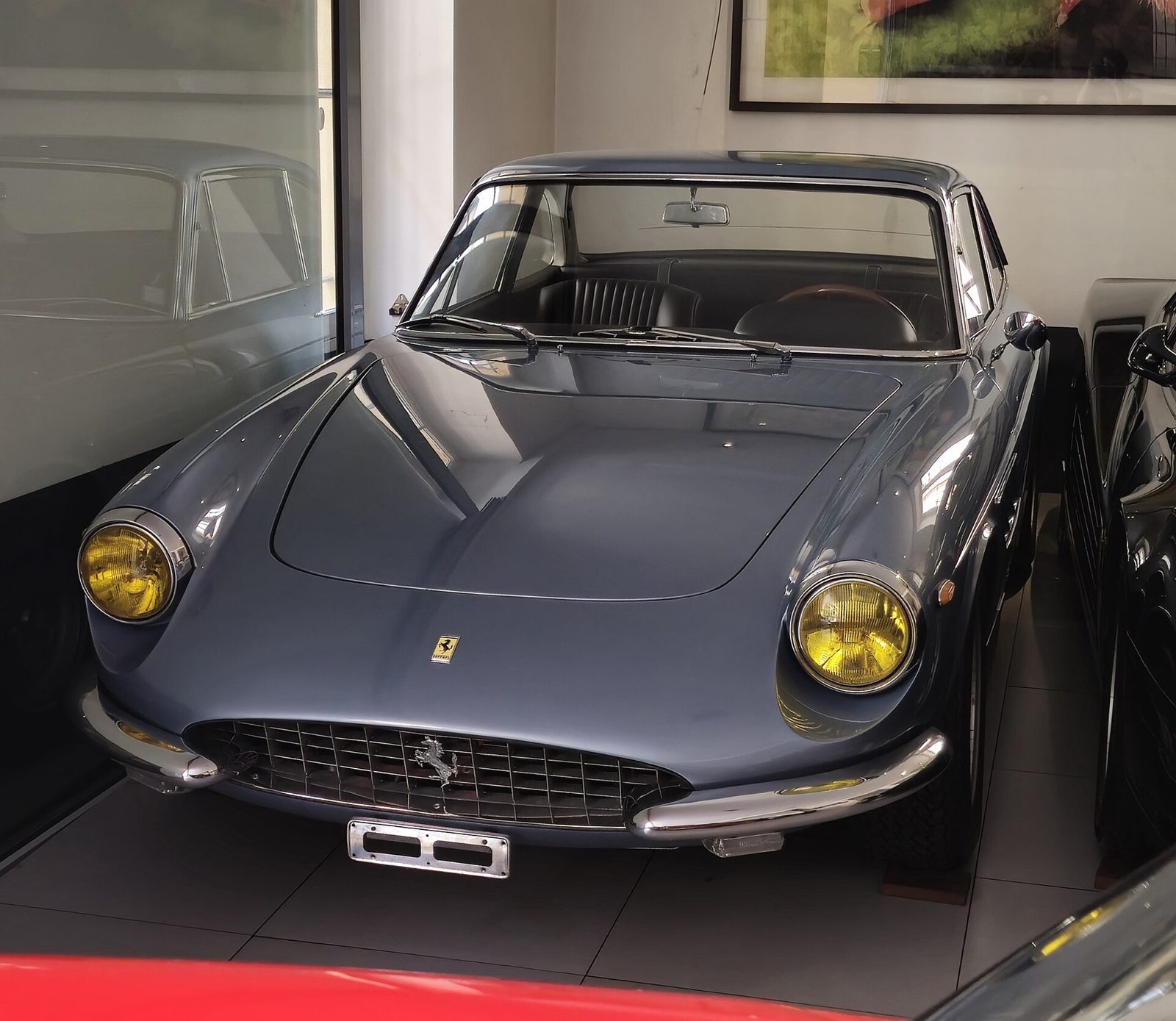
The Ferrari 330 GTC (1966-1968) was the car that first made a front-engined V12 Ferrari genuinely easy to live with. Shown at Geneva in March 1966, it placed the 4-liter single-cam Tipo 209 V12 from the 330 GT 2+2 into the short 94.5 in (2,400 mm) chassis of the 275 GTB, complete with that car's independent rear suspension, rear-mounted five-speed transaxle and the rigid torque tube Ferrari had introduced in April 1966. Pininfarina both styled and built the body, borrowing the 500 Superfast's nose and the 275 GTS's tail, with leather, electric windows and optional air conditioning inside. Ferrari claimed 300 hp; period testers recorded 0-60 mph in under seven seconds and top speeds around 145-152 mph, and remarked on the refinement as much as the pace. The open 330 GTS followed at Paris in October 1966. Around 600 coupes and around 100 spiders were built before the 4.4-liter 365 GTC and GTS replaced them in 1968, though sources disagree on the exact figures. As of September 2026 a good coupe sits around the mid-$500,000s on classic.com's benchmark, with the GTS at roughly four times that.
330 GTC
330 GTC and GTS
History
Where It Sat in the Range
By the mid-1960s Ferrari's road-car range had separated into two temperaments. The 275 GTB was the short-wheelbase berlinetta with competition manners, and the 330 GT 2+2 was the long, quiet four-seater with the 4-liter engine. Ferrari's own account of the 330 GTC is that it 'slotted in between' the two: it shared the 275 GTB's chassis and took the 2+2's engine, an enlarged version of the 275 unit that was, in Ferrari's words, 'virtually identical in specification to that used in the late series 330 GT 2+2 models'. The result was a two-seater with 300 hp that did not demand anything of its driver, which in 1966 was a new idea for Maranello; the Audrain museum describes it as 'a more luxurious alternative to the 275 GTB/4' and the effective replacement for the 500 Superfast.
Chassis, Torque Tube and Transaxle
The mechanical package is the interesting part. The Tipo 592 tubular chassis carried the 94.5 in (2,400 mm) wheelbase of the 275 GTB, and with it that car's independent rear suspension and rear-mounted five-speed transaxle. Ferrari specifies that the 330 GTC used the same arrangement as the post-April 1966 275 GTB: two engine mounting points and two transaxle support points, with a rigid torque tube connecting them 'to form a solid unit'. A development car, chassis 06431, cataloged by Gooding as the 275/330 GTC Prototipo and retained by Ferrari for testing through 1966, sits at the start of the story. Brakes were Girling discs all round with a cable handbrake, and the standard wheels were 7L x 14 in Borranis on 205-section tires.
The Engine
The Tipo 209/66 V12 displaced 3,967 cc from a 3.0 in (77 mm) bore and 71 mm stroke, giving the 330 cc per cylinder that named the car. It was a single-overhead-camshaft-per-bank Colombo unit with a seven-main-bearing crankshaft, wet sump and three twin-choke Webers, either 40 DCZ/6 or 40 DFI/2 depending on the car. Ferrari claimed 300 hp. The rpm at which that figure was quoted is not consistent across sources, 7,000 rpm in Ferrari's and RM Sotheby's material and 6,600 rpm in Gooding's and Sports Car Digest's, and the torque figure is similarly unsettled, evo and the Audrain museum giving 288 lb-ft against 240 lb-ft elsewhere. Premier Financial Services observes that the 330 matched the 275's 300 horsepower 'but at lower rpm and with more torque', which is the character of the car in one sentence. Road & Track found the engine happy to idle at 700 rpm and rev to 7,000.
Pininfarina, Geneva and Paris
Pininfarina designed and, unusually for the period, assembled the body. Ferrari describes the front as taking after the 500 Superfast and the rear as taking after the 275 GTS, and the thin-pillared glasshouse gave outstanding outward visibility. Inside there were leather seats, a wood-rimmed three-spoke wheel, electric windows as standard and air conditioning as an option. The coupe was presented at Geneva in March 1966; the open 330 GTS, with identical running gear, followed at the Paris Motor Show in October 1966. Pininfarina also produced a small number of special-bodied GTC coupes for the 1967 show season, one of which Sergio Pininfarina bought as a design study, and a single Zagato targa was built in 1967. Sources count the Speciales at four, six or one, so no number is asserted here.
Period Reception and Replacement
The period road tests were unusually warm. Road & Track's verdict on the GTS was 'go ahead, give yourself a treat, buy one', at a US price of $15,000; it recorded 0-60 mph in 6.9 seconds, praised the precise, strongly synchronized gearbox and the superbly rigid body, and was less complimentary about the brakes. Paul Frere in The Motor recorded a 14.6-second standing quarter in November 1966. Classic Motorsports later said the GTC 'could cruise at 130 mph all day long'. Production ran a little over two years, with Ferrari giving a chassis range of 08329 to 11613, and ended in 1968 when the 4.4-liter 365 GTC and GTS replaced the 330s with near-identical bodies. Of 1960s V12 Ferraris, the GTC is the one most often described as a driver's car rather than an exhibit, which has shaped how it has been used and how it is valued.
Common Problems
The Tipo 209 V12 is robust when maintained and has been in specialist hands for sixty years, but the wear points are predictable. Car Collector International names valve-guide wear, cooling neglect and carburetor synchronization as the primary concerns, with a correct top-end and cooling refresh quoted at $40,000 to $90,000. The three Webers need periodic balancing and hot starting can be reluctant; a period owner quoted by Classic Motorsports uses the auxiliary fuel pump to draw fresh fuel from the tank before a hot start. The rear transaxle is the GTC-specific liability: a rebuild is quoted at $25,000 to $55,000 and the symptoms are whine on the overrun and a notchy gearchange when hot. Girling disc brakes were criticized even when new, Road & Track marking them down in 1968, and the Classic Motorsports owner notes the pedal can go to the floor if the system is not kept in adjustment. The electrical system uses a Marelli distributor, a dynamo and Lucas switchgear, all of which age out; progressive rewiring is quoted at $5,000 to $18,000. Air conditioning, where fitted, was marginal and the same owner describes keeping it working as a matter of maintenance and patience. Corrosion in the sills, floors and A-pillars is the structural risk and the most expensive fault to put right. None of the ownership sources describe the torque-tube driveline as a fault area on the GTC; it was the fix for the earlier 275 GTB's driveline problems rather than a problem in itself.
What to Look For
Identity comes first on this model because a GTC is worth a fraction of a GTS and the two share every mechanical part. The genuine spiders are the 99 or 100 original chassis numbers; coupes converted to open bodywork exist and are openly traded as conversions, and classic.com lists one at $599,985 against a $2 million benchmark for a real car. The Ferrari Classiche 'Red Book' and a Marcel Massini history file are the two documents auction houses lean on, and the recent RM Sotheby's and Gooding lots that sold well all had matching engine, gearbox and body numbers confirmed by one or both. Engine and gearbox numbers should match the chassis; Gooding's chassis 9513 and RM's 9487 both carried their original units and gearbox 117 was recorded for the latter. On the mechanical side, Car Collector International's guide lists the checks that matter: a compression and leak-down test, a hot oil-pressure reading and an inspection of the radiator core, with blue smoke on start-up and overrun pointing to valve-guide wear and running hot in traffic to cooling neglect. Transaxle whine on the overrun and a notchy change when hot are the tell-tales for a tired rear unit. The body is steel on a tubular frame and the sills, floors and A-pillars are the corrosion points; a bare-metal Pininfarina body restoration is quoted at $70,000 to $220,000, so the state of the structure decides the price more than the paint does. Specification is worth recording: air conditioning and power windows were factory options and appear on the better-sold cars, and Borrani wire wheels were standard. Right-hand-drive cars, 22 by evo's count, need their configuration confirmed as original rather than converted. Service history matters in the usual way, but on this car the recent auction results show that a documented engine rebuild or transaxle overhaul, at $25,000 to $90,000, is reflected almost pound for pound in the result.
Market Notes
As of September 2026 classic.com's market benchmark for the Ferrari 330 GTC stands at $552,765 on a downward trend, with an average recorded sale of $537,494. Its lowest recorded result is a $39,200 sale on 26 October 2024; neither page explains the figure and it reads as an outlier rather than a data point about running cars. Recent results cluster more tightly. RM Sotheby's sold chassis 9487, a Classiche-certified LHD car with $34,000 of recent servicing, for $742,000 at Monterey in August 2025, and chassis 9595, an air-conditioned car with a 2016 engine rebuild and thirty years in one Phoenix ownership, for $588,000 at Arizona in January 2026. Broad Arrow sold a 1967 GTC for $450,500 in October 2025. Dealer asking prices on classic.com sit at $525,000 to $595,000. The open GTS is a different market: classic.com's benchmark is $2,005,709 on an upward trend with an average of $1,866,908 and a floor of $1,116,000 in August 2023. Gooding sold the unrestored, 39,500-mile chassis 9513 for $1,600,000 at Amelia Island in March 2025 against a $1.75 to $2.25 million estimate, Broad Arrow made 1,918,750 euros for a matching-numbers 1968 GTS at Villa d'Este in May 2026, and RM Sotheby's Monaco 2026 failed to sell chassis 10689 against a 1.4 to 1.8 million euro estimate. Auction figures are published sold prices including premium unless stated.
Where sources differ
The rpm at which the 300 hp peak is quoted and the torque figure both vary by source: 7,000 rpm (Ferrari, RM Sotheby's) against 6,600 rpm (Gooding, Sports Car Digest), and 288 lb-ft at 5,000 rpm (evo, Audrain) against 240 lb-ft at 5,000 rpm (supercars.net).
RM Sotheby's London 2024 catalog quotes 300 hp at 7,000 rpm; Gooding's 2023 and 2025 catalogs and Sports Car Digest quote 300 hp at 6,600 rpm. evo and the Audrain museum give 288 lb-ft of torque; supercars.net gives 240 lb-ft. No manufacturer torque figure was located and the disagreement is not resolved by any source consulted here.
Total 330 GTC production is stated as 598 or 600 depending on the source, with Ferrari's own page giving both figures and a chassis range of 08329 to 11613 excluding prototypes; no single figure is asserted here.
Ferrari's heritage page states '600 were built' in one paragraph and '598 examples were produced. (excluding prototypes)' in another. Wikipedia and Car Collector International state 598. RM Sotheby's, evo, Audrain, Premier Financial Services and Classic Motorsports use 600 or 'approximately 600'. RM Sotheby's separately gives 579 LHD cars and evo gives 22 RHD cars, which sum to 601. Not resolved by any source consulted here; productionTotal is left null.
Total 330 GTS production is stated as 100 by most published references and as 99 by RM Sotheby's and Gooding catalog entries; Ferrari's own GTS page gives no figure.
Wikipedia, Sports Car Market, Hagerty, Classic Motorsports, evo and Car Collector International state 100. RM Sotheby's (chassis 10689, 'the 63rd out of only 99 examples') and Gooding (chassis 9513, 'one of only 99 examples built') state 99. Ferrari's page is silent. Not resolved by any source consulted here.
Pininfarina built a small number of special-bodied 330 GTC Speciale coupes for the 1967 show season, one of which, chassis 8727, was bought by Sergio Pininfarina as a design study; the count is given as four, six or one depending on the source.
Wikipedia and Car Collector International state four Speciale coupes shown at Brussels 1967. RM Sotheby's catalog for chassis 8727 states six built on the 330 GTC platform. supercars.net describes a single car, chassis 9799, shown at Geneva 1967. Not resolved by any source consulted here.
Sources
- Ferrari 330 GTC (1966), Ferrari S.p.A. · manufacturer
- Ferrari 330 GTS (1966), Ferrari S.p.A. · manufacturer
- Ferrari 330, Wikipedia · encyclopedia
- Ferrari 330 GTC Market, classic.com · market-data
- Ferrari 330 GTS Market, classic.com · market-data
- Ferrari 330 GTC: Buyer's Guide, The Classic Valuer · market-data
- 1967 Ferrari 330 GTC by Pininfarina, Monterey 2025, RM Sotheby's · auction-house
- 1967 Ferrari 330 GTC by Pininfarina, Arizona 2026, RM Sotheby's · auction-house
- 1966 Ferrari 330 GTC by Pininfarina, London 2024, RM Sotheby's · auction-house
- 1967 Ferrari 330 GTS by Pininfarina, The Monaco Auction 2026, RM Sotheby's · auction-house
- 1966 Ferrari 330 GTC Speciale by Pininfarina, Arizona 2022, RM Sotheby's · auction-house
- 1967 Ferrari 330 GTS, Amelia Island Auctions 2025, Gooding Christie's · auction-house
- 1968 Ferrari 330 GTS, Pebble Beach Auctions 2023, Gooding & Company · auction-house
- 1964 Ferrari 275/330 GTC Prototipo, Amelia Island Auctions, Gooding Christie's · auction-house
- Broad Arrow Concorso d'Eleganza Villa d'Este Auction 2026: Top 10 Results and Highlights, duPont Registry · journalism
- Vintage R&T Road Test: 1968 Ferrari 330 GTS - Go Ahead, Give Yourself A Treat, Buy One, Curbside Classic · journalism
- 1966 Ferrari 330 GTC review - a racing brute in a fine suit, evo · journalism
- 1967 Ferrari 330 GTC, Sports Car Market · journalism
- 1967 Ferrari 330 GTS, Sports Car Market · journalism
- 1967 Ferrari 330 GTS, Hagerty Media (Sports Car Market reprint, Steve Ahlgrim) · journalism
- The Ferrari 330 GTC: A lifestyle coupe from the lifestyle era, Classic Motorsports · journalism
- 1967 Ferrari 330 GTS, Sports Car Digest · journalism
- Vintage Corner: Ferrari 330 GTC, Premier Financial Services · specialist
- 1967 Ferrari 330 GTC, Audrain Auto Museum · specialist
- Ferrari 330 Buyer's Guide (1963-1968), Car Collector International · specialist
- 1967 Ferrari 330 GTC Speciale, supercars.net · specialist
Synthesized from the sources above and cross-checked. We cite and link out; we do not republish other databases verbatim.
Fully Sorted is an independent publisher and is not affiliated with, endorsed by or sponsored by Ferrari S.p.A.. Ferrari and the model names on this page are trademarks of Ferrari S.p.A. and are used here only to identify the cars being described.
Chassis register
Nobody has recorded a car here yet. Own one, or know one? Chassis number, what you can prove about it, and a source if there is one. Every entry is reviewed before it appears.
Nerd Notes
What owners know that the sources don't. Every note is read and checked before it appears here.
Key Specs
- Power
- 300 hp claimed by Ferrari. Peak rpm varies by source: 7,000 rpm (Ferrari, RM Sotheby's), 6,600 rpm (Gooding, Sports Car Digest)
- Brakes
- Girling discs on all four wheels, cable-operated handbrake
- Engine
- 3,967 cc Tipo 209/66 60-degree Colombo V12, alloy block and heads with iron liners, seven-main-bearing crankshaft, chain-driven single overhead camshaft per bank, wet sump, three twin-choke Weber 40 DCZ/6 or 40 DFI/2 carburetors
- Layout
- Front-mounted longitudinal V12, rear-wheel drive via rear-mounted five-speed transaxle connected by a rigid torque tube
- Torque
- Quoted figures conflict: 288 lb-ft at 5,000 rpm (evo, Audrain museum) or 240 lb-ft at 5,000 rpm (supercars.net); no manufacturer figure was located
- Weight
- 3,104 lb for the GTS per evo, which describes the spider as 243 lb heavier than the coupe (implying about 2,862 lb for the GTC, a figure evo does not state directly); Classic Motorsports quotes 'nearly 2,900 lb' for the GTC. No factory curb weight located
- Chassis
- Tipo 592 tubular steel chassis, 94.5 in (2,400 mm) (94.5 in) wheelbase, shared with the post-April 1966 275 GTB; Pininfarina steel body, assembled by Pininfarina
- Top speed
- 152 mph (GTC) and 146 mph (GTS) per evo; RM Sotheby's quotes 150 mph; Sports Car Market cites 145 mph in period testing. All are claims or period figures rather than a single verified number
- Dimensions
- Length 177.4 in (4,505 mm), width 64.0 in (1,626 mm), height 47.8 in (1,214 mm) (evo)
- Suspension
- Independent all round by unequal-length wishbones, coil springs and telescopic dampers; the rear layout inherited from the 275 GTB
- Bore stroke
- 77 mm x 71 mm
- Compression
- 8.8:1 (evo)
- Acceleration
- 0-60 mph in 6.5 s (evo) to 6.9 s (Road & Track, 330 GTS); standing quarter mile 14.6 s (Paul Frere, The Motor, November 1966) and 14.9 s at 95 mph (Road & Track), as reported by Sports Car Market
- Period price
- US list about $14,000 to $15,000 for the GTC and $16,800 for the GTS (Classic Motorsports, Road & Track, Sports Car Market)
- Transmission
- Tipo 592/1369 five-speed all-synchromesh manual in unit with the final drive at the rear
- Wheels tires
- 7L x 14 in Borrani wire wheels with 205 x 14 tires as standard
- Chassis numbers
- 08329 to 11613 excluding prototypes, per Ferrari
Notable Variants
330 GTC (1966-1968)
The standard closed car, Geneva March 1966. Pininfarina body on the 275 GTB's 94.5 in (2,400 mm) chassis with the 4-liter Tipo 209 V12, rear transaxle and torque tube. The bulk of production and the entry point to a 1960s V12 Ferrari with a genuinely usable cabin.
330 GTS (1966-1968)
Open version shown at Paris in October 1966 with the same running gear. Roughly 99 or 100 built against about 600 coupes, and priced accordingly: as of September 2026 the classic.com benchmark for a GTS is nearly four times that for a GTC.
330 GTC, right-hand drive
evo puts the count at 22 closed cars in right-hand drive, and RM Sotheby's describes left-hand-drive production as 579 cars. Scarcer than the LHD car and of particular interest in the UK and Australia, though the premium is not consistent across sales.
330 GTC Speciale by Pininfarina
A handful of special-bodied coupes shown from the 1967 Brussels and Geneva shows; one (chassis 8727) was bought by Sergio Pininfarina as a design study and sold for $967,500 at RM Sotheby's Arizona in January 2022. Sources count four, six or one, so the number is treated as unknown here.
275/330 GTC Prototipo (chassis 06431)
The development car Gooding describes as the original prototype of the model, retained by Ferrari for testing through 1966 and documented by Marcel Massini; offered at Amelia Island with a $650,000 to $800,000 estimate. A single car, but it explains where the GTC's 275-derived chassis came from.
GTS conversions
Coupes cut into open cars are common enough that classic.com lists a '330 GTS Conversion' at $599,985 as a dealer asking price in August 2026, against a benchmark of about $2.0 million for a genuine GTS. Only the original spider chassis numbers carry the GTS value.
Value Trajectory
The 330 GTC spent decades as the affordable V12 Ferrari. Sports Car Market recorded that average examples were slow sellers at $75,000 in the early 2000s, that a $170,375 Christie's result in August 2006 looked expensive at the time, and that its own GTS valuation range then was $300,000 to $425,000. The 2010s re-rated the car with the rest of the 1960s Ferrari cohort. Since then the coupe has softened: as of September 2026 classic.com's benchmark of $552,765 carries a downward trend arrow, Car Collector International cites a 19.6 per cent year-on-year fall in a US price guide, and the spread between the $742,000 Monterey 2025 result and the $450,500 Broad Arrow result a few months later shows a market that is paying for certification and history and discounting the rest. The GTS has moved the other way: its classic.com benchmark of $2,005,709 is trending upward, though the 2026 results include a strong sale at Villa d'Este and a no-sale at Monaco, so the open car's market is selective rather than uniformly rising. The gap between the two body styles, roughly four to one as of September 2026, is the defining feature of the model's value history and is the reason conversions exist.
Next
Shopping for one?
Browse Ferrari listings, or decode a VIN before you buy.