
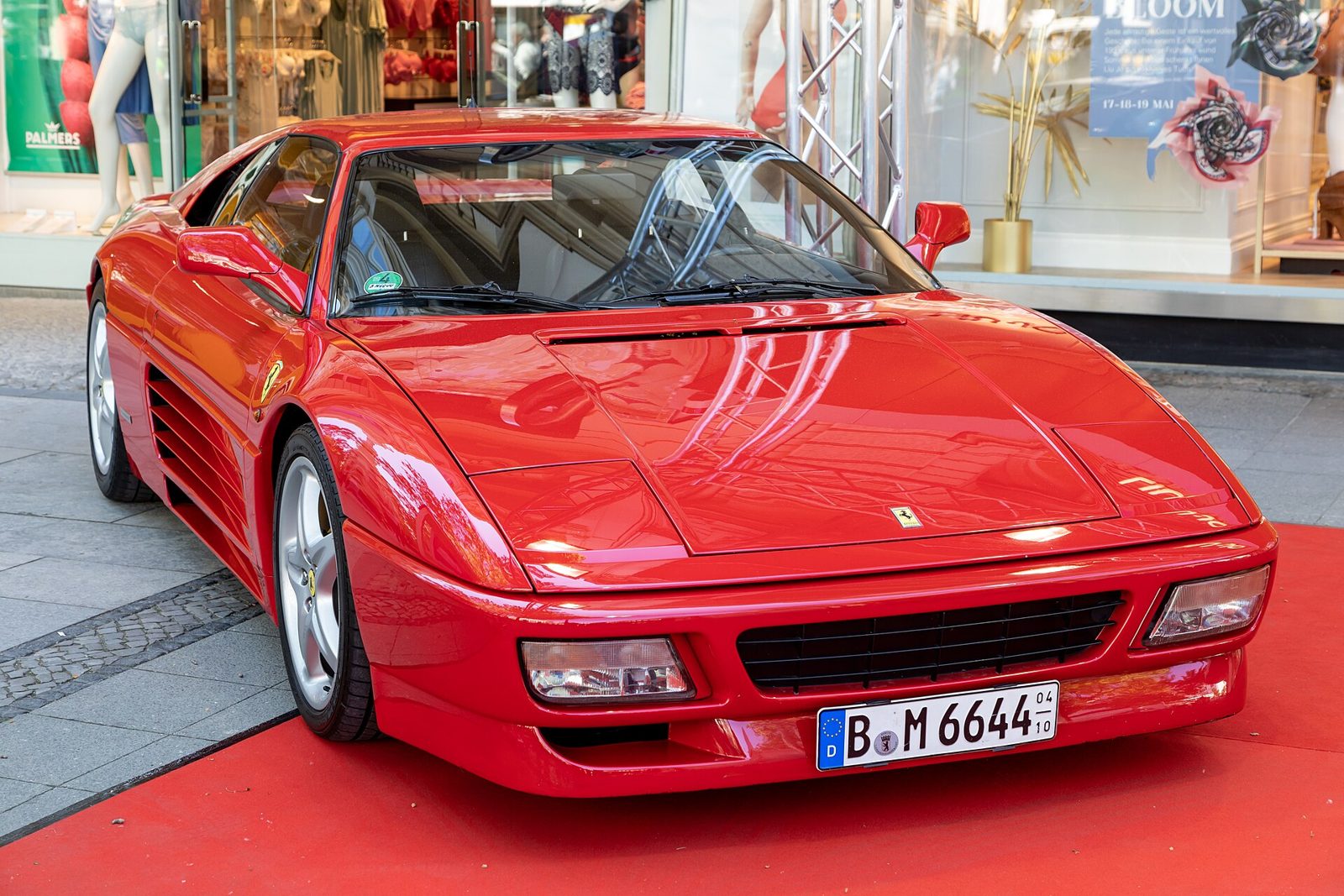
The Ferrari 348 (1989-1995) replaced the 328 and was the first all-new Ferrari presented after Enzo Ferrari's death in August 1988, though its development had begun under him. It broke with the transverse-engined layout that had served every mid-engined V8 Ferrari since the 1973 Dino 308 GT4: the enlarged 3,405 cc Tipo F119 V8 was turned longitudinally, mated to a transverse gearbox behind it, and set into a pressed steel semi-monocoque rather than a tube frame, a first for a Ferrari road car. Pininfarina's body, overseen by Leonardo Fioravanti, borrowed the Testarossa's strakes and drew a mixed reception. So did the car: early cars suffered publicized build and reliability faults and a chassis that period testers found unforgiving at the limit, and Luca di Montezemolo's dismissal of it has followed it since. Ferrari answered with revised suspension for 1992, the US-only Serie Speciale, the 320 hp GTB and GTS, the first full Spider and the Challenge series that began with it. Somewhere between 8,300 and 9,000 were built, the exact figures contested, before the F355 arrived in 1994.
348
TB/TS, GTB/GTS, Spider
Production by variant
How the 348run breaks down, and which variants are the scarce ones. Approximate figures from this model’s cited sources.
Rarest of the bunch: the 348 GT Competizione (1993-1994), only about 50 built, roughly 1 in every 59 348s. If provenance and rarity drive your buy, this is the one to hunt.
Figures approximate; see Sources below.
History
After Enzo
The 348 was shown at the Frankfurt Salon in September 1989 as the successor to the 328 GTB and GTS, the first completely new model announced by the company after Enzo Ferrari's death in August 1988. Ferrari describes it as the last mid-engined V8 developed under his direction, and the name follows the convention of the period: 3.4 liters, eight cylinders. The body was styled at Pininfarina under Leonardo Fioravanti and combined the horizontal side strakes of the Testarossa with a shorter, wedgier profile than the 328. The tb berlinetta and ts targa were offered from the start.
A New Architecture
Every mid-engined V8 Ferrari from the 1973 Dino 308 GT4 to the 328 had carried its engine transversely. The 348 turned the enlarged 3,405 cc Tipo F119 V8 to sit longitudinally, with a five-speed transverse gearbox in unit with the differential behind it, for a lower engine position and center of gravity. The structure changed too: a pressed steel semi-monocoque with robot-welded panels and a separate tubular sub-frame for the engine and transaxle, which Ferrari records as its first departure from the tubular chassis on a production model. The wheelbase grew by 4.3 in (110 mm) to 96.5 in (2,450 mm). The engine was quoted at 300 hp at 7,200 rpm on Bosch Motronic M2.5, with the M2.7 system arriving from chassis 84606 in late 1990.
An Uncomfortable Reception
The press was not kind. Motor Trend found that its roughly six-second 0-60 time could be bettered by cheaper cars, and Car and Driver ran a 348 tb against a GMC Syclone pick-up and reported that the truck won. British testers, Andrew Frankel among them, described a chassis that would recover a small slide but not a larger one, and a gearchange as poor as any road Ferrari's. Owners met cam-drive tensioner wear, failing Delco alternators, Motronic M2.5 faults and climate-control electronics that the factory addressed through a stream of running updates. Luca di Montezemolo is widely quoted dismissing the car in blunt terms after it was out-accelerated by a Golf GTI, and the Honda NSX had by then shown what a mid-engined car could be. Ferrari reworked the suspension hardware and settings for 1992 and moved the battery to the front late that year.
Serie Speciale, GTB, GTS and Spider
The reply to the criticism came in stages. For the United States, 100 Serie Speciale cars were built across late 1992 and early 1993 with a free-flow exhaust quoted at 312 hp, a 1.97 in (50 mm) wider rear track, a shorter final drive and Kevlar-shelled seats taken from the US-specification F40. In February 1993 the 348 Spider appeared, Ferrari's first full convertible mid-engined V8 and, by Forza's reckoning, the first true convertible in the range for more than twenty years, with strengthened door gussets and hinges to make up for the missing roof. In October 1993 the tb and ts became the GTB and GTS: the Tipo F119 H engine with compression raised to 10.8:1 and 320 hp, a wider rear track, revised geometry and a body-color engine cover. They lasted barely into 1994 before the F355 replaced them, which is why their runs are so small and so variously counted; the Spider continued into early 1995.
The Challenge and the Competizione
The Ferrari Challenge began in 1993 as an Italian and European championship using 348s fitted with a factory kit: a 320 hp engine, different exhaust, slick tires, modified brakes, dynamic air intakes, a roll cage, six-point harness, fire extinguisher and circuit breaker. The 348 Challenge ran until 1995, when the F355 Challenge took over. Alongside it Ferrari built the 348 GT Competizione on the GTB platform for GT racing homologation: 50 cars, eight right-hand drive, stripped of air conditioning and carpets to 2,601 lb, with F40 Evoluzione-derived brakes without ABS, rose-jointed suspension, 18-inch wheels and a racing clutch. It was the most focused 348 and remains the most valuable. The 348 then spent two decades as the cheap way into a mid-engined Ferrari, priced below both the 328 and the F355; that position was earned by its early reputation rather than by the later cars, which were better built, better sorted and, in the Spider's case, the best of the series.
Common Problems
Early Tipo F119 engines could suffer extensive wear of the cam-drive chain tensioner in the lower drive system and failure of the inner support bearing for the jackshaft; this was addressed by factory updates, and later engines are described as very strong with little likelihood of a rebuild under 50,000 miles. The belt service is engine-out and forms the major service Forza puts at three-year intervals. Oil leaks from cam covers and engine seals are routine. The Bosch Motronic M2.5 fitted to cars before chassis 84606 gave trouble and was superseded by M2.7. Early Delco alternators failed regularly and were replaced with Nippondenso units. The gearbox is the 348's weakest mechanical area: second gear is hard to select cold, the second-gear synchromesh wears, transfer gears become noisy, and a rebuild is the only durable fix. Clutches are short-lived, sometimes 10,000 to 15,000 miles, and the later multi-plate unit costs roughly twice the early single-plate to replace. The spring platforms that locate the coil springs can crack and let the springs drop. The electronic climate-control ECU fails and is no longer available; the switchgear's rubberized coating degrades into a sticky finish. Wiring and connector faults affect the air conditioning. The body is all steel and generally corrosion-resistant, but wheel arches, sills, door bottoms and door cavities rust on cars stored outside. Missing or damaged undertrays are a sign of careless ownership.
What to Look For
The single most useful thing a 348 can have is a service file from a marque specialist showing that the factory's running updates were applied, because Ferrari issued a great many of them and the cars that received them are different cars from those that did not. The cam-drive chain tensioner and its inner support bearing on early engines are the first thing to look for in that file; a later engine, or an early one with documented tensioner work, is the difference between a strong unit and one facing an engine-out rebuild. Confirm the belt service is current: two years on early cars, extended to three years or 24,000 miles on later ones, and always an engine-out job on this model because the sub-frame comes away with the powertrain. Establish which Motronic system the car has; M2.7 arrived from chassis 84606 in late 1990 and the earlier M2.5 is the one with the reputation. Check the year against the specification claimed: 1992-on suspension revisions, GTB/GTS engine cover and 320 hp engine, Serie Speciale seats and exhaust, Spider door reinforcements. Drive it from cold and try second gear, which baulks until the transaxle oil warms; a noisy gearbox points to worn transfer gears. Check the clutch for slip, and ask how many it has had, since 10,000 to 15,000 miles is a common life and a car with several changes has been driven hard. Look at the spring platforms for cracking, the cam covers for oil leaks, the undertrays for presence and damage, and the wheel arches and door bottoms for corrosion on an otherwise rust-resistant shell. Test the electronic climate control, since replacement ECUs are unavailable and repair means soldering. The sticky rubberized switchgear is universal rather than a fault of one car. Low mileage is not the virtue it is on an F40: several guides note that regularly used 348s are the more reliable ones.
Market Notes
As of September 2026, classic.com's Ferrari 348 market benchmark stands at approximately $86,734 across the series, with sub-model benchmarks of $85,726 for the tb (average sale $73,315, trending up), $85,235 for the ts (average $79,535, trending up), $82,329 for the Spider, $93,917 for the GTB and $95,157 for the GTS. The special cars sit well apart: $195,013 for the Serie Speciale, $203,660 for the Zagato Elaborazione and $261,626 for the 348 Challenge, each resting on a small number of sales. The recorded floor is $36,500 for a 1990 ts in January 2024 and $37,777 for a 1991 tb in June 2023. Recent results show mileage doing most of the work: a 522-mile 1993 tb made $145,000 in November 2025, a 7,000-mile 1990 ts $259,950 in June 2026, a 17,000-mile 1992 ts $225,000 in March 2026, while ordinary 27,000 to 38,000-mile cars sold between $75,000 and $96,000 through 2025-26 and a 34,000-mile 1995 Spider made $90,000 in August 2026. RM Sotheby's sold a 19,855-mile 1993 Serie Speciale tb, the only one in Blu Sera, for $335,000 at Miami in 2026, and a 1994 Challenge with 22,000 miles made $445,000 in August 2026. Auction figures are the houses' stated 'sold for' amounts; classic.com figures are as recorded on that site.
Where sources differ
Total 348 production is stated as 8,844 by Wikipedia and Classic Trader, as 'just under 9,000' by Ferrari, and as 'more than 8,300' by Forza magazine; no figure is asserted here.
Wikipedia and Classic Trader state 8,844. Ferrari Magazine states 'just under 9,000'. Forza states 'more than 8,300' with sub-totals of 3,116 berlinettas, 4,446 targas, 1,146 Spiders and 100 Serie Speciale. None of the sources consulted reconciles the totals, so productionTotal is left null.
Ferrari states 2,894 tb (chassis 81617 to 96679) and 4,228 ts (chassis 81651 to 96964); Supercar Nostalgia and Sports Car Market give 2,895 tb, Supercar Nostalgia gives 4,230 ts with 130 and 261 right-hand-drive cars respectively, and Forza gives 3,116 berlinettas and 4,446 targas.
Ferrari's heritage pages give 2,894 tb and 4,228 ts, figures repeated by Wikipedia, classic.com and Rosso Automobili. Supercar Nostalgia gives 2,895 and 4,230; Sports Car Market gives 2,895 tb. Forza gives 3,116 and 4,446, which may include GTB and GTS cars but still does not match any other combination. Not resolved by any source consulted.
GTB, GTS and Spider production figures are contested: Wikipedia and an RM Sotheby's catalog give 252 GTB and 137 GTS, while Supercar Nostalgia and Rosso Automobili give 222 GTB (14 right-hand drive) and 218 GTS (15 right-hand drive); the Spider is given as 1,090 (68 right-hand drive) by Supercar Nostalgia, 1,146 by Forza and Rosso Automobili, and 'more than 1,000' by Ferrari.
GTB: 252 (Wikipedia, RM Sotheby's London 2023) versus 222 (Supercar Nostalgia, Rosso Automobili). GTS: 137 (Wikipedia) versus 218 (Supercar Nostalgia, Rosso Automobili). Spider: 1,090 (Supercar Nostalgia) versus 1,146 (Forza, Rosso Automobili) versus 'more than 1,000' (Ferrari). Both RM Sotheby's and Supercar Nostalgia agree on 14 right-hand-drive GTBs. Not resolved by any source consulted.
The 348 Serie Speciale was a 100-car run for the United States built across 1992 and 1993 with a free-flow exhaust quoted at 312 hp, a 1.97 in (50 mm) wider rear track, shorter final drive, Pirelli P Zero tires and Kevlar-shelled seats derived from the US-specification F40; the split between coupes and targas is contested.
Wikipedia, Forza and RM Sotheby's state 100 cars. RM Sotheby's catalog says 35 coupes; Supercar Nostalgia says 33 tb and 67 ts; Rosso Automobili says 'around 80' in total. Not resolved by any source consulted.
Sources
- Ferrari 348 TB (1989), Ferrari S.p.A. · manufacturer
- Ferrari 348 TS (1989), Ferrari S.p.A. · manufacturer
- Ferrari 348 Spider (1993), Ferrari S.p.A. · manufacturer
- Ferrari 348 GT Competizione (1993), Ferrari S.p.A. · manufacturer
- 348 Challenge - Ferrari Challenge, Ferrari S.p.A. · manufacturer
- Numbers Game: Ferrari 348, Ferrari S.p.A. · manufacturer
- Ferrari 348, Wikipedia · encyclopedia
- Ferrari 348 tb & 348 ts Guide, Supercar Nostalgia · specialist
- Ferrari 348 GTB / 348 GTS / 348 Spider Guide, Supercar Nostalgia · specialist
- Ferrari 348: PH Used Buying Guide, PistonHeads · journalism
- Ferrari 348: Buying guide and review (1989-1994), Auto Express · journalism
- 1990 Ferrari 348 tb, Sports Car Market · journalism
- Ferrari 348, June 1997, Motor Sport Magazine · journalism
- Two Steps Forward, Issue 205, Forza Magazine · journalism
- 1993 Ferrari 348 Serie Speciale tb, Miami 2026, RM Sotheby's · auction-house
- 1994 Ferrari 348 GTB, London 2023, RM Sotheby's · auction-house
- Ferrari 348 Market, classic.com · market-data
- Ferrari 348 tb Market, classic.com · market-data
- Ferrari 348 ts Market, classic.com · market-data
- Complete Rundown Of All Ferrari 348 Models, Rosso Automobili · specialist
- The Ferrari 348 Buying Guide, Classic Trader · specialist
Synthesized from the sources above and cross-checked. We cite and link out; we do not republish other databases verbatim.
Fully Sorted is an independent publisher and is not affiliated with, endorsed by or sponsored by Ferrari S.p.A.. Ferrari and the model names on this page are trademarks of Ferrari S.p.A. and are used here only to identify the cars being described.
Chassis register
Nobody has recorded a car here yet. Own one, or know one? Chassis number, what you can prove about it, and a source if there is one. Every entry is reviewed before it appears.
Nerd Notes
What owners know that the sources don't. Every note is read and checked before it appears here.
Key Specs
- Power
- 300 hp at 7,200 rpm for tb/ts; 312 hp at 7,200 rpm claimed for Serie Speciale; 320 hp at 7,200 rpm for GTB/GTS/Spider - all manufacturer claims
- Brakes
- Ventilated discs all round with ATE anti-lock; GT Competizione used larger F40 Evoluzione-derived discs and calipers without ABS
- Engine
- 3,405 cc Tipo F119 V8, 3.3 in (85 mm) x 75 mm bore and stroke, twin overhead camshafts per bank, four valves per cylinder, dry sump, Bosch Motronic M2.5 (to chassis 84606) then M2.7
- Layout
- Mid-mounted longitudinal 90-degree V8 with transverse gearbox in unit with the differential, rear-wheel drive
- Torque
- 238-239 lb-ft at 4,200 rpm on 300 hp cars; 239 lb-ft at 5,000 rpm on the F119 H per Ferrari
- Weight
- Quoted figures vary: 3,071 lb tb and 3,082 lb ts per Supercar Nostalgia, 3,064 lb per Auto Express, 3,020 lb for 1993-on cars per Supercar Nostalgia, 3,307 lb curb per Wikipedia; GT Competizione 2,601 lb per Ferrari
- Chassis
- Pressed steel semi-monocoque with separate tubular steel rear sub-frame carrying engine and transaxle; Ferrari's first production road car of this construction
- Fuel tank
- Reduced to 88 liters on the 1993 GTB/GTS per Wikipedia
- Top speed
- 171 mph claimed for 300 hp cars; 174 mph / over 174 mph claimed for 320 hp cars - manufacturer claims
- Wheelbase
- 96.5 in (2,450 mm), 4.3 in (110 mm) longer than the 328
- Dimensions
- Length 166.5 in (4,230 mm), width approximately 74.5-74.6 in (1,892-1,894 mm), height approximately 46.0-46.1 in (1,168-1,170 mm)
- Suspension
- Independent unequal-length wishbones front and rear, coil springs over gas-filled dampers, anti-roll bars; geometry and settings revised for 1992 and again for the 1993 GTB/GTS
- Compression
- 10.4:1 on F119 D/G; 10.8:1 on F119 H from 1993
- Acceleration
- 0-62 mph in 5.4-5.6 s claimed; period US testing recorded 0-60 mph around 6 seconds and a 14.5 s quarter mile for early cars
- Transmission
- Five-speed plus reverse all-synchromesh transverse gearbox and transaxle; single-plate dry clutch on early cars, multi-plate later per Auto Express
- Chassis numbers
- tb 81617 to 96679; ts 81651 to 96964, both per Ferrari
Notable Variants
348 tb (1989-1993)
The original berlinetta. Ferrari gives 2,894 built; other sources give 2,895 or fold in later GTB production. Cars built after chassis 84606 (late 1990) carry Bosch Motronic M2.7 in place of the troublesome M2.5, and 1992-on cars received revised suspension settings; those distinctions matter more to owners than the badge.
348 ts (1989-1993)
Targa with a removable panel stowed behind the seats. Outsold the tb by around three to two (4,228 per Ferrari). Slightly heavier than the tb and, on early cars, more prone to the body flex that period testers criticized.
348 Serie Speciale (1992-1993, US market)
100 cars for the United States with a free-flow exhaust quoted at 312 hp, a 1.97 in (50 mm) wider rear track, shorter final drive, Pirelli P Zero tires and F40-style Kevlar bucket seats. Coupe-to-targa split is contested between sources. Now trades at roughly double a standard car.
348 GTB / GTS (1993-1994)
The run-out revision with the 320 hp F119 H engine, higher compression, wider rear track, revised geometry and body-color engine cover. Built for barely a year before the F355 and in small numbers (222 or 252 GTB depending on source; 218 or 137 GTS). Right-hand-drive cars are in the low teens for each.
348 Spider (1993-1995)
Ferrari's first full convertible mid-engined V8, launched February 1993 with strengthened door gussets and hinges. The most numerous of the 1993-on cars (1,090 or 1,146 depending on source) and the one Forza's testers found best built and most composed of the whole series.
348 Challenge (1993-1995)
The car that launched the Ferrari Challenge one-make series in 1993, with a 320 hp engine, different exhaust, slick tires, modified brakes, roll cage and six-point harness. Genuine factory-kitted cars trade far above road cars; classic.com's Challenge benchmark is roughly three times the tb figure.
348 GT Competizione (1993-1994)
50 built, eight in right-hand drive, on the GTB platform for GT racing homologation: 2,601 lb, F40 Evoluzione-derived brakes without ABS, rose-jointed suspension, 18-inch wheels, no air conditioning or carpets. The most valuable production 348.
348 tb Elaborazione by Zagato (1990-1992)
Ten cars rebodied in part by Zagato with a double-bubble roof, cited by Auto Express and Rosso Automobili. Rare enough that a market benchmark rests on very few sales.
Value Trajectory
After the 1989-90 speculative peak that touched every new Ferrari, spent most of its life at the bottom of the mid-engined V8 market. Classic Trader's September 2020 guide still described prices well below both 328 and F355 levels. Forza put tb and ts cars at $60,000 to $80,000 and the Serie Speciale at $75,000 to $95,000 in March 2023. As of September 2026 classic.com's benchmarks of roughly $85,000 to $95,000 for the standard cars and $195,000 for the Serie Speciale, on an upward trend, show the series re-rating as buyers priced out of the F355 arrive and as the period criticism fades against the reality of a sorted later car. The stratification is by mileage and documentation first, then by variant: the GTB, GTS and Spider carry modest premiums for the 320 hp engine and the later build, while the Challenge, GT Competizione, Serie Speciale and Zagato cars have decoupled into a separate market whose benchmarks rest on very few sales.
Next
Shopping for one?
Browse Ferrari listings, or decode a VIN before you buy.