
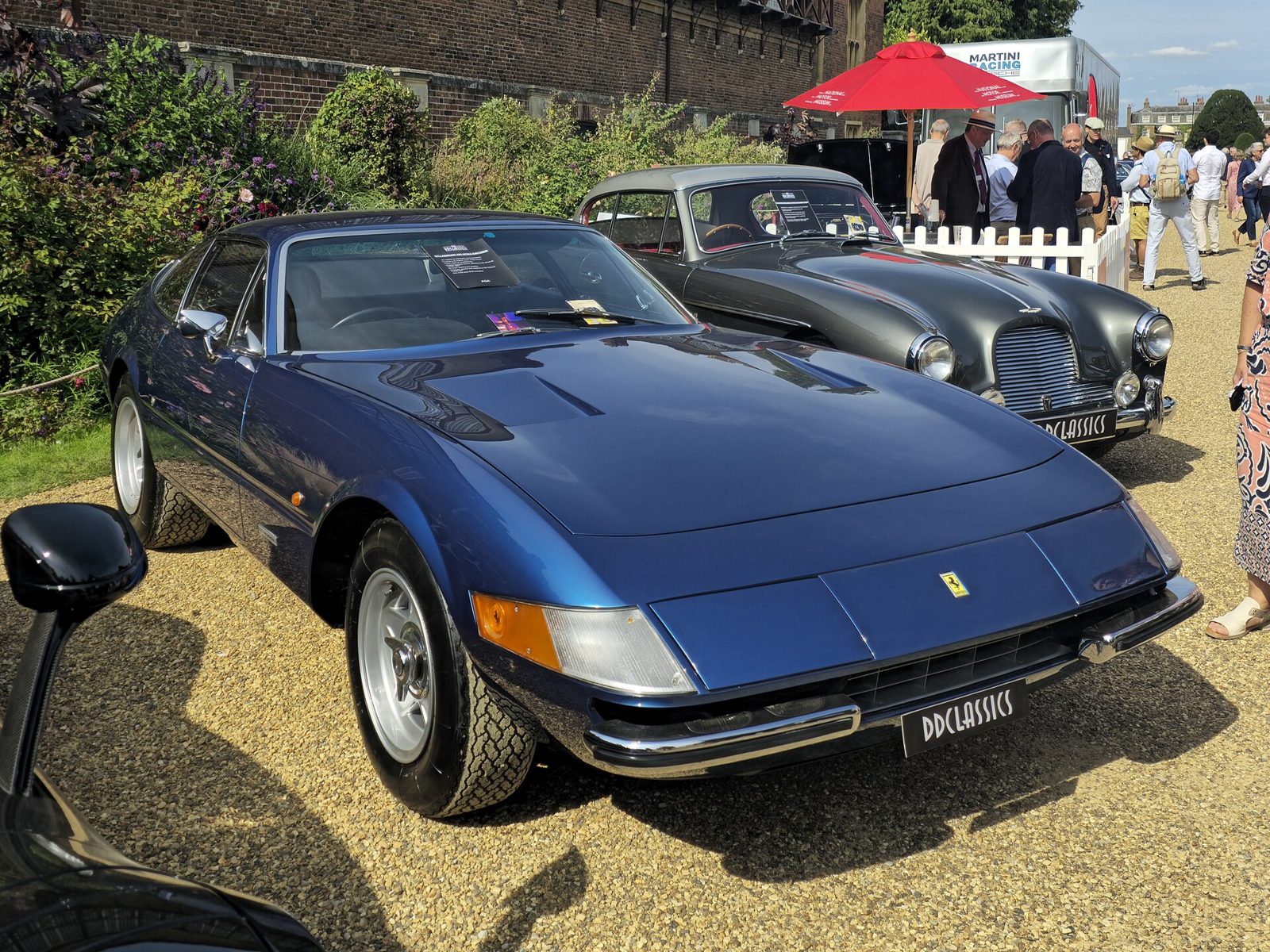
The Ferrari 365 GTB/4 (1968-1973) was the last of Maranello's front-engined two-seat V12 berlinettas in the line that ran back to the 166, and the car that closed that line at very high speed. Shown at the Paris Salon in October 1968 as the replacement for the 275 GTB/4, it took the Colombo V12 out to 4,390 cc with four overhead camshafts, six Weber carburetors and a claimed 352 hp at 7,500 rpm, fed through a rear-mounted five-speed transaxle for balance. Pininfarina's Leonardo Fioravanti drew the sharp-edged body and Scaglietti built it in steel with aluminum opening panels. The press called it Daytona after Ferrari's 1-2-3 at the 1967 24 Hours; the factory never adopted the name officially. Autocar recorded 174 mph and 0-60 mph in 5.4 seconds, figures that stood as the magazine's fastest for years. 1,284 berlinettas are generally agreed; the GTS/4 spider is given as either 121 or 122, the right-hand-drive count as 149 to 158, and the competition cars as 15 to 24 depending on who is counting. Group 4 versions won their class at Le Mans three years running.
365 GTB/4 Daytona
Berlinetta and GTS/4 Spider
History
Replacing the 275 GTB/4
By 1968 Ferrari's front-engined berlinetta was the 275 GTB/4, a 3.3-liter car of great charm that was being outrun by the mid-engined Lamborghini Miura. Ferrari's answer was not a mid-engined car but a larger and faster front-engined one, and the decision drew criticism at the time; Mel Nichols' period road test notes that the car was initially attacked for keeping the engine at the front. The 365 GTB/4 was shown at the Paris Salon in October 1968. Ferrari's own account describes it as the evolution of the 275 GTB/4, with the Colombo V12 enlarged from 3.3 to 4.4 liters, six Weber twin-choke 1.57 in (40 mm) carburetors and the rear transaxle retained for weight distribution. At 174 mph it was, in Ferrari's words, by some margin the fastest road Ferrari to that date.
Fioravanti, Pininfarina and Scaglietti
The body was drawn at Pininfarina by Leonardo Fioravanti, who would go on to the Dino, the 365 GT4 BB, the 308 and the 288 GTO and who has called the Daytona his favorite. Supercars.net quotes him saying he worked seven days without a break on the design. The shape abandoned the rounded forms of the 250 and 275 series for a sharp-edged wedge with a deep indentation line along the flanks and, on the first cars, four headlamps behind a full-width Perspex panel. Scaglietti built the bodies in Modena in steel over a Tipo 605 tubular frame, with aluminum doors, hood and trunk lid and a glassfiber inner tub on the berlinetta. The name came from outside: the press attached 'Daytona' after the 1967 24 Hours 1-2-3, and Ferrari used the name sparingly and always noted it was unofficial.
Engine, Transaxle and the Numbers
The Tipo 251 engine displaced 4,390 cc from an 3.2 in (81 mm) bore and 71 mm stroke, with twin camshafts per bank, two valves per cylinder, dry-sump lubrication and a 9.3:1 compression ratio. Ferrari claimed 352 hp at 7,500 rpm and 318 lb-ft at 5,500 rpm. Drive went through a torque tube to a five-speed transaxle with limited-slip differential. Motor Sport records that Autocar timed 0-60 mph in 5.4 seconds and reached 174 mph, figures that remained the magazine's road-test record for some time; Nichols' own test returned 5.5 seconds to 60 and a little over 12 seconds to 100 mph. The car was heavy and physical. Petrolicious describes steering that is heavy at low speeds and a rear end that breaks away suddenly on its narrow tires in the wet, and Nichols accepted the effort at the wheel and pedals as part of the car.
Spider, US Rules and Running Changes
The 365 GTS/4 spider was shown at Frankfurt in 1969, identical from the waist down but with steel floors, smaller twin tanks and a folding roof; Ferrari says it accounted for about ten per cent of sales. United States lighting regulations killed the Perspex nose, and pop-up headlamps were phased in between chassis 13800 and 14200 during 1971, with the satin aluminum nose band giving way to body color late that year. US cars ran 8.8:1 compression, a central muffler and electronic ignition, and from chassis 15701 the aluminum doors became steel so that side-impact bars could be fitted. Production ended in late 1973, by which time the 365 GT4 BB had taken over as the flagship.
Competition and the Cannonball
Ferrari built Group 4 versions in three series of five between 1971 and 1973, with lightened steel or aluminum bodies and engines tuned to between roughly 400 and 450 hp; Ferrari's own page counts 18 race-prepared berlinettas run by NART, Pozzi, Filipinetti, Swaters and Hoare. They took the GT class at Le Mans in 1972, 1973 and 1974, filling the first five class places in 1972, and a Daytona finished second overall and first in class at the 1979 Daytona 24 Hours, six years after production ended. On the road, Dan Gurney and Brock Yates drove chassis 14271 across America in the first Cannonball Baker run in November 1971, covering 2,876 miles in 35 hours 54 minutes at an average of 80.1 mph; Gurney later said they never exceeded 175 mph.
Common Problems
Timing chains are the well-known weak point: incorrect tensioning leads to premature wear or jumped teeth, while over-tightening damages the front camshaft bearing surfaces in the alloy heads, and access is poor on air-conditioned cars. Second-gear synchromesh suffers from poor technique or a mis-adjusted clutch, with a synchro overhaul quoted by Tom Yang at around $3,000 to $3,500 in 2005 money and cracked rear transaxle casings reported. The six Webers warp with age and admit air at the inlet tracts, and degraded rubber fuel hose is a fire risk on any car with a long gap in its history. The rear exhaust resonator rusts through from the bottom within a few years and a stainless replacement costs about twice the standard part. Brakes fade badly in hard or track use, the factory air conditioning was inadequate when new, and the steering is heavy enough at parking speeds that electric assistance is a common modification. Rust affects rear arches, door skins, the quarter-vent area and, in neglected cars, chassis outriggers, and both guides consulted assume that most cars have had metal repair at some point. A routine engine overhaul was quoted at $25,000 to $30,000 in 2005 and Petrolicious puts a rebuild at up to $50,000. Cars left unused in damp storage develop all of the above at once.
What to Look For
Documentation and originality carry the price. Ferrari Classiche certification confirms matching engine, transaxle and body numbers, and RM Sotheby's catalog entries lean on it heavily; the Monaco 2026 car had been certified in April that year. Establish the original color, since many cars have been changed, and note that a car titled as 1973 may have been built in 1972. Confirm which specification the car actually is: Perspex nose or pop-up lamps, European or US compression and exhaust, aluminum or steel doors, kilometer or mile instruments. Petrolicious warns against paying a premium for a 'rare Tipo A' claim, which simply means European pop-up cars, and against any dealer suggestion that Scaglietti built spiders beyond the factory run. Corrosion is the structural question. The steel is prone to rust around the rear wheel arches, the area between the quarter-light vent and the arch, lower door skins on steel-door US cars and, in bad cases, the chassis outriggers under the floor. Tom Yang's guide recommends demanding answers for any gap in the last ten to fifteen years of history, a compression test before purchase and a check that second-gear synchromesh works without noise. A complete original tool kit is worth a five-figure sum on its own. Take an extended drive from cold, because the engine takes a long time to come up to temperature and cold-stuck piston rings on a car that has sat will show themselves. Outside spider conversions, however well done, are berlinettas in the eyes of the market.
Market Notes
As of September 2026 classic.com's market benchmark for the 365 GTB/4 berlinetta stands at $641,683 on a downward trend, with an average recorded sale of $647,121 and a low of $309,350 for a 1973 car in September 2025. Recent tracked results include $865,000 for a 1971 car in August 2026, $792,000 for a 1972 car at Mecum in January 2026, $610,000 at Gooding Christie's in August 2026 and $500,000 for a 1973 car in January 2026, with five cars then listed between 640,000 euros and $799,890. The GTS/4 spider sits in a different bracket: as of September 2026 classic.com's benchmark is $2,699,633, also trending down, with a low of $2,200,000 in August 2025, and RM Sotheby's sold chassis 14901 for $2,315,000 including premium at Monterey in August 2026. The Competizione market is separate again: Gooding Christie's sold Series III chassis 16407 for $8,145,000 at Pebble Beach in August 2025, a record for the model. Premiums attach to Plexiglas-nose cars in some markets, to documented low mileage, to original colors and to Ferrari Classiche certification; right-hand drive, color changes, US specification and outside spider conversions sit below benchmark.
Where sources differ
Published weights for the Daytona vary widely, from 2,822 lb to 3,600 lb, and no single figure can be treated as authoritative.
Supercar Nostalgia gives 2,822 lb for the standard car and 3,472 lb for US cars. Mel Nichols' period test gives 3,500 lb dry. Supercars.net gives 3,600 lb curb. The sources do not state a common basis (dry versus curb, European versus US) and the spread is not resolved by any source consulted.
The number of factory 365 GTS/4 spiders is stated as either 122 or 121 depending on the source, so no combined production total is asserted for the model.
Ferrari's own model page states 122 spiders in the chassis range 14365 to 17073, and Wikipedia, classic.com, Petrolicious and Tom Yang repeat 122. Supercar Nostalgia states 121 production spiders plus prototypes, RM Sotheby's Monterey 2026 catalog describes chassis 14901 as the 37th of 121, and Motor Sport's 2020 guide also says 121. The one-car difference is probably a prototype counted or not counted, but no source says so and it is not resolved here; productionTotal is left null.
The number of right-hand-drive berlinettas is given as 149, 156 or 158 depending on the source.
Supercar Nostalgia states 149 RHD berlinettas. Wikipedia states 156 UK right-hand-drive coupes. RM Sotheby's London 2025 catalog, Motor Sport and DK Engineering all state 158. Not resolved by any source consulted.
Ferrari built competition Daytonas in three series of five cars between 1971 and 1973, but the total number of competition cars is given as 15, 18, 19 or 24 depending on the source and on whether non-factory builds are included.
Gooding Christie's, Wikipedia and Motor Sport state 15 official competition cars. RM Sotheby's states 24 completed of which 15 were officially recognized factory builds in three series of five. Ferrari's own Competizione page states 18 berlinettas were race-prepared. Tom Yang's guide states 19 competition variants. Not resolved by any source consulted.
Sources
- Ferrari 365 GTB4 (1968), Ferrari S.p.A. · manufacturer
- Ferrari 365 GTS4 (1969), Ferrari S.p.A. · manufacturer
- Ferrari 365 GTB4 Competizione (1971), Ferrari S.p.A. · manufacturer
- Remembering the 365 GTB4 Daytona, Ferrari S.p.A. · manufacturer
- Ferrari Daytona, Wikipedia · encyclopedia
- Ferrari 365 GTB/4 & 365 GTS/4 Daytona Guide, Supercar Nostalgia · specialist
- Ferrari 365 GTB/4 Daytona - The Ultimate Guide, Supercars.net · specialist
- Ferrari 365 GTB/4 Daytona Market, classic.com · market-data
- Ferrari 365 GTS/4 Daytona Market, classic.com · market-data
- 1972 Ferrari 365 GTB/4 Daytona Berlinetta by Scaglietti, The Monaco Auction 2026, RM Sotheby's · auction-house
- 1972 Ferrari 365 GTS/4 Daytona Spider by Scaglietti, The Monterey Auction 2026, RM Sotheby's · auction-house
- 1972 Ferrari 365 GTB/4 Daytona Berlinetta by Scaglietti, London 2025, RM Sotheby's · auction-house
- 1973 Ferrari 365 GTB/4 Daytona Competizione, Sealed - The Daytona, RM Sotheby's · auction-house
- Gooding Christie's Presents ex-Le Mans N.A.R.T. 1973 Ferrari 365 GTB/4 Daytona Competizione for Pebble Beach, Gooding Christie's · auction-house
- Gooding Christie's Achieves New Auction Record with $25.3 Million Ferrari 250 GT California Spider Competizione, Gooding Christie's · auction-house
- 1972 Ferrari 365 GTB/4 Daytona, Pebble Beach Auctions 2016, Gooding & Company · auction-house
- Road car buying guide: Ferrari 'Daytona', November 2020, Motor Sport Magazine · journalism
- 1973 Ferrari 365 GTB/4 Daytona - road test, Drive (reprint of Mel Nichols period road test) · journalism
- Want, Buy and Drive the Ferrari 365 GTB/4 Daytona, Petrolicious · specialist
- 365 GTB/4 Daytona Buyer's Guide, Tom Yang · specialist
- Vehicle Archive - Ferrari 365 GTB/4 'Daytona' (1973), DK Engineering · specialist
Synthesized from the sources above and cross-checked. We cite and link out; we do not republish other databases verbatim.
Fully Sorted is an independent publisher and is not affiliated with, endorsed by or sponsored by Ferrari S.p.A.. Ferrari and the model names on this page are trademarks of Ferrari S.p.A. and are used here only to identify the cars being described.
Chassis register
Nobody has recorded a car here yet. Own one, or know one? Chassis number, what you can prove about it, and a source if there is one. Every entry is reviewed before it appears.
Nerd Notes
What owners know that the sources don't. Every note is read and checked before it appears here.
Key Specs
- Power
- 352 hp at 7,500 rpm claimed for European cars (some sources quote 347 hp SAE); US output not separately stated by the sources consulted
- Brakes
- Girling vacuum-assisted ventilated discs all round
- Engine
- 4,390 cc Tipo 251 60-degree V12, all-alloy, twin overhead camshafts per bank, two valves per cylinder, dry sump, six Weber 40 DCN twin-choke carburetors
- Layout
- Front-mounted longitudinal V12, rear-mounted five-speed transaxle, rear-wheel drive
- Torque
- 318 lb-ft at 5,500 rpm claimed; Supercars.net quotes 319 lb-ft at 5,000 rpm
- Weight
- Sources disagree: 2,822 lb (Supercar Nostalgia, European car), 3,472 lb for US-specification cars (Supercar Nostalgia), 3,500 lb dry (Mel Nichols period test), 3,600 lb curb (Supercars.net). Treat any single figure with caution
- Chassis
- Tipo 605 welded tubular steel frame with glassfiber inner tub and floors on the berlinetta, steel floors on the spider; steel body panels by Scaglietti with aluminum doors, hood and trunk lid on earlier cars
- Top speed
- 174 mph claimed; Autocar recorded 174 mph in period per Motor Sport, and Mel Nichols' test used the same figure
- Wheelbase
- 94.5 in (2,400 mm) (94.5 in); tracks 56.6 in front, 56.1 in rear
- Dimensions
- 174.2 in (4,425 mm) long, 69.3 in (1,760 mm) wide, 49.0 in (1,245 mm) high
- Suspension
- Independent front and rear by unequal-length wishbones, coil springs and telescopic dampers
- Bore stroke
- 81 mm x 71 mm
- Compression
- 9.3:1 European; 8.8:1 US specification
- Acceleration
- 0-60 mph in 5.4 s recorded by Autocar in period; 5.5 s in Mel Nichols' test; Ferrari and Supercar Nostalgia quote 0-62 mph in 5.7 s for the standard car
- Transmission
- Five-speed all-synchromesh manual transaxle with limited-slip differential; ratios 3.075, 2.120, 1.572, 1.250, 0.964; final drive 3.300:1
- Wheels tires
- 15 x 7.5 in Cromodora cast alloy center-lock five-spokes (Borrani wires optional), 215/70 VR15 tires
- Fuel capacity
- 128 liters in two 64-liter tanks (berlinetta); 98 liters in twin 49-liter tanks (spider)
- Chassis numbers
- Spider range 14365 to 17073 per Ferrari; berlinetta range not stated by Ferrari's model page and not asserted here
Notable Variants
365 GTB/4 Plexiglas nose (1968-1971)
Early European cars carried four headlamps behind a full-width Perspex panel with a satin-finish aluminum nose band. Supercar Nostalgia puts the count at around 400, uncorroborated; pop-up lamps arrived gradually between chassis 13800 and 14200 to satisfy US lighting rules. Early cars command a premium in some markets.
365 GTB/4 pop-up headlamp berlinetta (1971-1973)
The bulk of production. Retractable lamps, body-color nose panel from late 1971 and, from chassis 15701, steel rather than aluminum doors. Most cars offered today are of this specification and it is the benchmark against which the market prices everything else.
365 GTB/4 US specification
Lower 8.8:1 compression, different Weber jetting, central muffler, electronic ignition, side marker lamps and, on late cars, side-impact bars in steel doors. Heavier than European cars and often carrying miles-reading instruments and factory air conditioning; a well-kept US car is not a lesser car, but a European-specification engine is worth confirming rather than assuming.
365 GTB/4 right-hand drive
Between 149 and 158 berlinettas depending on the source, most of them delivered to the UK. Right-hand-drive cars sell materially below comparable left-hand-drive examples, which is the usual RHD discount rather than a comment on the cars.
365 GTS/4 Daytona Spider
Shown at Frankfurt in 1969 and built from 1971 to 1973 with steel rather than glassfiber floors, twin 49-liter tanks and a folding canvas roof. Either 121 or 122 were built, seven of them right-hand drive. As of September 2026 classic.com's benchmark for the spider is roughly four times that of the berlinetta.
365 GTB/4 Competizione (Series I, II and III)
Fifteen officially recognized factory competition cars in three series of five, built for Group 4 with lightened bodies and engines tuned to between roughly 400 and 450 hp, plus further privateer and later conversions that push some counts to 24. Class winners at Le Mans in 1972, 1973 and 1974. Gooding Christie's sold Series III chassis 16407 for $8,145,000 at Pebble Beach in August 2025, a record for the model.
Spider conversions
During the 1980s price surge a number of berlinettas were cut into spiders by outside shops. However well executed, they are not factory cars and the market prices them as berlinettas or a little above, never as GTS/4s.
Value Trajectory
The Daytona listed at $19,500 in 1968. The market then fell with everything else and rebuilt slowly through the 1990s and 2000s. The 2013-2016 run took good berlinettas to $825,000, the price Gooding realized for a 12,000-mile 1972 car at Pebble Beach in 2016. As of September 2026 classic.com's berlinetta benchmark of $641,683 is trending down, with recent sales spread from $500,000 to $865,000, which reads as a market that has softened from its peak and is now stratifying by originality rather than rising across the board. Spiders have held better, with a benchmark of $2,699,633 as of September 2026, and the Competizione record of $8,145,000 in August 2025 shows the racing cars have decoupled from the road cars entirely.
Next
Shopping for one?
Browse Ferrari listings, or decode a VIN before you buy.