
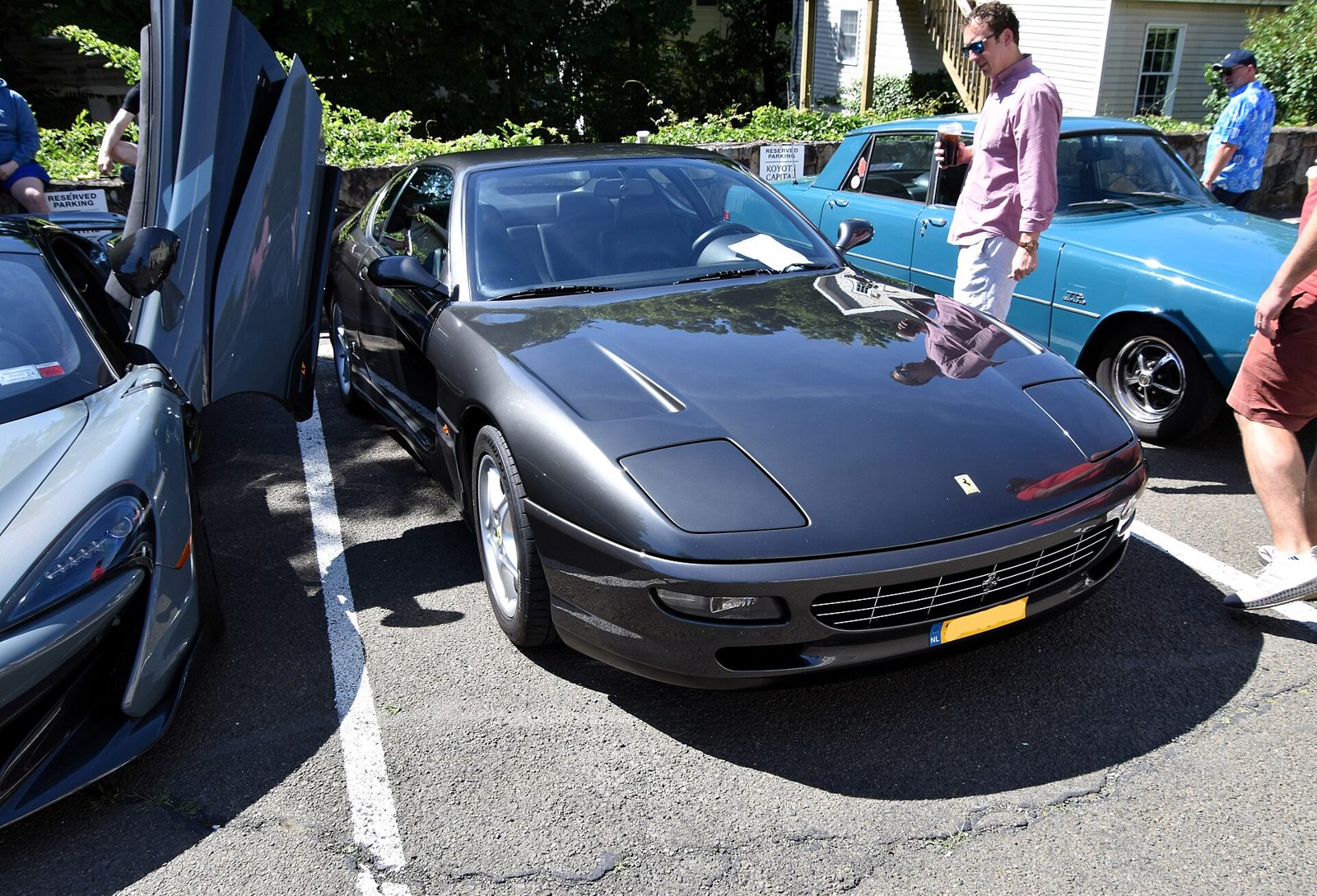
The Ferrari 456 (1992-2003) returned the marque to a front-engined V12 grand tourer for the first time since the 412 went out of production in 1989, and it did so with an all-new engine, the 5,474 cc Tipo F116, the first clean-sheet road-car V12 Ferrari had built since the Colombo unit. Pininfarina's Pietro Camardella drew a soft, unadorned four-seat coupe that turned away from the wedges and strakes of the 1980s, and a six-speed gearbox in unit with the rear differential gave near-even weight distribution and a cabin that genuinely seated four. Ferrari claimed 436 hp and a top speed above 186 mph, enough for the 456 to be sold as the fastest four-seater in the world. A four-speed automatic GTA followed, and in 1998 the 456M update brought a revised nose, carbon-fiber hood, traction control and a new firing order. Around 3,200 to 3,300 were built, and the exact figure is disputed. The 456 was under-appreciated for two decades and is now the least expensive way into a manual, naturally aspirated V12 Ferrari, a status that is changing as of September 2026.
456
456 GT, GTA, 456M
Production by variant
How the 456run breaks down, and which variants are the scarce ones. Approximate figures from this model’s cited sources.
Rarest of the bunch: the 456 GTA (from the mid-1990s), only about 400 built, roughly 1 in every 5 456s. If provenance and rarity drive your buy, this is the one to hunt.
Figures approximate; see Sources below.
History
Back to the Front
When the 412 ended in 1989 Ferrari was left without a four-seater for the first time in a quarter of a century, and without a front-engined road car at all. The 456 was the answer, announced in September 1992 and shown publicly at the Paris Salon the following month, with a launch dinner at the Palais du Cinquantenaire in Brussels. Ferrari's own account calls it the marque's first car designed with the twenty-first century in mind, and the first modern Ferrari to revert to the classic front-engine, rear-drive layout. The engine sat well back in the tubular steel frame and the six-speed gearbox was mounted in unit with the differential at the rear, giving a weight split that period testers measured at roughly 49/51 with four aboard. Twin airbags became standard in mid-1996.
A New V12
The Tipo F116 was the first all-new road-car V12 Ferrari had produced since the Colombo engine of the 1940s. It displaced 5,474 cc from an 3.5 in (88 mm) bore and 75 mm stroke, used a 65-degree vee angle, twin overhead camshafts per bank, four valves per cylinder, Nikasil-treated alloy liners and dry-sump lubrication, with Bosch Motronic M2.7 management. Ferrari quoted 436 hp at 6,250 rpm and 406 lb-ft at 4,500 rpm. In 1996 the F116 C arrived with Motronic M5.2 and, for the 1998 456M, a revised firing order adopted for smoothness; output was unchanged. The engine later took the over-four-liter class of the International Engine of the Year awards in 2000 and 2001, and Ferrari sold the car as the fastest production four-seater in the world, a claim repeated in RM Sotheby's cataloguing.
Camardella's Shape
Pininfarina's Pietro Camardella, working under Lorenzo Ramaciotti, gave the 456 curved, free-flowing surfaces in place of the wedge profiles and side strakes of the Testarossa era, with pop-up headlamps, a long hood and a Kamm tail carrying an electronically raised rear spoiler. The body was aluminum, bonded to the steel frame through a Feran interlayer, and the cabin was trimmed throughout in Connolly leather with electrically adjustable seats and four usable places. Period road testers found the steering over-assisted but the balance benign, one comparison with a Daytona describing a car that could be steered on the throttle with unusual ease for something of its size. Pininfarina built the bodies, with 1,435 completed by 1996 according to the encyclopedia record.
The Automatic Question
The 456 was launched as a manual only. Ferrari then added a four-speed automatic, the GTA, with the gearbox again in unit with the rear differential, its first automatic since the 400 and 412 line. Exactly when the GTA went on sale is genuinely unclear: supercars.net dates it from 1993, autoevolution from 1995, Classic & Sports Car and The Intercooler from 1996, Forza from 1997, and Classic Trader simply says shortly after launch. The gearbox's origin is contested too, Wikipedia crediting FF Developments in Michigan and Forza a Ricardo unit with General Motors internals. What is agreed is that buyers took to it: Classic & Sports Car reports 70 per cent of customers chose the automatic, and by the 456M the split was roughly even.
Modificato and Scaglietti
The 456M, shown at Geneva in March 1998, was an update rather than a new car. The nose was reshaped with a larger intake and integrated fog lamps, adding 1.30 in (33 mm) to overall length, the hood became carbon fiber, the electronically raised spoiler gave way to a fixed undertray element, the front suspension arms were revised to limit dive, front discs grew to 13.0 in (330 mm), and ASR traction control and electronic brake-force distribution arrived, the latter a first for Ferrari. Interior trim, door seals and the audio system were improved. In March 2002 a run of thirty two-tone 456M GT Scaglietti cars, ten with manual gearboxes, launched the Carrozzeria Scaglietti personalization program; the Geneva show car in Grigio Nuvolari over Grigio Scaglietti was specified for Michael Schumacher. Production ended in 2003, or 2004 in some accounts, and the 612 Scaglietti took over.
Common Problems
The V12 itself is robust, but cam-cover and inlet-manifold gasket leaks are routine on used examples and neglected oil changes produce sludge. Valve-guide wear is the expensive engine fault, described by Forza as a five-figure repair. Engine mounts sag with age. The four-speed automatic is the costly transmission: rough changes signal an impending rebuild and guides describe rectification as expensive, while a manual clutch change is also a substantial bill. The self-levelling rear suspension leaks as its membranes age, rear dampers weep but can be rebuilt, and worn bushes dull the handling. Electrics are the most frequent complaint: window regulators and their adjustment, door seals and wind noise on pre-M cars, intermittent switchgear, electrically adjustable seats that stop working, and the sticky-button syndrome that affects every Ferrari of the period. Pop-up headlamps corrode internally; stainless replacements for the internal disc exist. The gearbox oil cooler and its pipes corrode and were the subject of a recall. Fuel-tank rubber mounts disintegrate. Front tires and brakes have a short life, around 10,000 miles according to Forza, on a heavy car with 436 hp. Air-conditioning compressors are a known five-figure-in-dollars repair. Servicing costs from Forza: annual inspection 1,000-2,000 dollars, a major service 6,000-8,000 dollars for a manual and 8,000-10,000 for an automatic.
What to Look For
The gearbox decides the price band before anything else, so establishing that a car is a genuine factory manual, and for a 456M whether it is one of the small number of right-hand-drive manuals, is the first task. The cam belt is the recurring cost: guides quote replacement every three years or 19,000 miles, or five years in one UK source, and unlike the mid-engined cars the engine stays in the car, so a documented recent belt is worth paying for rather than a reason for suspicion. Look for oil at the cam covers and inlet manifold gaskets, and for tired engine mounts, which owners report can allow the engine to settle onto the oil-pressure sender. The self-levelling hydraulic rear suspension shares its reservoir with the power steering and its membranes go porous, so a car sitting low at the back or leaving damp patches under the rear dampers needs the system costed. Ferrari's own recommendation was new dampers every six years. Electric windows are the known weak point: regulators fail, seals leak and wind noise at speed was common enough on the original car that the 456M received revised door seals. Pop-up headlamps corrode internally and may judder. Check the transmission oil cooler and its pipework for corrosion, as recalls covered gearbox oil radiator pipe leaks, fuel leaks, brake fluid loss and the handbrake. Inside, the soft-touch switchgear goes sticky, the center console can flake, and sun-exposed dashboard and parcel-shelf leather shrinks. Air-conditioning compressors are a known and expensive failure. The best cars are the ones that have been driven and serviced annually, not the ones stored.
Market Notes
As of September 2026, classic.com's benchmark for the 456 GT stands at $86,088 with an average recorded sale of $77,914, on a rising trend, with tracked results running from $28,500 for a 1993 car in December 2022 to $230,000 for a 1995 car in September 2025. The 456M GT benchmark is $107,152 with an average sale of $105,014 and a floor of $66,000 in January 2024. Automatics sit well below: the 456 GTA benchmark is $52,672 and the 456M GTA $55,252, and classic.com's lowest recorded 456 result is $12,400 for a 1999 456M GTA project in June 2026. Across all four variants the average sale is $71,052. Auction evidence supports the spread. RM Sotheby's sold a 14,353-mile Nero 1995 456 GT for $95,200 and a 21,345-mile Rosso Barchetta 1999 456M GT for $123,200 at Monterey in August 2024, both quoted as sold-for figures, and classic.com records manual 456 GTs between $87,000 and $145,000 at auction in the first eight months of 2026. The premium for a manual, and above all a 456M manual, is the defining feature of this market.
Where sources differ
Total 456 production is usually printed as 3,289 cars but is not agreed once broken down by variant: the first-series 456 GT is given as 1,548 by Ferrari, Wikipedia, supercars.net and Forza but 1,526 by Classic & Sports Car, while the 456M manual count appears as 688, 668 or 640 depending on the source, and Forza's total is 3,222; no single total is asserted here.
Ferrari's 456 GT page states 1,548 GT with chassis 96157-111376. Wikipedia and supercars.net give 1,548 / 403 / 688 / 650 = 3,289; Supercar Nostalgia gives the same 688 / 650 for the 456M. Forza gives 1,548 / 403 / 640 / 631 = 3,222, and RM Sotheby's Monterey 2024 catalog describes a 1999 456M GT as one of 640 manuals. Classic & Sports Car prints 3,289 as the total but breaks it down as 1,526 / 402 / 668 / 660, which sums to 3,256. Classic Driver, Petrolicious, Classic Trader and The Intercooler repeat 3,289 without a breakdown. The 456M manual figure (688, 668 or 640) is the core of the disagreement and no source consulted resolves it, so productionTotal is null.
The 456 was launched as a manual only and Ferrari later added the four-speed automatic 456 GTA, its first automatic since the 400/412 line, with the gearbox in unit with the rear differential; the year it went on sale is not agreed, with 1993, 1995, 1996 and 1997 all in print, and its engineering origin is credited to different suppliers.
Ferrari's 456 GT page says the car was initially manual only but gives no GTA date. supercars.net dates the GTA 1993-1997; autoevolution says 1995 (and wrongly calls it a three-speed); Classic & Sports Car, Petrolicious and The Intercooler say 1996; Forza says 1997; Classic Trader says shortly after the 1992 launch. On the gearbox itself Wikipedia credits FF Developments of Michigan while Forza credits Ricardo using General Motors internals. Neither the date nor the supplier is resolved by any source consulted.
Sources
- Ferrari 456 GT (1992), Ferrari S.p.A. · manufacturer
- Ferrari 456 GTA, Ferrari S.p.A. · manufacturer
- Ferrari 456M GT, Ferrari S.p.A. · manufacturer
- Ferrari 456, Wikipedia · encyclopedia
- Ferrari 456 Market, classic.com · market-data
- Ferrari 456 GT Market, classic.com · market-data
- Ferrari 456M GT Market, classic.com · market-data
- Ferrari 456 GTA Market, classic.com · market-data
- 1995 Ferrari 456 GT, Monterey 2024, RM Sotheby's · auction-house
- 1999 Ferrari 456M GT, Monterey 2024, RM Sotheby's · auction-house
- Ferrari 456GT buyer's guide: what to pay and what to look for, Classic & Sports Car · journalism
- Grand Tourer or Grand Trouble? The Ferrari 456 GT buying guide, Classic Driver · journalism
- Ferrari 456 Buying Guide, Petrolicious · journalism
- Value & Versatility, Forza issue 203, Forza · journalism
- Giant road test 1993 Ferrari 456 GT vs. 1973 Ferrari 365 GTB/4 Daytona, Drive-My · journalism
- Ferrari 456: The Ultimate Guide, Supercars.net · specialist
- Guide: Ferrari 456M - a Historical & Technical Appraisal, Supercar Nostalgia · specialist
- Drive the ultimate Ferrari 456 specced by Michael Schumacher, Classic Driver · journalism
- Ferrari 456M GT Specifications, SBR Engineering · specialist
- 1999 Ferrari 456GT road test, MotorWeek · journalism
- Ferrari 456 GT: The Grossly Underrated Modern Classic, autoevolution · journalism
- Man Maths: Ferrari 456 GT, The Intercooler · journalism
- The Ferrari 456 buying guide. Ready for the ultimate GT?, Classic Trader · journalism
- 2002 Ferrari 456M GT - Manual, Malmo, Sweden, Collecting Cars · auction-house
- Ferrari 456 GT: Buyer's Guide, The Classic Valuer · market-data
Synthesized from the sources above and cross-checked. We cite and link out; we do not republish other databases verbatim.
Fully Sorted is an independent publisher and is not affiliated with, endorsed by or sponsored by Ferrari S.p.A.. Ferrari and the model names on this page are trademarks of Ferrari S.p.A. and are used here only to identify the cars being described.
Chassis register
Nobody has recorded a car here yet. Own one, or know one? Chassis number, what you can prove about it, and a source if there is one. Every entry is reviewed before it appears.
Nerd Notes
What owners know that the sources don't. Every note is read and checked before it appears here.
Key Specs
- Power
- 436 hp at 6,250 rpm, manufacturer claim; the 436/442 split in print is metric versus imperial horsepower, not a specification change
- Brakes
- Ventilated discs with four-piston calipers and ATE ABS; 456M front discs enlarged to 13.0 in (330 mm), 12.2 in (310 mm) rear retained
- Engine
- 5,474 cc Tipo F116 65-degree V12, all-alloy with Nikasil-treated liners, DOHC per bank, 48 valves, dry sump
- Layout
- Front-mounted longitudinal V12, rear-mounted transaxle gearbox in unit with the limited-slip differential, rear-wheel drive
- Length
- 186.2 in (4,730 mm) (456 GT); 187.5 in (4,763 mm) (456M)
- Torque
- 406 lb-ft at 4,500 rpm, manufacturer claim; UK tests quote 398-405 lb-ft
- Weight
- 3,726 lb dry per Ferrari-derived specialist data; 3,902-4,167 lb quoted as curb weight depending on gearbox and source
- Chassis
- Tubular steel spaceframe (factory reference F 116 CL) with aluminum body panels bonded through a Feran layer; carbon-fiber hood on the 456M
- Suspension
- Double wishbones all round, electronically adjustable dampers with three driver settings, self-levelling hydraulic rear suspension
- Bore stroke
- 88 mm x 75 mm
- Compression
- 10.6:1
- Acceleration
- 0-62 mph in 5.2 s claimed (manual), 5.5 s (automatic); 4.8 s to 60 mph recorded by Car and Driver in 1995 per Wikipedia; 5.4 s recorded by MotorWeek for an automatic in 1999
- Transmission
- 6-speed all-synchromesh manual transaxle (GT); 4-speed automatic transaxle (GTA)
- Fuel capacity
- 110 liters
- Chassis numbers
- 456 GT 96157 to 111376 per Ferrari; 456M from 109589 per SBR Engineering
- Wheelbase tracks
- 102.4 in (2,600 mm) wheelbase; front track 62.4 in (1,585 mm), rear track 63.2 in (1,606 mm)
- Engine management
- Bosch Motronic M2.7 (F116 B); Motronic M5.2 from 1996 (F116 C)
- Top speed claimed
- Over 186 mph; 186-194 mph appears in period claims and tests, none independently verified here
Notable Variants
456 GT (1992-1998)
The original manual car, and the only 456 for its first years. Six-speed transaxle, electronically operated rear spoiler, Motronic M2.7 until the 1996 management update. Ferrari gives 1,548 built; the most numerous and, in good order, the cheapest route into a manual V12 Ferrari.
456 GTA (from the mid-1990s)
Four-speed automatic in unit with the rear differential, Ferrari's first automatic since the 412. Around 400 built. Sources disagree on when it arrived (1993 to 1997 are all in print); it trades at a substantial discount to the manual and its gearbox is expensive to put right.
456M GT (1998-2003)
Modificato update shown at Geneva in March 1998: revised nose adding 1.30 in (33 mm), carbon-fiber hood, fixed undertray spoiler, larger 13.0 in (330 mm) front discs, ASR traction control and electronic brake-force distribution, new firing order. The manual count is the disputed one (640, 668 or 688) and right-hand-drive manuals are rarest of all.
456M GTA (1998-2003)
Automatic version of the facelift, around half of 456M production. The largest right-hand-drive population (136 per Supercar Nostalgia). Priced below the manual by a wide margin as of September 2026.
456M GT Scaglietti (2002)
Thirty two-tone cars launching Ferrari's Carrozzeria Scaglietti personalization program at Geneva 2002, ten with manual gearboxes; the show car in Grigio Nuvolari over Grigio Scaglietti was specified for Michael Schumacher. The nearest thing to a limited edition in the range.
456 GT Venice and other Brunei coachbuilds
Pininfarina-built estate cars, sedans and spiders commissioned for the Sultan of Brunei's family. Counts are single figures and rest on the encyclopedia entry; almost none have surfaced on the open market.
Value Trajectory
The 456 listed at roughly 200,000 to 250,000 dollars in the United States, with MotorWeek quoting 224,800 dollars for a 1999 GT and 229,950 for the GTA. It then followed the usual grand-tourer curve, losing most of that within fifteen years; Forza's November 2022 guide put manual 456s at 60,000 to 100,000 dollars and 456M manuals at 100,000 to 150,000 dollars. As of September 2026 classic.com shows both manual variants trending upward, with 456 GT auction results in 2026 concentrated between 87,000 and 145,000 dollars against a benchmark of 86,088 dollars, and the 456M GT benchmark at 107,152 dollars. Automatics have barely moved, and the gap between a manual and an automatic of the same year is now routinely a factor of two. The direction of travel is that the analogue V12 cohort, 550 Maranello included, has re-rated and the 456 manual is being pulled up behind it, while the GTA remains a cheap way to own the engine with the running costs of the dear one.
Next
Shopping for one?
Browse Ferrari listings, or decode a VIN before you buy.