
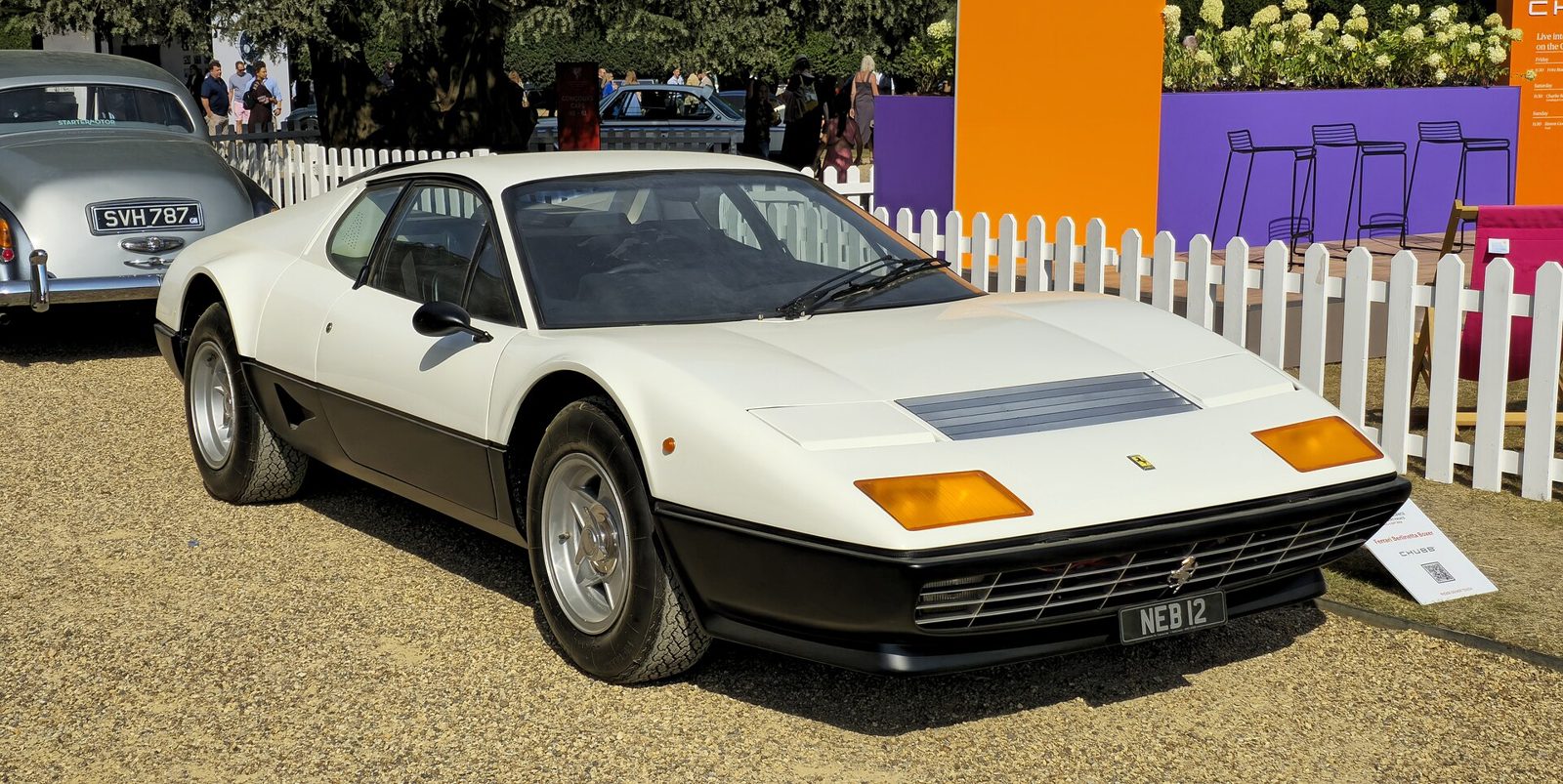
The Ferrari 512 BB (1976-1981) and its fuel-injected successor the 512 BBi (1981-1984) were the second and third forms of the Berlinetta Boxer, the mid-engined flat-twelve that replaced the front-engined Daytona at the top of Ferrari's range. The 365 GT4 BB of 1973 had established the layout, with a Formula 1-derived 180-degree twelve sitting above its gearbox; the 512 enlarged it to 4,943 cc, added dry-sump lubrication and a twin-plate clutch, widened the rear track and grew NACA ducts and a chin spoiler. Ferrari claimed 188 mph and Autocar, in 1978, recorded 163. Bosch K-Jetronic injection arrived in 1981 with a claimed 340 hp, and the BBi is the more tractable car on modern fuel. Neither version was ever sold officially in North America, so every US example is a gray-market federalization of variable quality. Sources agree on 1,007 BBi cars; the carbureted car is stated at 929 by Ferrari and 927 by Octane, so no combined total is asserted here.
512 BB
512 BB and BBi
History
From Daytona to Boxer
Ferrari's road-car flagship had been front-engined since the beginning; the Daytona of 1968 was the last of that line. Ferrari's own heritage page for the 365 GT4 BB describes 'the new 12-cylinder boxer derived from the Formula 1 car' and 'the mid-engined layout that marked the end of Ferrari's traditional front-engined solution for its top performance models'. Pininfarina showed the shape at Turin in 1971 under Leonardo Fioravanti, and production began in 1973 with a 4,390 cc engine. Whether it was ever a true boxer is a separate argument: Mauro Forghieri insisted it was a 180-degree vee and would rather the B had stood for Bialbero; Fioravanti says BB began as a nickname for Brigitte Bardot. Either way, 387 of the 365 GT4 BB were built before the 512 arrived.
The 512: Five Liters and a Dry Sump
The 512 BB was shown at Paris in October 1976. The name switched to Ferrari's newer convention, five liters and twelve cylinders, and the engine grew to 4,943 cc at 82 x 78 mm. Wet-sump oil starvation under hard cornering on the 365 was answered with a dry sump, and the single-plate clutch that owners found heavy gave way to a twin-plate unit. Outside, the rear track went from 59.8 in (1,520 mm) to 61.5 in (1,563 mm) to carry 9-inch rear wheels, NACA ducts appeared ahead of the rear arches to feed the brakes, the nose dropped and gained a spoiler, and six tail lamps became four. Four triple-choke Weber 40 IF 3C carburetors sat in the vee. Ferrari's brochures quoted 360 hp, later revised in Ferrari's own literature to 340, a discrepancy the sources consulted here reproduce rather than explain.
Claimed Speed and Measured Speed
Ferrari claimed 188 mph, or 188 mph, and the number entered popular memory through a photograph taken on the M1 at dawn. Chris Meek, who owned Mallory Park, had his right-hand-drive 512 BB, chassis 21689, photographed at an indicated 188 mph to settle a dispute over the claim; the picture became a bedroom poster. Autocar's test of 13 May 1978 was less obliging. Their car reached 163 mph at 5,975 rpm with the speedometer reading 174, and the magazine calculated from the gearing that the claimed figure was out of reach. Ferrari suggested the car was out of tune and Autocar offered a retest. The 0-60 mph time of 6.2 seconds was respectable, and the writers were more struck by the engine's flexibility from 2,000 rpm in any gear. John Bolster in Autosport called it the fastest practical road car in the world. The 163 mph figure was nonetheless entered in the Guinness Book of Records as the fastest independently road-tested production car of its day.
Injection: The 512 BBi
By 1980 emissions law made carbureted compliance for the gray market close to impossible, and in 1981 the 512 BBi replaced the Webers with Bosch K-Jetronic mechanical injection and fitted Marelli electronic ignition with a rev limiter. Ferrari quoted 340 hp at 6,000 rpm and promoted quieter, smoother running as an ecological advance. The car moved to 16-inch center-lock wheels on Michelin TRX tires, the driving lamps came out from behind the grille, and the interior gained a leather-rimmed wheel and central locking. Supercar Nostalgia records 1,007 BBi cars, 43 of them right-hand drive.
The Gray Market and the BB/LM
Enzo Ferrari took the view that eight-cylinder cars would do for the United States, so neither BB nor BBi was ever homologated there. Demand was met by importers such as Dick Fritz's Amerispec, whose federalization ran to more than 75 modifications per car, including a rebuilt front bumper structure and, on carbureted cars, air injection and catalysts, for around US$14,000. The work was never standardized. In competition, dealers prepared cars to factory instructions as the 512 BB/LM: three Series 1 cars for Le Mans in 1978, none of which finished, then 25 Series 2 cars with Lucas injection, Pininfarina long-tail bodywork and 460-480 hp. Fifth overall and a GTX class win at Le Mans in 1981 was the high point. BBi production ended in 1984 when the Testarossa took over the flat-twelve.
Common Problems
The big one is the timing belt service, which is engine-out on every Boxer. Classic Trader puts a clutch change at 2,500-3,000 euros, a gearbox overhaul at 20,000-25,000 euros and a complete engine overhaul at 70,000 euros and rising; Moto Gallery quotes $200,000 for a full flat-twelve rebuild. Valve clearance checks are due every 10,000 miles and take about a day and a half at 900-1,000 euros, and even an oil change is around 700 euros. Cylinder head gaskets are prone to failure and the sodium-filled exhaust valves can fail, both of which Maserati-Net and Hagerty list independently. The differential is a recognized weak link; the RM Arizona 2026 car had its differential rebuilt during a 2016 engine-out service, and FerrariChat owners describe transmission repairs as common and increasingly dependent on custom-made parts. The gearbox sits under the engine and its oil runs hot, so a two-to-three-year change is advised. Carbureted cars suffer vapour lock on modern alcohol-blended fuel, a problem the K-Jetronic BBi largely avoids, and their Webers need periodic balancing. The metric Michelin TRX tires on the BBi are expensive and limited in supply. Federalized cars can carry crude bumper structures, emissions plumbing and wiring that complicate both maintenance and any later return to European specification. Annual oil and brake fluid changes and a three-year belt interval are the guides' recommendations; owners on FerrariChat are more relaxed, suggesting ten years or 19,000 miles, and the difference between those two views is a matter for the buyer to weigh.
What to Look For
Service history is the first question, because the belts run inside an engine that has to come out to reach them. Hagerty quotes restoration specialist Dave Helms to the effect that history is everything on these cars, and RM Sotheby's catalog for a $302,000 BBi itemized a $12,000 engine-out belt service in 2018 and a further $53,000 of work since. A car with no engine-out invoice in the last decade should be priced as needing one, and FerrariChat owners advise buying before rather than after that service so the depth of the work is under the buyer's control; stripped cam-cover studs, damaged head threads and old bodges only show once the engine is on the bench. Ask for a compression test and evidence of head-gasket and sodium-valve work, both named weak points. Establish which car it is: carbureted BB or injected BBi, and confirm the engine number prefix (F110A on a BBi, as on both RM lots cited here) matches the chassis. Establish whether it was federalized, by whom, and what was done, since Hagerty's specialists warn that reversing a federalization carries legal exposure in the United States and the work was never standardized. Original European cars sit at the top of the market. Check the differential has been reinforced or rebuilt, and that the gearbox oil has been changed on a two-to-three-year cycle, since it sits below the engine and runs hot. Look at wheels and tires: the BBi's metric TRX rims limit tire choice and many cars now wear later wheels, which is fine if the originals come with the car. A Ferrari Classiche Red Book, as on the Gooding Pebble Beach car, settles the matching-numbers question in the buyer's favor.
Market Notes
As of September 2026, classic.com's market benchmark for the carbureted BB 512 stands at $274,871 with an average sale of $262,548 and an upward trend; recorded results run from $121,000 for a Zender-bodied 1980 car in October 2021 to $440,000 for a 1978 car at Mecum in January 2026, with 2026 results of $401,401 at Scottsdale in June and $368,000 at Monterey in August. The BB 512i benchmark is $276,157 on a downward trend, with an average of $270,973 and a floor of $92,000 for a Koenig-modified 1983 car in September 2025. Auction lots fetched for this page bracket the injected car: RM Sotheby's sold a 1984 BBi with 66,588 miles, federalized and wearing 17-inch wheels, for $212,800 at Arizona in January 2026; Gooding sold a Classiche-certified late 1984 car for $307,500 at Pebble Beach in August 2025, below its $325,000-400,000 estimate; and RM Sotheby's made $302,000 at Miami in 2025 for a white 1983 car with a Zegna interior and over $53,000 of recent service. Hagerty's market piece recorded a 1981 car at $473,000 at RM Monterey in 2014 and A.J. Foyt's BBi at $440,000 at Scottsdale in 2015, which suggests the top of the market has not moved much in a decade. Hagerty's specialist source rates unmodified European cars as the most desirable, with federalized cars discounted. The BB/LM is a different market: classic.com's benchmark is $2,226,441 as of September 2026, and RM Sotheby's failed to sell chassis 35529 at Paris in February 2025 against a 2.0-2.5 million euro estimate. All classic.com figures are all-in results as recorded by that site.
Where sources differ
The 512 BB's power rating is not consistent even within Ferrari's own literature: early brochures quoted 360 hp, Ferrari's current model page quotes 340 hp, and the quoted peak rpm ranges from 6,200 to 6,800 across the sources consulted. No single figure is asserted here.
Ferrari's model page states 'claimed 340 hp'. Wikipedia records 360 hp in sales brochures, revised to 340 in later publications, with the peak at 6,200 rpm. Supercars.net and Octane give 360 hp at 6,200 rpm; Drive gives 360 hp at 6,800 rpm. The discrepancy is not explained by any source consulted and is left unresolved.
Production of the carbureted 512 BB is stated as 929 cars by Ferrari, with chassis numbers 19677 to 38487, and repeated by most secondary sources, but Octane states 927; the fuel-injected 512 BBi is stated as 1,007 cars by every source consulted. No combined total is asserted.
Ferrari's model page states 929 for the 512 BB (chassis 19677-38487); Wikipedia, Classic Trader, Maserati-Net, supercars.net and Moto Gallery repeat 929 and Hagerty gives 'just over 900'. Octane states 'one of only 927 BBs produced'. Moto Gallery additionally gives a chassis range of 19781 to 34347 that does not match Ferrari's. The 1,007 BBi figure is uncontested. The 927 versus 929 discrepancy is not explained by any source consulted and remains unresolved, so productionTotal is left null.
Sources
- Ferrari 512 BB (1976), Ferrari S.p.A. · manufacturer
- Ferrari 365 GT4 BB (1973), Ferrari S.p.A. · manufacturer
- Ferrari 512 BB LM (1978), Ferrari S.p.A. · manufacturer
- Ferrari Berlinetta Boxer, Wikipedia · encyclopedia
- Classic Trader Reviews: The Ferrari 512 BB/BBi buying guide, Classic Trader · journalism
- Ferrari 512 BB / Berlinetta Boxer: Model Guide & Weak Points, Maserati-Net · specialist
- Ferrari 512 BB - The Ultimate Guide, Supercars.net · specialist
- Ferrari BB 512 Market, classic.com · market-data
- Ferrari BB 512i Market, classic.com · market-data
- Ferrari Berlinetta Boxer (BB) Market, classic.com · market-data
- Ferrari BB 512 - Berlinetta Boxer - The Road Legend, Collectors Car World · journalism
- 1984 Ferrari 512 BBi, Arizona 2026, RM Sotheby's · auction-house
- 1983 Ferrari 512 BBi, Miami 2025, RM Sotheby's · auction-house
- 1979 Ferrari 512 BB/LM, The Monterey Auction 2026, RM Sotheby's · auction-house
- 1981 Ferrari 512 BB/LM, Paris 2025, RM Sotheby's · auction-house
- Throwback Thursday - was our Ferrari 512 BB fast enough? 13 May 1978, Autocar · journalism
- 1984 Ferrari 512 BBi, Pebble Beach Auctions, Gooding Christie's · auction-house
- Ferrari 512BB - driving the 188mph Poster star, Octane · journalism
- Ferrari 512i BB Guide, Supercar Nostalgia · specialist
- Ferrari 512 BB: The Definitive History, Specs, and Legacy, Moto Gallery · specialist
- Ferrari 512 BB road test, Drive · journalism
- Market Spotlight: Ferrari 512 BB and BBi, Hagerty Media · journalism
- 512 BB maintenance costs, FerrariChat · club-forum
Synthesized from the sources above and cross-checked. We cite and link out; we do not republish other databases verbatim.
Fully Sorted is an independent publisher and is not affiliated with, endorsed by or sponsored by Ferrari S.p.A.. Ferrari and the model names on this page are trademarks of Ferrari S.p.A. and are used here only to identify the cars being described.
Chassis register
Nobody has recorded a car here yet. Own one, or know one? Chassis number, what you can prove about it, and a source if there is one. Every entry is reviewed before it appears.
Nerd Notes
What owners know that the sources don't. Every note is read and checked before it appears here.
Key Specs
- Power
- 512 BB: 360 hp in early brochures, 340 hp in later Ferrari literature - manufacturer claims that do not agree with one another; 512 BBi: 340 hp at 6,000 rpm claimed
- Engine
- 4,943 cc 180-degree flat-12, 3.2 in (82 mm) x 78 mm, 9.2:1 compression, all-alloy, dry sump; Tipo F102 B (carbureted) and Tipo F110 A (injected)
- Layout
- Mid-mounted longitudinal flat-12 with the five-speed gearbox beneath the engine, rear-wheel drive
- Torque
- Approximately 331-333 lb-ft; quoted peak varies from 4,200 rpm (BBi) to 4,300-4,600 rpm (BB) by source
- Weight
- Quoted variously: 3,086 lb (BB) and 3,305 lb (BBi) per Supercar Nostalgia; 3,340 lb per Wikipedia and Classic Trader; 3,602 lb curb per supercars.net. No figure here is independently weighed
- Chassis
- Tubular steel frame with steel center body, aluminum doors and clamshell front and rear covers, glassfiber bumpers; factory type F 102 BB 100 (BB) and F102 CB 100 (BBi)
- Ignition
- Electronic ignition (512 BB); Magneti Marelli electronic ignition with rev limiter (512 BBi)
- Dimensions
- 173.2 in (4,400 mm) long, 72.0 in (1,830 mm) wide, 44.1 in (1,120 mm) high
- Valvetrain
- Twin belt-driven overhead camshafts per bank, two valves per cylinder, sodium-filled exhaust valves
- Fuel system
- Four Weber 40 IF 3C triple-choke carburetors (512 BB); Bosch K-Jetronic mechanical injection (512 BBi)
- Acceleration
- 0-62 mph 5.4 s claimed; 0-60 mph 6.2 s recorded by Autocar in 1978
- Transmission
- 5-speed manual transaxle mounted under the crankcase, twin-plate clutch (single-plate on the 365 GT4 BB)
- Wheels tires
- 512 BB: 15-inch Cromodora, 7.5 in front and 9 in rear, 215/70 and 225/70 VR15; 512 BBi: 16-inch center-lock Cromodora on Michelin TRX
- Fuel capacity
- 120 liters in twin tanks
- Chassis numbers
- 512 BB: 19677 to 38487 per Ferrari (a low-reliability source gives 19781 to 34347)
- Wheelbase track
- 98.4 in (2,500 mm) wheelbase; front track 59.1 in (1,500 mm), rear track 61.5 in (1,563 mm) (widened from the 365's 59.8 in (1,520 mm))
- Top speed tested
- 163 mph at 5,975 rpm, Autocar, May 1978; Octane cites a Road & Track figure of 175 mph
- Top speed claimed
- 188 mph - manufacturer claim, never matched in an independent test
Notable Variants
512 BB (carbureted, 1976-1981)
Four triple-choke Webers, dry sump, twin-plate clutch and the wider rear track that distinguish it from the 365. Louder and less tractable on modern fuel than the BBi, and more expensive to keep in tune, which is exactly why some buyers prefer it.
512 BB right-hand drive
UK-market cars carried Ferrari's 188 mph claim into the British press; Autocar's 1978 test car and the Chris Meek 'M1 poster' car (chassis 21689) were both right-hand drive. A firm RHD count for the 512 BB was not established by any source consulted here.
512 BBi (1981-1984)
Bosch K-Jetronic injection, Marelli electronic ignition, 340 hp at 6,000 rpm, metric Michelin TRX tires on 16-inch wheels, exposed driving lamps and a new tail badge. The more usable car, and the one federalization shops found easiest to make comply.
512 BBi with Zegna interior
RM Sotheby's cataloged a 1983 car as one of approximately 27 examples with cabins tailored by Ermenegildo Zegna; it sold for $302,000 at Miami in 2025. A small documented sub-series worth checking against the build sheet.
Gray-market federalized cars
Amerispec and others carried out more than 75 modifications per car, including a rebuilt front bumper structure and, on carbureted cars, catalysts and air injection, at around US$14,000 a time. Quality varied and the work was never standardized; unmodified European cars are the ones the trade prefers.
Koenig and Zender conversions
Period German widebody and tuning conversions. The lowest recorded classic.com results for both BB and BBi as of September 2026 are a Zender car ($121,000, 2021) and a Koenig car ($92,000, September 2025), which shows how the market treats them.
512 BB/LM
Competition version prepared to factory instructions: three Series 1 cars for Le Mans 1978, then 25 Series 2 cars with Lucas injection and Pininfarina long-tail bodywork, quoted at 460-480 hp. Best result fifth overall at Le Mans 1981. A separate market with a classic.com benchmark above $2.2 million.
Value Trajectory
The Boxer was expensive when new, about US$38,000 at the outset. Hagerty's market piece, written after the 2014-2015 peak, recorded a 263 per cent rise in average auction prices since 2011, with a 1981 car at $473,000 in 2014 and the A.J. Foyt BBi at $440,000 in 2015. The decade since has been flat to gently rising rather than a second surge. As of September 2026 classic.com's benchmarks sit at $274,871 for the BB 512, trending up, and $276,157 for the BB 512i, trending down, with the best 2026 results at $440,000 and $401,401 for carbureted cars and ordinary federalized or high-mileage examples in the $210,000-310,000 band. The gap between the two engines has narrowed to almost nothing at the benchmark level, though good carbureted cars now set the high results. Modified Koenig and Zender cars trade at a heavy discount, and the BB/LM has decoupled entirely at a benchmark above $2.2 million. What separates cars within the range is documentation, an unmodified European specification and a recent engine-out service, not year or color.
Next
Shopping for one?
Browse Ferrari listings, or decode a VIN before you buy.