
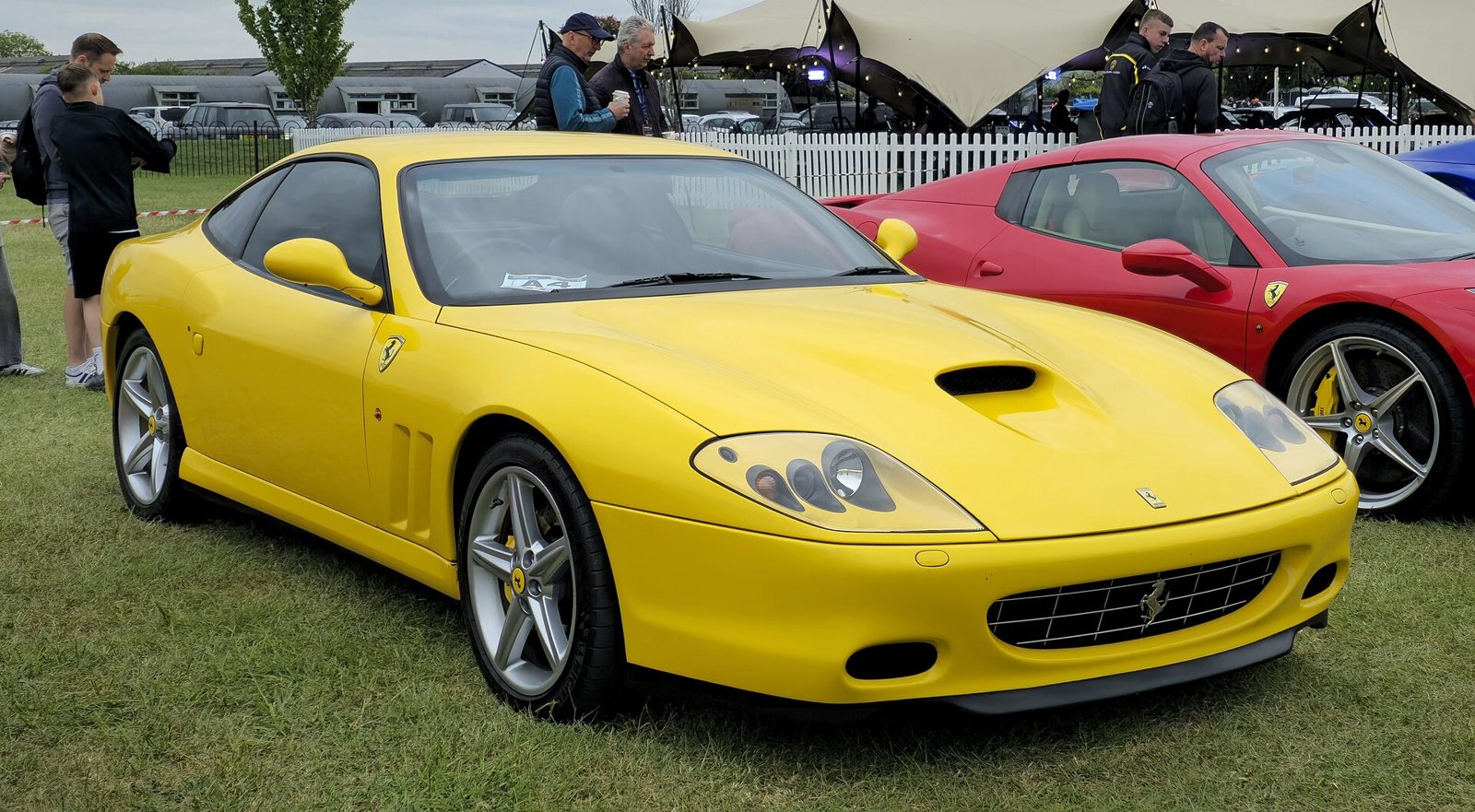
The Ferrari 550 Maranello (1996-2001) was the car with which Ferrari reversed two decades of mid-engined flagship thinking and returned its fastest road car to the front-engined, rear-transaxle layout of the 365 GTB/4 Daytona. Launched to the press at the Nürburgring in July 1996 with Schumacher, Irvine, Lauda and Scheckter on hand, it replaced the F512M and drew its 5,474 cc 65-degree V12 from the 456 GT, tuned here to a claimed 478 hp at 7,000 rpm and driving through a gated six-speed transaxle. Pininfarina's body, under Lorenzo Ramaciotti, was welded aluminum over a tubular steel frame and quoted at 3,726 lb curb with a drag coefficient of 0.33; Ferrari claimed 199 mph and 0-62 mph in 4.4 seconds, and in October 1998 a 550 set production-car records for 62.1 miles and one hour at Marysville, Ohio. A 33-car World Speed Record edition followed in 1999, and the 448-car 550 Barchetta Pininfarina closed the run in 2001 before the 575M arrived in 2002. Sources disagree on how many coupes were built, from about 3,000 to 3,715, and no single figure is asserted here.
550 Maranello
550 Maranello and Barchetta
History
Montezemolo Turns the Car Around
For 23 years, from the 365 GT4 BB of 1973 to the F512M, Ferrari's flagship two-seater had carried a flat-twelve behind the driver. Luca di Montezemolo, president from 1991, decided the next one would not. The reasoning, as Ferrari's own account puts it, was to answer those who believed a front-engined V12 could not out-perform a mid-engined car while also being far more practical; evo records the decision as a decree from the top. The engineering basis already existed in the 456 GT 2+2 of 1992, whose 5.5-liter V12, tubular steel frame and rear transaxle were carried over to a wheelbase shortened by 3.9 in (100 mm) to 98.4 in (2,500 mm). The model name reverted to total displacement rather than the per-cylinder figure used for the 456.
Nürburgring, July 1996
The 550 was shown to the press at a Ferrari gathering at the Nürburgring in July 1996, where Michael Schumacher and Eddie Irvine drove it on the circuit alongside Niki Lauda and Jody Scheckter. Pininfarina's shape, credited to Lorenzo Ramaciotti's studio with Elvio D'Aprile on the exterior, echoed the 456 in its proportions and reached further back for detail: twin air slots in the front wings after the 250 GTO and 275 GTB, and a tail-light treatment closer to the Daytona than the 456's had been. Reception was not universal: RAC's retrospective records early comparisons to a pumped-up Toyota Supra. Autocar's road test of 27 November 1996 recorded 0-60 mph in 4.6 seconds and 0-100 mph in 10.1 seconds, and the magazine named the car Britain's Best Driver's Car in 1998.
What Was Under the Aluminum
The F133 A engine displaced 5,474 cc from 3.5 in (88 mm) by 3.0 in (75 mm) cylinders, with four valves per cylinder, dry-sump lubrication, Nicasil-treated liners, titanium connecting rods, variable intake geometry and Bosch Motronic M5.2 management, for a claimed 478 hp at 7,000 rpm and 420 lb-ft at 5,000 rpm. The six-speed gearbox sat at the rear in unit with the differential, joined to the engine by a rigid steel tube. Aluminum panels were welded to the steel frame through Feran, a sandwich material that permitted joining the two metals. Electronically controlled dampers offered Normal and Sport modes tied into ASR traction control and four-channel ABS, and Servotronic speed-sensitive steering was standard. Ferrari quoted 3,726 lb curb, a Cd of 0.33 with downforce on both axles, 199 mph and 0-62 mph in 4.4 seconds.
Marysville, the WSR Cars and the Barchetta
On 12 October 1998 at the Transportation Research Center track in Marysville, Ohio, a 550 covered 62.1 miles at an average of 189 mph and 184 miles in one hour, refuelling stop included, which Ferrari presented as production-car records. Thirty-three World Speed Record cars followed in 1999 with the Fiorano handling pack, carbon seats, harnesses and a leather-trimmed roll cage; RM Sotheby's states 23 were left-hand drive and most were Grigio Titanio over Bordeaux. At the Paris show in October 2000 Ferrari unveiled the 550 Barchetta Pininfarina to mark the carrozzeria's seventieth anniversary: 448 numbered cars built in 2001, with a windshield roughly 3.9 in (100 mm) lower than the coupe's, rear roll hoops, a high-strength steel tube in the screen surround and a manual soft top for emergencies only, the deletion of a proper hood offsetting the weight of the reinforcement so that curb weight matched the coupe.
Racing Without Ferrari, and the 575M
Ferrari itself did not race the 550. Frederic Dor's Care Racing commissioned Prodrive to build a GT car from it; Ferrari tested the first chassis at Fiorano with Luca Badoer and declined to take the program on. Ten cars were built. With the V12 enlarged to 5,983 cc for about 600 hp and weight cut to around 2,425 lb, they won the GTS class at Le Mans in 2003 with Kox, Enge and Davies, took the Spa 24 Hours outright in 2004 and, by Girardo's count, scored 69 wins from 343 races between 2001 and 2008. The road car was replaced in 2002 by the 575M Maranello, with the engine at 5.75 liters and an F1 paddle-shift option, which is why the 550 is now read as the last of the purely manual front-engined V12 Ferraris.
Common Problems
The V12 itself is regarded as strong, and RAC and evo both call the car unusually reliable for an exotic, but a consistent set of faults recurs across the buying guides. Oil leaks from cam cover gaskets, front cam seals and the rear of the engine are routine and are best dealt with at the cam-belt service; coolant leaks into the engine vee from aging hoses are equally common. Blocked scuttle drains let water reach the ECU. The front crankshaft pulley can delaminate, felt as vibration under way. Early cars had gearbox selection problems in first, third and fifth, and the second and third synchromesh wears, and a rebuild is a major job. Two recalls are documented: leaking fuel pipe clamping ferrules on 1997-98 cars and a gearbox oil cooler pipe that could starve the transaxle. The original Speedline wheels were recalled for cracking. Interior problems are the most visible: the leather dash shrinks and lifts, and the soft-touch plastic on switches, handles and vents turns tacky. Air-conditioning compressor seals leak, power-steering racks weep and dampers fail, with refurbishment or replacement needed a corner at a time. Aluminum corrosion appears at panel edges and around glass seals. Forza adds engine mounts and rapid front pad and tire wear.
What to Look For
Service history carries more weight on this car than on most, because the maintenance items are predictable and the record shows whether they were done. Cam belts are quoted at three-year intervals by PistonHeads, evo and R&D Automotive, and a car past that point without evidence of the work is priced accordingly; on the 550 the belts are accessible from the front of the engine, so the job is cheaper than on a mid-engined car. Check the clutch for a high biting point and a noisy release bearing, and read the history for how many have been fitted: Classic & Sports Car suggests 40-50,000 miles from a considerate driver, PistonHeads under 10,000 from a heavy-footed one. The gearbox should select first, third and fifth cleanly once warm; a stiff second gear from cold is normal. Confirm the wheels are BBS, since the original Speedline magnesium wheels absorbed water, cracked and were recalled. Inspect the dashboard leather for shrinkage and lifting, the door handles, switches and vents for the sticky degraded soft-touch finish, and both screens for delamination. Look for coolant traces in the engine vee, oil at the cam covers and rear seal, power-steering fluid at the rack, and fuel smell on 1997-98 cars covered by the fuel pipe recall. Check the airbag and alarm warning lights extinguish and that both black key fobs and the red master key are present. On the Barchetta, PistonHeads advises checking for scuttle shake, and the numbered Pininfarina plaque and rear hoops should be intact. A Classiche Red Book is increasingly what separates the top results from the rest.
Market Notes
As of September 2026, classic.com's market benchmark for the 550 Maranello coupe stands at $205,384 on an upward trend, with an average recorded sale of $184,454, a low of $53,001 for a 1999 car in May 2025, and 23 examples listed. Dealer asking prices logged there in August 2026 ran from $324,985 for a 40,000-mile 1998 car to $459,000 for a 14,000-mile 1999 example; these are asks, not sales. Auction results describe the top of the market: RM Sotheby's sold a 5,732-mile 2001 car in Grigio Alloy for $368,000 at Monterey in August 2025, Gooding sold a 2,933-mile 2001 car for $368,000 at Pebble Beach in August 2024, and RM Sotheby's Arizona in January 2026 returned $274,400 for a sub-30,000-mile Blu Pozzi car with a rebuilt engine. Above that, provenance and certification move the figure sharply: a single-owner, 3,382 miles, Classiche-certified Blu NART car made $610,000 at RM Sotheby's Monterey in August 2026, and Broad Arrow's Quail sale the same week set a stated model record of $648,500 for a 527-mile Classiche 1998 car. RM Sotheby's Munich sold a 25,430 miles WSR car for 376,250 euros in 2025. The Barchetta has separated from the coupe entirely: classic.com's benchmark is $705,771, and August 2026 produced a stated record of $1,627,500 at Broad Arrow for a Nero D.S. car estimated at $1.1 to $1.4 million, plus $1,265,000 at Mecum Monterey and a 2022 low of $218,500. All auction prices quoted include buyer's premium.
Where sources differ
Ferrari quotes 3,726 lb curb for both coupe and Barchetta, while independent sources give 3,732 lb, 3,783 lb and 3,911 lb; the difference reflects test conditions and is not resolved here.
Ferrari states 3,726 lb curb. Classic & Sports Car states 3,732 lb, evo 3,783 lb and Wikipedia 3,911 lb. No source explains its measurement basis, so the figures are listed rather than reconciled.
Sources give the number of 550 Maranello coupes built as 3,083, about 3,000, 3,600 or 3,715, and Ferrari's own page gives no total; no single figure is asserted here.
Wikipedia, Classic & Sports Car, PistonHeads, evo and R&D Automotive state 3,083 (457 RHD). Sports Car Market and Forza state 'some 3,600'. RM Sotheby's Monterey 2026 catalog states 'approximately 3,000'; RM Sotheby's Arizona 2026 catalog states 3,715. Ferrari states only the chassis range 99928-126807. Not resolved by any source consulted here, so productionTotal is null.
The 550 Barchetta Pininfarina, unveiled at Paris in October 2000 for Pininfarina's seventieth anniversary, is stated by Ferrari as a numbered edition of 448 cars built in 2001, though some sources give 457, and twelve prototypes are separately counted by some.
Ferrari, Wikipedia, Gooding, classic.com, RAC and evo state 448 numbered production cars. Wikipedia and Classic & Sports Car add 12 prototypes (P01-P12) for 460 in total. PistonHeads and R&D Automotive state 457, and give 48 UK cars where RAC gives 45. The 457 figure is not explained by either source and is not resolved here.
Sources
- Ferrari 550 Maranello (1996) - Ferrari.com, Ferrari S.p.A. · manufacturer
- Ferrari 550 Barchetta Pininfarina (2000) - Ferrari.com, Ferrari S.p.A. · manufacturer
- Ferrari 550, Wikipedia · encyclopedia
- Ferrari 550 Maranello buyer's guide: what to pay and what to look for, Classic & Sports Car · journalism
- Ferrari 550 Maranello buying guide: powertrain, PistonHeads · journalism
- Ferrari 550 Maranello buying guide: introduction, PistonHeads · journalism
- Ferrari 550 Maranello: history, specs and used review, evo · journalism
- 2001 Ferrari 550 Maranello - Sports Car Market, Sports Car Market · journalism
- 1999 Ferrari 550 Maranello | The Monterey Auction 2026 | RM Sotheby's, RM Sotheby's · auction-house
- 2000 Ferrari 550 Maranello WSR | Munich 2025 | RM Sotheby's, RM Sotheby's · auction-house
- 2001 Ferrari 550 Maranello | Monterey 2025 | RM Sotheby's, RM Sotheby's · auction-house
- 2001 Ferrari 550 Maranello | Arizona 2026 | RM Sotheby's, RM Sotheby's · auction-house
- 2001 Ferrari 550 Barchetta | Amelia Island Auction 2022 | Gooding Christie's, Gooding & Company · auction-house
- 2001 Ferrari 550 Barchetta | Pebble Beach Auctions 2007 | Gooding & Company, Gooding & Company · auction-house
- Ferrari Enzo tops Broad Arrow's $97.4 million debut of The Quail Auction, Old Cars Weekly · journalism
- Ferrari 550 Maranello Market - CLASSIC.COM, classic.com · market-data
- Ferrari 550 Barchetta Pininfarina Market - CLASSIC.COM, classic.com · market-data
- 2001 Ferrari 550 GTZ Barchetta sold at Gooding Christie's Pebble Beach (2024) - CLASSIC.COM, classic.com · market-data
- Ferrari 550 Maranello Prodrive: behind the wheel of a V12 Le Mans icon, evo · journalism
- This trio of Ferrari 550 Maranello Prodrives will rock Goodwood-goers to their cores, Girardo & Co. · specialist
- $4.29M 2001 Ferrari 550 GT1 shatters online auction record, Hagerty Media · journalism
- Ferrari 550 Maranello Buyers Guide - R&D Automotive, R&D Automotive · specialist
- The Ultimate Ferrari 550 Maranello Buying Guide, Giallo Modena · specialist
- The Classics | Issue 197 | Forza, Forza Magazine · journalism
- Ferrari 550 Maranello (1996 - 2002) used car review | RAC Drive, RAC · journalism
Synthesized from the sources above and cross-checked. We cite and link out; we do not republish other databases verbatim.
Fully Sorted is an independent publisher and is not affiliated with, endorsed by or sponsored by Ferrari S.p.A.. Ferrari and the model names on this page are trademarks of Ferrari S.p.A. and are used here only to identify the cars being described.
Chassis register
Nobody has recorded a car here yet. Own one, or know one? Chassis number, what you can prove about it, and a source if there is one. Every entry is reviewed before it appears.
Nerd Notes
What owners know that the sources don't. Every note is read and checked before it appears here.
Key Specs
- Power
- 478 hp at 7,000 rpm, manufacturer claim; UK road tests quoted 478-479 hp for the same output
- Engine
- 5,474 cc Tipo F133 A 65-degree V12, 3.5 in (88 mm) x 75 mm bore and stroke, light alloy block and heads, Nicasil-treated liners, titanium connecting rods
- Layout
- Front-mounted longitudinal V12, rear-wheel drive via rear-mounted six-speed transaxle in unit with a limited-slip differential
- Torque
- 420 lb-ft (420 lb-ft, approximately 419 lb-ft) at 5,000 rpm, manufacturer claim
- Weight
- 3,726 lb curb per Ferrari (coupe and Barchetta alike); independent figures range from 3,732 lb (Classic & Sports Car) through 3,783 lb (evo) to 3,911 lb (Wikipedia)
- Chassis
- Tubular steel frame (factory chassis type F 133 AB) with aluminum alloy body panels welded to the steel via Feran sandwich material; composite front and rear valances
- Fuel tank
- 114 liters
- Top speed
- 199 mph claimed for the coupe; 186 mph claimed for the Barchetta; Classic & Sports Car quotes 186 mph for the open car
- Dimensions
- Length 179.1 in (4,550 mm), width 76.2 in (1,935 mm), height 50.3 in (1,277 mm) (Barchetta 49.5 in (1,258 mm)), wheelbase 98.4 in (2,500 mm), front track 64.3 in (1,632 mm), rear track 62.4 in (1,586 mm); drag coefficient 0.33
- Suspension
- Independent unequal-length wishbones all round, coil springs over gas dampers, anti-roll bars; electronically controlled dampers with driver-selectable Normal and Sport modes, integrated with ASR traction control and ABS
- Valvetrain
- Twin overhead camshafts per bank, four valves per cylinder, hydraulic tappets, variable intake geometry with a third plenum
- Compression
- 10.8:1
- Lubrication
- Dry sump
- Acceleration
- 0-62 mph in 4.4 s claimed; Autocar recorded 0-60 mph in 4.6 s and 0-100 mph in 10.1 s in November 1996, Motor Trend 0-60 mph in 4.2 s in 2000
- Transmission
- Six-speed manual plus reverse, gated, rear transaxle; single-plate clutch
- Wheels tires
- 18-inch five-spoke alloys, 8.5J front and 10.5J rear; 225/40 ZR18 front (Barchetta 255/40) and 295/35 ZR18 rear; original Speedline magnesium wheels recalled and replaced by BBS
- Fuel ignition
- Bosch Motronic M5.2 combined injection and static ignition, single spark plug per cylinder; twelve electropneumatic throttle valves
- Chassis numbers
- 99928 to 126807 within Ferrari's continuous road-car sequence, per Ferrari
Notable Variants
550 Maranello (1996-2001)
The standard berlinetta. Ferrari's first front-engined two-seat V12 flagship since the Daytona, with a gated six-speed transaxle and driver-selectable damping. The only body offered for the first four years of production.
550 Maranello 'World Speed Record' (WSR), 1999
Thirty-three cars commemorating the October 1998 production-car records at Marysville, Ohio. Fiorano handling pack, carbon bucket seats, harnesses, a leather-trimmed roll cage and suede steering wheel; most were Grigio Titanio over Bordeaux, and only 23 were left-hand drive.
550 Maranello with Fiorano handling package
Factory suspension and brake package fitted to the WSR cars and available separately. Cars carrying it are identified in auction catalogs as a distinct and generally preferred specification.
550 Barchetta Pininfarina (2001)
Unveiled at Paris in October 2000 for Pininfarina's seventieth anniversary; 448 numbered cars built at Maranello in 2001, each with a plaque signed by Sergio Pininfarina. Windshield cut roughly 3.9 in (100 mm) lower than the coupe, rear roll hoops, and a manual soft top intended for emergencies only.
550 GTZ Barchetta by Zagato
Coachbuilt rebody of the Barchetta by Zagato, stated by Wikipedia as limited to three cars. One sold at Gooding's Pebble Beach sale in August 2024 for $841,000, categorized by classic.com as a custom rather than a production model.
550 Maranello Prodrive (550 GTS / GT1), 2001-2008
Ten racing cars designed and built by Prodrive for Frederic Dor's Care Racing, without Ferrari's participation. Won the GTS class at Le Mans in 2003 and the Spa 24 Hours outright in 2004; one sold for $4,290,000 at RM Sotheby's online Monterey sale in 2020.
Value Trajectory
The 550 listed at roughly $200,000 in the United States, and then did what most modern Ferraris did: it depreciated. Sports Car Market records US values falling below $75,000 by 2012 as maintenance costs deterred buyers. Recovery came with the wider re-rating of manual, naturally aspirated Ferraris once the F1 gearbox became the norm; the 550's status as the last front-engined V12 sold only with a gated manual is now the center of its story. As of September 2026 classic.com's coupe benchmark of $205,384 is trending upward, ordinary good cars trade at $270,000-$370,000 at auction, and the very low-mileage, Classiche-certified cars have moved to $610,000-$648,500 with two stated records set in August 2026 alone. The Barchetta has run harder still: from $258,500 for a 200-mile car at Gooding Pebble Beach in 2007 and a $218,500 low in 2022 to $1,627,500 in August 2026. The market is stratifying on mileage, certification and color rather than lifting evenly, and the gap between a driven, well-serviced car and a preserved one has widened rather than closed.
Next
Shopping for one?
Browse Ferrari listings, or decode a VIN before you buy.