
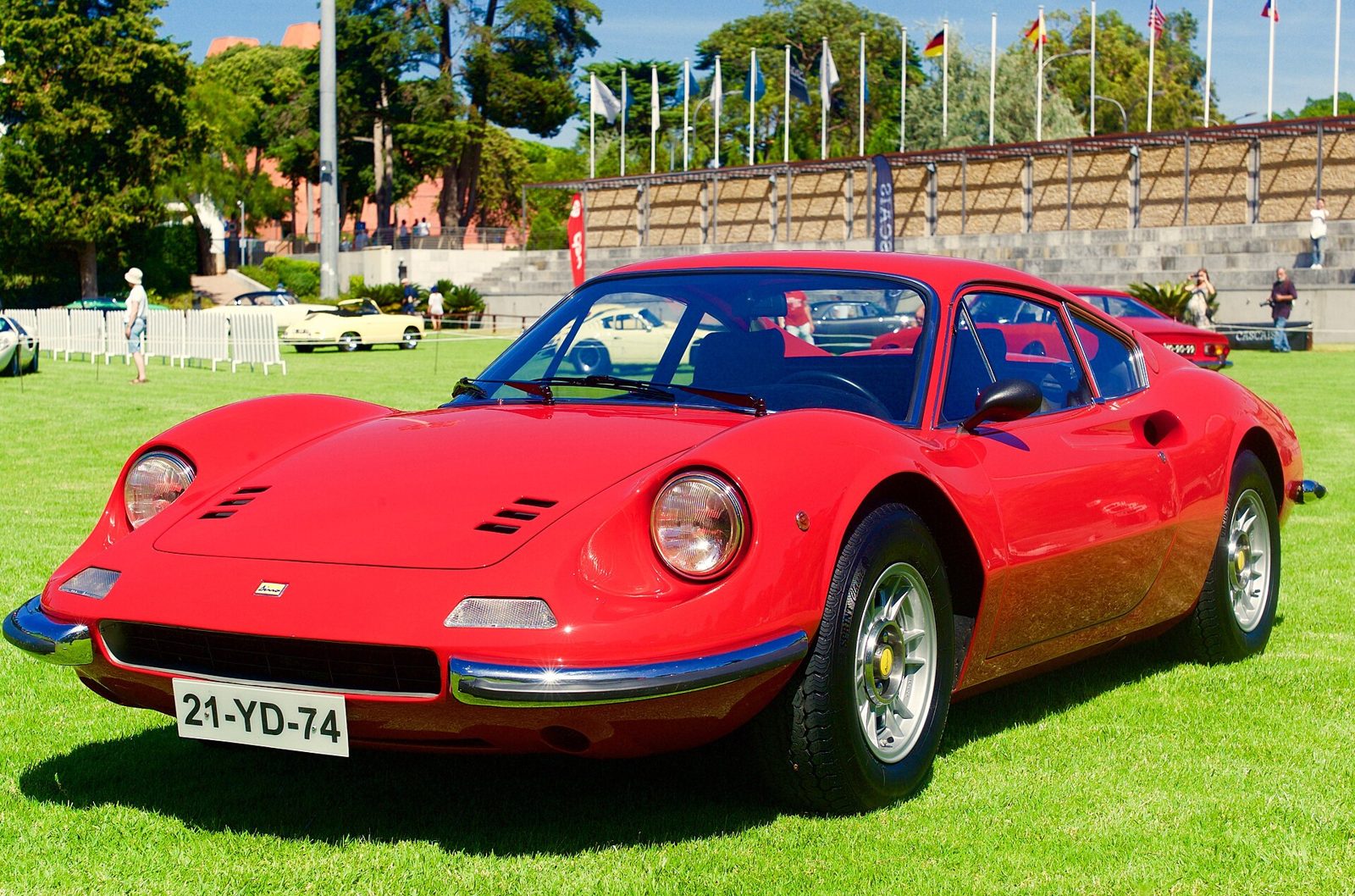
The Dino 246 GT and GTS were built at Maranello between 1969 and 1974 and sold under the Dino marque rather than as Ferraris. No prancing horse appeared on the nose, the wheels or the badging; Enzo Ferrari's stated position was that a car with half the cylinders of a V12 should not carry the name. The V6 existed at all because Formula Two rules of the mid-1960s required a racing engine derived from a production unit built in quantity, and Ferrari could not build 500 of anything in a year, so an agreement with Fiat produced the engine instead. The road car that followed was the 206 GT of 1967-69, an all-aluminum 2.0-liter of which roughly 152 were made. For 1969 the engine grew to 2,418 cc and swapped its aluminum block for cast iron, the wheelbase went up 2.4 in (60 mm), and the body changed to steel: cheaper, heavier, rust-prone, and buildable in numbers Ferrari had never previously reached. An open GTS with a lift-out targa panel followed in March 1972. Three series, L, M and E, divide the run.
Dino 246
Dino 246 GT and GTS
History
A Rule About Five Hundred Engines
The Dino V6 is a homologation artefact. Formula Two rules adopted in the mid-1960s required a racing engine derived from a production unit built in quantity, 500 of them within a defined period, and Ferrari, then building a few hundred cars a year, had no prospect of meeting that alone. An agreement signed on 1 March 1965 committed Fiat to producing the six-cylinder Dino engine in numbers sufficient for its adoption in a Ferrari single-seater; Fiat used it in its own front-engined coupe and spider from 1966-67, Ferrari transversely behind the driver. The name came from Enzo Ferrari's son Alfredo, called Dino, who died in 1956 and had argued for the six-cylinder layout. The badging followed the same logic: these cars carried Dino script and no Ferrari nomenclature anywhere.
Aluminum, and Not Many of Them
The 206 GT reached production in 1968, its body a Pininfarina design credited to Brovarone and Fioravanti, built by Scaglietti in Modena, in aluminum throughout. The Tipo 135 B engine displaced 1,987 cc from 86 x 57 mm, a 65-degree V6 with twin overhead camshafts per bank and an alloy block and head running cast-iron wet liners. Ferrari quotes 180 hp; specialist accounts give 160 hp at 7,200 rpm, close to the rating Fiat used, and the two are not reconciled. Around 152 were built between 1967 and 1969, all left-hand drive, at roughly three a week; period assessments put it short of power against the Porsches it faced.
Steel and Cast Iron
For 1969 the car became the 246 GT. Bore and stroke went to 92.5 x 60 mm for 2,418 cc, and the aluminum block was replaced by cast iron. That was a manufacturing decision, not an engineering one: Fiat was building the enlarged engine in volume, and iron suited the numbers and the cost. In Ferrari tune it made 192 hp at 7,600 rpm. The wheelbase grew 2.4 in (60 mm) to 92.1 in (2,340 mm), absorbed by a longer engine cover and a repositioned fuel filler. The body went from aluminum to steel, doors and hood excepted; Motor Sport put the weight penalty at nearly 400 lb. The other consequence took longer to appear: the 246 corrodes in a way the 206 does not, and rust now dominates its condition hierarchy.
L, M and E
The run divides into three series, Tipo 607 L, M and E. L-series cars, 357 built to the summer of 1970 in chassis 00400 to 01116, are left-hand drive only and carry center-lock knock-off wheels. The M-series took five-stud wheels with Dino center caps, a revised gearbox, ATE brakes and relocated door locks, and introduced right-hand drive from around October 1970, running to July 1971 in chassis 01118 to 02130. The E-series, from late 1971 to the end in 1974, is much the largest and the most developed, with further gearbox changes and upgraded Weber carburetors, and is said to have been built at three cars a day. Published counts for the M and E series differ by enough to change the model's total by nearly two hundred cars.
The Targa, the Options and the Americans
The 246 GTS was shown at Geneva in March 1972: the same shape with the rear quarter windows replaced by blanked sail panels carrying ventilation grilles, a reinforced structure, and a lift-out black roof panel. It exists only in E-series form, from chassis 03408; 1,274 is the figure almost every source repeats. From around chassis 4000 came the two options that define the model's upper specification: 365 GTB/4 Daytona-pattern seats and Group 4-style flared arches with 7.5-inch Campagnolo wheels, priced separately but ordered together often enough to become the shorthand 'chairs and flares'. RM Sotheby's puts the number of GTS cars built with both at fewer than 150. American cars were their own specification: an air pump and revised valve timing cutting output to 175 hp, recessed vertical amber indicators, corner markers and reflectors, and the chassis number stamped on the steering column, read through the windshield. NHTSA's import rulings confirm a United States-certified 246 GTS for 1973.
Common Problems
Corrosion is the defining fault and the most expensive to put right, because it is structural rather than cosmetic. The Magneti Marelli Dinoplex capacitive-discharge ignition is the second recurring theme: the working test is a characteristic hum from the transformer core when the key reaches the on position, and silence indicates a problem. Specialist attention is generally recommended rather than roadside diagnosis. Timing chains stretch and become noisy; catastrophic failure is rare but a slack chain is not something to run on. Worn valve guides and tired pistons show as a smoky exhaust. Oil changes at 3,000 miles and tappet adjustment at 6,000 were the factory rhythm, and cars that have not had it show it. Second gear is stiff when cold on a healthy car and frees as it warms; grinding between first and second when warm means the synchronisers have gone and the gearbox needs rebuilding. Cooling is a persistent weakness, with electric fan failures and air trapped in the system; Hagerty's guidance is that around 195 degrees is normal and 225 indicates trouble. Wiring insulation deteriorates with age, and scorching behind the ignition switch is a serious finding. Motor Sport's 1989 catalog of period irritations, weak second-gear synchromesh, unreliable electronic ignition, fragile door handles and slow window motors, has aged well.
What to Look For
Structure before anything else. The 246 is a steel body on a steel semi-monocoque and it rusts comprehensively: sills, floorpan, front luggage compartment, wheel arches, lower doors, the rear chassis and the suspension mounting points. Hagerty singles out the center chassis tubes and the sandwiched panels behind the rear wheels, which trap water and hide what they are doing. A visual inspection is not enough; a structural examination on a lift, by somebody who has seen a rotten one, is the difference between a car and a project. Establish which series is in front of you and confirm it agrees with the chassis number: L-series cars run 00400-01116 on knock-off center-lock wheels, M-series 01118-02130 on five-stud wheels, and the E-series from 02132, with the GTS starting at 03408. Confirm engine and gearbox numbers against the chassis, which matters most on a 206 and on any car described as chairs-and-flares, since both options were retrofittable and both now carry money; original factory invoices, as with the 2022 RM car, are the strongest evidence a car left Maranello with them. On American cars, look for the recessed vertical amber indicators, the corner markers and the column-stamped chassis number, and treat their absence as a question rather than an answer. Ferrari Classiche certification appears on several of the strongest recent auction cars. Interiors have almost always been retrimmed, so what matters is whether the retrim is correct.
Market Notes
As of August 2026 classic.com records a market benchmark of $400,980 for the 246 GT with an average recorded sale of $393,611 and a rising trend, against a benchmark of $620,203 and an average of $576,859 for the GTS. The open car has carried that premium consistently; Hagerty put the gap at roughly $50,000, which recent results suggest understates it. Tracked coupe results as of August 2026 run from $192,500 for a 1971 car in April 2025 to $643,000 for an 857-mile 1972 example on 14 August 2026. GTS results as of August 2026 run from $260,000 in August 2023 to a $1,106,000 figure recorded in June 2026 for a modified 'Evo 3.6' car, which is not a standard-specification comparison. Auction evidence fills in the middle. RM Sotheby's sold restored, numbers-matching L-series chassis 00908 for $434,000 at Monterey in August 2025 and an M-series car in rare Verde Germoglio for 331,250 euros at Paris in 2019. For the GTS, RM took $637,500 at Monterey in August 2026 for a late E-series car and $802,500 at Monterey in 2022 for chassis 06462, which carried both options and the invoice showing them; Gooding took $561,000 for a chairs-and-flares GTS at Amelia Island in 2015.
Where sources differ
The 206 GT's Tipo 135 B engine displaced 1,987 cc from a bore and stroke of 86 x 57 mm, a 65-degree V6 with twin overhead camshafts per bank and an alloy block and head running cast-iron wet liners, but its quoted output is not consistent across sources.
Ferrari's own page states 180 hp and Motor Sport gives 180 hp at 8,000 rpm. Supercar Nostalgia states 160 hp at 7,200 rpm, Dino UK states 160 hp DIN, and Stellantis Heritage gives 160 hp at 7,500 rpm for the Fiat installation. Whether the gap reflects Ferrari and Fiat states of tune or differing measurement standards is not resolved by any source consulted here.
The M-series ran to July 1971 in chassis 01118 to 02130 and introduced right-hand drive from around October 1970 along with five-stud wheels, a revised gearbox, ATE brakes and relocated door locks, but published counts for it differ.
Wikipedia, Supercar Nostalgia and Hagerty each state 507 M-series cars. classic.com states 506. RM Sotheby's catalog for chassis 01406 states only 497 were produced. The difference is not explained by any source consulted here and is not resolved.
Total 246 GT and GTS production is stated as either about 3,569 or about 3,761 cars depending on the source, and no single figure is asserted here.
Wikipedia and Supercar Nostalgia give 1,431 E-series coupes, producing 2,295 GT and a 3,569 total; Supercar Nostalgia nonetheless prints an overall figure of 3,760. Hagerty gives 1,623 E-series coupes and classic.com 1,624, producing 2,487 GT and the 3,761 total that RM Sotheby's uses at Monterey 2025. Motor Sport in April 1989 gives 2,732 GT and 1,180 GTS, agreeing with none of them. No source consulted here resolves the discrepancy, so productionTotal is null.
Sources
- Vintage Corner: Ferrari Dino 246 GTS, Premier Financial Services · specialist
- Ferrari Dino 206 GT (1967), Ferrari S.p.A. · manufacturer
- Ferrari Dino 246 GT (1969), Ferrari S.p.A. · manufacturer
- Ferrari Dino 246 GTS (1972), Ferrari S.p.A. · manufacturer
- Fiat Dino Spider | Stories | FCA Heritage, Stellantis Heritage · manufacturer
- DINO History, Dino UK · club-forum
- Dino 206 GT and 246 GT, Wikipedia · encyclopedia
- Ferrari Dino 246 GT & 246 GTS Guide, Supercar Nostalgia · specialist
- Ferrari Dino 206 GT Guide, Supercar Nostalgia · specialist
- Your handy 1969-74 Dino 246 GT and GTS buyer's guide, Hagerty Media · journalism
- 1967-1974 Ferrari Dino 206 GT and 246 GT buying guide, Magneto · journalism
- The Ferrari Dino 246 GT & GTS, April 1989, Motor Sport · journalism
- 500 miles in a Ferrari Dino 246 GT - 13 May 1971, Autocar · journalism
- The Dino 206/246 Buying Guide - The baby Ferrari that had to earn its name, Classic Trader · journalism
- Dino 246 GT Market, classic.com · market-data
- Dino 246 GTS (1972 to 1974), classic.com · market-data
- 1970 Ferrari Dino 246 GT 'L-Series' by Scaglietti, Monterey 2025, RM Sotheby's · auction-house
- 1970 Ferrari Dino 246 GT by Scaglietti, Paris 2019, RM Sotheby's · auction-house
- 1973 Ferrari Dino 246 GTS 'Chairs & Flares' by Scaglietti, Monterey 2022, RM Sotheby's · auction-house
- 1974 Ferrari Dino 246 GTS by Scaglietti, The Monterey Auction 2026, RM Sotheby's · auction-house
- 1974 Ferrari Dino 246 GTS, Amelia Island 2015, Gooding & Company · auction-house
- Federal Register, 17 March 1995: Decision that Nonconforming 1973 Ferrari Dino 246 GTS Passenger Cars Are Eligible for Importation, National Highway Traffic Safety Administration · government
Synthesized from the sources above and cross-checked. We cite and link out; we do not republish other databases verbatim.
Fully Sorted is an independent publisher and is not affiliated with, endorsed by or sponsored by Ferrari S.p.A.. Ferrari and the model names on this page are trademarks of Ferrari S.p.A. and are used here only to identify the cars being described.
Chassis register
Nobody has recorded a car here yet. Own one, or know one? Chassis number, what you can prove about it, and a source if there is one. Every entry is reviewed before it appears.
Nerd Notes
What owners know that the sources don't. Every note is read and checked before it appears here.
Key Specs
- Power
- 192 hp at 7,600 rpm claimed for European specification; 175 hp for United States cars with air pump and revised timing
- Brakes
- Servo-assisted discs all round; ATE from the M-series
- Engine
- 2,418 cc Dino 65-degree V6, cast-iron block with alloy heads, chain-driven twin overhead camshafts per bank, two valves per cylinder, three Weber carburetors, Magneti Marelli Dinoplex ignition
- Layout
- Transversely mid-mounted engine behind the cabin, rear-wheel drive
- Torque
- Approximately 166 lb-ft at 5,500 rpm
- Weight
- 2,381 lb dry as usually quoted; 2,380 lb for the GT and 2,426 lb for the GTS; Autocar recorded 2,687 lb in 1971
- Wheels
- 6.5-inch Cromodora alloys as standard; 7.5-inch Campagnolo with flared arches optional
- Chassis
- Steel semi-monocoque on a tubular structure with steel bodywork; doors and hood in aluminum (the 206 GT was aluminum throughout)
- Price new
- By 1974, the final year, the US price of a 246 GTS exceeded $15,000 (Premier Financial Services). No verified US list price for the 1969-71 cars was found; Autocar road-tested a UK car in May 1971.
- Top speed
- 146 mph claimed; Autocar reached 140 mph against a quoted 145 mph in May 1971
- Wheelbase
- 92.1 in (2,340 mm), lengthened by 2.4 in (60 mm) over the 206 GT; Wikipedia gives 90.2 in (2,290 mm) for the 206
- Suspension
- Independent front and rear by unequal-length wishbones, coil springs, Koni dampers and anti-roll bars
- Bore stroke
- 92.5 mm x 60 mm (206 GT: 3.4 in (86 mm) x 57 mm)
- Compression
- 9.0:1
- Acceleration
- 0-60 mph in approximately 7.1 seconds per Magneto; Road & Track recorded about 7.0 seconds
- Transmission
- 5-speed manual in unit with the engine and final drive, dog-leg pattern
Notable Variants
Dino 206 GT (1967-1969)
The predecessor, and a different car where it matters: an all-aluminum body over a 89.8 in (2,280 mm) wheelbase, an alloy-block 1,987 cc V6, left-hand drive only, roughly 152 built. Scarcity puts it above any 246, and originality of engine and chassis numbers is scrutinized harder here than anywhere else in the line.
246 GT L-series (Tipo 607 L)
357 cars to the summer of 1970, chassis 00400-01116, left-hand drive only, identified by center-lock knock-off wheels. The series most sought on rarity and on the earliest specification of trim and detail.
246 GT M-series (Tipo 607 M)
A short transitional run to July 1971, chassis 01118-02130, with five-stud wheels and Dino center caps, a revised gearbox, ATE brakes, a smaller steering wheel and relocated door locks. Right-hand drive arrived within this series, from around October 1970. Counts range from 497 to 507.
246 GT E-series (Tipo 607 E)
Late 1971 to 1974 and much the largest series, with the most developed specification: further gearbox revisions and upgraded Weber carburetors. Production is described as having reached three cars a day. This is where the sources disagree most sharply on volume.
246 GTS (from March 1972)
Targa-roofed E-series car launched at Geneva, from chassis 03408, with a lift-out black roof panel, ventilation grilles in place of rear quarter windows and a reinforced structure. 1,274 is the usual figure, and it carries a consistent premium over the coupe.
'Chairs and flares'
Two separate factory options from around chassis 4000: 365 GTB/4 Daytona-pattern seats and Group 4-style flared arches with 7.5-inch Campagnolo wheels. One surviving invoice shows them at $675 for the arches and $110 for the seats. RM Sotheby's states fewer than 150 GTS cars were built with both.
United States specification
An air pump and revised valve timing reduced output to 175 hp. Identified by vertical amber indicators recessed into the bodywork, rectangular corner marker lights, reflectors near the plate, and the chassis number stamped on the steering column to be read through the windshield. NHTSA records confirm a US-certified 246 GTS for 1973.
Value Trajectory
The Dino spent its first two decades as the cheap way into Maranello, which is precisely why so many were used hard and repaired badly. Motor Sport observed in April 1989 that a good car had multiplied at least fifteenfold in six years, the model's first speculative move. The modern re-rating came later: Hagerty records excellent-condition 246 GTs appreciating roughly 206 per cent between 2009 and 2015, then giving back around 17 per cent from a 2017 peak before steadying. As of August 2026 classic.com shows both body styles trending upward, with the coupe benchmark at $400,980 and the GTS at $620,203. The spread within the model has widened rather than narrowed. An L-series car with matching numbers, a documented GTS, and above all a chairs-and-flares car with paperwork proving the options were fitted new now occupy a different bracket from an ordinary E-series coupe with an unclear restoration. Hagerty also notes that interest remains concentrated in older buyers, with baby boomers at 62 per cent of quotes against 37 per cent of the wider collector market, which is worth weighing against the trend line.
Next
Shopping for one?
Browse Ferrari listings, or decode a VIN before you buy.