
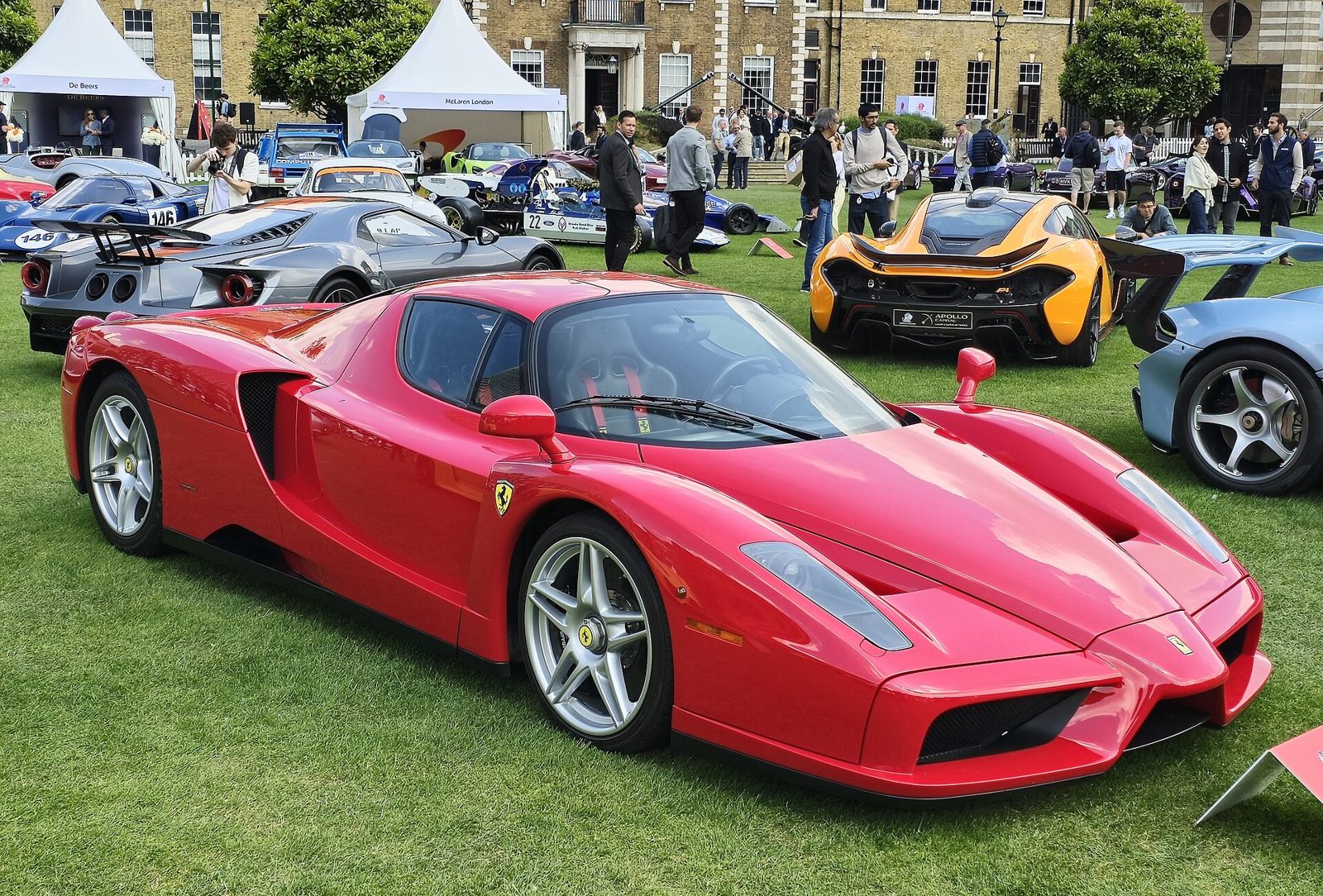
The Ferrari Enzo (2002-2004) was the fourth in the line of flagship Ferraris that began with the 288 GTO, and the first to carry the founder's name. It was announced at the Paris Motor Show in September 2002, at the height of Scuderia Ferrari's Formula One dominance, and was sold by invitation to existing clients before production started. Beneath Pininfarina bodywork styled under Ken Okuyama sat a carbon-fiber and aluminum-honeycomb monocoque, pushrod suspension, Brembo carbon-ceramic brakes and active aerodynamics, all of them firsts or near-firsts for a road Ferrari. The engine was the new 5,998 cc Tipo F140 V12, quoted at 651 hp at 7,800 rpm, driving through a six-speed F1 automated manual; no manual was offered and every car was left-hand drive. Ferrari says 399 were built for road use plus one further car for the Vatican, while RM Sotheby's and Wikipedia now print 498, a disagreement no source resolves. In 2026 the model's auction record more than doubled in the space of a few months, moving the Enzo into eight-figure territory.
History
The Name and the Moment
Ferrari does not lend its founder's name lightly. The Enzo arrived in 2002, the year Michael Schumacher clinched the Drivers' Championship with eleven rounds run and Ferrari took the Constructors' title alongside it, and the company's own account presents the car as a tribute to Enzo Ferrari that bundled up the technology of that winning period. It followed the 288 GTO, F40 and F50 as the fourth flagship, and Ferrari's magazine has since described its launch as coinciding with the Scuderia's 'imperial phase'. The car was shown at the Paris Motor Show in September 2002, by which point every example had already been allocated: Ferrari offered it by invitation to established customers, and Supercar Nostalgia records that the run had been raised from 349 to 399 before the reveal.
Formula One Technology for the Road
The structure was new. A carbon-fiber monocoque with an aluminum-honeycomb core, quoted at 203 lb, carried the engine on a cast alloy subframe, and the double-wishbone suspension used pushrod-actuated dampers that could be adjusted from the cockpit. Brembo's carbon-ceramic brakes, 15.0 in (380 mm) at each corner, were a first for a Ferrari road car. The aerodynamics were active, with front underbody flaps and a rear spoiler that trimmed downforce with speed; Ferrari quoted 1,709 lb at 186 mph, falling again towards maximum speed. The steering wheel carried a strip of LEDs that lit in 500 rpm steps, together with the buttons for reverse and traction control that previewed the later manettino. Michael Schumacher's involvement in chassis development was part of the launch story and remains part of the sales pitch.
The F140 Engine
The Enzo was the first recipient of the F140 V12, a 5,998 cc, 65-degree unit with titanium connecting rods, dry-sump lubrication and variable-length induction, managed by Bosch Motronic ME7. Ferrari quoted 651 hp at 7,800 rpm and 485 lb-ft at 5,500 rpm, and presented it as the most powerful naturally aspirated engine in the world. Only one transmission was offered, a six-speed Graziano automated manual with a twin-plate electro-hydraulic clutch and 150 millisecond shifts in Race mode. Supercar Nostalgia records the car lapping Fiorano 4.5 seconds faster than the F50. Ferrari claimed 0-62 mph in 3.65 seconds and 217 mph; Motor Trend recorded 3.3 seconds to 60 mph at Fiorano in 2003 but could not run to maximum speed in the time it was given.
Okuyama's Shape
Pininfarina built the carbon-fiber and Nomex body, and the design was led by Ken Okuyama, who Hagerty notes was the first non-Italian to style a Ferrari and who was later Pininfarina's creative director. Ferrari's own magazine concedes the car is 'angular rather than voluptuary', with a Formula One-style prow and complex flanks that put function ahead of the marque's usual sensuality; Bloomberg Businessweek went as far as listing it among the ugliest cars of the past fifty years. Inside there was exposed carbon, Sparco carbon seats with four-point harnesses, manual window winders and no stereo. The color palette was limited to three shades at launch before the full Ferrari range was opened, which is why single-digit color counts now feature so prominently in auction catalogs.
Four Hundred, or Four Hundred and Ninety-Eight
Production ran from October 2002 to May 2004. Ferrari's own page states that 399 cars were developed for road use; a 400th, titled as a 2005 and chassis 141920, was built for Pope John Paul II, who asked that it be sold for tsunami relief instead. It went under the hammer at Maranello in June 2005 alongside the M3 development mule, and RM Sotheby's described it in 2015 as 'the 400th and final Enzo built'. The same auction house's 2026 catalogs state 498 built with 111 for the United States, and Wikipedia now agrees on 498. No source consulted reconciles the two figures. The Enzo's mechanicals went on to underpin the track-only FXX from 2005, the Maserati MC12 and the one-off Pininfarina P4/5 built on the last unregistered US-specification chassis, and the line ended with the LaFerrari of 2013, at which point the naturally aspirated flagship era closed.
Common Problems
The F140 V12 itself has a strong reputation, is chain-driven and needs no cam-belt service, with oil changes recommended at 7,500 miles or yearly. The expense lies elsewhere. The F1 transmission is the recurring liability: Secret Entourage quoted a clutch assembly at $6,000 in 2012, and supercars.net notes that clutch life depends heavily on driving style. Top Gear calls the semi-automatic gearbox the car's Achilles heel, on the grounds that its electro-hydraulic technology has a sell-by date that a manual does not, and specialist support for the control units and actuators will only become more important with age. Brakes are the other big-ticket item: a full carbon-ceramic brake job was quoted at around $40,000 in 2012 and has not become cheaper. A comprehensive service was put at around $9,000 and insurance at upwards of $6,000 a year in the same 2012 piece, figures that predate the current values and should be read as a floor. Parts are scarce and costly, and long-stored cars bring the usual problems of perished seals, stale fuel and flat batteries. Rear visibility is poor by design. Ken Okuyama's defense, when caught speeding in his own Enzo in 2022, was that the car needed to be kept moving to avoid overheating; whatever its legal merit, slow traffic in hot weather is not this car's natural habitat.
What to Look For
Documentation carries more weight on an Enzo than on almost any other modern Ferrari, because so much of the 2026 price spread is explained by mileage and originality rather than by specification, which barely varies. Ferrari Classiche certification, open to road cars over twenty years old and therefore to every Enzo, produces a Certificate of Authenticity signed by Piero Ferrari and a Red Book confirming matching chassis, engine, transaxle and bodywork; the cars achieving the strongest 2026 results almost all carried one. The original three-piece fitted luggage with red dust covers, the trunk toolkit, the owner's manuals and the delivery congratulation letter are treated by auction houses as part of the car, and their absence is noticed. Establish the color from the factory build rather than the paint: the current market pays for Nero DS, Argento Nurburgring, Giallo and other low-count shades, and a repaint into one of them is not the same thing. Check the interior for retrims, which do occur; DK Engineering's UK car had been retrimmed by Zanasi in 2015 and disclosed it. On the mechanical side, the F1 gearbox is the component most sensitive to history: clutch wear is strongly linked to how the car has been driven, and hydraulic actuator and pump replacement is costly, so evidence of recent clutch measurement and a dry, correctly functioning F1 system matters. Carbon-ceramic discs are very expensive to replace; inspect them and the callipers rather than assuming. Every Enzo is left-hand drive, so a claimed right-hand-drive car is not one. Very low mileage is not automatically a virtue: a car showing a few hundred miles after twenty years may need every rubber component, fluid and battery attended to before it can be used, and the Okuyama anecdote of an Enzo needing speed to keep cool is a reminder that these cars were not designed for idling.
Market Notes
As of September 2026, classic.com's Ferrari Enzo benchmark stands at approximately $8.09 million with an average recorded sale of about $6.75 million, on a rising trend, with tracked results spanning $1,917,500 (November 2022) to $17,875,000 (January 2026). The shape of that range is a 2026 story. The model record set by the Vatican car at RM Sotheby's Monterey in August 2015, $6,050,000, stood for a decade; classic-car-auctions.info then records the record tripling within weeks. Mecum sold a 649-mile Giallo car from the Bachman collection at Kissimmee in January 2026 for $17,875,000 including premium, and a Rosso Dino example with around 3,700 miles for $11,110,000 at the same sale. RM Sotheby's followed with $9,300,000 for a 746-mile US car at Arizona in January 2026 and 8,105,000 euros for a 178 miles Classiche-certified car at Paris the same month. Broad Arrow's single-owner Nero DS car with under 450 miles made $15,185,000 at Amelia Island in March 2026 against a $12-16 million estimate. Driven cars sit well below: RM Sotheby's took 6,530,000 euros for a 11,855 miles Argento Nurburgring car at Monaco in April 2026 and $9,410,000 for a 9,834-mile Classiche-certified US car at Monterey in August 2026, while Mecum's 595-mile car made $12,100,000 the same weekend. Whether a quoted figure includes buyer's premium is not always stated on the pages read here; where it is, the Kissimmee figure does. Premiums attach to sub-1,000-mile odometers, unusual factory colors, single ownership, a complete luggage and tool set and a Classiche Red Book; higher-mileage European cars in common colors anchor the bottom of the current range.
Where sources differ
Ferrari quotes 2,767 lb dry; published curb weights range from 3,009 lb (Supercar Nostalgia) to 3,263 lb (evo, supercars.net), and the sources do not agree on the running weight.
Top Gear and Wikipedia give 2,767 lb dry. Supercar Nostalgia gives 3,009 lb curb. Evo and supercars.net give 3,263 lb curb. The dry figure is a manufacturer claim and the two curb figures differ by 254 lb; which is correct is not resolved by any source consulted here.
Total Enzo production is stated as 399 road cars plus one further car by Ferrari, DK Engineering, classic-car-auctions.info and RM Sotheby's 2015 catalog; as 400 by evo and supercars.net; and as 498 by RM Sotheby's 2026 catalogs and Wikipedia, with Supercar Nostalgia saying 'around the 500 mark'. No total is asserted here.
Ferrari's model page states 399 developed for road use. DK Engineering quotes Ferrari at 399 (+1). classic-car-auctions.info states 399 plus a 400th for the Pope. RM Sotheby's 2015 catalog calls chassis 141920 'the 400th and final Enzo built'. Evo and supercars.net state 400. RM Sotheby's Paris, Arizona and Monterey 2026 catalogs state 498 built with 111 for the US. Wikipedia states 498. Supercar Nostalgia says around 500. The gap between 400 and 498 is not explained by any source consulted and is unresolved, so productionTotal is null.
Sources
- Enzo Ferrari (2002), Ferrari S.p.A. · manufacturer
- All in the Name: The Enzo Ferrari, Ferrari S.p.A. · manufacturer
- Ferrari Classiche: Certification, Ferrari S.p.A. · manufacturer
- Ferrari Enzo, Wikipedia · encyclopedia
- Ferrari Enzo (2002 - 2004) - review, history and specs, evo · journalism
- Ferrari Enzo: the Schumacher-honed hypercar that got better the faster you went, Top Gear · journalism
- Mecum's Kissimmee 2026 Ferrari feast: 250 GTO goes for $38.5m, but $17m Enzo shocks, Magneto · journalism
- Ferrari Enzo Guide, Supercar Nostalgia · specialist
- Ferrari Enzo: The Ultimate Guide, Supercars.net · specialist
- Ferrari Enzo for sale - Vehicle Sales - DK Engineering, DK Engineering · specialist
- Ferrari Maintenance Costs: Our Expert Guide, Scuderia Car Parts · specialist
- Cost of Ownership - Ferrari Enzo, Secret Entourage · specialist
- Ferrari Enzo Market, classic.com · market-data
- Ferrari Enzo: Most Expensive Auction Prices (2005-2026), Classic Car Auctions (classic-car-auctions.info) · market-data
- 2004 Ferrari Enzo, Paris 2026, RM Sotheby's · auction-house
- RM Sotheby's Opens the 2026 Auction Season with $63 Million Arizona Sale, Led by Ferrari Enzo, F50 and LaFerrari, RM Sotheby's · auction-house
- 2004 Ferrari Enzo, The Monaco Auction 2026, RM Sotheby's · auction-house
- 2003 Ferrari Enzo, The Monterey Auction 2026, RM Sotheby's · auction-house
- 2005 Ferrari Enzo, Monterey 2015, RM Sotheby's · auction-house
- Broad Arrow Reveals Private Collection Led by Single-Owner Nero Ferrari Enzo as Final Entries for The Amelia Concours Auction, Broad Arrow Auctions (via Hagerty newsroom) · auction-house
- Ferrari Enzo stylist gets bagged for speeding in his own design, Hagerty Media · journalism
- ECR - Ferrari Enzo details (400th car), Exclusive Car Registry · registry
Synthesized from the sources above and cross-checked. We cite and link out; we do not republish other databases verbatim.
Fully Sorted is an independent publisher and is not affiliated with, endorsed by or sponsored by Ferrari S.p.A.. Ferrari and the model names on this page are trademarks of Ferrari S.p.A. and are used here only to identify the cars being described.
Chassis register
Nobody has recorded a car here yet. Own one, or know one? Chassis number, what you can prove about it, and a source if there is one. Every entry is reviewed before it appears.
Nerd Notes
What owners know that the sources don't. Every note is read and checked before it appears here.
Key Specs
- Fuel
- Two 55-liter aluminum tanks
- Power
- 651 hp at 7,800 rpm, Ferrari claim; presented at launch as the most powerful naturally aspirated road engine in the world
- Brakes
- Brembo carbon-ceramic (CCM) discs, 15.0 in (380 mm) all round, six-piston front and four-piston rear callipers, ABS and ASR standard
- Engine
- 5,998 cc Tipo F140 B naturally aspirated 65-degree V12, alloy block and heads, titanium connecting rods, dry sump, variable-length induction, Bosch Motronic ME7
- Layout
- Mid-mounted longitudinal engine, rear-wheel drive
- Torque
- 485 lb-ft at 5,500 rpm, Ferrari claim
- Weight
- 2,767 lb dry per Ferrari and Top Gear; curb weight quoted at 3,009 lb by Supercar Nostalgia and 3,263 lb by Evo and supercars.net, so the running weight depends on which source is read
- Chassis
- Carbon-fiber monocoque with aluminum honeycomb core, quoted at 203 lb bare; engine carried on a cast alloy subframe; wheelbase 104.3 in (2,650 mm)
- Bodywork
- Carbon-fiber and Nomex sandwich panels by Pininfarina, styled under Ken Okuyama; butterfly doors, glass engine cover, no stereo, manual window winders
- Suspension
- Double wishbones front and rear with pushrod-actuated coil springs and cockpit-adjustable Skyhook adaptive dampers
- Valvetrain
- Twin overhead camshafts per bank, four valves per cylinder, 8,200 rpm redline
- Bore stroke
- 92.0 mm x 75.2 mm
- Compression
- 11.2:1
- Acceleration
- 0-62 mph in 3.65 s per Ferrari; 0-60 mph in 3.3 s recorded by Motor Trend at Fiorano in 2003; Evo recorded 3.65 s to 62 mph against a 3.1 s claim
- Aerodynamics
- Active front underbody flaps, adjustable rear spoiler and rear diffuser; downforce quoted at 756 lb at 124 mph and 1,709 lb at 186 mph, reducing towards maximum speed
- Transmission
- 6-speed Graziano automated manual (F1) with electro-hydraulic twin-plate clutch and carbon-fiber paddles; 150 ms shift time in Race mode; no manual gearbox was offered
- Wheels tires
- 19-inch center-lock alloys, 9 in front and 13 in rear; Bridgestone Potenza RE050A Scuderia, 245/35 ZR19 front and 345/35 ZR19 rear
- Top speed claimed
- 217 mph (217-218 mph), manufacturer claim; no independently verified maximum-speed run was found among the sources consulted
Notable Variants
Enzo (European specification)
The standard car as delivered in Europe and the UK: left-hand drive only, F1 gearbox only, no manual, no right-hand-drive variant. Optioned mainly on seat size, calliper and instrument color, stitching and Alcantara inserts, so 'specification' on an Enzo is mostly about color and originality.
Enzo (US specification)
RM Sotheby's catalogs put the US allocation at 111 cars. US cars carry the same mechanical specification; the 2026 auction record has been set almost entirely by US-delivered examples with very low mileage.
The 400th car (chassis 141920)
Titled as a 2005, built after the announced run closed, intended as a gift to Pope John Paul II and sold instead at Maranello in June 2005 for tsunami relief. Sold again by RM Sotheby's at Monterey in August 2015 for $6,050,000 with 111 miles recorded, a model record that stood for a decade.
Development mules M1, M2 and M3
Three prototypes built on Ferrari 348 bodywork; M3 was constructed between 25 September and 25 November 2000 and was sold at the June 2005 Maranello auction for 195,500 euros. Not road cars and not counted in any production figure.
Non-standard colors
Only three exterior colors were offered at first before the full palette opened up. DK Engineering counts 43 cars in black across five shades, with just four in Nero DS; RM Sotheby's counts nine in Argento Nurburgring. Rare colors have drawn clear premiums in 2026 results.
FXX (track-only derivative)
Launched 2005 with a 6.3-liter development of the F140 at around 789 hp, sold at 1.3 million euros into a factory-run client test program and later upgraded to Evoluzione specification. Built on Enzo architecture but counted separately, and not road-registrable.
Value Trajectory
The Enzo listed at about $650,000 in the United States. Values held around list through the 2000s, with the papal car making $1.1 million at its 2005 charity sale, and then rose steadily through the 2010s as the analogue supercar cohort re-rated; the Vatican car's $6,050,000 at RM Sotheby's Monterey in August 2015 became a record that lasted ten years. As recently as August 2024 a tracked sale was recorded at $2.6 million, and supercars.net's five-year average sat at $3.4 million. As of September 2026 the picture is different: classic.com's benchmark is around $8.09 million on a rising trend, five cars sold above $9 million in the first two months of 2026, and the record now stands at $17,875,000. Classic Driver's reading of Broad Arrow's $15,185,000 Amelia Island result was that it might mark a plateau at a very high level rather than a further leg up, and classic-car-auctions.info asks openly whether the market has moved permanently or whether a correction follows. What is clear is that the spread between a sub-1,000-mile single-owner car and a well-used one has widened to several multiples, and that low mileage, rare color and certification now do most of the work.
Next
Shopping for one?
Browse Ferrari listings, or decode a VIN before you buy.