
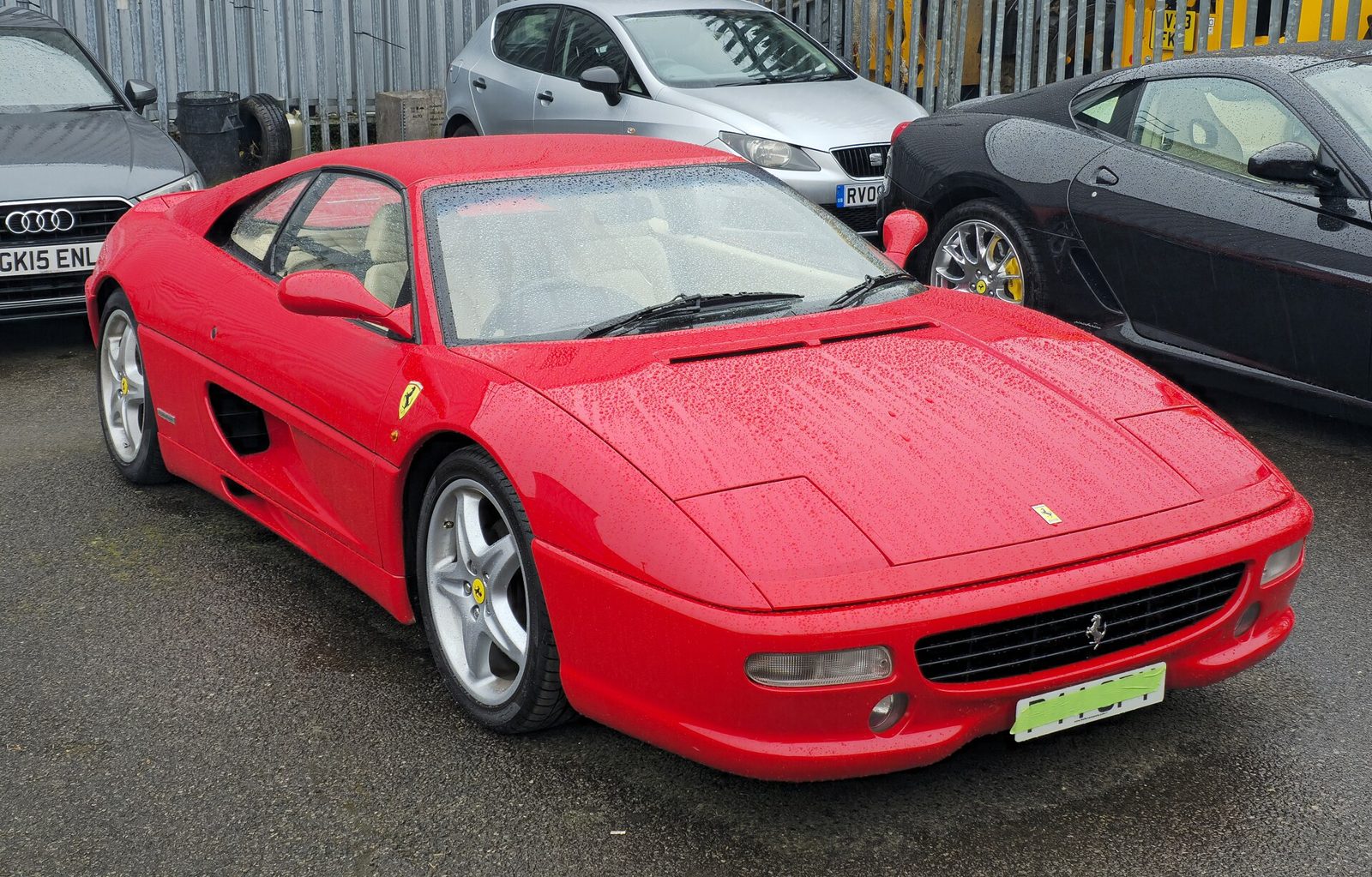
The Ferrari F355 (1994-1999) replaced the 348 and set out to correct almost everything the earlier car had been criticized for. The name is a specification rather than a badge: 3.5 liters and five valves per cylinder, three inlet and two exhaust, on a flat-plane-crank 90-degree V8 claimed at 375 hp at 8,250 rpm. That works out at roughly 108 horsepower per liter from a naturally aspirated production engine in 1994, a specific output no road-car rival could match at the time, the McLaren F1 included. Underneath sat a flat undertray with channelled ducting that produced downforce where the 348 had produced lift, after more than 1,300 hours of wind-tunnel work. Three bodies were offered - Berlinetta, targa-roofed GTS and convertible Spider - and in 1997 the Berlinetta became the first road car sold with a Formula One-derived electrohydraulic paddle-shift gearbox. Around eleven thousand were built, the run closing with the Serie Fiorano Spiders of 1999.
History
Undoing the 348
Luca di Montezemolo took over Ferrari at the end of 1991 and is reported to have rejected the 348 outright, canceling plans for a hotter version and ordering a redesign instead. The 348 was quick but widely held to be nervous at the limit and poorly built next to the Honda NSX, which Ferrari benchmarked directly. The F355 that emerged in May 1994 kept the 348's architecture - steel monocoque, longitudinal mid engine, tubular rear subframe - and revised almost everything attached to it. Ferrari's own measure of the change was a Fiorano lap two seconds quicker than the twelve-cylinder 512 TR.
Five Valves, and What the Name Means
The badge is arithmetic: 3.5 liters, five valves per cylinder. Three inlet and two exhaust, on twin cams per bank, gave the breathing that let a 3,496 cc flat-plane V8 run to 8,250 rpm for a claimed 375 hp - 375 hp. Titanium rods, forged pistons and dry-sump lubrication supported the rev ceiling. The specific output is the point: about 107 hp per liter, or 108 hp per liter in metric horsepower, which is why published figures hover between the two for one engine. Either way it was around 107 hp per liter from an unforced production engine in 1994, ahead of the McLaren F1's 76.8. Bosch Motronic 2.7 managed the first cars; Motronic M5.2 arrived for 1996 with a revised exhaust, a four-spoke airbag wheel and a passenger airbag, and specialists have preferred the later cars ever since.
The Floor
The less advertised change was underneath. Pininfarina and Ferrari gave the F355 a flat undertray with channelled ducting and a Nolder profile at the top of the tail, developed across more than 1,300 hours in the wind tunnel. Where the 348 generated lift at speed, the F355's floor produced downforce and balanced it between the axles, which is a large part of why the car earned a reputation for stability its predecessor never did. The open Spider needed its own program, quoted at 1,800 hours.
Three Bodies and the First Paddles
The Berlinetta and the targa-roofed GTS came first; the fully convertible Spider followed, dated by some sources to 1995 and by others to 1996, and brought the first electrically powered hood on a Ferrari. The GTS was the last mid-engined Ferrari with the flying-buttress rear screen. Then, in 1997, the Berlinetta became the first road car in the world offered with an electrohydraulic paddle-shift gearbox derived from Formula One practice, quoted at 150-millisecond shifts in Sport mode. Cars so equipped dropped the F from the badge and were sold simply as the 355 F1. The system was a genuine first, and it aged quickly: buyers today pay more for the open-gate manual than for the innovation.
Fiorano, and the End
A one-make F355 Challenge appeared from late 1995, sold as a factory kit of cage, seats, brakes, wheels and slicks. The road car's run closed in 1999 with the Serie Fiorano, a Spider carrying Competizione-derived suspension, a wider track, a faster rack, drilled discs, the Challenge rear grille and a numbered plaque; the same hardware was also sold in Europe as a standalone Fiorano handling pack. Nearly thirty per cent of production went in that final year. The 360 Modena replaced it with an aluminum structure and, for the first time on a mid-engined V8 Ferrari, a cam-belt change that did not require the engine to come out.
Common Problems
Two faults dominate ownership. The exhaust manifolds crack, and every source consulted treats this as when rather than whether. The primaries sit inside heat-shield cladding that traps temperature until the thin-wall tube fails. QuickSilver describes them as 0.05 in (1.2 mm) material in 409-grade stainless; WhichCar attributes the failures to 0.08 in (2 mm) gauge and puts typical onset at 35,000 to 34,000 miles. The fixes divide into Ferrari replacement, widely reported to fail again; specialist reconditioning; aftermarket systems such as Tubi; and exchange rebuilds on the original heat shields with primaries stepped to 0.06 in (1.5 mm) in 304-grade stainless. The right-hand manifold cannot be removed until the oil tank comes out, which is why quotes for one side are not half the quote for both. Second, bronze valve guides on earlier cars wear and pass oil, and the fix is a head rebuild. Beyond those: rattling exhaust bypass valves, failing electronic damper actuators, catalyst degradation, sticky thermoplastic switchgear, shrinking dash leather, corroded buttresses and subframes, and F1 clutches finished inside 5,000 miles of hard use.
What to Look For
Two documents matter more than the car's appearance. The first is the belt service record: the factory procedure on every F355 is engine and gearbox out, so an invoice itemizing cam belts, tensioner bearings, accessory belts and cam-cover gaskets, with a date and a mileage, is the difference between a serviced car and an asserted one. A vague 'major service' line is not evidence. The second is the valve-guide history. Early cars used bronze guides that wore, letting oil past and producing smoke; steel guides became the fix. Which guides a car has cannot be told from its build year, so the history has to be confirmed against the chassis and engine numbers. Check the manifolds directly and treat original factory items with suspicion rather than pleasure, since cracking is close to universal and the cladding hides it. Look at the rear buttresses, sill plates and engine cradle for corrosion where aluminum meets steel. On F1 cars, establish clutch wear from a reader rather than by feel, since 15,000 to 30,000 miles is the usual life. On Spiders, cycle the hood fully, since hydraulic failures are common. Later Motronic M5.2 manual cars are the configuration specialists steer towards, and on any US car the 2009 fuel-line recall should be confirmed as carried out.
Market Notes
As of August 2026 classic.com publishes no single benchmark for the F355 as a whole and instead splits the model by body and transmission. The benchmarks stand at $153,376 for the Berlinetta manual and $115,201 for the Berlinetta F1; $176,036 for the GTS manual and $156,748 for the GTS F1; $131,382 for the Spider manual and $96,031 for the Spider F1. Two sub-markets sit above the ordinary cars: the Challenge at $158,915 and the Serie Fiorano at $267,660, the latter rising. Cars converted from F1 to a manual gate are tracked separately at $213,057, which says something about how firmly the market prices the pedal. The headline average across every variant is $279,502, pulled upward by Fiorano and Challenge cars, and the lowest recorded sale is $34,999 for a 1998 F1 Spider in July 2022. Auction evidence sits in the same territory. RM Sotheby's sold a Classiche-certified 1995 Berlinetta once owned by Michele Alboreto for 166,750 euros at Milan in 2025 and a 1997 manual Spider for 195,500 euros at Monaco in 2026, both as reported by the house and inclusive of premium. A 1996 GTS manual with 14,899 miles failed to sell against a 180,000-220,000 pound estimate at Cliveden House in 2025, which marks roughly where the top of the GTS market currently resists.
Where sources differ
Published totals for F355 production do not agree, ranging from 11,206 to 11,273 cars, and no single figure is asserted here; within that, roughly 3,717 Spiders of which about 2,664 were manual, and 2,577 GTS, are the figures on which the sources consulted do agree.
Wikipedia, conceptcarz and WhichCar state 11,273, with Berlinetta 4,871, Spider 3,717, GTS 2,577 and Challenge 108. Supercar Nostalgia states 11,206, with Berlinetta 4,915, Spider 3,714 and GTS 2,577. The discrepancy is not explained by any source consulted here and is not resolved, so productionTotal is left null.
The 1999 Serie Fiorano run-out Spider is recorded either as 104 cars against an announced limit of 100, or as a flat 100, and the manual content of the run is given as either 26 cars or six.
Wikipedia, RM Sotheby's, classic.com and WhichCar all state 104 built against 100 announced, with Wikipedia giving 74 US F1, 26 US manual, 3 European F1 and 1 South African F1. conceptcarz states a run of 100, all Spiders, of which only six had the six-speed gearbox. Neither the total nor the manual count is resolved by any source consulted here; both remain unresolved.
Sources give different wall thicknesses for the original exhaust manifold primaries, so the failure is well attested but its precise cause in gauge terms is not settled.
QuickSilver, which rebuilds the parts, describes the factory primaries as 0.05 in (1.2 mm) material in type 409 stainless and steps its exchange units up to 0.06 in (1.5 mm) in type 304. WhichCar attributes the cracking to 0.08 in (2 mm) gauge metal and places typical onset at 21,748-34,175 miles. The two figures cannot both describe the same tube and the conflict is not resolved by any source consulted here.
Published cam-belt intervals for the F355 differ, and an owner cannot rely on a single number without checking the documentation for the market their car was supplied to.
the355.com gives the factory schedule as every 31,000 miles and not more than three years for European cars, against five years for US cars. PistonHeads and Magneto both give three years or 30,000 miles. Affordable Supercar cites original Ferrari guidance of belt inspection at 52,500 miles, a three-year requirement applied later to certified pre-owned cars, and five years as common practice. These are not resolved by any source consulted here.
Early cars used bronze valve guides that wore and passed oil, with steel guides adopted as the fix, but the affected period is stated differently by different sources and cannot be determined from a car's build year alone.
PistonHeads places the change at post-1997 and describes pre-1997 cars as most vulnerable. WhichCar states roughly 20 per cent of 1995 cars were affected but adds that problem batches also reached 1997 and 1998 cars. the355.com states it is not possible to tell which guides a car has from its build year and that the specification must be confirmed with Ferrari against the chassis and engine numbers. The affected range is not resolved by any source consulted here.
Sources
- Ferrari F355, Wikipedia · encyclopedia
- Ferrari F355 Guide, Supercar Nostalgia · specialist
- 1997 Ferrari F355, conceptcarz.com · specialist
- 1999 Ferrari F355 Serie Fiorano, conceptcarz.com · specialist
- Modern Classic: Ferrari 355, WhichCar / Wheels · journalism
- Ferrari F355 Buying Guide - Powertrain, PistonHeads · journalism
- 1994-1999 Ferrari F355 buying guide, Magneto · journalism
- Ferrari F355 (1994 - 2000) used car review, RAC · journalism
- Mechanicals - F355 Buyer's Guide, the355.com · specialist
- Servicing schedule - the355, the355.com · specialist
- Ferrari F355 Manifold EXCHANGE (1994-99), QuickSilver Exhausts · specialist
- Ferraris' Most Feared Maintenance Item: The Engine-Out Belt Service - Revisited, Affordable Supercar · specialist
- $1924 Ferrari F355 engine out belt service, FerrariChat · club-forum
- Safety Recall 09V-447, Ferrari F355 fuel supply pipes, US National Highway Traffic Safety Administration · government
- Ferrari F355 Market, classic.com · market-data
- Ferrari F355 Spider Serie Fiorano Market, classic.com · market-data
- 1995 Ferrari F355 Berlinetta, Milan, RM Sotheby's · auction-house
- 1997 Ferrari F355 Spider, The Monaco Auction 2026, RM Sotheby's · auction-house
- 1999 Ferrari 355 F1 Spider 'Serie Fiorano', Miami 2024, RM Sotheby's · auction-house
- 1996 Ferrari F355 GTS, Cliveden House 2025, RM Sotheby's · auction-house
Synthesized from the sources above and cross-checked. We cite and link out; we do not republish other databases verbatim.
Fully Sorted is an independent publisher and is not affiliated with, endorsed by or sponsored by Ferrari S.p.A.. Ferrari and the model names on this page are trademarks of Ferrari S.p.A. and are used here only to identify the cars being described.
Chassis register
Nobody has recorded a car here yet. Own one, or know one? Chassis number, what you can prove about it, and a source if there is one. Every entry is reviewed before it appears.
Nerd Notes
What owners know that the sources don't. Every note is read and checked before it appears here.
Key Specs
- Power
- 375 hp at 8,250 rpm - manufacturer claim; roughly 107 hp or 108 hp per liter depending on which unit the figure is quoted in
- Engine
- 3,495-3,496 cc Tipo F129 90-degree V8, flat-plane crank, naturally aspirated (sources split between 3,495 cc and 3,496 cc)
- Layout
- Mid-mounted longitudinal engine, rear-wheel drive
- Stroke
- 77 mm, raised 0.08 in (2 mm) over the 348's
- Torque
- 268 lb-ft at 6,000 rpm - manufacturer claim
- Weight
- 3,269-3,300 lb curb depending on body style; Ferrari's own dry-weight figure was not retrieved here
- Chassis
- Steel monocoque with a tubular steel rear subframe carrying the engine and transaxle
- Suspension
- Independent unequal-length wishbones with coil springs over electronically controlled gas dampers, Comfort and Sport settings, anti-roll bars front and rear
- Valvetrain
- Twin overhead camshafts per bank, five valves per cylinder - three inlet, two exhaust
- Compression
- 11.0:1 per Wikipedia; 11.1:1 per Supercar Nostalgia
- Lubrication
- Dry sump
- Acceleration
- 4.7 s to 62 mph claimed; independent tests recorded 4.5-4.9 s to 60 mph and a 13.0-13.3 s quarter mile
- Aerodynamics
- Flat undertray with channelled ducting and a Nolder profile on the tail; over 1,300 hours of wind-tunnel work for the closed cars, 1,800 hours for the Spider
- Transmission
- 6-speed manual; 6-speed electrohydraulic F1 paddle-shift optional from 1997, quoted at 150-millisecond shifts in Sport
- Brakes wheels
- Ventilated discs; 18-inch wheels with 225/40 ZR18 front and 265/40 ZR18 rear tires
- Engine management
- Bosch Motronic 2.7 on 1994-1995 cars; Bosch Motronic M5.2 from the 1996 model year
- Top speed claimed
- 183 mph - manufacturer claim; independent measurement returned about 179 mph against the rev limiter
Notable Variants
F355 Berlinetta
The fixed-roof coupe, launched first in May 1994 and the stiffest of the three bodies. It was also the car chosen to introduce the F1 paddle-shift gearbox in 1997, so the earliest paddle cars are Berlinettas.
F355 GTS
Targa with a lift-out panel stowed behind the seats. The last mid-engined Ferrari to use the flying-buttress rear screen, and the body style with the smallest production run at 2,577 cars, which is reflected in the market.
F355 Spider
Full convertible and the first Ferrari soft-top with an electrically powered folding mechanism. Ferrari quoted 1,800 hours of wind-tunnel development for the open body alone. The hood mechanism is the body style's own maintenance liability.
355 F1 (paddle-shift)
From 1997 the electrohydraulic paddle gearbox was offered across all three bodies, and cars so equipped dropped the F from the badge to read simply 355. Historically important as the first such system on a road car, but the manual carries a consistent premium today.
F355 Challenge
One-make race car, generally given as 108 built, supplied as a factory-to-dealer conversion kit with roll cage, competition seats, uprated Brembo brakes, magnesium Speedline wheels and slicks. Twenty-eight were right-hand drive.
Serie Fiorano (1999)
Run-out Spider announced as 100 cars and generally recorded at 104: Competizione-derived suspension with stiffer springs and thicker anti-roll bars, a wider track, a faster steering rack, drilled and ventilated discs with competition pads, the Challenge rear grille, carbon-fiber interior trim and a numbered dashboard plaque. The same chassis hardware was also sold in Europe as a standalone Fiorano handling pack, which is a different thing from a numbered Serie car.
Value Trajectory
The F355 spent two decades as a used Ferrari rather than a collectable one, held down by the running costs that still define it and by the shadow of the 348. It re-rated from the middle of the 2010s as the last analogue mid-engined V8 Ferrari - hydraulic steering, an open gate on most cars, no traction control - and has since sorted itself along three axes rather than one. Transmission is the sharpest: as of August 2026 classic.com's manual benchmarks run roughly 12 to 37 per cent above the F1 equivalents in the same body, and cars converted from F1 to a manual gate are tracked as their own market at $213,057. Body style is second, with the GTS ahead of the Berlinetta and the Spider trailing both. Documented mechanical history is third and increasingly decisive, because a car needing manifolds and an engine-out belt service carries a five-figure liability that the price has to absorb. The specials have decoupled: the Serie Fiorano benchmark of $267,660, rising as of August 2026, and the Challenge at $158,915 both sit well clear of standard cars. The pattern is one of widening spread rather than uniform appreciation.
Next
Shopping for one?
Browse Ferrari listings, or decode a VIN before you buy.