
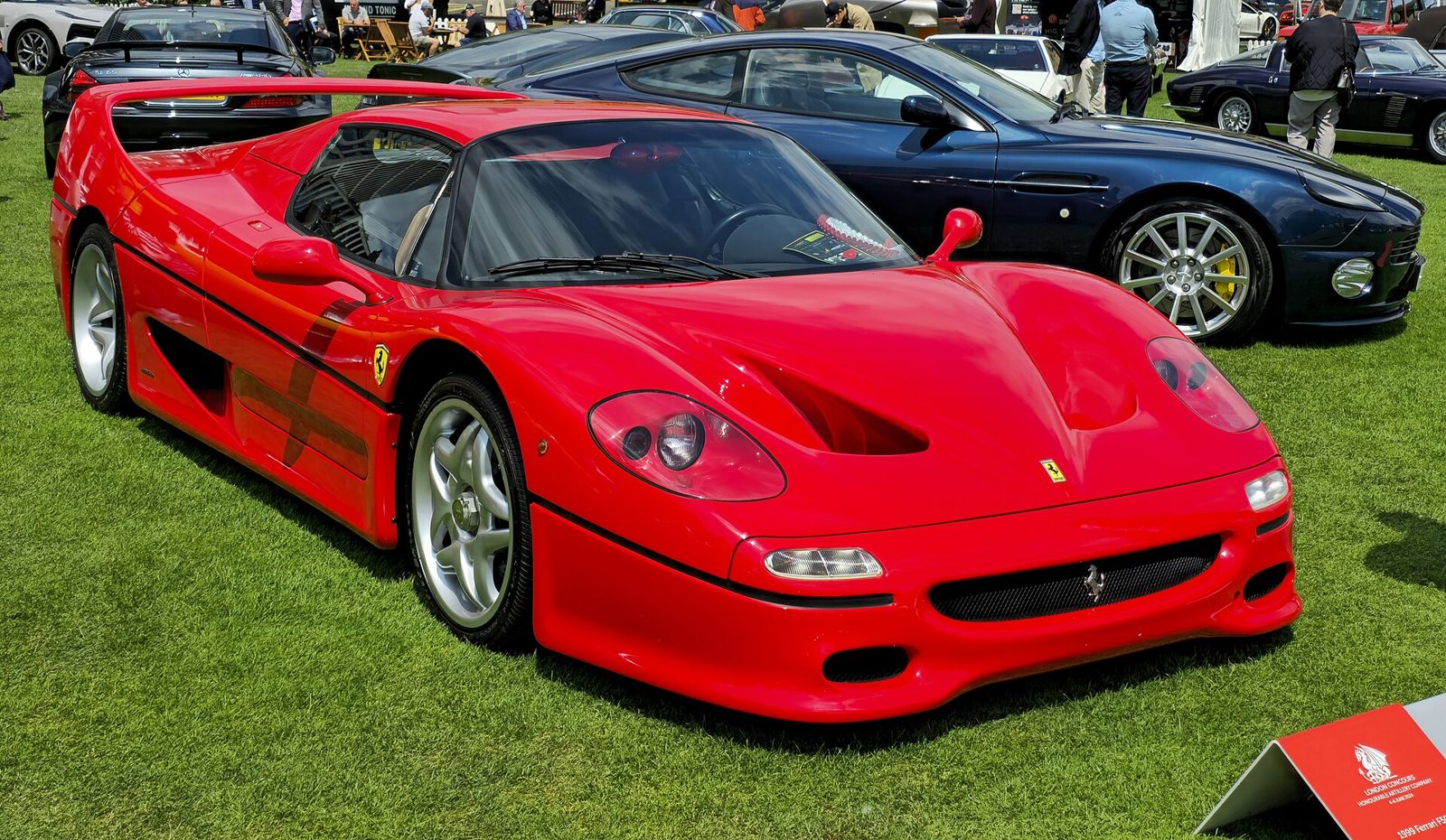
The Ferrari F50 (1995-1997) was conceived, by Piero Ferrari's own account, to answer a customer's question about why Ferrari could not build something close to a Formula One car for the road. It was unveiled at Geneva in March 1995 to mark the company's fiftieth year, two years ahead of the actual anniversary, and it did what the F40 had not: it used genuine racing architecture, the 65-degree V12 from the 1990 641 Grand Prix car enlarged from 3.5 to 4.7 liters, bolted to a carbon-fiber monocoque as a stressed member, with pushrod suspension hung from the engine and gearbox. Ferrari claimed 513 hp at 8,500 rpm, 2,712 lb dry, 202 mph and 0-62 mph in 3.87 seconds. There was no servo, no ABS, no power steering and no traction control; the roof was a removable hardtop with a fabric emergency hood. Production was fixed at 349 cars, 55 of them for the United States, where they were initially leased rather than sold. Received coolly in period against the McLaren F1, the F50 has since been re-read as the last naturally aspirated, manual-gearbox Ferrari flagship.
F50
349 built · 2-door, 2-seat Barchetta with removable carbon-fiber hardtop and folding fabric emergency roof (targa-style)
How rare is it?
With about 349 built, the Ferrari F50 is rarer than a F40 (~1k) yet more common than a McLaren F1 (~106).
Approximate total production placed on a log scale against well-known reference cars, for scale only. Figures and any disputes are detailed in the production notes and sources.
History
Piero Ferrari's Question
The F50 began, in Piero Ferrari's telling to Peter Robinson in 1995, with a customer asking in 1989 why Ferrari could not make something close to a Formula One car that could be driven on the road. Enzo Ferrari had died the year before, and the F40 had been a turbocharged evolution of a canceled Group B program. This time Ferrari Engineering set out to build a road car around Grand Prix architecture from the start; Curbside Classic has the design essentially ready by 1993. The car was shown at Geneva in March 1995 as the fiftieth-anniversary Ferrari, although the anniversary proper fell in 1997, which is also when the last car was built.
An F1 Engine Enlarged
The engine is the substance of the claim. Ferrari took the 65-degree V12 that had powered the 641 in 1990, the car in which Alain Prost won five Grands Prix and Nigel Mansell one, and enlarged it from 3.5 to 4.7 liters with an 3.3 in (85 mm) bore and 69 mm stroke. Top Gear's summary is that the vee angle, block and five-valve heads were carried over and everything else was new; Secret Classics notes Mahle pistons and titanium connecting rods. The racing unit had revved to around 15,000 rpm; the road version's redline was 8,500 rpm, at which Ferrari quoted 513 hp, a little over 39 hp more than the F40. Torque, 347 lb-ft at 6,500 rpm, was modest beside the turbocharged car it replaced. A six-speed manual transaxle was chosen over the paddle-shift gearbox then in Formula One, for longevity according to Supercar Nostalgia.
Carbon Tub, Stressed Engine, Open Roof
The F50 was the first Ferrari road car built on a carbon-fiber monocoque. The tub, in T300 pre-preg carbon with a Nomex core, weighed around 225 lb, and Ferrari quotes torsional stiffness of 25,498 lb-ft per degree. The engine was bolted to the rear of the tub as a load-bearing member and the rear suspension hung from the gearbox casing, as on a Grand Prix car, with pushrods operating horizontal coil springs and electronically controlled Bilstein dampers at both ends. Rubber Sekur fuel tanks holding 105 liters sat either side of the engine. The steering was unassisted and the Brembo brakes had neither servo nor ABS. Pininfarina's body, credited to Pietro Camardella under Lorenzo Ramaciotti and descended from the 1989 Mythos concept, was a barchetta with a removable hardtop and a fabric emergency roof, less slippery than the F40 at 0.37 Cd. Dry weight was quoted at 2,712 lb.
349 Cars and a Lease
Production was fixed at 349 cars; autoevolution says only 348 were sold, the last kept for Ferrari's museum. CAR found the order book full through the whole run in early 1996 and reported that Ferrari selected owners to keep speculators out, a direct reaction to the F40 bubble. In the United States, where 55 cars were allocated, list was about $475,000 and the company leased them for two years before allowing purchase; a dealer source quotes $240,000 down, $5,600 a month and a $150,000 buy-out. Against a US list of about $475,000, Secret Classics gives a German list price of roughly DM 750,000. Colors were narrow: 302 red, 31 yellow, sixteen in dark red, silver and black. A GT1 version developed with Dallara and Michelotto, at around 750 hp, was abandoned in 1996 when the rules let Porsche and others homologate purpose-built cars; three finished F50 GTs went to clients on condition they were never raced and the remaining tubs were destroyed.
Panned, Then Forgiven
The F50 arrived a year after the McLaren F1 had, in Top Gear's phrase, rearranged everyone's expectations, and Curbside Classic lists the EB110, Diablo SE30 Jota and XJ220 as rivals with around 100 hp more. The reception was muted: heavier and less aerodynamic than the F40, slower on paper, and a targa where the F40 had been a berlinetta. Paul Horrell's 1996 road test for CAR was less equivocal, praising a light, precise gearchange, feelsome unassisted steering, colossal non-servo brakes and a Monaco-tunnel howl. The verdict changed over two decades as a naturally aspirated racing V12, a manual gearbox and a carbon tub became a combination no manufacturer would offer again; by August 2026 the car was setting records at Monterey.
Common Problems
No source consulted here publishes a systematic fault list for the F50, and the pattern of the car's problems has to be read from what the auction catalogs and specialist writers record as having been done. The recurring items are the fuel cells, the engine-out service and the clutch. The two rubber Sekur tanks are a life-limited component and their replacement appears on the service history of the Arizona 2026, Monterey 2025 and Monterey 2026 cars alike; a car without a dated replacement should be assumed to need one. Because the V12 is bolted to the tub as a stressed member and carries the rear suspension on its gearbox casing, major service means removing the drivetrain from the monocoque, which is why Secret Classics quotes over 100,000 euros for an engine-out service in 2019 and why RM Sotheby's describes six-figure servicing on the cars it has sold. A clutch rebuild is recorded on the ex-Tyson car and the dry twin-plate unit is a wear item in any car that is driven. The electronically controlled Bilstein dampers and the electric front lift are complex for their age, and one catalog records electronic updates as a service item. Air-conditioning recharge and brake-line replacement appear on the Arizona car's most recent bill. The ownership guide from Maserati-Net, which is brief, stresses that the fuel tank assembly with its integrated pump should be checked for leaks and pressure loss and that the car needs specialists who have worked on the model, a point made implicitly by the Newport Beach, Hawaii and Central Florida dealer names that recur in the catalogs.
What to Look For
Start with the number. Each car carries a plaque giving its place in the run, and the auction catalogs quote it (060/349, 079/349, 239/349); it should agree with the chassis number and with Ferrari's records. Ferrari Classiche certification, which requires the original chassis and confirms matching engine, transaxle and bodywork, is present on the cars that have set recent records and was renewed with a new Red Book on the ex-Lauren car in December 2024; its absence on a car of this value needs an explanation. The accessory set is unusually important because the F50 was delivered with a great deal of it: removable hardtop, ideally in its flight case, the fabric emergency roof and its roll hoops, the roof conversion equipment, tool kit, owner's manuals, Schedoni luggage and the Tod's driving boots. Cars sold with all of it have made the top prices. Establish the fuel-cell history in writing; the rubber Sekur tanks sit either side of the engine and replacement appears on the service record of every high-value car sold recently. Establish when the last engine-out service was done and by whom, since the engine is a structural member of the chassis and Secret Classics quotes more than 100,000 euros for such a service in 2019. Modification history matters: the Arizona 2026 car had been twin-turbocharged in a previous ownership and returned to factory specification, and a car in that position depends entirely on the quality of the reversal. Check the electronic damping works on all four corners and that the front lift operates. Color is worth verifying against the factory record given the premiums on Giallo Modena and the sixteen cars in the three rarer colors. Mileage should be reconciled with invoices and, on US cars, with the lease-period history, since the earliest years of these cars were spent under a structure that discouraged use.
Market Notes
As of September 2026, classic.com's Ferrari F50 market benchmark stands at $8,039,743 on an upward trend, with an average recorded sale of $6,639,605; the lowest tracked result is $2,940,500 for the ex-Rod Stewart 1997 car in November 2023, and the highest is $14,575,000. The 2026 auction calendar has repriced the model three times in eight months. RM Sotheby's Arizona sale in January 2026 took the Rosso Corsa car 060/349, showing 8,195 miles after six-figure servicing, to $8,805,000. Mecum's Kissimmee sale the same month produced $12,210,000 and its Indianapolis sale in May 2026 $9,790,000, both recorded by classic.com; RM Sotheby's carried a $6.5 million to $7.5 million estimate on car 223/349 at Retromobile in January, per Hagerty. At Monterey in August 2026 RM Sotheby's sold the ex-Mike Tyson US car 079/349, Classiche-certified with 6,196 miles, for $12,105,000, and Mecum sold the Swiss-delivered Giallo Modena car 239/349, with around 4,505 miles, its hardtop, Schedoni luggage, books, tools and Tod's driving boots, for $14,575,000, reported as the model record and only the third F50 above $10 million. For scale, the ex-Ralph Lauren Giallo Modena US car made $9,245,000 at RM Sotheby's Monterey in August 2025 and Magneto cites $5,505,000 for an F50 there in 2024. All figures are the houses' published results; the lot pages consulted do not say whether buyer's premium is included. Magneto's reading of the wider Monterey market was that cars with provenance drew premiums while ordinary examples met resistance; for the F50 that means color, mileage, Classiche status and completeness of the accessory set are doing most of the work above the benchmark.
Where sources differ
Ferrari claimed 513 hp and 347 lb-ft at 6,500 rpm; the manufacturer, CAR magazine, autoevolution and Supercar Nostalgia place peak power at 8,500 rpm, but secondary sources quote other engine speeds for the same output.
Ferrari's Winning Formula article, CAR (1996), autoevolution, Wikipedia and Supercar Nostalgia state peak power at 8,500 rpm. supercars.net states 513 hp at 8,000 rpm. Top Gear states 513 hp at 7,000 rpm. The output figure itself is consistent across all of them once CV and hp are converted; only the engine speed differs, and none of the secondary sources explains its figure. Not resolved by any source consulted here.
Production ended in July 1997 according to Wikipedia, classic.com and Supercar Nostalgia, but RM Sotheby's Monterey 2026 catalog states that production concluded in 1998.
Wikipedia, classic.com and Supercar Nostalgia state the last car was built in July 1997. RM Sotheby's Monterey 2026 lot description states '349 numbered examples. through the conclusion of production in 1998'. Not resolved by any source consulted here.
Sources
- The F50: A Formula 1 car for the road, Ferrari S.p.A. · manufacturer
- Winning Formula, Ferrari S.p.A. · manufacturer
- Ferrari Classiche: Certification, Ferrari S.p.A. · manufacturer
- Ferrari F50, Wikipedia · encyclopedia
- Legalised ecstasy: the first Ferrari F50 road test (CAR archive, 1996), CAR magazine · journalism
- Ferrari F50: history has apologised to this Nineties nat-asp V12 hero, Top Gear · journalism
- Ferrari F50 Review: An F1 Car for the Road?, The Intercooler · journalism
- 1996 Ferrari F50 - The Big Five-O, Curbside Classic · journalism
- 1996 Ferrari F50 GT: One of three, Classic Driver · journalism
- Ferrari F50 Guide, Supercar Nostalgia · specialist
- Ferrari F50, Secret Classics · specialist
- Ferrari F50: The Ultimate Guide, supercars.net · specialist
- Ferrari F50: Specs, Price, Production & F50 GT, Ferrari of Fort Lauderdale · specialist
- FERRARI F50 Specs, Performance & Photos - 1995, 1996, 1997, autoevolution · specialist
- Ferrari F50 Market, classic.com · market-data
- 1995 Ferrari F50, The Monterey Auction 2026, RM Sotheby's · auction-house
- 1995 Ferrari F50, Arizona 2026, RM Sotheby's · auction-house
- 1995 Ferrari F50, Monterey 2025, RM Sotheby's · auction-house
- Giallo Modena Ferrari F50 Heads to Mecum Monterey, The Speed Journal · journalism
- 2026 Mecum Monterey Sale (Auction Results), Classic Car Auctions (classic-car-auctions.info) · market-data
- 12 Multi-Million-Dollar Ferrari Models Crossing the Block at Retromobile 2026, Hagerty Media · journalism
- Monterey 2026 auctions deliver record prices and mixed fortunes across Car Week sales, Magneto · journalism
Synthesized from the sources above and cross-checked. We cite and link out; we do not republish other databases verbatim.
Fully Sorted is an independent publisher and is not affiliated with, endorsed by or sponsored by Ferrari S.p.A.. Ferrari and the model names on this page are trademarks of Ferrari S.p.A. and are used here only to identify the cars being described.
Chassis register
Nobody has recorded a car here yet. Own one, or know one? Chassis number, what you can prove about it, and a source if there is one. Every entry is reviewed before it appears.
Nerd Notes
What owners know that the sources don't. Every note is read and checked before it appears here.
Key Specs
- Power
- 513 hp at 8,500 rpm as claimed by Ferrari; peak rpm is quoted differently by some secondary sources (see claims)
- Brakes
- Brembo cross-drilled and ventilated discs, 14.0 in (356 mm) front and 13.2 in (335 mm) rear, four-piston aluminum calipers; no servo assistance and no ABS
- Engine
- 4,698 cc Tipo F130 B 65-degree V12, naturally aspirated, derived from the 3.5-liter V12 of the 1990 641 Formula One car; Mahle forged pistons, titanium connecting rods, dry sump, Bosch Motronic 2.7, two catalysts
- Layout
- Mid-mounted longitudinal engine bolted to the rear bulkhead of the monocoque as a stressed member, rear-wheel drive
- Torque
- 347 lb-ft at 6,500 rpm claimed
- Weight
- 2,712 lb dry as claimed by Ferrari and quoted by CAR, Top Gear and Supercar Nostalgia; supercars.net gives 3,086 lb curb
- Chassis
- Carbon-fiber monocoque (T300 pre-preg carbon with Nomex core) weighing about 225 lb per Supercar Nostalgia; torsional stiffness quoted at 25,498 lb-ft per degree
- Redline
- 8,500 rpm, with fuel cut-off quoted at 8,640 rpm by Wikipedia and a maximum of 8,700 rpm by Secret Classics
- Steering
- Unassisted rack and pinion
- Dimensions
- Length 176.4 in (4,480 mm), width 78.2 in (1,986 mm), height 44.1 in (1,120 mm), wheelbase 101.6 in (2,580 mm) (5.2 in (131 mm) longer than the F40); drag coefficient 0.37
- Suspension
- Double wishbones front and rear with pushrod-actuated horizontally mounted coil springs and Bilstein dampers, electronically controlled damping, 1.57 in (40 mm) electric front ride-height lift
- Valvetrain
- Twin overhead camshafts per bank, five valves per cylinder (60 valves)
- Bore stroke
- 85 mm x 69 mm
- Compression
- 11.3:1
- Acceleration
- 0-62 mph in 3.87 s claimed by Ferrari; 3.7 s to 60 mph quoted by CAR in 1996, 3.8 s by Wikipedia; standing quarter mile 12.1 s at 123 mph per Wikipedia
- Transmission
- 6-speed manual transaxle in unit with the engine, gated shift, dry twin-plate clutch, limited-slip differential
- Wheels tires
- 18-inch Speedline magnesium wheels on titanium hubs, 8.5 in front and 13 in rear; 245/35 ZR18 front and 335/30 ZR18 rear, Goodyear Eagle developed for the car
- Top speed claimed
- 202 mph - manufacturer claim; none of the sources consulted records an independent maximum-speed test
Notable Variants
F50 (European specification)
294 of the 349 cars. Instruments in kilometers; the August 2026 record car was a Swiss delivery. Otherwise mechanically identical to US cars; the market treats the two on provenance and condition rather than specification.
F50 (US specification)
55 cars, sold initially through a two-year lease with a purchase option at the end, a structure intended to stop immediate resale for profit. Instruments in miles. Only two were factory-finished in Giallo Modena.
F50 in Giallo Modena
31 cars. The rarest of the mainstream colors to reach the open market with any regularity, and the color of the two highest published auction results: the ex-Ralph Lauren car at $9,245,000 in 2025 and the Swiss-delivered car 239/349 at $14,575,000 in August 2026.
F50 in Rosso Barchetta, Argento Nurburgring or Nero Daytona
Sixteen cars in total across the three colors (8, 4 and 4). Genuinely scarce; none of the auction results fetched for this page involved one, so their premium over Rosso Corsa is not established here.
F50 Pininfarina right-hand-drive conversions
Small batch converted for the Sultan of Brunei, given as eight by Supercar Nostalgia. Not part of the 349-car numbering logic as far as any source states, and effectively absent from the market.
F50 GT
Fixed-roof competition derivative developed with Dallara and Michelotto for the 1996 GT1 category, quoted at around 750 hp with a sequential gearbox and roughly 441 lb removed. Three finished cars were sold on condition they were never raced; three further tubs were destroyed. Trades in a different market from the road car entirely.
Value Trajectory
The F50 listed at between about $475,000 and something over $500,000 in the United States, where the first two years were a lease. It then spent a long period as the least loved of the Ferrari supercar line, judged against the F40 it replaced and the McLaren F1 it could not match. Recovery came with the wider re-rating of naturally aspirated, manual-gearbox supercars: supercars.net records an average of $4.2 million across fifteen sales between 2019 and 2024 with a ceiling of $5,505,000 in August 2024, and classic.com's low point of $2,940,500 dates from November 2023. From there the curve steepened sharply. As of September 2026 classic.com's benchmark is $8,039,743 and trending upward, and the 2026 sequence of $8,805,000 and $12,210,000 in January, $9,790,000 in May, then $12,105,000 and $14,575,000 in August shows a market moving faster than any published guide; Ferrari of Fort Lauderdale's typical range, $6.0 million to $9.2 million as of September 2026, already sits below the last two results. What the results also show is stratification: the record cars are yellow, low-mileage, Classiche-certified and complete, and the gap between those and a red car with an ordinary history has widened in absolute terms even as the whole market has risen.
Next
Shopping for one?
Browse Ferrari listings, or decode a VIN before you buy.