
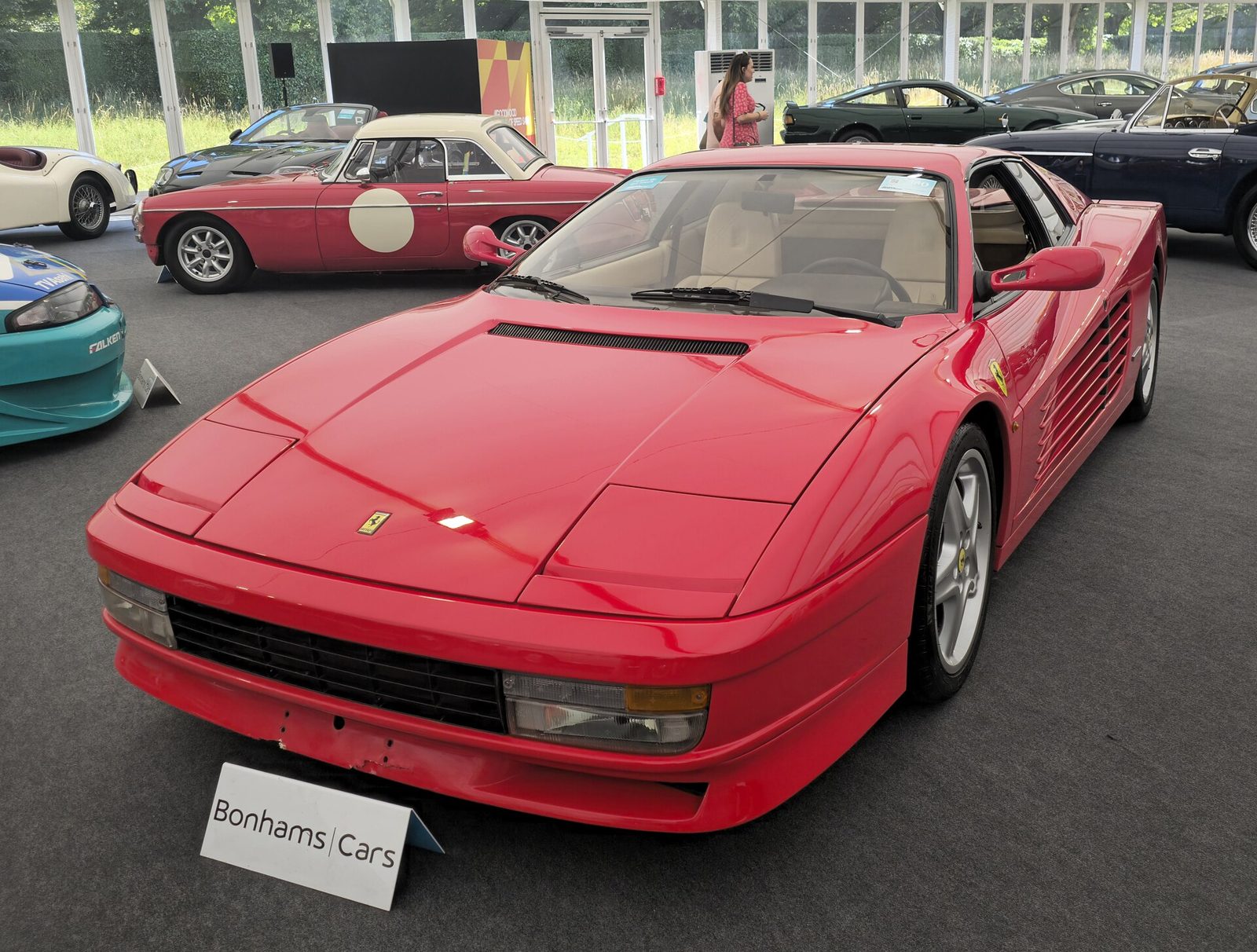
The Ferrari Testarossa (1984-1991) replaced the 512 BBi and was designed around two specific complaints about that car: a cabin cooked by coolant pipes running the length of the chassis, and almost no luggage. Moving the radiators to the flanks fixed both, and produced the feature the car is known for, since several markets required large body openings to be covered and Pininfarina answered with slatted strakes. The team under Leonardo Fioravanti drew a car 5.7 in (146 mm) wider than the Boxer, with a 4,943 cc four-valve flat-12 of 390 hp behind the cabin. It was also the first twelve-cylinder Ferrari legally saleable in the United States since 1973, which is much of why 7,177 were built where the Boxer sold in hundreds. The launch cars carry a single high-mounted mirror and single-nut wheels, both of which went during the run.
Testarossa
7,177 built · 2-door Berlinetta (fixed-roof coupe) · 2-door Spider (one factory car, chassis 62897, plus eleven Pininfarina commissions counted within the production total)
How rare is it?
With about 7,177 built, the Ferrari Testarossa is rarer than a DeLorean (~9k) yet more common than a F40 (~1k).
Approximate total production placed on a log scale against well-known reference cars, for scale only. Figures and any disputes are detailed in the production notes and sources.
History
Fixing the Boxer
Ferrari began work on a 512 BBi successor in 1978. The Boxer sold respectably but carried two faults that mattered: a front-mounted radiator whose plumbing ran the length of the car and turned the cabin into an oven, and almost nowhere to put luggage. It was also not certifiable for the United States, shutting Ferrari out of its most valuable twelve-cylinder market. A plan to restyle the car was abandoned in favor of a new one. The Testarossa was made deliberately larger: 77.8 in (1,976 mm) wide, a wheelbase stretched to 100.4 in (2,550 mm), a taller roofline and carpeted luggage space under the front lid. The name recalled the 500 TR and 250 Testa Rossa racers of the 1950s and the red cam covers they shared with the new four-valve heads.
The Strakes Were Not a Style Decision
The radiators moved to the flanks, eliminating the transfer pipework and the heat with it, and requiring two very large side intakes. Several markets outlawed openings of that size, so they had to be covered. Pininfarina's team - Emanuele Nicosia, who originated the design, with Ian Cameron, Guido Campoli and Diego Ottina under Leonardo Fioravanti - turned that requirement into the slatted ducts that define the car. Fioravanti, trained in aerodynamics, set the layout; the result needed no rear spoiler and recorded a drag coefficient of 0.36 against the Countach's 0.42. Air passed through the engine bay and out at the tail and engine lid. Cooling drove the shape, and the shape made the car wider at the rear than the front.
The American Return
The Testarossa was the first twelve-cylinder Ferrari certified for United States sale since 1973, and America took it in volume. US and Japanese cars used the Tipo F113 A 040 with catalysts, KE-Jetronic and a secondary air pump, rated 380 hp at 5,750 rpm against 390 at 6,300 for Europe, with square side repeaters, heavier bumpers and, from 1987, a motorized belt up the A-pillar. Even so, waiting lists ran to two or three years, and 150 to 200 European cars were federalized privately and imported gray. Ferrari's supply of two US cars to Universal Television, chassis 63259 and 63631, repainted white for night filming, did the rest.
Seven Years of Quiet Revision
The Testarossa changed less than its seven-year run suggests, but the changes it made now divide the market. At Geneva in March 1986 the single high mirror gave way to twin low ones and the metric TRX wheels to 16-inch rims; European engines became the F113 B with KE-Jetronic. In June 1988, from chassis 75997, the single-nut wheels gave way to a five-stud pattern, bringing revised suspension, dampers, brakes and steering column with them. From 1989, at chassis 82967, catalytic converters became standard everywhere, and the specification was essentially static thereafter.
512 TR, F512 M and the End of the Flat-12
The 512 TR, shown to press in Maranello in November 1991 and to the public at Los Angeles in January 1992, was a genuine re-engineering rather than a facelift. Engine and gearbox dropped 1.18 in (30 mm), compression rose to 10:1, Bosch Motronic M2.7 replaced the mechanical injection, and output reached 428 hp. The F512 M of October 1994 exchanged the pop-up headlamps for fixed units under glass and the full-width tail grille for round lamps, and ran to 501 cars before the 550 Maranello ended twenty-five years of flat-12 road cars in 1996.
Common Problems
The flat-12 is described by specialists as strong; the recurring costs are the systems around it. Water pumps are the classic nuisance: FerrariChat contributors report the original pump weeping oil past a rear seal meant to hold back splash rather than pressurized oil, with a drain hole between the two seals as the tell, and the settled advice is to deal with it while the engine is out. Petrolicious notes that pre-1989 pumps can fail prematurely and that factory updates exist. Air-conditioning rubber deteriorates with disuse, and the system was never strong. Infrequent use also leaves dried fuel residue in the K-Jetronic or KE-Jetronic metering, which needs a Bosch specialist rather than a Ferrari one. The gearbox baulks when cold, second gear in particular, which is normal rather than a fault, but Petrolicious puts clutch life at around 15,000 miles and the clutch is another engine-out job. Electrics are the weak area, with period immobilisers unreliable and dash switchgear aging badly, and a new dash top is a four-figure item.
What to Look For
Establish the specification first, because the market prices it precisely. The engine type stamped on the block distinguishes the European F113 A and F113 B from the US-Japanese F113 A 040 and the Swiss-Swedish 046 variants, and it does not always match what a listing claims. A genuine single-mirror car should have a chassis number below 67079 for a European example or 67487 for a US one; twin mirrors on an early chassis are retrofits, not factory. Single-nut wheels ran to 75997, and the five-stud change brought different suspension, dampers, brakes and column, so a mismatch between wheel type and chassis number means someone has been busy. Cars on original 16.3 in (415 mm) TRX tires need those tires, and they are expensive and hard to find. Then the paperwork. Cam-belt dates matter more than mileage here, and the interval is contested, so a documented history without gaps beats a single recent invoice. Because the belt job requires the engine and rear subframe to come out, that visit is when a competent shop deals with the water pump seals, clutch and coolant hoses; belts alone on a high-hours car is a partial job. Check every instrument, look hard at seat bolsters and the dash top, and treat long storage as a cost, not a virtue.
Market Notes
As of August 2026, classic.com puts the Testarossa market benchmark at $176,295 on a rising trend, with an average recorded sale of $167,345, tracked results running from $68,000 for a 1989 car on 27 January 2022 to $522,500 for another 1989 car on 15 August 2026, and 17 cars advertised between $169,000 and $425,980. The spread between those two 1989 examples is the whole story of this market. Monterey week 2026 bears it out: RM Sotheby's published a sold price of $472,500 for a 1988 US-specification car showing 1,059 miles with a January 2026 belt service, brakes and clutch, while Gooding Christie's realized $257,600 at Pebble Beach on 14 August 2026 for a 1989 US car with 15,740 miles that had sat in one Californian family for over thirty-five years. The successors sit above the Testarossa: as of August 2026 classic.com's benchmark is $302,708 for the 512 TR and $551,984 for the F512 M, both rising.
Where sources differ
Sources do not agree on when Testarossa production ended, which is why some cars are titled as 1992.
Red Headed states July 1984 to late 1991. Wikipedia states 1984 until 1991. Supercar Nostalgia states early 1992. classic.com lists model years 1984 to 1992. Red Headed records that Testarossa and 512 TR assembly overlapped from April 1991, which would explain but does not settle it. Not resolved by any source consulted here.
The 512 TR that closed the Testarossa run is stated at either 2,261 or 2,280 cars depending on the source, and no single figure is asserted here.
Ferrari's archive states 2,261 examples, chassis 89100 to 99743, and Red Headed independently gives the same total and range plus 408 cars to North America. Classic & Sports Car states 2,280. The difference propagates into the family total, which Classic & Sports Car puts at 9,958. Not resolved by any source consulted here.
The F512 M ran to 501 cars, chassis 99375 to 105516, built between late 1994 and early 1996, of which 75 went to North America; the right-hand-drive count is disputed.
Ferrari, Red Headed and Classic & Sports Car agree on 501 cars. Red Headed states 75 went to North America, each numbered as one of 75. Classic & Sports Car states 41 right-hand-drive cars. Wikipedia states both that 75 went to North America and that 75 were right-hand drive, which cannot be the same 75. Not resolved by any source consulted here.
The recommended cam-belt interval is genuinely contested, and because the job requires the engine and rear subframe to be removed the difference is expensive.
Classic & Sports Car states every three years. Petrolicious states every 15,000 miles or three years. J. Scuderia Automotive publishes every 30,000 miles or five years. Owners on FerrariChat report three years to nine or ten on low-mileage cars, and name tensioners rather than belts as the wear item. Not resolved by any source consulted here.
Sources
- Testarossa, Ferrari S.p.A. · manufacturer
- 512 TR, Ferrari S.p.A. · manufacturer
- F512 M, Ferrari S.p.A. · manufacturer
- Ferrari Testarossa, Wikipedia · encyclopedia
- Guide: Ferrari Testarossa - a Historical & Technical Appraisal, Supercar Nostalgia · specialist
- Red Headed - Testarossa: Production, Red Headed · registry
- Red Headed - Testarossa: Versions, Red Headed · registry
- Red Headed - Testarossa: Specifications, Red Headed · registry
- Red Headed - 512 TR: Production, Red Headed · registry
- Red Headed - F512 M: Production, Red Headed · registry
- Ferrari Testarossa Market, classic.com · market-data
- Ferrari 512 TR Market, classic.com · market-data
- Ferrari F512 M Market, classic.com · market-data
- Buyer's guide: Ferrari Testarossa, Classic & Sports Car · journalism
- Ferrari Testarossa Buying Guide, Petrolicious · journalism
- Ferrari Testarossa - road test, July 1986, Motor Sport · journalism
- Everyday supercar, February 1992, Motor Sport · journalism
- 1988 Ferrari Testarossa, The Monterey Auction 2026, RM Sotheby's · auction-house
- 1989 Ferrari Testarossa, Pebble Beach Auctions 2026, Gooding Christie's · auction-house
- Ferrari Testarossa / TR 512 Service Menu, J. Scuderia Automotive · specialist
- Water Pump replacement during belt service on TR, FerrariChat · club-forum
- Testarossa Cambelt service, FerrariChat · club-forum
Synthesized from the sources above and cross-checked. We cite and link out; we do not republish other databases verbatim.
Fully Sorted is an independent publisher and is not affiliated with, endorsed by or sponsored by Ferrari S.p.A.. Ferrari and the model names on this page are trademarks of Ferrari S.p.A. and are used here only to identify the cars being described.
Chassis register
Nobody has recorded a car here yet. Own one, or know one? Chassis number, what you can prove about it, and a source if there is one. Every entry is reviewed before it appears.
Nerd Notes
What owners know that the sources don't. Every note is read and checked before it appears here.
Key Specs
- Power
- 390 hp at 6,300 rpm claimed, European specification; 380 hp at 5,750 rpm for US, Canadian and Japanese cars
- Brakes
- Ventilated discs, 12.4 in (315 mm) front and 12.2 in (310 mm) rear
- Engine
- 4,943 cc Tipo F113 flat-12 (180-degree V12), all-alloy, dry sump, twin side-mounted radiators
- Layout
- Longitudinal mid-mounted engine, rear-wheel drive, gearbox beneath and behind the engine
- Torque
- 361 lb-ft at 4,500 rpm European; 347 lb-ft quoted for US specification
- Weight
- 3,320 lb dry; 3,660 lb dry for the US version (Red Headed)
- Chassis
- Tipo F110 AB tubular steel frame with removable rear subframe; steel cabin and doors, aluminum panels, 100.4 in (2,550 mm) wheelbase
- Valvetrain
- Twin belt-driven overhead camshafts per bank, 48 valves, driven from the crankshaft rather than idler gears
- Bore stroke
- 82 mm x 78 mm
- Compression
- 9.2:1 to 9.3:1 European; 8.8:1 to 9.3:1 across the emissions variants per Red Headed
- Lubrication
- Dry sump
- Acceleration
- 5.8 s to 62 mph quoted; 5.0 s to 60 mph at Car and Driver and Road & Track, 5.3 s at Motor, 5.8 s at Autocar
- Transmission
- 5-speed manual with open gate, twin-plate hydraulic clutch, limited-slip differential; ABS never fitted
- Wheels tires
- Single center-nut magnesium five-spoke on 16.3 in (415 mm) Michelin TRX to March 1986, then 8J and 10J x 16 in; five-stud OZ or Speedline from June 1988
- Fuel ignition
- Bosch K-Jetronic (F113 A) or KE-Jetronic (later types), Marelli Microplex MED 120A then 120B
- Top speed tested
- 176 mph (Car and Driver), 181 mph (Road & Track), 178 mph (Motor), 180.1 mph (Autocar); Motor Sport's February 1992 panel listed 171 mph
- Top speed claimed
- 180 mph - manufacturer figure, not independently established
Notable Variants
Monospecchio, single-nut (1984 to March 1986)
The launch specification: one high-mounted driver's-side mirror at the top of the A-pillar, the result of a misread European rearward-visibility rule, and magnesium five-spoke wheels on a single center nut with 16.3 in (415 mm) Michelin TRX tires. The cars collectors chase, and the tires are why they are awkward to run.
Five-bolt cars, the so-called 88.5 (from June 1988)
From chassis 75997 the center-lock wheel gave way to a five-stud pattern by OZ and Speedline, with revised column, suspension, dampers and brakes and a wider track. Easier to live with, less sought after.
United States and Canadian specification (Tipo F113 A 040)
Catalysed, KE-Jetronic, 380 hp at 5,750 rpm rather than 390 at 6,300, with square side repeaters, larger bumpers, a third brake light from 1986 and, from 1987, a motorized belt up the A-pillar. US dry weight 3,660 lb against 3,320 lb.
Swiss and Swedish specification (F113 A 046 / F113 B 046)
A third emissions specification: KE-Jetronic from the start but initially without catalysts, gaining them with the F113 B 046. Rarely identified correctly in listings; the engine type stamped on the block settles it.
Testarossa Spider, chassis 62897
One factory Spider, built by Pininfarina in 1986 for Fiat chairman Gianni Agnelli, with reinforced chassis, cut-down screen, retractable roof and a Valeo transmission switchable to full automatic because a leg injury made a clutch pedal difficult.
512 TR (1991-1994)
Not a facelift. Engine and gearbox dropped 1.18 in (30 mm), compression raised to 10:1, Motronic M2.7 and new plenums for 428 hp at 6,750 rpm, with reworked shift, brakes and interior.
F512 M (1994-1996)
The last Ferrari flat-12. Fixed headlamps under glass replaced the pop-ups, round tail lamps replaced the full-width grille, NACA ducts appeared in the front lid, and titanium rods with a lighter crank allowed a 7,500 rpm limiter.
Value Trajectory
The Testarossa spent the 2000s as the cheap way into a twelve-cylinder Ferrari and has spent the 2010s and 2020s leaving that position. As of August 2026 classic.com's benchmark stands at $176,295 and is trending upward, but the benchmark understates what is happening at the top: the same model recorded $68,000 in January 2022 and $522,500 in August 2026, and Monterey week 2026 produced $472,500 for a 1,059-mile 1988 car and $257,600 for a 15,740-mile 1989 car within a day of each other. That is a market sorting itself by mileage, specification and documentation rather than lifting evenly. Single-mirror, single-nut launch cars and low-mileage examples carry the top of the range; ordinary five-stud cars with average miles have moved far less.
Next
Shopping for one?
Browse Ferrari listings, or decode a VIN before you buy.