
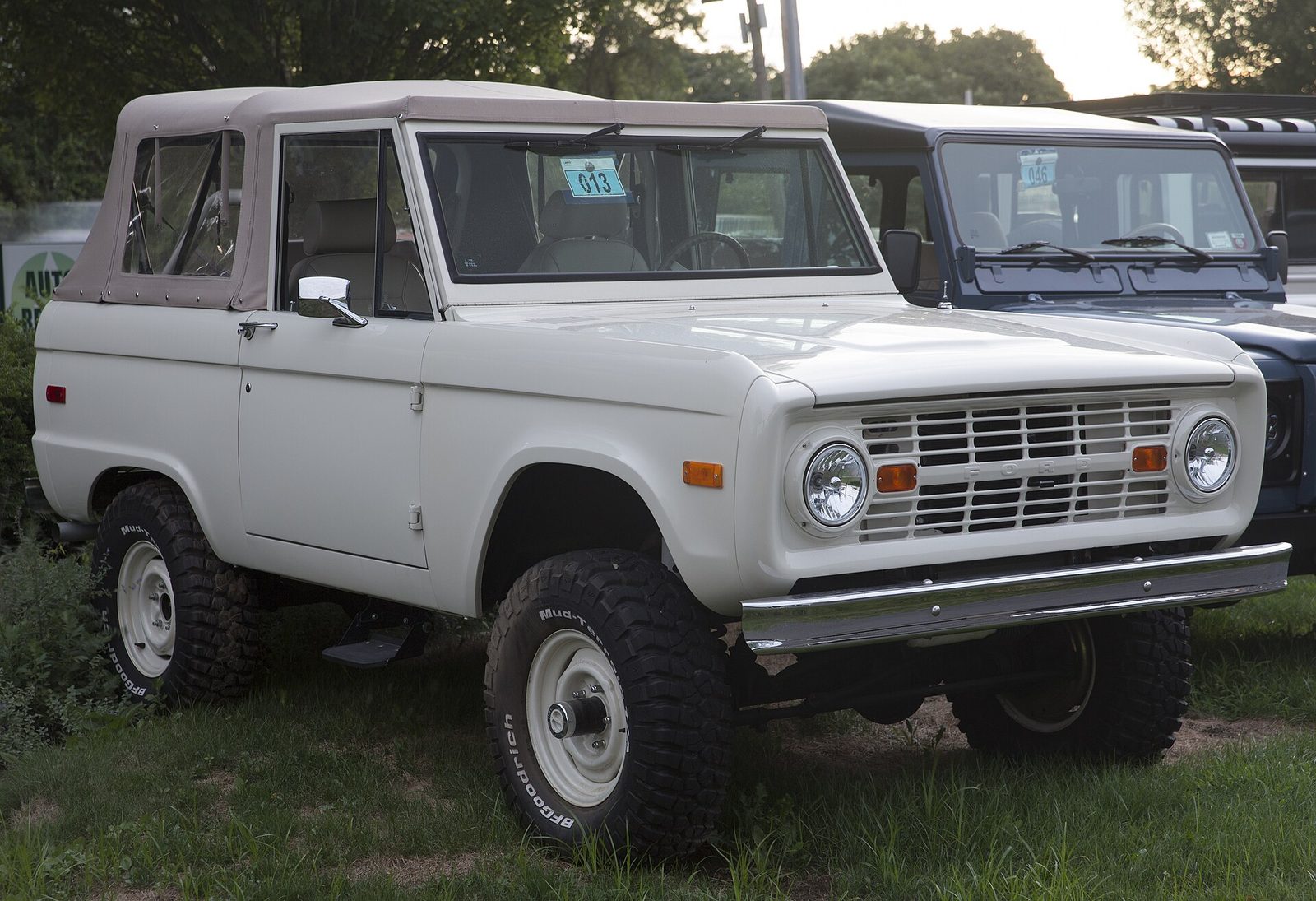
The first-generation Ford Bronco (1966-1977) was Ford's original compact 4x4, conceived under Donald Frey and approved by Lee Iacocca to challenge the Jeep CJ-5 and International Scout. Riding a purpose-built 92-inch wheelbase with standard four-wheel drive, coil-spring front suspension and a Dana 20 transfer case, it launched in three bodies: a full wagon, a half-cab pickup, and a doorless open-body roadster. Power began with a 170-cubic-inch six, joined within months by a 289 V8, later a 302, with a 200 six becoming standard in 1973. The slow-selling roadster was dropped after 1968 and the half-cab after 1972, leaving the wagon to finish the run. About 225,000 were built before the larger, F-100-based second generation arrived for 1978. Decades later the 'early Bronco' became a restomod darling led by builders like Icon, Gateway and Velocity, sending values sharply upward and cementing its status as a blue-chip collectible SUV.
Bronco
1966-1977 (First Generation)
225,861 built · Wagon · Half-Cab Pickup · Roadster (open body)
How rare is it?
With about 225,861 built, the Ford Bronco is rarer than a Mustang '65–'68 (~1.3M) yet more common than a 240Z (~160k).
Approximate total production placed on a log scale against well-known reference cars, for scale only. Figures and any disputes are detailed in the production notes and sources.
History
Origins and Launch
The Bronco was developed in the early 1960s under product manager Donald Frey and engineer Paul Axelrad, with Lee Iacocca approving production. Introduced for 1966, it was a clean-sheet compact off-roader on a dedicated 92-inch wheelbase - sized between the Jeep CJ-5 and International Scout - with box-section body-on-frame construction, standard four-wheel drive, a Dana 20 transfer case, a coil-spring/radius-arm front end and a Ford 9-inch rear axle on leaf springs.
Body Styles and Engines
Three bodies launched together: a two-door wagon, a half-cab pickup (Ford's 'Sport Utility'), and an open-body roadster with fold-flat windshield. The 170-cubic-inch six was standard; a 289 V8 arrived within months of launch, growing to 302 cubic inches for 1969. A 200 six became standard in 1973, the same year an automatic transmission finally appeared. From 1975 the 302 V8 was the only engine, now with catalytic converter.
Trimming the Range
The roadster sold poorly and was withdrawn after 1968; the half-cab was dropped after 1972. Special variants added flavor: the 1967 Sport package, the early-1970s Ranger trim, and Bill Stroppe's dealer-sold Baja Bronco (~650 built). The first generation ended in 1977, replaced by the bigger F-Series-based Bronco.
Restomod Revival
From around 2012, Icon 4x4 (Jonathan Ward) popularized six-figure early-Bronco restomods, followed by Gateway Bronco, Velocity Restorations and others. This boom pulled up donor-truck prices and, with the 2021 new-Bronco launch renewing attention, drove values to record highs before the market cooled from its peak.
Common Problems
Rust is the dominant problem - frames, floorpans, rocker panels and any pocket where dirt and salt collect. Mechanically the trucks are robust: the 170/200 sixes and 289/302 V8s, the 3-speed Toploader, Dana 20 transfer case and Ford 9-inch rear are durable and well-supported by parts. The bigger risks are prior abuse from off-road use, amateur lifts and larger tires causing driveline and steering wear, and poorly executed modifications or restorations.
What to Look For
Prioritize a rust-free frame, floors, rockers and body seams over cosmetics - rust is the make-or-break issue. Check for cut or flared fenders, homemade lifts and hacked wiring, which are common and can hide structural damage. Power steering and factory-V8 cars command premiums; matching-numbers and documented, uncut originals are increasingly prized. Confirm the body style (wagon vs. rare roadster/half-cab) and verify VIN/build data. On restomods, scrutinize build quality, brand reputation and receipts, since finish and drivetrain choices drive value.
Market Notes
As of mid-2026, the early Bronco remains one of the most valuable vintage 4x4s but has come off its 2021-2022 highs, which coincided with the sixth-generation Bronco's launch. Hagerty pegged excellent (#2) examples around a $53,650 median in 2021 after values had roughly doubled from 2016; guides in 2024 placed good drivers near $55k - $85k and excellent originals around $90k - $140k, with concours and factory-V8 cars higher. Purpose-built restomods (Icon, Gateway, Velocity) routinely trade well into six figures, and standout auction cars have brought $300k - $440k (Barrett-Jackson, 2025). Stock, driver-quality and heavily-modified examples have softened or plateaued since the peak, while top restomods and exceptional originals stay strong - so 'the market' depends heavily on which segment you mean.
Where sources differ
Quoted horsepower for the standard 170 six differs between sources (about 105 hp per Wikipedia vs. ~102 hp per Hagerty).
Minor discrepancy in rated output for the base six; both figures are in circulation and the difference is not material.
Since the 2021-2022 peak, stock and driver-quality early Broncos have softened or plateaued while top restomods and exceptional originals remain strong.
Sources diverge: Hagerty and general market commentary indicate cooling from the peak, while some restomod-seller and enthusiast guides emphasize continued appreciation; direction is segment-dependent.
Sources
- 1st Generation Bronco (1966-1977) — Ford Bronco History, Ford Motor Company · manufacturer
- Ford Bronco, Wikipedia · reference-book
- Your handy 1966-77 Ford Bronco buyer's guide, Hagerty Media · journalism
- Vintage Ford Bronco values: A breakdown by generation, Hagerty Media · journalism
- A brief history of Icon's Ford Bronco restomod operation, Autoblog · journalism
- First Generation Ford Bronco Value And Investment Guide, Get Vintage Vehicles · journalism
Synthesized from the sources above and cross-checked. We cite and link out; we do not republish other databases verbatim.
Fully Sorted is an independent publisher and is not affiliated with, endorsed by or sponsored by Ford. Ford and the model names on this page are trademarks of their respective owners and are used here only to identify the cars being described.
Chassis register
Nobody has recorded a car here yet. Own one, or know one? Chassis number, what you can prove about it, and a source if there is one. Every entry is reviewed before it appears.
Nerd Notes
What owners know that the sources don't. Every note is read and checked before it appears here.
Key Specs
- Wheelbase
- 92 in
- Drivetrain
- Four-wheel drive standard; Dana 20 transfer case with locking hubs
- Competitors
- Jeep CJ-5, International Scout
- Construction
- Body-on-frame, box-section chassis
- Transmission
- 3-speed manual standard; 3-speed automatic optional from 1973
- Front suspension
- Coil springs with radius arms and lateral track bar
- Rear axle/suspension
- Ford 9-inch axle on leaf springs
Notable Variants
Roadster (open body)
Doorless, roofless launch variant with fold-flat windshield; poorest seller, withdrawn after the 1968 model year and now the rarest first-gen body style.
Sport / Bronco Sport
Chrome-trim appearance package introduced for 1967; became a standalone model around 1970.
Ranger
Top-line trim (early 1970s) with body stripes, upgraded interior and specific wheel covers.
Baja Bronco (Stroppe)
Bill Stroppe-prepared off-road package marketed through Ford dealers ~1971-75; roll bar, fender flares, quick-ratio power steering, automatic and distinctive paint. Only about 650 built; disputed exact count.
Value Trajectory
Values were modest for decades, then climbed steeply after the Icon-led restomod boom (from ~2012), roughly doubling between 2016 and 2019 and peaking around the 2021-2022 new-Bronco launch. Since then the broad market for stock and driver-grade trucks has cooled or leveled off, while blue-chip restomods and exceptional originals continue to set records. Long term the early Bronco has firmly established itself as a collectible, but buyers today should expect a two-tier, segment-dependent market rather than uniform appreciation.
Market Snapshot
4 recorded sales, too few for a median worth standing behind, so here is the range instead.
Range $68,000 – $128,000
Next
Shopping for one?
Browse Ford listings, or decode a VIN before you buy.