
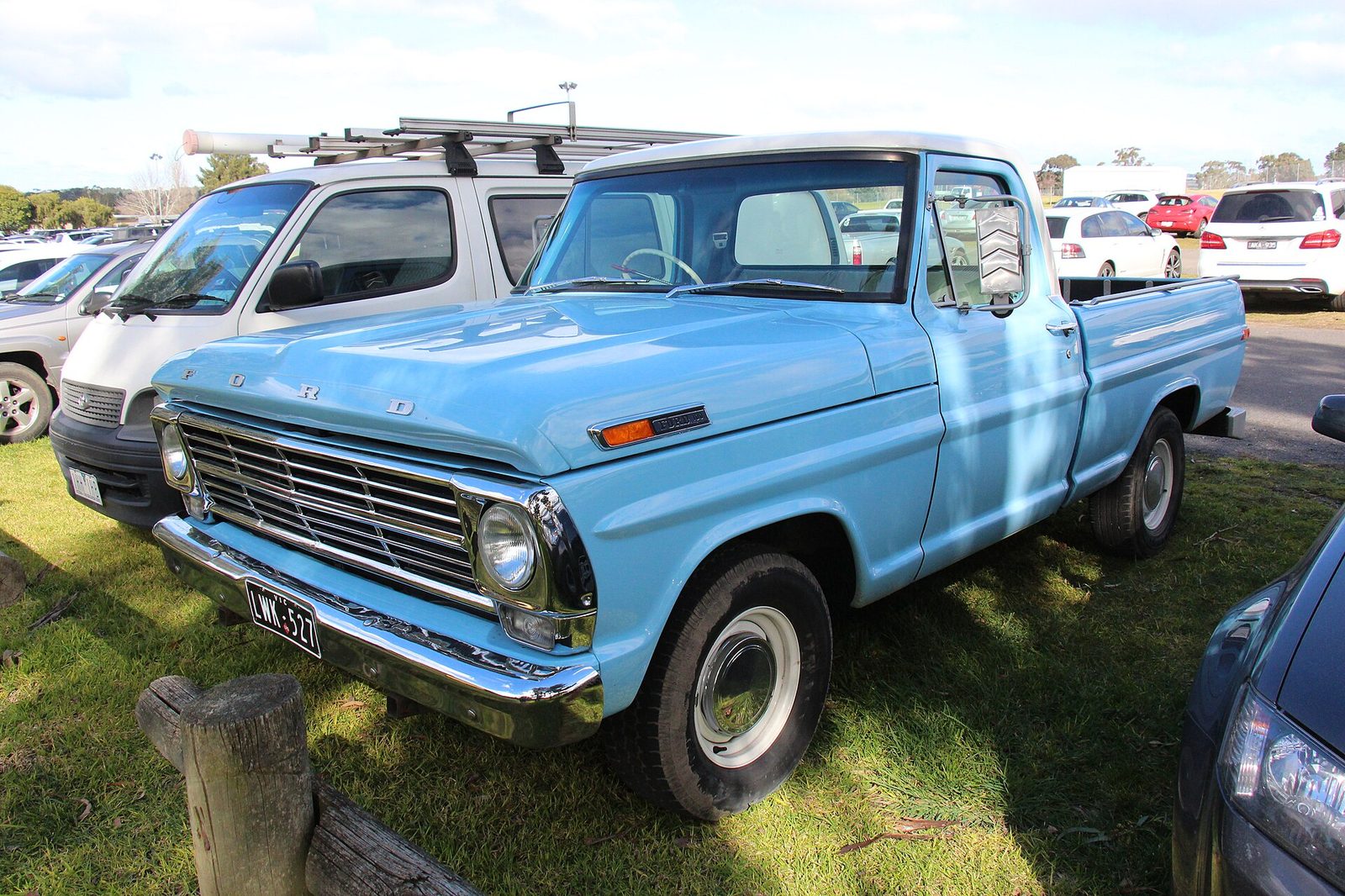
The fifth-generation Ford F-Series, built for the 1967 to 1972 model years and universally called the bumpside after the horizontal crease running from front fender to tailgate, is the generation in which the American pickup stopped being only a tool. The cab was new for 1967, wider and glassier, with about three more inches of room. The trim ladder climbed from a rubber-matted Custom Cab to a carpeted, wood-grained Ranger XLT, and air conditioning, power steering and an AM/FM radio could all be ordered on a truck. Underneath sat Ford's Twin I-Beam front suspension, introduced in 1965 and sold on the promise that the thing worked like a truck and rode like a car. Two inline sixes of 240 and 300 cubic inches covered the working end of the range, the FE V8s the rest, joined by the 302 Windsor from 1969. The generation now divides into two markets that barely overlap: lowered two-wheel-drive trucks built for the road, and four-wheel-drive restomods built to be driven hard.
F-100
Fifth generation (‘bumpside’)
History
The 1967 Redesign
The fifth-generation F-Series arrived for 1967 on a chassis whose important changes had happened in 1965, so the news was above the frame rails. The cab was new: more glass, a wider body, roughly three additional inches of interior room. The styling signature was a single horizontal crease running from the leading edge of the front fender through the door and along the bedside to the tailgate, and enthusiasts named the generation after it. Bumpside now does more work in the classified advertisements than the model designation does. Ford and Chevrolet traded the American truck sales lead through the run - Ford in 1967, 1969 and 1970, Chevrolet in 1968, 1971 and 1972 - and that rivalry is why a 1972 pickup can be found with cloth seats and factory air.
Works Like a Truck, Rides Like a Car
Twin I-Beam had been introduced on the 1965 trucks and carried through unchanged in principle. Two forged chrome-moly I-beams of roughly three feet sit offset and overlapping beneath the front of the chassis, each pivoting on the frame rail opposite its own wheel. Because the arc each wheel travels is long, camber change is smaller than a short-arm swing axle would give, though it is still there. Coil springs carry the load and a forged steel radius arm each side takes the braking and fore-and-aft loads. The ride was softer than a beam axle and Ford advertised the point relentlessly. The costs were real: near a degree of camber change per inch of travel, very little caster, awkward alignment, hard use of front tires and shock absorbers, and a steering box with a reputation for weeping. Four-wheel-drive trucks did not get Twin I-Beam at all.
Sixes, FEs, and the 351 That Never Came
The engine range was straightforward. The 240 and 300 cubic-inch overhead-valve sixes did the work; the 300 shares its 4.00 in bore with the 240 and adds stroke, and its 170 hp gross at 3,800 rpm matters far less than its 283 lb-ft at 1,600 rpm. The V8 was the 352 FE for 1967, replaced for 1968 by the 360 and 390 FE, with the 302 Windsor joining from 1969. For 1972 the 390 is listed as two-wheel drive only. There was no 351 in a bumpside: the 1972 VIN engine codes run A, B, G, Y and H for the 240, 300, 302, 360 and 390 and nothing else. A 351 in one of these trucks is a swap, however early it was done.
From Custom Cab to Ranger XLT
At launch the ladder ran Base, Custom Cab and Ranger, the Ranger bringing carpet, thicker foam and upholstered door inserts. Around the turn of the decade Ford reorganized it into Custom, Sport Custom, Ranger and Ranger XLT, and the XLT is the one that mattered: wood-tone dash and tailgate appliqué, pleated cloth and vinyl, full carpet, extra insulation, cargo lamp, aluminum moldings. Sources disagree over whether it appeared for 1970 or 1971. Either way a pickup was being sold on comfort, and the King Ranch and Limited trucks of today descend from that decision.
Beds, Four-Wheel Drive and the Highboy
Two beds ran throughout: the flush-sided Styleside, whose crease continues uninterrupted to the tailgate, and the Flareside, whose crease stops at the back of the cab and whose fenders stand proud of the box. The Styleside won decisively in period, so the Flareside is the scarcer truck now. Four-wheel drive grew steadily across the run, and on the F-250 it produced the truck later nicknamed the Highboy, whose divorced transfer case - a separate unit driven from the gearbox by a short shaft rather than bolted to it - needs enough front driveshaft clearance to raise the body well above a two-wheel-drive truck, a rear block levelling the stance.
Common Problems
Twin I-Beam wears in ways unfamiliar to anyone used to wishbones. The pivot bushings, radius arm bushings and steering joints are all consumables, and once they are tired the truck wanders. The geometry gives roughly a degree of camber change per inch of travel and very little caster, which produces poor straight-line stability on rough surfaces, heavy and uneven front tire wear and short shock absorber life. Alignment is awkward, and a truck whose ride height has been altered without correcting the beams will eat tires indefinitely. Steering boxes of the period are described as notably leak-prone.
Corrosion is the other structural theme, concentrated in the cab corners, floor pans, cab mounts, cowl sides, drip rails, lower fenders and doors, bed floor and outboard bed seams. Fifty-year-old wiring degrades and full harness replacement is normal in a serious rebuild. Brakes are drums at both ends with power assistance only an option, so a truck carrying a modern engine on standard brakes is under-braked by a wide margin. The engines are the least of it: the 300 six is an unstressed long-stroke design with a cast-iron block and head, and high mileages on it are unremarkable. Its faults are thirst, weight and an unwillingness to rev, not fragility.
What to Look For
Structure before anything else. Owners name the same places repeatedly: the cab corners where they drop away beside the frame rails, the floor pans and cab mounts, the battery tray, the cowl sides, the roof drip rail perimeter, lower front fenders and door bottoms, the bed floor, the seam down the outboard bedsides and the right inner fender apron. Rust there often signals worse underneath, and the frame is the first thing to put a light on.
The data plate settles most identity questions. The first three characters give series and drivetrain - F10 for a two-wheel-drive F-100, F11 for four-wheel drive, F25 and F26 for the F-250 - the fourth is the engine code, and the third digit of the body code separates Flareside from Styleside. A grille-center Ranger badge is correct only for 1968 and 1969 and is easily transplanted; the interior trim code is the harder evidence. On a claimed Highboy the divorced transfer case and its visible front crossmember are the proof, not ride height.
On a modified truck the questions change, because an engine alone is not a build. The useful signal is whether the chassis was addressed - a purpose-built frame or an engineered front subframe rather than modern power loaded into unaltered original rails - and whether brakes, steering, wiring, fuel and cooling came up with it. The documented builds at this end of the market pair the engine with a replacement front end, rack-and-pinion steering, a rebuilt rear axle and large four-wheel discs.
Market Notes
All figures here are classic.com data read as of August 2026. For the fifth-generation F-100 the CLASSIC.COM Market Benchmark stands at $33,619 against an average recorded sale of $35,646, trending upward, from 38 trucks listed. Across the generation the benchmark is $33,883; the F-250 sits at $33,961 on a $32,165 average. Beneath those averages the spread is enormous. The lowest F-100 sale classic.com records is $2,772 for a 1972 Explorer in September 2025, and an $800 1972 F-350 changed hands the same month. The highest completed sale it records for the generation is $194,995 for a 1972 F-100 Custom at Lithia Springs, Georgia on 6 August 2026. Larger numbers exist only as asking prices: a 1971 F-100 by Velocity Restorations listed at $309,900 in January 2026, and a 1972 F-250 by the same shop at $364,900 with 500 miles showing - builds offered, not sales recorded. The 1972 F-100 results give the shape of the middle as of August 2026: $61,000 for a modified truck in July, $27,500 for an original Sport Custom in June, $10,500 for an original Ranger, $7,400 for a modified Custom in August. Modification moves a truck in either direction; a correct, unmodified 1969 F-250 Highboy made $45,900 on 21 August 2026.
Where sources differ
Whether a 170 cubic-inch Thriftpower six was available in these trucks is not settled by the sources consulted here.
Wikipedia lists a 170 cu in six at 105 hp for 1967-1972 and Classic Industries lists the same engine for 1967 only. FORDification's 1967 VIN engine-code table gives only A, B and Y for the 240, 300 and 352 plus their low-compression variants, and contains no 170 code at all. Not resolved by any source consulted here, so the engine is listed with that caveat attached rather than asserted.
The trim ladder ran Base, Custom Cab and Ranger at launch and was reorganized at the turn of the decade into Custom, Sport Custom, Ranger and Ranger XLT, but the model years in which the Sport Custom and the Ranger XLT first appeared are given differently by different sources.
Wikipedia, Velocity Restorations and Classic Industries all place the Ranger XLT at 1970. FordF100s.com states it debuted for 1971 above an existing Ranger. On the Sport Custom, Velocity Restorations says 1970 and FordF100s.com says 1969. No factory sales literature was retrieved in this session, so the point is not resolved here and no introduction year is asserted.
No production total is asserted for this generation because the two standard reference books disagree materially: for 1972 F-100 Styleside pickups the Ford Pickup Truck Red Book gives 407,660 and the Standard Catalog of Light-Duty Ford Trucks gives 457,746, a difference of 50,086 trucks in one body style in one year.
FORDification reprints both books side by side and states the discrepancy itself: Red Book 389,337 (4x2) plus 18,323 (4x4) equals 407,660 against the Standard Catalog's 457,746 for 1972 F-100 Styleside, plus a further 13,804 gap on 1972 F-250 Styleside. It is single-sourced because FORDification is the only page retrieved that reproduces both tables and names the disagreement; neither book was consulted directly. The conflict is not resolved, so productionTotal is null.
Sources
- Ford F-Series (fifth generation), Wikipedia · encyclopedia
- 1967-1972 Ford F100: The Ultimate Bumpside Identification and Builder's Guide, Classic Industries · specialist
- Fifth Generation (1967-1972) Ford F-Series: Ford Trucks Go Mainstream, The Truth About Cars · journalism
- 1967-1972 Ford Pickup Production Numbers, FORDification.com · specialist
- Decoding Your 1967 Ford Truck VIN, FORDification.com · specialist
- Decoding Your 1972 Ford Truck VIN, FORDification.com · specialist
- How it Works: Ford Twin I-Beam Suspension, Mac's Motor City Garage · specialist
- Ford F-100 - 5th Gen Market, classic.com · market-data
- Ford F-Series - 5th Gen Market, classic.com · market-data
- 1972 Ford F-100 - 5th Gen Market, classic.com · market-data
- Ford F-250 - 5th Gen Market, classic.com · market-data
- A Glimpse Into The Future: Fifth Gen (1967-1972) Ford F-Series, Velocity Restorations · specialist
- Classic Ford Truck Highboy, Velocity Restorations · specialist
- 1967-1972 Ford F-100 Bumpside Guide, FordF100s.com · specialist
- 1971 Ford F-100: Ranger XLT Debut, 360 V8 Specs & Values, FordF100s.com · specialist
- Common Rust Spots to look for?, Ford Truck Enthusiasts · club-forum
- Swapping I-Beams for IFS: Classic Performance Products 1965-1979 F100 Independent Front Suspension, Classic Truck Performance · specialist
- Supercharged Coyote Powers this Wicked '71 Ford Bumpside, In The Garage Media · journalism
- Ford 300 cid, 4.9L I-6 Engine Specs & Info, F150Hub · specialist
Synthesized from the sources above and cross-checked. We cite and link out; we do not republish other databases verbatim.
Fully Sorted is an independent publisher and is not affiliated with, endorsed by or sponsored by Ford. Ford and the model names on this page are trademarks of their respective owners and are used here only to identify the cars being described.
Chassis register
Nobody has recorded a car here yet. Own one, or know one? Chassis number, what you can prove about it, and a source if there is one. Every entry is reviewed before it appears.
Nerd Notes
What owners know that the sources don't. Every note is read and checked before it appears here.
Key Specs
- Axles
- Four-wheel-drive trucks use a Dana 44, Dana 44HD or Dana 60 front and a Dana 60 rear on 4.10:1, with a divorced transfer case (Dana 24 or New Process 205)
- Power
- Gross: 240 six 150 hp, 300 six 170 hp at 3,800 rpm, 352 FE 208 hp, 360 FE 215 hp, 390 FE 255 hp, 302 Windsor 205 hp. Ford moved to SAE net for 1972, at which point the 302 is quoted at 154 hp, the 360 at 196 hp and the 390 at 201 hp
- Brakes
- Drums front and rear, power assistance optional and described as reaching four-wheel-drive F-Series for 1972. No source consulted confirms a factory front disc on this generation
- Engine
- 240 and 300 cu in inline sixes; 352 cu in FE V8 for 1967, replaced by the 360 and 390 FE for 1968; 302 cu in Windsor V8 from 1969. No 351 cu in V8 was offered
- Layout
- Front longitudinal engine, rear-wheel drive; part-time four-wheel drive optional on F-100 (VIN series F11) and F-250 (F26)
- Torque
- 300 six quoted at 283 lb-ft at 1,600 rpm. No consistent factory torque figure for the 240 six or for the FE and Windsor V8s in truck tune appears in the sources consulted, so none is stated
- Weight
- A 1971 F-100 short-bed is quoted at 3,615 lb curb by one specialist reference. No factory weight table was retrieved, and the figure varies widely with cab, bed, drivetrain and engine
- Chassis
- Separate ladder frame with bolted cab and separate bed; conventional cab, chassis cab and cowl-and-chassis bodies
- Steering
- Recirculating-ball steering box, manual or power assisted
- Wheelbases
- F-100 115 in or 131 in; F-250 131 in, or 149 in for the Crew Cab; F-350 135 in, 159 in or 164.5 in
- Bed lengths
- Styleside 6.5 ft and 8 ft; Flareside 6.5 ft and 8 ft, with 9 ft listed on the heavier series
- Acceleration
- No period independent road test with instrumented figures was retrieved. The unattributed 0-60 mph ranges that circulate online are not traceable to a measured test and are not repeated here
- Transmission
- Three-speed column-shift manual, four-speed New Process 435 manual, or three-speed automatic
- Rear suspension
- Live axle on semi-elliptic leaf springs
- Front suspension
- Twin I-Beam on two-wheel drive: two forged chrome-moly I-beams of roughly 36 in, offset and overlapping, each pivoting on the frame rail opposite its own wheel, with coil springs and a forged steel radius arm per side. Four-wheel drive uses a solid Dana beam axle on leaf springs
Notable Variants
Base / Custom Cab (Custom from 1970)
The working specification: rubber mat, painted metal door panels, vinyl bench, aluminum scuff plates. Most of these trucks left the plant close to this, and an unmolested one is now harder to find than a Ranger, because nobody thought to keep them.
Ranger
The upper trim at launch: thicker seat foam, color-keyed carpet, upholstered door inserts, extra brightwork, its own hubcaps. For 1968 and 1969 only a Ranger emblem sat in the grille center - a one-glance identifier, easily transplanted, worth checking against the trim code.
Sport Custom
The middle rung added when the ladder was reorganized at the turn of the decade: heavier foam, two-tone vinyl, color-keyed mats, better instrumentation, without the Ranger's carpet and wood-tone. Sources place its arrival at 1969 or 1970.
Ranger XLT
The top of the range and the point of the generation: full carpet, pleated cloth and vinyl, wood-tone dash and tailgate appliqué, heavy door padding, extra insulation, cargo lamp, aluminum moldings, 12-inch mirror. Correct XLT trim is the hardest thing to source on a restoration.
Explorer Special
A marketing package rather than a trim line, carried in the 1972 interior trim codes alongside Ranger XLT. In Canada the Explorer name was used differently again, as a series sitting between base and Custom Cab. Claims of Explorer provenance need paper, not a decal.
F-100 4x4 (VIN series F11)
A small part of F-100 output at the start and a growing one by the end - 3,926 trucks in 1967 against 18,815 in 1972. It carries a solid front beam axle on leaf springs rather than Twin I-Beam, which makes it the natural platform for a lifted build and a poor one for a lowered one.
F-250 4x4 ‘Highboy’
Not a Ford name. The 4x4 F-250 carries a divorced transfer case - a separate unit driven from the gearbox by a short shaft - and the front driveshaft clearance it needs is what raises the body, not a lift kit. Dana 44, 44HD or 60 front, Dana 60 rear, 4.10:1. The visible front crossmember is the tell.
Value Trajectory
For most of its life this was a cheap truck, which is why so few unmodified ones survive and why the good ones have moved so far. The classic.com benchmark for the fifth-generation F-100 sits at $33,619 as of August 2026 and is trending upward, the F-250 at $33,961 on the same date, and those single figures conceal what are really two markets. Original, honest trucks trade in a band the 2026 results place broadly between ten and thirty thousand dollars, condition and completeness doing almost all the work. Professionally built restomods trade in a separate economy an order of magnitude above, where a 1972 F-100 Custom reached $194,995 in August 2026 and finished shop builds are offered at $309,900 and $364,900. The gap between those populations has been widening rather than closing, and the middle is where value is destroyed: an amateur build carries the cost of the modification without the credibility of the engineering, and a $7,400 modified 1972 Custom in August 2026 sits beneath what a tidy original of the same truck brings.
Next
Shopping for one?
Browse Ford listings, or decode a VIN before you buy.