
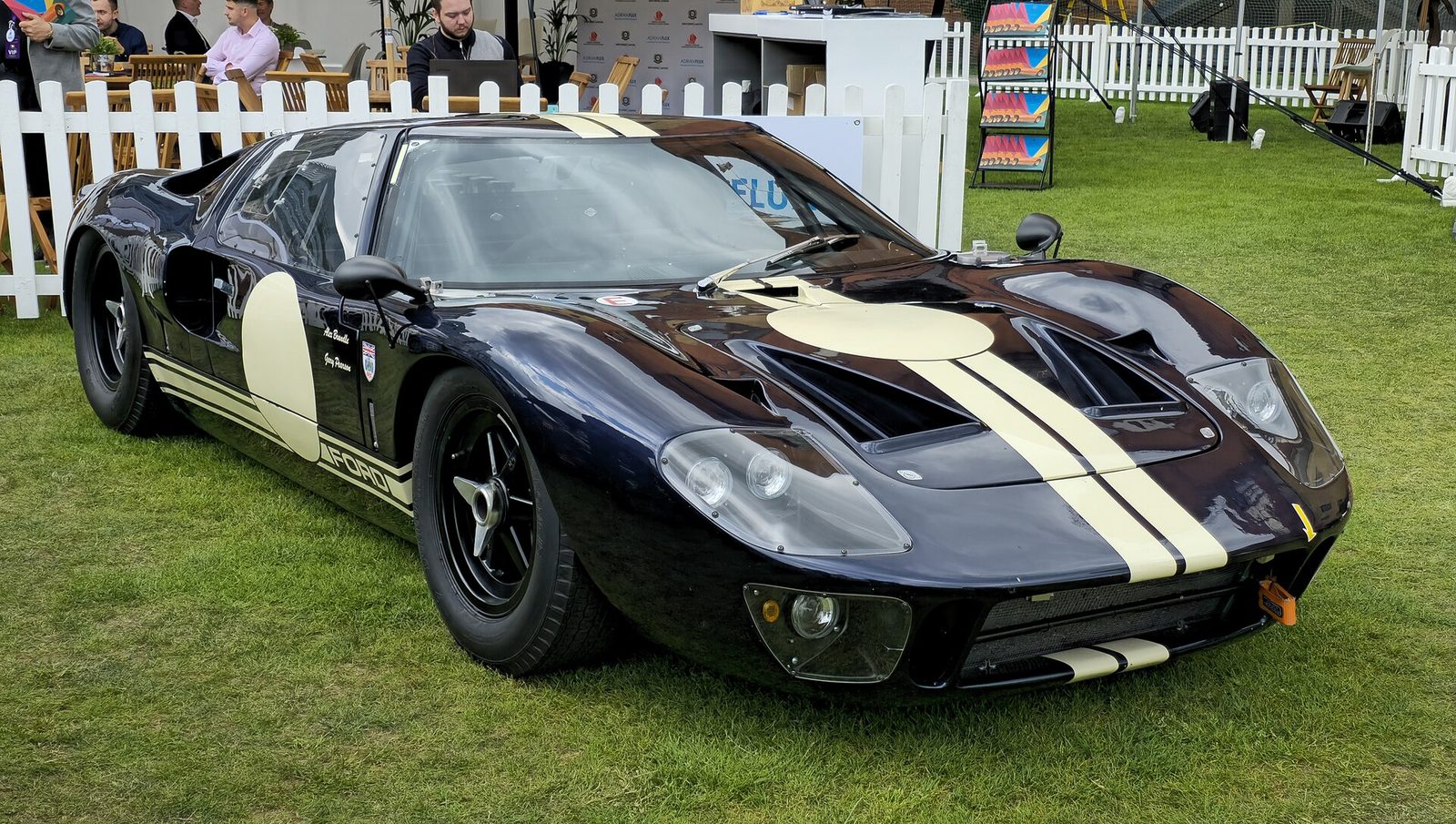
The Ford GT40 was the product of Henry Ford II's decision, after a failed attempt to buy Ferrari, to win the 24 Hours of Le Mans outright. Its starting point was Eric Broadley's Lola Mk6 GT of 1963: Ford bought two of the three built, hired Broadley alongside John Wyer and Roy Lunn, and set up Ford Advanced Vehicles at Slough to turn the idea into a Ford. The name records the car's height, forty inches at the top of the windshield. Four marks followed, and they are not variations on a single car. The Mk I carried a 4.7-liter small-block in a steel semi-monocoque; the Mk II took the 7.0-liter 427 and delivered the 1966 one-two-three; the Mk III was a lengthened, softened road car of which seven were built; the Mk IV, built in Dearborn by Kar Kraft on a honeycomb-aluminum tub, won in 1967. Gulf-liveried J.W. Automotive Mk Is then won in 1968 and 1969, the second time with the same chassis, GT40P/1075. Published period totals cluster around a hundred cars. The number of cars wearing the shape today is very much larger.
GT40
Mk I / Mk II / Mk III / Mk IV
History
Lola, Slough and a Purchase That Did Not Happen
Ford's program began with a deal that fell through. Henry Ford II wanted Le Mans, Ferrari would not be bought, and the fastest route to a mid-engined prototype was to acquire someone else's. Eric Broadley had shown the Lola Mk6 GT at the London Racing Car Show in January 1963: a monocoque car carrying a Ford Fairlane-derived V8 as a fully stressed member, three years before Formula 1 adopted the idea, with a Colotti four-speed behind it. Broadley drove it to Le Mans himself, arrived after scrutineering had closed and was admitted anyway; Hobbs and Attwood ran well until the transmission failed at five in the morning. Three Mk6s were built. Ford took two as rolling test beds, signed Broadley to a two-year contract and set him to work under Roy Lunn at Ford Advanced Vehicles in Slough, with John Wyer running the operation. Broadley lasted a year. He wanted an aluminum chassis and Lunn insisted on steel for cost and repairability; Broadley left with the prototype and the workshop building, which had been his to begin with.
From Small Block to Big Block
The first cars were quick and fragile. Three were entered at Le Mans in 1964 and all three retired, one on transmission, one on fire, Phil Hill's running third at dawn before it stopped. Racing was taken away from Broadley and Wyer and handed to Carroll Shelby. Ford's own account credits Roy Lunn's Dearborn team with the 427-engined GT40X experiment, which Ken Miles tested at Romeo at 210 mph before saying it was the car he wanted at Le Mans. Seven-liter cars were entered in 1965 and retired, leaving a customer Ferrari 250 LM to win. The 1966 Mk II settled it, with three cars crossing the line together. The finish is still argued over: the ACO's response to Ford's plan for a dead heat gave the victory to Bruce McLaren and Chris Amon and denied Ken Miles the Daytona, Sebring and Le Mans treble in one season.
The J-Car and the Honeycomb Tub
The Mk IV was a different car under the skin and the only GT40 built in America. Kar Kraft constructed the chassis and body using aircraft practice: a honeycomb aluminum main structure reinforced with riveted aluminum L-sections, skinned in bonded and riveted aluminum and cured in an autoclave. Wikipedia records the resulting tub at 86 lb and the complete car at 2,661 lb, some 300 lb below the Mk II. Kar Kraft assembled the cars and passed them to Shelby American and Holman-Moody for race preparation. Dan Gurney and A.J. Foyt won Le Mans in 1967 four laps clear of the Ferrari P4; the sister car of Andretti and Bianchi was running second when a front pad was refitted the wrong way round and let go at the Esses. The program ended almost immediately afterwards, when the FIA capped prototype capacity at 305 cu in for 1968.
Gulf, 1075 and the Second Act
The rule change should have finished the GT40 and instead handed it two more wins. J.W. Automotive ran 5.0-liter Mk Is in Gulf colors, and chassis GT40P/1075 won in 1968 with Pedro Rodriguez and Lucien Bianchi by five clear laps, then won again in 1969 with Jacky Ickx and Jackie Oliver after a last-lap pass at the White House by about a hundred yards. One car, two victories, five years after the model's first Le Mans humiliation.
The Road Cars
Road GT40s came in two forms. Thirty-one Mk Is were specified for the road, twenty of them destined for Ford's Mk I Promotion and Disposal Program. The Mk III was the deliberate attempt: eight inches longer in the tail with somewhere to put luggage, twin headlamps raised to legal height, softer damping, a central gearchange for left-hand drive, 306 hp. Ford asked $18,500 against $16,500 for a racing Mk I, built seven and sold three. Denis Jenkinson, testing a road car for Motor Sport in December 1966, called the steering unbelievably accurate and the ride superb, then noted that he could not carry a toothbrush in it.
Common Problems
The steel semi-monocoque is the recurring structural issue. Superformance, building under license, substitutes zinc-coated steel precisely because the original material rusted, and substitutes aluminum for magnesium in several locations where the period castings degrade. Corrosion in the sills is compounded by the fuel installation: the period car carried Goodyear bag cells in the sill boxes, twenty Imperial gallons across two tanks, and perished bags are both a running problem and a fire risk. Transmissions are the other constraint. The Colotti four-speed of the earliest cars was replaced by the ZF 5DS-25 because the Colotti was not durable, and ZF units and their internals are scarce; the Mk II and Mk IV used the Kar Kraft T-44 instead, which is scarcer still. Brakes are unassisted Girling discs and wear quickly when the car is used as intended. Period criticism of the driving experience has aged into ownership reality: Motor Sport in 1966 found entry and exit difficult for taller drivers, three-quarter rear vision poor, road dirt swirling onto the rear lamps and license plate, and driveline wind-up on lazy gearchanges, alongside 13.7 mpg driven hard. The Mk III attracted specific complaint over its central linkage, noticeably heavier than the Mk I's right-hand change, and over build quality generally.
What to Look For
The first question on any GT40 is which car is actually being offered, because most cars sold under the name were built after 1980. Safir Engineering completed forty Mk V continuations between April 1981 and September 2000 using unfilled blocks inside the original series - GT40P-1090 to 1100, 1115 to 1125 and 1128 to 1145 - and Superformance has built cars under Safir license since 2000 that also carry GT40P numbers continuing the original sequence and are registry-eligible on that basis. Safir's own statement is that it has licensed roughly two-thirds of all GT40s ever produced. Beyond the licensed cars sits an unlicensed replica trade large enough that Safir registered the trademark in 1985 specifically to police it. A GT40P chassis number therefore dates nothing on its own. What separates a 1960s car is documentation of the tub: period race records, continuity of ownership and the research of recognized marque historians, which recent consignments have cited as part of the file. Period competition cars were rebuilt, rebodied and renumbered as a matter of routine, and at least one, P/1033, was converted for road use by Sbarro before being rebuilt again. Original steel monocoques rust, so a car that has been re-tubbed is a different proposition to one that has not, and the paperwork is where that shows. On road cars, whether the car left Slough in road trim or was converted later is a material distinction, as is which of the seven Mk IIIs is on offer and how it is driven.
Market Notes
As of September 2026, classic.com tracks a thin but very high public record for original GT40s: an average sale of $8,531,667 across the results it holds, with a low of $4,405,000 for a 1967 car on 2 March 2024 and a high of $12,375,000 for a 1966 Mk II factory lightweight on 16 January 2026, and a single car listed for sale. That sample is small enough that individual results move it, and it does not capture everything: RM Sotheby's sold Mk II chassis P/1032, a Holman-Moody 1966 Le Mans entrant and 1966 Sebring runner-up, for $13,205,000 at its Miami sale in 2025. Road cars trade below competition cars but not by as much as might be expected. Mecum sold Mk I road car P/1034, described as the first of the thirty-one road cars delivered to a private customer, for $7,040,000 including premium at Kissimmee in January 2025, against $6,930,000 for the GT40 sold there in 2024. Not everything clears: RM Sotheby's offered road-specification P/1058 at Miami in 2026 against a $6,500,000 to $8,000,000 estimate and it did not sell. Mk IVs have carried lower published estimates than either, Gooding pitching J-10 at $2,500,000 to $3,000,000 at Pebble Beach in 2018. All figures are as of September 2026 and as reported by the houses concerned.
Where sources differ
Sources disagree on which Mk IV chassis won Le Mans in 1967 for Dan Gurney and A.J. Foyt.
The Shelby American Collection states the 1967 race was won by chassis J-5 driven by Gurney and Foyt. The Simeone Foundation states the winning car was J6. Motor Sport names the drivers but not the chassis. Not resolved by any source consulted here.
Published output and weight figures for the Mk IV differ substantially between museum and auction sources and no single figure is asserted here.
The Shelby American Collection states 550 hp and 2,250 lb for J-4. The Simeone Foundation states 530 hp for J-8. Gooding's catalog for J-10 states approximately 500 hp at 6,400 rpm. Wikipedia gives the complete J-car at 2,661 lb, roughly 2,660 lb. Not resolved by any source consulted here.
Published totals for GT40 production do not agree and no single figure is asserted here.
Wikipedia's narrative states around 100 cars in total while its own specification table states 105. Supercar Nostalgia reads the Mk I run as P/1000 to P/1084, roughly 85 cars, where RM Sotheby's states 87 Mk I variants. RM Sotheby's states eight Mk IIs where Ultimatecarpage states eleven plus two prototypes. Wikipedia counts six Mk IVs from nine J-specification chassis, the Shelby American Collection counts two J-cars and six Mk IVs completed in 1967, and Gooding states twelve built with ten remaining. Not resolved by any source consulted here, so productionTotal is left null.
Seven Mk III road cars were built, but sources disagree on the drive-hand split and on when the run ended.
The Petersen Automotive Museum and MotorCities both state that four of the seven were left-hand drive; Wikipedia states that four were right-hand drive. On dates, Supercar Nostalgia gives the run as December 1966 to June 1969 while MotorCities states the last car, M3/1107, was completed in June 1967. Not resolved by any source consulted here.
Sources
- GT40X 1965 Le Mans, Ford Motor Company · manufacturer
- Ford GT40, Wikipedia · encyclopedia
- GT40 chassis numbers, GT40 Archives · registry
- GT40 History - Peter Thorp letter, Safir GT40 Spares Ltd · specialist
- Safir GT40 Spares, Safir GT40 Spares Ltd · specialist
- 1967 FORD GT J-4, Shelby American Collection · specialist
- 1967 FORD GT MK IV J-7, Shelby American Collection · specialist
- 1967 Ford GT40 MK IV, Simeone Foundation Automotive Museum · specialist
- 1967 Ford GT40 Mk III, Petersen Automotive Museum · specialist
- Lola GT Mk6: The Alpha and Omega of the Ford GT, Revs Institute · specialist
- GT40 genesis: how Eric Broadley's Lola Mk6 sparked Ford's Le Mans revolution, Motor Sport · journalism
- Ford GT40 at Le Mans: How a Bitter Failure Inspired an Epic Victory, Motor Sport · journalism
- On the road with the Ford GT40, December 1966, Motor Sport · journalism
- Ford GT40 Mk1 Guide, Supercar Nostalgia · specialist
- Ford GT40 Mk3 Guide, Supercar Nostalgia · specialist
- Remembering the Ford GT40 MKIII Road Car, MotorCities National Heritage Area · specialist
- 1966 Ford GT40 Mk II Chassis, Ultimatecarpage · specialist
- Superformance GT40: Continuing a Legacy, Classic Motorsports · journalism
- Ford GT40 Market, classic.com · market-data
- 1966 Ford GT40 Mk II, Miami 2025, RM Sotheby's · auction-house
- 1967 Ford GT40 Mk I, Miami 2026, RM Sotheby's · auction-house
- 1966 Ford GT40 Mk I, Monterey 2016, RM Sotheby's · auction-house
- 1967 Ford GT40 Mk IV, Gooding & Company · auction-house
- 2025 Mecum Kissimmee Auction (Top Sale Results), Classic Car Auctions · market-data
Synthesized from the sources above and cross-checked. We cite and link out; we do not republish other databases verbatim.
Fully Sorted is an independent publisher and is not affiliated with, endorsed by or sponsored by Ford. Ford and the model names on this page are trademarks of their respective owners and are used here only to identify the cars being described.
Chassis register
Nobody has recorded a car here yet. Own one, or know one? Chassis number, what you can prove about it, and a source if there is one. Every entry is reviewed before it appears.
Nerd Notes
What owners know that the sources don't. Every note is read and checked before it appears here.
Key Specs
- Body
- Fiberglass doors and panels by Glass Fiber Engineering, Farnham; roof-cut doors that take a section of the roof with them
- Power
- 380 hp at 6,500 rpm (Mk I competition); 306 hp (Mk III); 425 hp at 6,000 rpm (Gulf Mk I); Mk IV quoted at approximately 500-550 hp depending on source
- Brakes
- Four-wheel Girling stage II ventilated discs
- Engine
- 4,736 cc (289 cu in) Ford small-block on four Weber 48 IDA in Mk I form; 427 cu in Ford FE big-block in Mk II and Mk IV; 302 cu in Windsor in the 1968-69 Gulf cars
- Height
- 40 inches (1.02 m) at the top of the windshield, which is what the model name records
- Layout
- Mid-mounted longitudinal V8, rear-wheel drive
- Torque
- 330 lb-ft at 5,500 rpm (Mk I competition); 329 lb-ft at 4,200 rpm (Mk III)
- Weight
- 2,006 lb for a competition Mk I, road cars roughly 110 lb heavier; Wikipedia gives 2,661 lb for the complete J-car against 2,250 lb quoted by the Shelby American Collection for its Mk IV
- Chassis
- Steel semi-monocoque with fiberglass body panels (Mk I, Mk II, Mk III); bonded and riveted honeycomb-aluminum tub with L-section reinforcement (Mk IV)
- Top speed
- 164 mph quoted in road trim by Motor Sport in December 1966; about 165 mph for the Mk III; Mk IV Mulsanne figures range from 213 mph to over 230 mph across sources
- Wheelbase
- 92 in (2,337 mm)
- Suspension
- Independent front and rear with Koni adjustable dampers
- Fuel system
- Twin sill-mounted Goodyear fuel cells, 20 Imperial gallons total on the period road car
- Acceleration
- 0-60 mph in approximately 5.0-5.3 seconds for the Mk III road car, source figures differing
- Transmission
- ZF 5DS-25 five-speed all-synchromesh transaxle with triple-plate clutch and limited-slip differential, replacing the Colotti four-speed of the earliest cars; Kar Kraft T-44 four-speed on Mk II and Mk IV
- Chassis numbers
- GT/101-GT/112 prototypes; GT40P/1000 upward for series cars; M3/1101-M3/1107 for Mk III; J-1 upward for the Dearborn J-cars and Mk IVs
Notable Variants
Mk I (competition)
The core car: steel semi-monocoque by Abbey Panels of Coventry, fiberglass panels from Glass Fiber Engineering of Farnham, 4.7-liter small-block on four Webers, ZF 5DS-25 transaxle. Chassis GT40P/1075 won Le Mans in both 1968 and 1969 in Gulf colors.
Mk I (road specification)
Thirty-one of the Mk I run were built to road trim, twenty of them earmarked for Ford's Mk I Promotion and Disposal Program. These cars carry the strongest documentation of any GT40 outside outright race winners.
Mk II
The 7.0-liter 427 FE car with a Kar Kraft four-speed transaxle that took the 1966 Le Mans one-two-three. Eight factory-supported cars were entered that year: three by Shelby American, three by Holman-Moody, two by Alan Mann.
Mk III
The purpose-built road car: eight inches of extra tail with a luggage bay, raised twin headlamps, softened damping, central gearchange, 306 hp. Seven were built at $18,500 against $16,500 for a racing Mk I, and only three found customers.
Mk IV (J-car)
Built at Kar Kraft in Dearborn on a bonded and riveted honeycomb-aluminum tub cured in an autoclave, the first use of the technique in a racing car. Won Le Mans in 1967 with Gurney and Foyt, then was made obsolete when the FIA capped prototypes at 305 cu in.
Alan Mann lightweight
Two cars of a planned five, AMGT40/1 and AMGT40/2, built in 1966 with light alloy bodywork and other weight-saving changes. They sit outside the GT40P sequence in their own AM GT series.
Safir Mk V
Continuation cars built from 1981 under Safir Engineering with J.W. Engineering overseeing, using unfilled blocks inside the original GT40P sequence. Forty were completed, the last, GT40P-1145, in September 2000; five were big-block cars.
Superformance GT40 (licensed continuation)
Built under Safir license since 2000 and issued GT40P numbers continuing the original sequence, which makes them registry-eligible. Safir states it has licensed roughly two-thirds of all cars ever produced under the GT40 name.
Value Trajectory
The GT40 has not followed the boom-and-bust arc of the late-1980s supercars because it was never a speculative instrument. It is a small population of racing cars with continuous, traceable competition histories, and it has re-rated steadily as that kind of provenance has become the dominant driver in the collector market. The direction is legible in the road cars, which are the most comparable population: Mecum's Kissimmee result moved from $6,930,000 in 2024 to $7,040,000 including premium for P/1034 in January 2025, while a Mk II with Le Mans and Sebring history reached $13,205,000 at RM Sotheby's Miami in 2025. As of September 2026, classic.com's tracked high stands at $12,375,000. The unsold RM Sotheby's offering of P/1058 at Miami in 2026 against a $6,500,000 to $8,000,000 estimate suggests the top of the road-car band is being tested rather than cleared. The licensed continuation market moves on its own logic and in the same direction: rolling chassis bought from Superformance at $65,000 to $90,000 in 2006 were reselling at $230,000 to $240,000 against new prices of $153,000 for a rolling chassis and $200,000 to $250,000 complete, all as of September 2026.
Next
Shopping for one?
Browse Ford listings, or decode a VIN before you buy.