
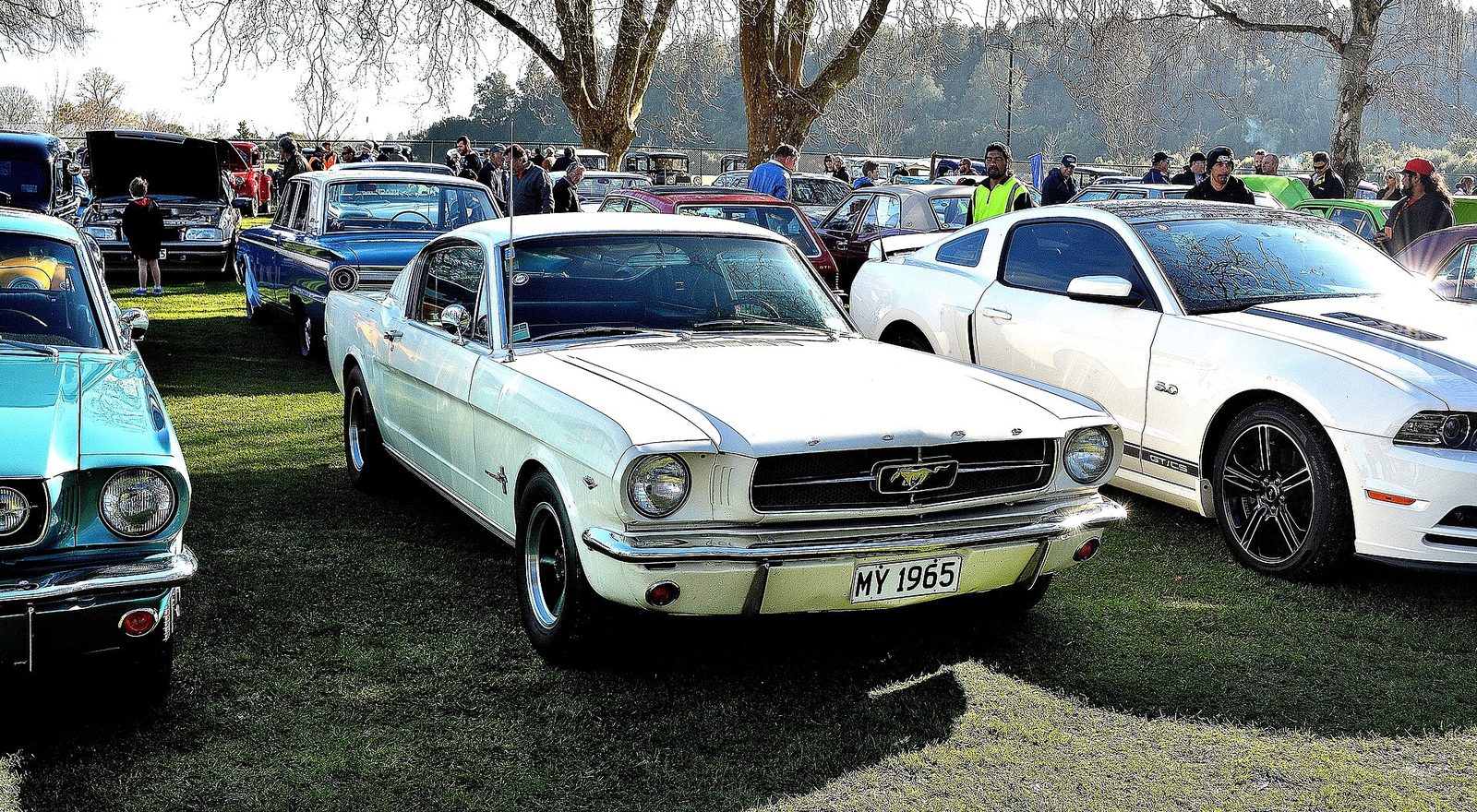
The first-generation Ford Mustang, unveiled April 17, 1964, created the 'pony car' segment and remains the defining affordable American classic. Built on humble Falcon mechanicals with a long-hood/short-deck shape and a low base price, it sold explosively - over one million cars inside roughly the first 18 months. Buyers chose hardtop coupe, fastback, or convertible bodies and engines from thrifty sixes up to the 271 hp 289 HiPo V8. A 1967 restyle enlarged the engine bay to accept FE big-blocks (390, then the 428 Cobra Jet in April 1968), while GT and GTA packages added performance dress-up. Because Ford built these cars in enormous numbers and reproduction parts are essentially universal, the first-gen Mustang has the deepest buyer pool of any American collector car: a genuinely condition- and options-driven market where a clean six-cylinder coupe stays attainable while HiPo, big-block, and correct V8 convertibles/fastbacks command real premiums.
Mustang
1965-1968 (First Generation)
1,956,544 built · Hardtop Coupe · Fastback · Convertible
How rare is it?
With about 1,956,544 built, the Ford Mustang is rarer than a Beetle (~22M) yet more common than a Mustang '65–'68 (~1.3M).
Approximate total production placed on a log scale against well-known reference cars, for scale only. Figures and any disputes are detailed in the production notes and sources.
History
Launch and the '1964½' Debate
Ford introduced the Mustang on April 17, 1964, at the New York World's Fair, roughly four months before the standard 1965 model year began. Enthusiasts call these early cars '1964½,' but Ford titled and VIN-coded all of them as 1965 models - so the designation is an enthusiast convention rather than a factory model year, and it remains a point of ongoing debate. The formula was simple and shrewd: Falcon underpinnings, a long-hood/short-deck body, a low entry price, and a vast options list that let buyers build economy commuters or credible performance cars.
Runaway First-Year Sales
Demand was unprecedented. Ford reported about 22,000 orders on day one, and production passed one million cars in roughly the first 18 months. Reported totals depend on how the early cars are counted: a '1964½' figure of 121,538 is often listed separately, while 559,451 is variously cited as the balance of, or the entirety of, the 1965 model year. The hardtop coupe dominated volume; convertibles and fastbacks (the latter added August 1964) were smaller shares.
Body Styles and Engines
Three bodies anchored the range - hardtop coupe, convertible, and the 2+2 fastback. Engines spanned 170/200 sixes and 260/289 V8s, topped by the solid-lifter 271 hp 289 HiPo 'K-code.'
The 1967 Restyle and Big-Blocks
The 1967 redesign grew the car slightly and, crucially, widened the engine bay to fit Ford's FE big-block: first the 390 (offered with GT/GTA trim), then the legendary 428 Cobra Jet in April 1968, rated a deliberately modest 335 hp. A new 302 small-block also arrived for 1968, and disc brakes and safety equipment expanded through the period.
Common Problems
Structural and cosmetic rust (see above) is the leading issue on unrestored cars. Original drum brakes and recirculating-ball steering feel vintage; many cars have been upgraded. Six-cylinder cars are simple and durable but slow; K-code 289s need correct maintenance of their solid lifters. Beware 'tribute' cars represented as originals, and mismatched drivetrains. Because reproduction parts are near-universal and inexpensive, mechanical restoration is straightforward - rust repair and provenance verification are where real cost and risk live.
What to Look For
Rust is the dominant concern: inspect floorpans, frame rails, torque boxes, lower doors, trunk floor, the cowl/vent area below the windshield, the rear-window channel, under the battery tray, and the shock towers. Confirm the engine code against the VIN/door data plate (or a Marti Report for 1967-68 cars) to verify a claimed HiPo K-code, GT/GTA, or big-block - badges are easily added. Watch for fiberglass patches and heavy body filler hiding structural rot, tired weatherstrip and bushings, and inoperative gauges/lights. Documented, matching-numbers cars and genuine GT/HiPo/Cobra Jet examples carry large premiums over clone or re-badged cars.
Market Notes
As of mid-2026, classic.com's aggregated first-generation Mustang listings showed an average sale price near $61,000, but that figure is skewed upward by Shelbys, big-blocks, and show-quality convertibles - the bulk of ordinary driver-grade coupes trade well below it, with the cheapest project cars selling for a few hundred to a few thousand dollars. This is fundamentally a condition- and configuration-driven market: Hagerty notes premiums of roughly +10 percent for a factory four-speed and a discount of about -10 percent for automatics, with rare color/option and HiPo/big-block combinations commanding the largest gains. Directionally, values have been stable-to-slowly-rising rather than volatile, with early hardtop coupes remaining among the most attainable entry points into the classic-car hobby. Figures are directional and change with each auction cycle.
Where sources differ
The '1964½' label is an enthusiast convention; Ford titled and VIN-coded all early cars as 1965 models.
Enthusiasts and some data sites (early-mustang, CJ Pony Parts) list a distinct '1964½' total of 121,538, while Ford's own titling and VINs treat every early car as a 1965 model - so whether '1964½' is a real model year is genuinely contested.
Reported first-year totals are 121,538 early cars and 559,451 for 1965, but sources disagree on whether 559,451 already includes the early cars.
early-mustang and CJ Pony Parts list 121,538 and 559,451 as separate rows (combined ~680,989), whereas MustangSpecs reports 559,451 as the entire 1965 model year without noting the early cars - yielding different first-year totals.
Sources
- Ford Mustang (first generation), Wikipedia · journalism
- Mustang Sales by Year / Mustang Production Numbers, CJ Pony Parts · club-forum
- 64-66 Production Totals, Early-Mustang.com · registry
- Your handy 1965-66 Ford Mustang buyer's guide, Hagerty Media · journalism
- Ford Mustang – 1st Gen Market, CLASSIC.COM · journalism
- 1965 Ford Mustang Production Numbers, MustangSpecs · reference-book
Synthesized from the sources above and cross-checked. We cite and link out; we do not republish other databases verbatim.
Fully Sorted is an independent publisher and is not affiliated with, endorsed by or sponsored by Ford. Ford and the model names on this page are trademarks of their respective owners and are used here only to identify the cars being described.
Chassis register
Nobody has recorded a car here yet. Own one, or know one? Chassis number, what you can prove about it, and a source if there is one. Every entry is reviewed before it appears.
Nerd Notes
What owners know that the sources don't. Every note is read and checked before it appears here.
Key Specs
- Layout
- Front engine, rear-wheel drive
- Platform
- Ford Falcon-derived unibody
- IntroDate
- April 17, 1964 (New York World's Fair)
- Wheelbase
- 108 in (all first-gen 1965-68)
- TopBigBlock
- 428 Cobra Jet, 335 hp (advertised; underrated)
- TopSmallBlock
- 289 HiPo K-code, 271 hp
- Transmissions
- 3-speed manual, 4-speed manual, Cruise-O-Matic 3-speed automatic
Notable Variants
GT Equipment Group (1965-68)
Option package requiring a V8; added fog lamps, rocker/side stripes, dual exhaust with trumpet tips, grille-mounted lamps, and (early) front disc brakes.
GTA (1967-68)
GT package ordered with the Cruise-O-Matic automatic; 'A' denotes automatic. Available with the 390 FE big-block enabled by the 1967 restyle.
289 HiPo 'K-code' (1965-67)
Solid-lifter 271 hp high-performance 289; the top small-block and a sought-after original spec today.
428 Cobra Jet (1968½)
Introduced April 1968; rated a conservative 335 hp and widely regarded as underrated. Basis of the most valuable non-Shelby first-gen small-run cars.
Shelby GT350 / GT500 (related)
Carroll Shelby's performance conversions of the Mustang fastback; a separate, much pricier collector tier, not the base first-gen car.
Value Trajectory
Long-term appreciation has been steady rather than explosive, insulated from the sharper swings seen in muscle-car speculation. The enormous surviving population and total parts availability keep driver-grade coupes affordable and liquid, sustaining the deepest buyer pool of any American classic. Value concentrates at the top of the range - HiPo 289s, 390/428 big-blocks, GT/GTA fastbacks, and correct convertibles - while base six-cylinder coupes remain accessible entry points expected to hold value more than surge.
Market Snapshot
Range $32,000 – $248,000
Next
Shopping for one?
Browse Ford listings, or decode a VIN before you buy.