
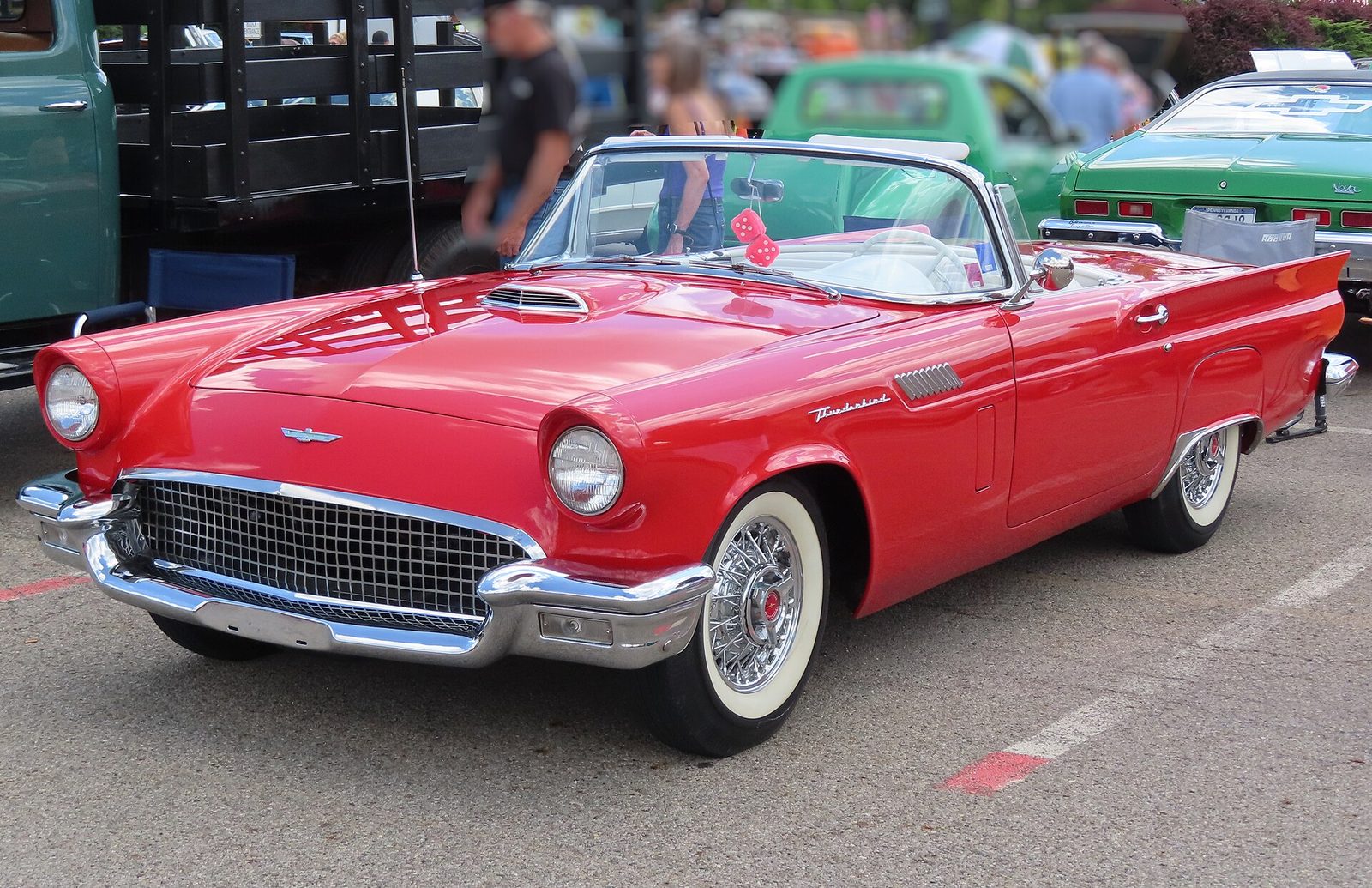
The first-generation Ford Thunderbird (1955-1957) was Ford's answer to the Chevrolet Corvette, and it answered by declining the question. Where Chevrolet built a glass-fiber sports car, Ford built a steel two-seater with a V8 as standard, wind-up windows, a detachable hardtop and an automatic option, and sold it as a personal car rather than a sports car. The distinction worked commercially: 16,155 Thunderbirds left Dearborn in 1955 against roughly 700 Corvettes. Three model years produced three visibly different cars - the clean 1955, the 1956 with its outside-mounted Continental spare, cowl vents and optional porthole hardtop, and the restyled 1957 with a longer tail, larger fins and 14-inch wheels, the only year to offer the supercharged F-code 312. Robert McNamara then ended the two-seater after 53,166 cars to make room for a four-seat 1958 Thunderbird that outsold it, which is the commercial verdict and has never been the popular one.
Thunderbird
First generation (the two-seat 'Baby Bird' or 'Classic Thunderbird')
History
Answering the Corvette
Chevrolet showed the Corvette in January 1953 and Ford answered the same day, presenting a two-seater design for approval that became a project shortly afterwards. Who started it is not agreed. Frank Hershey, Ford Division's styling chief, said he set the work going in the summer of 1952 on hearing about Chevrolet's car, and put Bill Boyer in charge of the studio. George Walker told Time in 1957 that Joe Oros had the idea and that he himself sold it to Henry Ford II at the Paris show. Product manager Tom Case credited general manager Lewis Crusoe. The designer John Samsen's account has the studio working from early 1952 under secrecy, the project nearly canceled when engineering refused glass fiber on tooling cost, and Henry Ford II insisting it be built even at a loss, on condition it looked enough like the 1955 Ford to justify steel tooling.
A Personal Car
Crusoe's specification separated the car from the Corvette before a line was drawn: a V8 as standard, wind-up windows, proper trim, and a buyer described internally as an affluent businessman. Ford's press material called it a personal car, a phrase that puzzled observers at the time and turned out to name a market segment that did not yet exist. It appeared at the Detroit Auto Show on 20 February 1954, the first car was built on 9 September 1954 and sales opened on 22 October. Ford had planned for 10,000 and took 3,500 orders in ten days. Motor Trend's figures show what kind of car it was: 0-60 mph in about eleven seconds against 8.3 for a V8 Corvette. Zora Arkus-Duntov used the Thunderbird's arrival as the argument that saved the Corvette from cancellation.
The 1956 Compromises
For 1956 Crusoe moved the spare wheel out of the trunk and onto the rear bumper as a Continental kit. It freed luggage space and cost the car its balance: the spare, the heavier bumper and the bracing to carry them added close to 300 lb behind the rear axle, raising the polar moment enough to produce tail-wagging in quick corners, and Ford answered with softer rear springs and a slower steering ratio. Cowl vents appeared ahead of the doors to get air into a cabin that had none, wind wings went on the A-pillars, and the exhaust moved to the bumper ends. The change that outlived all of them cost nothing: porthole windows in the detachable hardtop, offered as a no-cost option to improve rear three-quarter vision. Not every 1956-57 hardtop has them. The 312 Y-block joined the range at 215 hp with overdrive and 225 with Ford-O-Matic.
1957, and a Supercharger
The 1957 restyle put the spare back in the trunk, standing upright in a tail 5.3 inches longer than 1956's, with larger fins, bigger tail lights, a reshaped front bumper and grille, the Thunderbird script moved from the fins to the front wings, and 14-inch wheels in place of 15. The engine list grew into a ladder: 212 hp from the 292, 245 from the D-code 312, 270 from the twin-carburetor E-code, and a claimed 300 from the F-code, a 312 carrying a McCulloch/Paxton VR57 supercharger, reinforced heads and compression cut to 8.5:1. Competition versions of 285 and 340 hp were listed. A supercharged car ran 138.755 mph at the Daytona speed trials and exceeded 160 mph at Bonneville. The window shut at once: the Automobile Manufacturers Association's voluntary ban on performance promotion took effect on 1 July 1957, after the de Portago crash at the Mille Miglia, and NASCAR barred superchargers on cost grounds.
McNamara Ends It
Robert McNamara had replaced Crusoe as general manager in early 1955. The Thunderbird was selling above plan but making little money, with no route to more volume, and McNamara backed a four-seat replacement, project 195H, instead. Tom Case proposed in September 1957 that the two-seater continue alongside it; McNamara refused. The last two-seat cars were built in December 1957, three months beyond a normal model year because the 1958 car was late. The four-seat Squarebird arrived on Ford Motor Company's first unibody platform, built at a new plant at Wixom, took Motor Trend's Car of the Year, and sold 37,892 in a poor year for the industry. Ford had been right about the money.
Common Problems
Rust is the defining problem and it is structural rather than cosmetic. The separate frame, the inner rockers, the floors and the trunk floor all rot, and CTCI's restoration budget puts body repair alone at $8,000 to $18,000 before paint, which it costs at $12,000 to $25,000. Bodies that look sound often hide old collision repair or panels that no longer fit, which is why the club's own guidance is to hold fifteen to twenty per cent of the budget back for what appears once the car is stripped.
Overheating is reported often enough by owners to be treated as a characteristic of the Y-block installation rather than an individual fault, and auxiliary electric fans are a common retrofit. Power brake boosters deteriorate and can fail completely. Fuel and fluid leaks around the engine bay are routine on unrestored cars, and carburetors are frequently not the originals, which affects both running quality and value.
On F-code cars the supercharger installation is the specific liability. The blower drive differs between manual and automatic cars - two belts on manual cars, one on automatics using a wider front groove in the crank pulley - and the F-code heads run a reduced 8.5:1 compression, so a mismatched rebuild is possible and not always visible. Chrome and trim work is expensive and slow, budgeted by CTCI at $4,000 to $10,000 on its own.
What to Look For
Start with the body and the frame, because that is where the money is. CTCI's worked restoration example and owners on the Ford Thunderbird Forum name the same places: rocker panels and the inner rockers behind them, floors, lower front wings, the trunk floor, the wheel openings, the seams ahead of the doors, and the areas around the windshield surround and rear deck. Door pillars that flex when the door is lifted indicate structural rust rather than tired hinges, and heavy undercoating is a reason to look harder rather than to relax.
Then establish which car it is. The data plate carries the engine code, and the gap between a 292, a 245 hp D-code, a twin-carburetor E-code and a supercharged F-code is the gap between price bands. Sports Car Market notes that D-code cars converted to supercharged specification - Code-D/F cars in the trade - are part of why published F-code counts differ between experts, so an F-code claim wants documentation: the data plate, the build sheet or original invoice, and ideally the original blower and its bracketry rather than a period-correct assembly acquired later.
Year identification is straightforward and worth checking against the paperwork. A 1955 car has no portholes and 15-inch wheels; a 1956 car carries the outside-mounted Continental spare and cowl vents ahead of the doors; a 1957 car has the longer tail, larger fins and 14-inch wheels. Portholes were a no-cost option from 1956 and not every hardtop received them, so their absence is evidence of nothing. Both tops present and fitting properly is worth real money. Ask directly about overheating, which owners describe as a standing characteristic rather than a one-car fault, and about the power brake booster, which can fail outright.
Market Notes
As of August 2026 classic.com's benchmark for the first-generation Thunderbird stands at $38,861 against an average recorded sale of $41,895, with 142 cars listed and the trend arrow pointing down. The tracked range runs from $1,100 for a bare 1956 chassis in October 2022 to $111,491 for a 1957 car sold at North East, Pennsylvania on 7 August 2026. Auction evidence sits inside that band: RM Sotheby's took $56,000 for a Peacock Blue 1956 from the Dare to Dream Collection in 2024, and a 1955 in the Saragga Collection made 48,875 euros in 2019. Old Cars Weekly put a pristine 1955 with both tops at $60,000 to $70,000, and Hyman Ltd was asking $82,500 for a 1957 E-code roadster. RM Sotheby's published results include buyer's premium. Supercharged F-code cars trade in a separate market: RM Sotheby's sold one for $137,500 at Hershey in 2014 and another for $224,000 at Amelia Island in 2023, while Sports Car Market records a median of $188,000, a high sale of $247,500, a $319,000 RM result in 2006 and $193,900 including premium at Barrett-Jackson in April 2016. The direction of travel is softer: Autoblog reported that the 1957 market has weakened meaningfully since 2023, citing a Hagerty index update of January 2025 that placed the 1957 Thunderbird last in its 1950s American Classics segment for the quarter, at minus eight per cent.
Where sources differ
Who originated the Thunderbird program is not agreed among the people who were there.
Frank Hershey said he began the work in the summer of 1952 on learning of the Corvette. George Walker told Time in 1957 that Joe Oros conceived it and that Walker sold it to Henry Ford II at the Paris show. Product manager Tom Case credited general manager Lewis Crusoe. Ford's own archives show no sports-car project before Hershey's 1952 initiative. Not resolved by any source consulted here.
The 1955 model-year figure is given as 16,155 by most sources and as 16,156 by one, so the generation total is either 53,166 or 53,167.
Wikipedia, CTCI and Curbside Classic all state 16,155 for 1955. Old Cars Weekly states 16,156. The one-car difference is trivial in substance but it is a real disagreement between credible sources, is not resolved by any of them, and so no single generation total is asserted here.
The number of supercharged F-code 1957 Thunderbirds built is not settled, with published figures ranging from 196 to about 212.
Old Cars Weekly and TopSpeed each state 196 F-code engines. Ate Up With Motor states 208. RM Sotheby's cataloged a car in 2014 as one of 'some 208-211' and another in 2023 as one of 'approximately 200'. Sports Car Market gives approximately 212, as does Autoblog. Old Cars Weekly offers a partial reconciliation - 196 F-codes plus about fifteen supercharged D-code 'DF' cars against an official approximation of 211 blowers across both series - and Sports Car Market notes that converted Code-D/F cars are counted by some experts and not others. No source consulted here resolves the spread, so productionTotal is left null.
The true output of the supercharged F-code 312 is not agreed, and neither is the rpm at which its rated power and torque were produced.
Wikipedia gives 300 hp at 4,800 rpm with 439 lb-ft at 2,600 rpm. Over-Drive Magazine gives 300 hp at 5,000 rpm with 340 lb-ft at 5,300 rpm. RM Sotheby's Amelia Island 2023 catalog calls the 300 hp rating questionable and states that period tests and Paxton Products itself put the figure closer to 400. TopSpeed reports anecdotal claims of about 360 hp, Old Cars Weekly gives 325 to 340 after tuning, and CTCI gives a 300-360 hp range. These figures are not resolved by any source consulted here, so no single output is asserted.
The 1955 Thunderbird's curb weight is quoted as 2,980 lb by one source and described as nearly 4,000 lb by another.
Old Cars Weekly states a curb weight of 2,980 lb. Curbside Classic states the car weighed nearly 4,000 lb, a difference of roughly a third that materially changes how the car reads against the Corvette. Neither shows its working and the discrepancy is not resolved by any source consulted here, so both figures are carried.
Sources
- Ford Thunderbird (first generation), Wikipedia · encyclopedia
- Ford Thunderbird (second generation), Wikipedia · encyclopedia
- Little Bird: The 1955-1957 Ford Thunderbird, Ate Up With Motor · specialist
- Hatching the 1955 Thunderbird, Dean's Garage · specialist
- Ford Thunderbird, Classic Thunderbird Club International · club-forum
- Thunderbird Restoration Budget Example for 1955-57, Classic Thunderbird Club International · club-forum
- What to look at before buying a 1957 Thunderbird, Ford Thunderbird Forum · club-forum
- Vintage Muscle: the 1957 Thunderbird F-Code, Old Cars Weekly · journalism
- Car of the Week: 1955 Ford Thunderbird, Old Cars Weekly · journalism
- 1957 Ford Thunderbird F-code, Sports Car Market · market-data
- 1957 Ford Thunderbird F-Code: The Forgotten Factory Supercharged Car, TopSpeed · journalism
- Ford Thunderbird 1st Gen Market, classic.com · market-data
- 1957 Ford Thunderbird F-Code, Hershey 2014, RM Sotheby's · auction-house
- 1957 Ford Thunderbird F-Code, Amelia Island 2023, RM Sotheby's · auction-house
- 1956 Ford Thunderbird, Dare to Dream Collection, RM Sotheby's · auction-house
- 1955 Ford Thunderbird, The Saragga Collection, RM Sotheby's · auction-house
- 1957 Ford Thunderbird E-Code Roadster, Hyman Ltd · specialist
- 1957 Ford Thunderbird Fact Sheet, Over-Drive Magazine · specialist
- 1955 Ford Thunderbird Fact Sheet, Over-Drive Magazine · specialist
- How The 1957 Racing Ban Killed American Factory Race Teams Overnight, Jalopnik · journalism
- Curbside Classic: 1955 Ford Thunderbird - A Personal Car Of Distinction, Curbside Classic · journalism
- 1957 Ford Thunderbird For Sale At $20,000, From the Final Week of Two-Seat Production, Autoblog · journalism
Synthesized from the sources above and cross-checked. We cite and link out; we do not republish other databases verbatim.
Fully Sorted is an independent publisher and is not affiliated with, endorsed by or sponsored by Ford. Ford and the model names on this page are trademarks of their respective owners and are used here only to identify the cars being described.
Chassis register
Nobody has recorded a car here yet. Own one, or know one? Chassis number, what you can prove about it, and a source if there is one. Every entry is reviewed before it appears.
Nerd Notes
What owners know that the sources don't. Every note is read and checked before it appears here.
Key Specs
- Power
- 1955: 193 hp at 4,400 rpm (manual), 198 hp (Ford-O-Matic). 1956: 202 hp (292), 215 hp overdrive and 225 hp automatic (312). 1957: 212 hp at 4,700 rpm (292), 245 hp at 4,500 rpm (D-code), 270 hp at 4,500 rpm (E-code), 300 hp claimed (F-code), with 285 and 340 hp competition ratings listed
- Tires
- 6.70 x 15 four-ply tubeless (1955); 7.50 x 14 four-ply tubeless (1957)
- Engine
- 1955: 292 cu in (4,785 cc) Y-block V8. 1956: 292 cu in standard, 312 cu in (5,113 cc) optional. 1957: 292 cu in standard, with the 312 in D-code, E-code and supercharged F-code forms
- Layout
- Front-mounted longitudinal V8, rear-wheel drive, two seats
- Length
- 175.3 in (1955); 181.4 in (1957), the body itself 5.3 in longer than 1956 mostly in the tail
- Torque
- 1955: 280 lb-ft at 2,600 rpm (manual), 286 lb-ft at 2,500 rpm (automatic). 1957: 297 lb-ft at 2,700 rpm (292), 332 lb-ft at 3,200 rpm (D-code), 336 lb-ft at 3,400 rpm (E-code). The F-code figure is not agreed - see the disputed claim
- Weight
- 2,980 lb curb weight quoted for 1955 by Old Cars Weekly; Curbside Classic describes the car as approaching 4,000 lb. The 1956 Continental kit added close to 300 lb behind the rear axle
- Chassis
- Separate box-section steel frame with a steel body; detachable glass-fiber hardtop standard, folding fabric roof optional
- Induction
- Autolite 2100 two-barrel (292); Holley 4150 four-barrel (D-code 312); twin Holley 4000 four-barrels (E-code); single four-barrel with McCulloch/Paxton VR57 centrifugal supercharger (F-code)
- Top speed
- Approximately 120 mph estimated by Motor Trend for the 1955 car - an estimate, not a measured figure. A modified supercharged 1957 recorded 138.755 mph at the Daytona speed trials and exceeded 160 mph at Bonneville
- Wheelbase
- 102.0 in (2,591 mm), unchanged across all three years
- Compression
- 1955 292 (bore and stroke 3.75 x 3.30 in): 8.1:1 manual, 8.5:1 with Ford-O-Matic. F-code heads cut compression to 8.5:1 from the D-code specification
- Acceleration
- 0-60 mph in about 11 seconds for a 1955 Ford-O-Matic car as recorded by Motor Trend, against 8.3 seconds for the V8 Corvette
- Transmission
- Three-speed manual standard; three-speed manual with overdrive or three-speed Ford-O-Matic automatic optional
Notable Variants
1955 Thunderbird
First year and the cleanest shape: no portholes, 15-inch wheels on 6.70 x 15 tires, the 292 Y-block only, and the detachable glass-fiber hardtop as standard with the fabric top a paid option. The first production car, serial P5FH100005, survives.
1956 Thunderbird (Continental kit)
The outside-mounted spare, heavier rear bumper and supporting bracing that Lewis Crusoe ordered to free trunk space. Unique to the year, and the reason 1956 cars steer and corner differently to the others. Also the year cowl vents and A-pillar wind wings appeared.
Porthole hardtop
A no-cost option from 1956, added to improve rear three-quarter vision with the hardtop in place. Not every 1956-57 hardtop received them, so absence proves nothing, but the porthole roof is the car's most recognizable feature and is priced accordingly.
1957 D-code Thunderbird
The volume performance car of the last year: 312 cu in with a Holley four-barrel, 245 hp at 4,500 rpm, standard with overdrive and Ford-O-Matic, in the restyled body with the longer tail and 14-inch wheels.
1957 E-code 'Thunderbird Special'
Twin Holley four-barrel 312 rated at 270 hp at 4,500 rpm, with a 285 hp competition version listed. Hyman Ltd puts the 1957 E-code count at 1,449 cars, under seven per cent of the year's output.
1957 F-code supercharged
McCulloch/Paxton VR57 centrifugal supercharger on a reinforced-head 312 with compression cut to 8.5:1, factory-rated 300 hp, with a 340 hp over-the-counter racing version listed alongside the dual-quad car's 285. The rarest and most valuable specification, and the one whose build count no two sources agree on.
Value Trajectory
The two-seater became collectable almost at once, because the 1958 car was a different proposition and the 1955-57 cars were being sought out within a decade of leaving Dearborn. That early start gave the model a long, mature market rather than a speculative one, and it has spent recent years going the wrong way. As of August 2026 the classic.com benchmark of $38,861 carries a downward trend, and Autoblog cited a Hagerty index update from January 2025 that ranked the 1957 Thunderbird the weakest performer in its 1950s American Classics segment for that quarter, down eight per cent. The explanation offered by both Sports Car Market and Autoblog is generational: the buyers who wanted these cars are selling, and those replacing them want something else. The supercharged F-code is the exception, though not a smooth one - Sports Car Market's record runs from $319,000 in 2006 to $193,900 in 2016 - while the $224,000 paid at Amelia Island in 2023 suggests the small, well-documented end of the run holds value as ordinary cars drift. The practical consequence is that restoration cost now exceeds finished value for most examples.
Next
Shopping for one?
Browse Ford listings, or decode a VIN before you buy.